Soldier Systems Tactical Tailor Categories EmailArchives Home

Archive for the ‘Air Force’ Category

Epic Fail

Wednesday, September 1st, 2010

The Air Force’s current fixation with “PT” is the latest in a long line of fads. As you have probably heard, Airman are failing the new biannual Air Force Fitness Test (AFFT) at the rate of about 25%. Unfortunately, instead of actually creating a culture of physical fitness, they have got everyone worried about the test. Worse yet, one element of that test has become particularly troublesome. That element is the waist measurement. In fact, some Airmen are actually getting liposuction in order to pass the waist measurement.

So what exactly is wrong with the waist measurement? Well, it’s a simple case of symbolism over substance. It seems, someone likes skinny folks. The waist measurement does not assess an individual’s health and what’s more it is not scaled for age nor height. A 5′ tall Airman has to have the same waist measurement to pass as an Airman who is 6′ tall. By the same token, an 18 year old has the same standard as a 48 year old. This makes no sense. The test is so weighted in favor of the skinny that an older Airman with a large waist has to actually be in better shape than a young Airman. He must be more capable in the push up, sit up, and run portions of the test in order to just pass. So the skinny kid can be in worse shape than the old fat guy and still pass. In fact, he can score better. Make sense? Check out this PT score calculator to see how you compare.

One would think that things couldn’t be worse than Air Force personnel undergoing plastic surgery in order to pass a PT test but it does. The Air Force leadership has lost so much faith in its commanders and their NCOs that it has gone and hired civilian testers. Yes, it’s true. Physical Fitness testing is no longer conducted by Unit Fitness Monitors since they can’t be trusted. Instead, the Air Force has hired a cadre of civilian testers. They aren’t even required to be able to demonstrate proper form for the four events let alone even pass.

To throw gasoline on this fire, as fitness is an individual responsibility, many units see no reason to provide time during the duty day to conduct PT. The machine is unwilling to sacrifice man hours to develop a more healthy force. The mission capable rate must not be compromised.

The Air Force leadership needs to get this under control. Dump the waist measurement. Anything that prompts service members to undergo risky surgeries deserves some Congressional oversight. Better yet, develop a test that actually measures true fitness and reflects tasks Airmen actually are expected to accomplish. Also, develop a true culture of fitness where leaders lead by example and commanders are responsible for their unit’s program and performance. And for goodness sakes, get rid of those civilian testers. They are an embarrassment. You can’t outsource integrity.

Air Force to Adopt OCP?

Friday, August 27th, 2010

According to a recent press release from the Office of the Secretary of the Air Force, this may very well be the case.

“We are committed to equipping Airmen with the most advanced capabilities available at the earliest time possible,” Air Force officials said Aug. 24. “Based on feedback from Airmen, we believe the Operation Enduring Freedom Camouflage Pattern (OCP) provides advanced protection to servicemembers while operating outside the wire in Afghanistan. Army (officials), while beginning an aggressive fielding schedule, (are) working with Air Force (officials) to support developing a long-term joint fielding strategy later this year.”

This is great news for Afghanistan-bound Airmen. Maybe the Air Force will just say what the heck and issue all deploying Airmen MultiCam clothing and equipment.

USAF Uniform Website

Monday, August 23rd, 2010

The Air Force Personnel Center has launched a new website dedicated to uniforms. While it highlights all of the Air Force’s Garrison uniforms, the most appropriate ensemble in the inventory looks to be the Informal Uniform. Seemingly designed for their endless Casual Friday, it consists of a blue polo shirt and khaki slacks (yes, we said slacks). In reality it is intended for select Air Force organizations while traveling or under conditions where the other uniform combinations would not be appropriate. No mention is made of any of the service’s combat uniforms unless you count the poorly monikered Airman Battle Uniform.

www.afpc.randolph.af.mil/dress/uniforms.asp

FAST Helmet Added to USAF Parachutist Approved for Use List

Thursday, March 18th, 2010

Both the Ops-Core Ballistic and FAST helmets have been added to the US Air Force parachutist approved for use list which details equipment that have been certified for airborne operations. This means that they have passed an evaluation including helmet acceleration testing. Following the 1998 parachute fatality of Pararescueman SrA Sean McDermott, the Air Force has taken extra care to ensure that new air items are meticulously tested prior to approval.

Ops-Core Ballistic FAST Helmet

Two caveats have been placed on use of the helmets. First, it cannot be jumped with Night Vision Devices unless criteria in MAJCOM standards are adhered to. Second, nothing may be mounted on the side rails during jumps except O2 mounting straps. Additionally, direction from the Air Staff indicates that the helmets must be properly fitted and MAJCOMs should seek contracted fit training.

www.ops-core.com

Camo – Is the Air Force Next?

Monday, February 22nd, 2010

Battlefield Airmen Wearing MultiCam

Every time I think about this issue I keep hearing a little ditty in my head, “Fly boys, fly boys, what ya gonna do? What ya gonna do when they come for you?” The Army was specifically called out by Congress to look at alternative camo patterns for use in Afghanistan. They have dealt with the issue by approving Crye Precision’s MultiCam pattern. In a similar vein, The Navy has responded to their need for camouflage for their ground combatants by adopting slightly modified versions of the SOCOM-developed AOR patterns.

CCT in HaitiIt is about the Air Force deals with their camo issue and follows a similar course to their sister services. It was easy to blend in with an Army clad in UCP but I can’t imagine it will be very long before someone realizes that Airmen are now sticking out like sore thumbs. Due to the relatively small number of Battlefield Airmen and associated Expeditionary forces requiring proper camouflage, it would be best to just adopt MultiCam. Most of the Air Force’s ground forces are embedded with the Army at some level anyway. In fact, we already regularly see Air Force personnel wearing MultiCam in a variety of environments including recent operations in Haiti.

ABUGranted, the Air Force’s current Desert Tiger Stripe pattern does a great job of branding. The pattern was developed specifically to give the Air Force a distinctive look. In fact, former Chief of Staff of the Air Force Gen Jumper, began seeking a new uniform after being referred to as a Soldier at a ceremony at DC’s Bolling Air Force Base. Unfortunately, it shares a similar color palette with the Army’s universal Camouflage pattern although it adds Slate Blue as a fourth color. It does darken the pattern up a bit but it still really isn’t up to the task of concealing an Airman in the field. And that’s not to mention the cut of the uniform. Every single one of the other services has fielded a modern combat uniform. The Airman Battle Uniform on the other hand, seemed to keep all of the bad features of the BDU with none of the advantages of the lessons learned by the other services.

So come on Air Force, do your Airmen right and issue a decent uniform in an effective camouflage pattern to everyone deployed to combat zones.

Air Force Chooses Stain-Resistant Boot

Tuesday, February 2nd, 2010

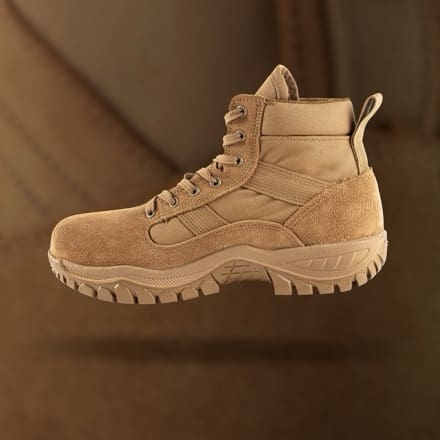
When the Air Force adopted the ABU and its associated Digital Tiger Stripe pattern, they also selected a new rough out Sage Green boot to complement it. Unfortunately, for those Airmen working in industrial areas such as the flight line, fuels, and maintenance the suede absorbed fuel, lubricants, and other liquids and not only looked awful, but were hazardous as well.

Sage Green, full-grain leather boot with rubber heel and toe reinforcements

In a 45 day test at Luke Air Force Base, Arizona, 200 Airmen in the maintenance, medical, and civil engineering career fields tried out four different boot designs.

· “Style A” – A hot weather, safety-toe boot construction with full-grain, smooth sage green leather.
· “Style B” – A temperate weather boot constructed with full-grain, smooth sage green leather. This test boot was the only non-safety toe boot included in the wear test. This boot was only tested on Airmen in non-flight line, non-industrial work environments that did not require a safety toe.
· “Style C” – A hot weather, safety-toe boot constructed with full-grain, smooth sage green leather. The heel and toe areas of the boot had rubber reinforcements that are also sage green in color.
· “Style D” – A temperate weather, safety-toe construction with full-grain, smooth sage green leather.

In the end, the Air Force Uniform Office recommended the adoption of a Sage Green, full-grain leather boot with rubber heel and toe reinforcements. As an interim solution, Air Force maintenance troops have been wearing Black boots due to the poor performance of teh standard issue boots in industrial applications. However, they will have to transition to the new Sage Green boots as they become available. It is important to note that this boot will be solely for use by Airmen working in industrial areas.

Let’s Camouflage Those Weapons

Friday, December 4th, 2009

DefenseTech published an article today on a subject we have been looking at for some time. This is our take on the issue.

U.S. Army photo by Staff Sgt. Andrew Smith

Amid all of the ballyhoo surrounding the Congressionally directed adoption of a area-specific camouflage pattern for Afghanistan a major weak link remains. PEO-Soldier has worked diligently to camouflage virtually piece of a Soldier’s kit save one; his rifle. Probably the most important item issued to a Soldier, the Army has yet to fully come to grips with the “Black Rifle”. And it’s not just rifles. Grenade launchers, Squad Automatic Weapons, and crew served implements of destruction all come in basic black.

So, awhile back I queried PEO-Soldier about this and they provided me with this reply:
“Soldiers in the field do in fact camouflage their weapons based upon the situation and environment. For example, snipers may tie certain cloth materials to break up the outline/profile of their weapon. Moving forward, PM Soldier Weapons in conjunction with TACOM Rock Island will be writing up a procedure guide that details how soldiers could employ temporary paints to camouflage their weapons for field environments.”

I have some additional information about the first part of the reply. The Ghillie Suit Accessory Kit recently received a face lift including the replacement of burlap with a Fire Resistant yarn. Burlap catches fire easily so this is a much needed change. Available in Light Coyote, Light Green, and Madeira (Brown), hopefully, this material will be available for wider spread use soon.

FNH SCAR

There has been some light in this tunnel and there have been some changes to this long standing policy. SOCOM, in particular has adopted Flat Dark Earth (FDE) as a color for some of its Special Operations Peculiar Modification (SOPMOD) carbine accessories. Additionally, the SOF Combat Assault Rifle (SCAR) comes in a battlefield friendly FDE base color. Furthermore, industry is rife with both weapons and accessories in a variety of finishes. Additionally, S.O. Tech has developed a fabric suppressor cover designed to camouflage its shape and yet still resist melting.

Unfortunately, the other services can be even worse about the issue than the Army. The Air Force for example, has published specific guidance forbidding the painting of weapons or the use of non-issue accessories. Once again, it seems as though someone doesn’t realize there is a war on.

Hopefully, the new weapon camo guide from Rock Island will hit the field soon. Also, based on the same requirements facilitating the study of enhanced personal camouflage, we hope to see a requirement for a weapon color that does not contrast with the Soldier’s other equipment or battlefield environment.

USAF Issues Fleece Wear Guidance

Thursday, November 5th, 2009

The 98th Air Force Virtual Uniform Board (they really ought to consider renaming that thing) released a policy message last month dictating wear of the new Air Force sage green fleece as an outer garment for the airman battle uniform. (italics mine)

Air Force Fleece

According to the message, the sage green fleece which is made from Polartec® Thermal Pro® may only be worn over the ABU top. It is not authorized to be worn solely over a T-shirt or thermal underwear when worn as an outer garment. So at least it can actually be worn as an outer garment but once again the fashion police take precedence over operational value.

According to the message signed by Lt. Gen. Richard Y. Newton III, deputy chief of staff for Manpower and Personnel, at Headquarters U.S. Air Force, Washington, authorized wear of the sage green fleece requires the following:
- a Velcro ABU print last name tape with dark blue block lettering, centered between the zipper and sleeve seam on the wearer’s right chest,
- a Velcro ABU print U.S. Air Force tape with dark blue block lettering, adjacent to the name tape and centered between the zipper and sleeve seem on the wearers left chest,
- a Velcro subdued cloth rank with a solid sage green background, flushed and centered above the last name tape on the wearer’s right chest,
- the fleece must remain zipped no lower than halfway between the name tape and the collar,
- the collar must be folded over and resting on the shoulder, chest and back when the zipper is not completely zipped,
- the bottom length of the fleece must be as close to length of ABU top as possible,
- the sleeves must be worn down at all times, (obvious shoe cleriksm right here. They are always up in arms over flight suit sleeves pushed up)
- the fleece must be kept in a neat, serviceable and professional appearance at all times.

Items authorized for wear with the fleece include black or sage green leather, suede or knit gloves, black or sage green watch caps, black scarves that are tucked in, and black ear muffs. Yes, black earmuffs. I have never actually seen anyone wear these so if you have a picture please send it in.

The uniform board has authorized wear of the sage green fleece without name tapes and rank as an outer garment until Oct 1, 2010. Both the black and the green fleece without tapes and rank may be worn as a liner to the all-purpose environmental clothing system, or APECS. The black fleece will phase-out Oct 1, 2010. You will only need name tapes and rank if it is worn as an outer garment. Naturally, the sage green fleece jackets will be made available first to deployed Airmen and eventually available at AAFES/MCSS. ADS also offers the Gen III clothing so you might want to check them out.

Looks an awful lot like the Level 3 garment found in ECWCS Gen III to me. Sage Green, Foliage Green. Is there really a difference? So, all told, big win for Airmen. They get to wear a practical garment at home station. Also, big win for the shoe clerks who seem to ruin every good idea with rules that make no sense.

Reflective Belts – Oh the Irony

Sunday, November 1st, 2009

Reflective Belts - Oh the Irony

Only the Air Force could over do common sense to the point it may well get someone killed. The Air Force has long ordered personnel serving in high traffic areas and on flight lines to wear reflective belts in order to increase their visibility and reduce accident related injuries. Ok, I might buy that one. But somewhere along the way, the intent of this altruistic order got twisted and the directive was extended to those serving in combat zones. Combat zones you say? Unfortunately, yes.

I wonder how long it will be until someone in the AF clothing office gets a load of Royal Australian Navy’s DPCU with integrated reflective stripes. It would kill two birds with one stone. The Air Force would have a uniform with inappropriate camo AND integrated reflective stripes. (Yeah, that’s a cheap shot. The clothing office is doing a pretty good job considering the institutional momentum they pitted against.)

New RAN Uniform

Sure, this insanity has been going on for some time but finally, some are just plain fed up. It has gotten so out of hand that there is now a Facebook page dedicated to the cause. Decisions like this could get a guy killed.

I have a news flash for the Air Force. We are at war. There are bad people who want to kill our Airmen. Why would you do anything to make it easier? My answer to this whole conundrum? Find the Brainiac responsible and have him go for a walk outside the wire. That ought to sort this nonsense out.

Hey Congress, maybe this is something worth looking into. If the Army is going to face scrutiny over how effective its camo pattern is, maybe someone ought to take the Air Force to task for plain old bad judgment. Some of the comments make my skin crawl. One Airman on Facebook commented, “There are confirmed snipers around the perimeter of the flight line…here, put on your reflective belt so you don’t get run over by a fire truck!”

Air Force Finally Mandates Tucked Boot Laces

Sunday, June 14th, 2009

Not bad, it only took them 62 years. I can’t believe it was never a safety issue before this. I mean someone had to have tripped on those big bunny ear loop laces hanging out of the Corafram Jump Boots at some point. Despite having never made it into AFI 36-2903, they insist that Airmen wear reflective belts day or night.

Please take a moment to peruse the whole list of approved changes to the Air Force uniform. But even better is that the Air Force includes all of the suggestions that didn’t make the cut and some of them are whacky as hell.

Read the entire list here.

100% Cotton ABU Now Available From Propper

Thursday, November 27th, 2008

Propper

Propper has struck a major coup for Airmen everywhere by offering a 100% version of the ABU. This is an excellent alternative to the current issue garment which has drawn a lot of heat from the field due to its heavy fabric.

Men’s 100% Cotton ABUs are already available and women’s sizes will also be available in the next 2-3 weeks.

ABU Coat ABU Trouser

The men’s coat comes in sizes 36-48 in short, regular and long lengths and the men’s trousers are available in sizes 30-42 in short, regular and long lengths. Women’s sizes for both the coat and trousers are size 4 in short and regular lengths and sizes 6-16 in extra short, short, regular and long lengths.

The 100% Cotton ABU does not have a permanent press finish but is NIR-compliant.

Propper’s Part numbers are:
F542555 – Men’s coat
F542655 – Women’s coat
F521555 – Men’s trouser
F521655 – Women’s trouser

Contact Propper for more information.

Photos from Propper.

Bradford Dyeing Association to Close

Tuesday, October 21st, 2008

Bradford Dyeing announced on 25 September that they would close in two months due to a dispute with the Defense Logistics Agency over shading issues on the Airman Battle Uniform. Ironically the Air Force relies Bradford for all of its Digital Tigerstripe material. Bradford also supplies a large percentage of the Berry compliant textiles used by the US military and its closure will be a blow to a American textile industry already over stressed with supporting the military. Bradford has endured a recent fire, union issues, as well as the same issues every small business is facing with overall state of the economy, but the DLA dispute was the final factor. Unfortunately, Bradford Dyeing representatives have been unavailable for comment.

There is an excellent article in the Westerly Sun with more information.

Airmen Battle System – Ground Update

Sunday, October 19th, 2008

Back in May we published an article about the Air Force’s slow response to field an FR combat uniform. Well, it looks like there is finally light at the end of the tunnel. 2500 to 3000 ensembles consisting of jacket, pants, and combat shirt should be issued in February although officials don’t anticipate full fielding for at least a year. The Air Force is planning a much larger wear test of up to 10,000 sets next summer and fielding would follow from that. Why has this taken so long? Much of it has to do with the service’s desire to go their own way rather than just adapt Army or Marine FR clothing items by changing the clothing’s camouflage pattern. For example, sources tell us that development of the Airman Battle Shirt was stalled in order to integrate forearm pockets into the design. For a description of the entire ABS-G systems read this.

Additionally, efforts to field an Air Force variant of the IOTV have been stymied, and a completely new body armor system is under development. Naturally, the new armor will be in the Air Force pattern but no solicitation articulating requirements has been issued.

Airmen Battle System-Ground Components

Thursday, October 16th, 2008

Undergarments
Men’s boxers, women’s panties, short and long-sleeved T-shirts, a bra, and long underwear pants will be fielded in the same Sand color as the current ABU T-shirt. The garments can be worn alone or in concert with one another along the lines of the Army’s Gen III ECWCS.

Airman Battle Ensemble
The FR Airman Battle Ensemble will be fielded in the ABU’s digital Tigerstripe pattern which adapted the Army’s UCP colorway by adding a fourth color; Slate. Since the garment consisting of a jacket and trousers is designed specifically for combat the overall design has been altered slightly from the ABU although it’s general appearance will remain the same.

The jacket unfortunately retains the front zipper as well as the same useless, four chest pockets found on the ABU/BDU but adds zippered pockets on the upper sleeve as well velcro pockets on the forearm.

The trousers a near exact copy of the FR variant of the ACU.

Airman Battle Shirt
Along the same lines as the Marine Corps’ FROG shirt and Army’s Combat Shirt, the ABS will feature a moisture-wicking torso mated to FR sleeves with padded elbows and the same sleeve and forearm pocket setup as the Battle Ensemble jacket. Currently, the ABS has a mock turtleneck like the ACS. The torso will be a a solid color and the sleeves in digital Tigerstripe.

Foul-weather Jacket and Trousers
For inclement weather the Air Force is planning a lightweight rainsuit. There is also discussion of a solid colored fleece jacket although no one has gone so far as to consider a program on the level of FREE or Gen III ECWCS for the Air Force.

Accessories
FR socks, balaclavas, gloves, as well as belts are under development and will join the other equipment as they are ready for fielding although most of these items are available commercially.

Armor
Although not officially a component of ABS-G, the Defensor Fortis Load Carrying System (DF-LCS) developed for ACC’s SF community and soon adopted for all Security Forces AF-wide is now available in the Air Force digital pattern. Additionally, an Air Force unique body armor system is under development.

New Battle Gear Improves Capabilities for Combat Airmen

Thursday, October 2nd, 2008

by Staff Sgt. Andrea Thacker
Air Forces Central Public Affairs – Combined Air and Space Operations Center

9/25/2008 – SOUTHWEST ASIA (AFPN) — Battlefield Airmen will soon receive a new equipment item that will improve their ability to execute their combat duties.

The new airman battle system-ground is a tactical ensemble, or equipment item, for Airmen who perform their mission outside the wire in close coordination with ground forces.

“It will provide Airmen with the right level of safety combined with a fully functional, tactically proficient ensemble, thereby, increasing their confidence and ability to perform their mission,” said Chief Master Sgt. Scott Dearduff, the 9th Air Force and Air Forces Central command chief.

Airmen are operating outside the wire in an increasing number of ground-centric traditional and nontraditional Air Force missions. The ABS-G was created to fulfill an urgent operational need to enable Airmen to function effectively in ground combat operations.

“The safety and confidence provided to our ground combat Airmen from the development of the ABS-G is a key “outside-the-wire” priority,” said Lt. Gen. Gary L. North, the Air Forces Central commander.

“Today, more than ever, we have Airmen conducting operations in the ground battle space, ” General North said. “Our effort to provide them with our airman ground combat ensemble provides them with the highest level of utility, comfort and protection. This is key to our ability to work outside the wire in an ensemble that is optimized for the environment our Airmen are facing.”

Traditional battlefield Airmen who had experience operating outside the wire contributed to the ABS-G development by providing suggestions and feedback during the first prototype phase.

The ensemble was designed with the tactical configuration in mind, said Col. Lawrence Jackson II, the Air Forces Central expeditionary ground combat support adviser.

“We spoke to members in the field to find out what changes would be tactically efficient. These inputs guided the design,” he said.

The airman battle ensemble is comprised of the coat, pants and battle shirt. It is basically a tactical fire resistant adaptation of the current ABU. The ABE is the core of the ABS-G.

“It wasn’t designed to replace the airman battle uniform,” Chief Dearduff said. “It was designed to give us a fire-retardant tactical ensemble that is fully integrated through multiple layers of clothing and equipment to provide maximum fire protection, warmth and tactical functionality.”

The developers stressed the ABE is considered a personal protective ensemble and not a uniform. The ABE will be unit controlled, issued equipment and will only be worn by select Airmen based on their assigned mission. The Air Force will issue an ABE only if it is needed. It will not be for sale in the military clothing sales stores.

Two fundamental warfighter requirements drove the ABE configuration: the need for fire resistance and the tactical integration with body armor, Colonel Jackson said.

“The ABE was designed for ground combat Airmen by ground combat Airmen,” said Colonel Jackson, who spent a year commanding Airmen of the 732nd Air Expeditionary Group during the Operation Iraqi Freedom 2006 to 2007 surge. “We spoke with ground combat Airmen, we lived with ground combat Airmen, we are ground combat Airmen.”

Since ground combat is a full spectrum business, wearing the ABE in layers allows for maximum temperature and weather adaptability across the full range of climate and weather conditions.

Pockets were configured for access while wearing full body armor, including shoulder and side plate protection. Each layer of the ABS-G has identical sleeve and leg pocket configurations.

The ABS-G will be distributed in the February 2009 timeframe. The testing phase will most likely last 18 to 24 months. Several Airmen are wear-testing the ensemble in selected units in the area of responsibility now.

“We will use the constant feedback from the test phase to improve the ensemble accordingly,” Colonel Jackson said. “We want to get it right. Your feedback will help us make it so.”

Air Force Reconsiders Black Boots

Thursday, July 3rd, 2008

One of the major issues brought to the attention of the latest Air Force Uniform Board is the susceptibility of suede boots to the grease and other lubricants often encountered by maintainers. The new sage green boot has been singled out as looking particularly natty after just a few days on the flight line. Although many Airmen maintain that the tan suede boots currently issued for wear in the CENTCOM AOR are less likely to show stains.

Still to be determined is who will be allowed to wear black boots and under what circumstances. What has been made very clear is that the sage boot is here to stay but the material may change to something more robust or the suede may receive a stain resistant treatment.

Team Soldier Certified Gear

Thursday, June 19th, 2008

PEO-Soldier mentioned this item at the APBI in May, but didn’t have any details on implementation. However, they have just made a formal announcement of the Team Soldier Certification program. The reasoning behind the program is sound. The point is to help Soldiers identify soldier systems items that meet certifications for issue. This will help both individual Soldiers as well as units to avoid purchasing substandard equipment. Certification has already been implemented for Protective Eyewear, FR Gloves, and the Family of Flashlights.

PEO Soldier is developing Authorized Products Lists (APLs) for certain types of gear. When an item is authorized, it is placed on the APL. The APLs are published on the PEO Website, furnished to the Army/Air Force Exchange Service (AAFES), and communicated to Army commands. Eventually every commercial item authorized for use by Soldiers will have this certification.

One VERY interesting piece of information on the program has surfaced. Vendors selling authorized items in commercial retail stores may use the logo on the item and in their advertising. The logo will be the way Soldiers can verify that the item is authorized. Vendors using the logo for commercial retail sale of authorized items will require a License and Royalty Agreement with the US Army. And as a warning to those who might counterfeit the new logo, the PEO-Soldier website says this, “PEO Soldier, working with Army Legal Services, will take action to ensure that only actual authorized items have the logo. A range and series of actions will be taken against any fraudulent use of the logo.”

Each item will be identified with a tag similar to this one.
Team Soldier Certified Gear Tag

Both the USMC and USAF have indicated that they will follow suit.

AFRL’s TRON

Saturday, June 14th, 2008

TRON

My first exposure to TRON was at SOFIC in conjunction with BAE’s Corona system. Since then I have been doing some research on this revolutionary Combat ID system. I post the article from February of this year from Associated Press as a backgrounder.

Originally published by Associated Press February 20, 2008

DAYTON, Ohio – When Taliban forces attacked a police checkpoint in central Afghanistan under dark of night in late 2006, special-operations Master Sgt. Andrew Martin called in air support and then slapped a high-tech cloth-like device on his helmet for protection.

Fresh from labs at Wright-Patterson Air Force Base, the device transmitted light from a powerful light-emitting diode, or LED, that pulsed through a fiber optic bundle, giving off infrared signals visible to pilots wearing night-vision goggles.

“The pilots were able to very quickly pick it up,” recalled Martin, who has since retired from the Air Force. “What didn’t happen was additional questions from the pilots asking me my location.”

The new technology – called Target Recognition Operator Notification system – was designed to easily identify friendly forces and avoid casualties from friendly fire.

Martin liked the equipment so much he used it on about 35 missions over six months. He said it is better than strobe lights, which can be mistaken for machine-gun fire, or reflective tape, which is difficult to see from the air.

“U.S. forces have been dogged by the difficulty of finding each other in the fog of battle,” said Loren Thompson, a defense analyst with the Lexington Institute in Arlington, Va. “What this new innovation allows is easy identification of friendly forces without helping the enemy do the same thing.”

Brian Hunt, an engineer with the Air Force Research Lab, said he and his team were approached in 2004 and asked to develop such a system. Working with Lumitex Inc. of Strongsville, the effort was part of a rapid-reaction program where researchers were given up to $100,000 and one year to come up with a product.

“A lot of different units saw the need for something like this, to be able to clearly determine friend or foe,” Hunt said.

The group produced 108 prototypes in six months. Each unit costs about $100.

Built in to the nylon-like cloth is a circuit board and a battery pack. The woven nature of the cloth emits light in a controlled way, creating a uniform surface.

The system can run 200 hours on two double-A batteries and weighs less than three ounces. It can be worn on tactical vests, around an arm or mounted to a helmet.

“You can put it anywhere,” Hunt said. “It’s got Velcro on the back. It sticks to everything.”

The circuitry also allows the system to flash at different speeds. That enables pilots to identify different groups of friendly forces and see which group is under attack, which group is trying to circle the enemy, and who the reinforcements are, among other things.

Mike Sedillo, support contractor at the research lab, said he would like to see the system in the hands of all U.S. forces in the battlefield and become standard equipment in air-crew survival kits.

Sedillo said researchers are working to upgrade the system so it will transmit light in other parts of the spectrum, making it more difficult for enemy forces to detect with conventional night vision technology.

“Friendly fire incidents in general are declining, but in counterinsurgency or counter-terror warfare it’s much harder to sort out our people from the other side because there are no front lines,” Thompson said. “This invention is well-suited to a world in which all the old features of battlefield like secure areas and front lines are missing.”

Copyright AP 2008, Photo Copyright AP 2008

The Danger of Optical Brighteners

Monday, June 9th, 2008

This article courtesy of

Some detergents a hazard for ABUs

EIELSON AIR FORCE BASE, Alaska--Pictured, the Army Combat Uniform, with material identical to the Airman Battle Uniform, shows the difference optical brighteners make under ultra-violet lighting. Laundry detergents with additives known as
Download HiRes

by compiled from staff reports
354th Fighter Wing Public Affairs

9/4/2007 – EIELSON AIR FORCE BASE, Alaska — Laundry additives known as “optical brighteners” should not be used for washing the Airman Battle Uniform.

Laundry instructions for ABUs specify not using any laundry detergents that contain optical brighteners.

Optical Brighteners make the ABU more detectable by night vision equipment and make the ABU more visible in a low-light environment of any kind, by reflecting more of any available light.

Optical brighteners are chemicals that absorb the ultraviolet and violet region of colors in a fabric. They trick the eye into seeing a brighter shade and reflect more light.


Near Infrared (nIR) capability of the ABU is degraded when washed with detergents containing optical brighteners. Because most commercial detergents contain optical brighteners, there is generally no indication on the packaging.

The impact of optical brighteners is permanent, it cannot be washed out.

Laundry detergents that do not contain optical brighteners:
Bold Powder
Cheer Liquid (all versions)
Cheer Powder (all versions)
All Powder (all versions)
Surf Powder (all versions)
All Detergent Free Clear Country Save Liquid Detergent
Allen’s Naturally Laundry Detergent (liquid and powder)
Bi-O-Kleen Laundry Detergent (liquid and powder)
Charlie’s Soap (liquid and powder)
ECOS Free and Clear Laundry Detergent
Mountain Green Liquid Laundry Detergent
Nature Clean (liquid and powder)
Ecover Ecological Liquid Detergent
Oxy-Prime Powdered Laundry Detergent
Planet Ultra laundry detergents
Seventh Generation Laundry detergents
SportwashSun and Earth LiquidSurf Powder (not Surf Liquid)
Washeze
Woolite, original and dark.

*No federal endorsement of products intended

Air Force FIRESAFE Program

Saturday, May 24th, 2008

The Air Force Clothing Office is hard at work developing new clothing for Airmen serving in ground combat.

The overarching program is called FIRESAFE and charged with development of the Airman Combat System – Ground, Fire Resistant Airman Battle Uniform and the thus far, ill-fated Airman Battle Shirt.

The Fire Resistant Airman Battle Uniform should be on track as the Air Force is leveraging an Army contract for the FR ACU and has only to decide how the coat’s pockets will be laid out. Amazingly, this remains a point of contention for all of the FR clothing items even though they have no garrison application. There is still a faction that wants the enlisted to wear their stripes on their sleeves even in the field.

The Airman Combat System – Ground will consist of under garments, a battle uniform, cold weather clothing, ballistic protection, load carrying system, and ancillary items (these were unspecified).

Air Force clothing programs

Tuesday, May 20th, 2008

The mythical Airman Battle Shirt based on the Army’s successful (Army of One chest logo aside) Army Combat Shirt has yet to even see prototype stage. The original plan was to leverage the Army ACS contract and just change the color to the Air Force pattern in order to get the garment to the troops as quickly as possible. However, sources tell me that the entire program has been held up by one action officer in theater who feels that forearm pockets would be superior to the current bicep pockets found on the ACS.

And the band played on…