FirstSpear TV

Archive for the ‘Guest Post’ Category

Arctic Mobility Sustainment System Tested at Army’s Cold Regions Test Center

Monday, April 29th, 2024

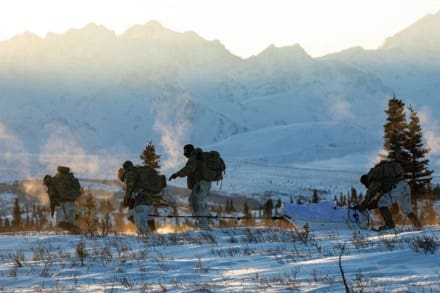
FORT GREELY, Alaska — Deployed Soldiers are constantly loaded down with gear, but nowhere more so than when operating in a cold weather environment.

In addition to their conventional weapons, Soldiers need to utilize heavy equipment like space heaters, cooking stoves, fuel and heavy-duty thermal tents to survive operations in the Arctic.

Candidates to serve as the Army’s Arctic Mobility Sustainment System underwent rigorous testing at U.S. Army Cold Regions Test Center, or CRTC, this winter with the help of Soldiers from the Army’s 11th Airborne stationed at Joint Base Elmendorf-Richardson, Washington.

“When they go out in zone seven operations, this is the new stuff they will be pulling out there with them to set up shelters,” said Danielle Schmidt, assistant test officer. “We went through a lot of changes since the test started up here all based on learning what works and what doesn’t in the cold.”

The system selected as a result of this testing will eventually replace the legacy Ahkio sled and 10-person tent the Army currently uses. Testers expected and coveted extreme cold for the multi-week test, with the interior Alaska winter delivered more than they expected.

“The whole time the test was going it didn’t get above minus 20 Fahrenheit,” said Isaac Howell, senior test officer. “It was good test conditions for what we were doing, but it was difficult on the Soldiers. Sustained movement in the Arctic day in and day out at those temperatures is not easy.”

On a typical day Soldiers would pack the Arctic Mobility Sustainment System sled under test with the tent, a heater and their basic standard issue items for Arctic infantry operations. The Soldiers would then pull the sleds in either nine-Soldier squads or four to five Soldier teams with CRTC’s test personnel led the way. Moving the heavy sleds across CRTC’s hilly tundra and thickly forested areas is challenging in any conditions, but particularly so in the extreme cold and deep snow of winter.

“Our snow is so dry and powdery,” said Howell. “You don’t stand on it at all, whether you are in skis or snowshoes — you don’t go across the top of it, you go through it. You are plowing snow the entire day regardless of whether you are wearing snowshoes or not.”

After a two-and-a-half-hour movement, testers kept track of how long it took the Soldiers to emplace and erect each tent and get the space heaters operating. Following a cold weather Meal Ready to Eat for lunch, the Soldiers disassembled the tent and heater and returned to their day’s starting point following a different route. Following a survey and hot meal, the Soldiers reassembled the tents and heaters and prepared to sleep in the long, cold Arctic nights, which sometimes approached minus 50 degrees Fahrenheit.

“The Soldiers were instrumented for safety purposes to make sure they didn’t get too cold or hypothermic,” said Schmidt. “If they did get too cold, they could pull themselves. We had noxious gas sensors in the tents where the heaters were operating as another safety precaution.”

Despite the hardships, the participating Soldiers gave high marks to CRTC’s test crew.

“It was pretty cool being able to experience that and see what all the new equipment is like,” said Pvt. 1st Class Tyler Worrell.

By Mark Schauer

Assessing the Joint Force: An Inside Look at the Office of the Director, Operational Test and Evaluation

Saturday, April 27th, 2024

Congress requires the independent assessment of the operational effectiveness, suitability, survivability and — where applicable — lethality of Defense Department weapon and business systems by testing production representative systems, used by regular service members who are trained on the systems before a decision on full-rate production is reached.  

This is where the Office of the Director, Operational Test and Evaluation comes in.
Established by Congress in 1983, the DOT&E serves as the principal official and adviser to the secretary of defense, the undersecretary of defense for acquisition and sustainment, the undersecretary of defense for research and engineering, and the secretaries of the military departments on all matters related to both the operational test and evaluation and live-fire test and evaluation of the services and systems acquired by DOD. 

Currently, the DOT&E is independently assessing about 250 systems throughout DOD, with a system being “anything from a business system all the way to space satellites and everything in between,” said Raymond O’Toole Jr., principal deputy director of operational test and evaluation during a recent interview.  

The standard routine for evaluating a system begins with a team from DOT&E partnering with the program office responsible for the acquisition of the system. The team then works with the program office, as well as members of the Office of the Undersecretary of Defense for Research and Engineering, which is responsible for developmental testing, to develop a test and evaluation master plan or a test and evaluation strategy if it’s following a pathway other than the major capability acquisition pathway.

During system testing, DOT&E works to get a credible evaluation of each system’s suitability, survivability, operational effectiveness and — when appropriate — lethality with a goal of enabling the delivery and fielding of proven capabilities to warfighters.  

One key aspect of DOT&E’s testing process is that weapons systems are tested in realistic combat conditions.  

“We’re not restricted or bound by a requirements document with regard to our assessment of the operational effectiveness and suitability of the system,” said Garry Bishop, deputy director of operational test and evaluation for land and expeditionary warfare. 

“We look at it from a realistic combat environment [with] realistic combat conditions,” Bishop continued. “A system may not be required to have certain capabilities against certain threats … but we assess that in that operational environment.” 

As an example of such testing in the operational environment rather than just testing basic system requirements, O’Toole referenced the Army’s Bradley Fighting Vehicle.
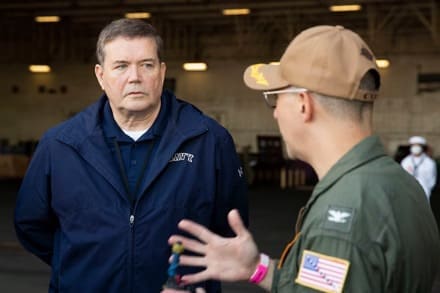
“The Bradley doesn’t go out by itself,” he said. “So, while we do look at the individual Bradley with respect to its survivability against live-fire threats, when we do operational testing, we’re also assessing how it’s used in operations …  as a unit of [fighting vehicles] and not just an individual Bradley.” 

In addition to the independent assessments that DOT&E conducts, the office also assembles an annual report each fiscal year for Congress and the secretary of defense. 

“While we don’t report on all 250 programs, we do report on the programs that have had significant operational and live-fire testing in that fiscal year,” said O’Toole, who holds a doctorate in engineering. He added that the National Defense Authorization Act requires DOD’s service secretaries to document their positions with respect to DOT&E’s report.   

Along with testing in realistic combat conditions, another aspect of what makes DOT&E somewhat unique among government organizations is the office’s independence.     

“Under Title 10 [of the U.S. Code], that’s what we owe to Congress: our independent assessment, not filtered by the secretary of defense and not filtered by the services, but [rather] it’s our assessment. The director’s assessment is based upon the data that we provide and the operational testing and live-fire testing that was conducted,” Bishop explained.

“So, … an unbiased, unfiltered assessment is what you get from DOT&E,” he said.   

Though Congress and the secretary of defense are DOT&E’s primary audience, O’Toole sees the organization as being a service to the front-line men and women in uniform.  

“I really believe our customer is the warfighter,” said O’Toole. “Because we are telling the warfighter what the truth is about, what they are getting out in the field.” 

To that end, O’Toole said DOT&E has been working for years to see how the organization can speed up the process of gathering data generated in other fields, in hopes of being able to use that data to satisfy some elements of a system’s operational test and evaluation master plan, thus potentially expediting that system’s delivery.  

“We are constantly looking at the ability to increase the speed of our assessments as a faster way to support the needs of the warfighter,” O’Toole said. 

One way DOT&E is going about that is by working to get away from the linear test model — in which a system has to go through contractor testing and developmental testing before it can get to operational testing — to a more integrated test model. 

“We’re trying to get more of our operational insights earlier in the [system’s] development phase where you can actually affect changes to the design, if needed, and get some insight that determines the scale and scoping of operational testing as you progress through the life cycle of the program,” Bishop said.  

As one example of that, Bishop referenced a recently completed test of the Army’s terrestrial layer system, which is designed to deliver integrated cyber and electronic warfare capabilities to soldiers on the battlefield.
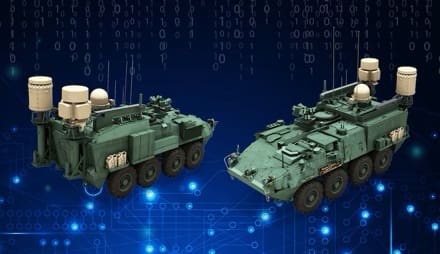
Bishop said that DOT&E was involved from the very early stages of that system’s development, which allowed DOT&E to explain to the system developer what the team was looking for in operational testing. As a result, the developer was able to adjust some of the system’s testing mechanisms to account for how the soldiers were actually using the system out in the field. 

“Testing doesn’t cause delays; the results of testing cause delays if deficiencies are found and the developer chooses to correct them,” said Bishop. “So, the job of testers — both developmental and operational — is to inform the developer. The earlier they can find those deficiencies and vulnerabilities, the earlier the opportunity to fix the system, so that when it’s filtered to our warfighters, they get a credible system.”    

In addition to test and evaluation within the Defense Department, DOT&E also is responsible for the International Test and Evaluation Program. According to DOT&E literature on the program, the ITEP “permits establishment of bilateral and multilateral agreements between the United States and international partners.”   

“We are unique,” O’Toole said. “There is no other organization like DOT&E, in the world that provides independent assessment.” 

Being responsible for international test and evaluation sometimes affords DOT&E leadership the opportunity to interact with members of international defense communities. One example is when O’Toole recently held a briefing at the International  Armoured Vehicles Conference in London in January. 

“During the briefing, the room was very focused, and it’s not because I was the guy standing up there; it’s because of the message I was delivering,” O’Toole said. “And that message was [that] we provide credible assessment, and we’re not afraid to go and say where things are wrong, how to go fix it, and then retest it. We also say what is right or working as intended.” 

Moving forward, O’Toole said that DOT&E will be focusing not just on testing individual systems, but families of interconnected systems. 

“And we’re looking at that not just from a testing standpoint, but from a training standpoint,” he added. 

As an example of that, O’Toole mentioned the Joint Simulation Environment that is used to train pilots of the F-35 Lightning II — the DOD’s premiere, multirole combat aircraft.
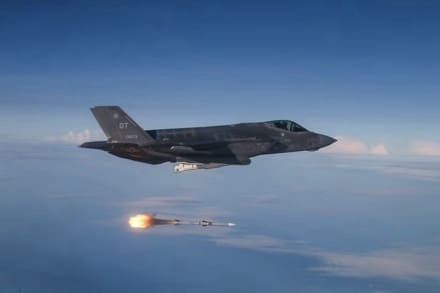
“People are saying to me … that they’ve gotten more out of sitting in a JSE cockpit than they ever got when they were on the range and out in the open air because of the threats and capabilities that they were able to actually utilize,” he said, referring to the fact that safety and environmental restrictions on ranges sometimes preclude the testing of certain capabilities and threats.  

O’Toole also said DOT&E is getting more involved with the world of artificial intelligence.

“We’re very involved with the industry, and the best and the brightest [individuals] on how to utilize and test artificial intelligence,” O’Toole said, adding that DOT&E is fully engaged with DOD’s Chief Digital and Artificial Intelligence Office.  

“We’re thinking ahead, and that’s where we’re going; that’s where we want to be going; and that’s where we need to go for the future.”

By Matthew Olay, DOD News

B.E. Meyers & Co. Hosts SOF Week 50th Anniversary of the Vietnam War Veterans Recognition Event (Tampa, FL)


Saturday, April 27th, 2024

26 April 2024 (Redmond, WA) – B.E. Meyers & Company, Inc., a US defense technology manufacturer in its 50th year, is proud to partner with the US Vietnam War Commemorative Office as a Commemorative Partner.

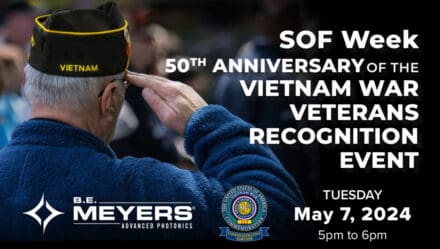
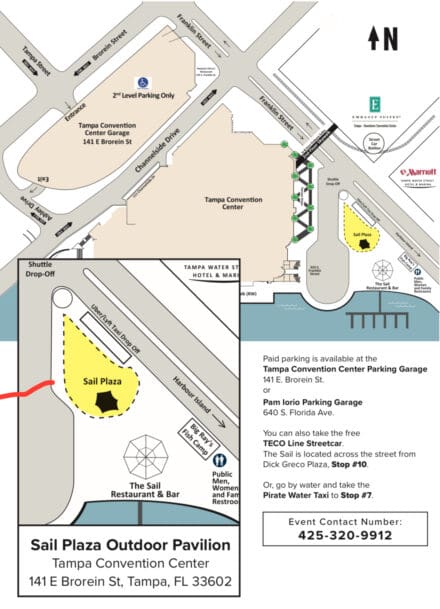
On Tuesday, 07 May 2024 from 5pm to 6pm, B.E. Meyers & Co. will host the SOF Week 50th Anniversary Recognition of Vietnam Veterans at the Sail Outdoor Pavilion next to the Tampa Convention Center,141 E Brorein St, Tampa, FL 33602. Please join us in this special event to recognize and honor the Vietnam Veterans in the Tampa area. Help us make it a memorable occasion by showing your gratitude and support for these remarkable individuals who have served our country with valor and raise a glass in their honor.

Remarks and pinning ceremony for Vietnam Veterans in attendance with MG Edward J. Chrystal, Jr., Director, The United States of America Vietnam War Commemoration.

Vietnam Veterans who plan to attend and wish to be honored at the event, please contact us with your service and contact details at: events@bemeyers.com or 425-320-9912.

For all others attendees, please RSVP at www.eventcreate.com/e/sofweekvietnam50th

(Click on photo to download brochure.)
Special Thanks to the Global SOF Foundation and American Legion Post 138.

10th Mountain Division Sustainment Brigade Hosts Innovative Technology Symposium

Saturday, April 27th, 2024

FORT DRUM, N.Y. — The 10th Mountain Division Sustainment Brigade hosted the Innovative Technology Symposium on April 15, 2024 to discuss how the Army is augmenting warfighting capabilities with emerging technologies.

“The intent of this symposium is essentially for us to bring in some of the new technology to Fort Drum and highlight how we can work with different agency partners to get this into the hands of our Soldiers,” said Chief Warrant Officer 2 Edilma Cruz, 10th Mountain Division Sustainment Bridge strategic mobility officer.

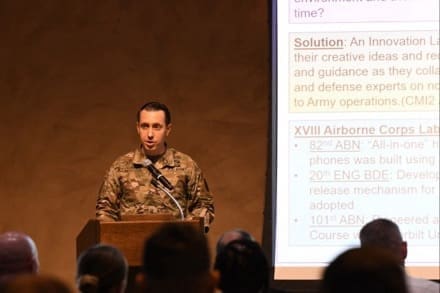
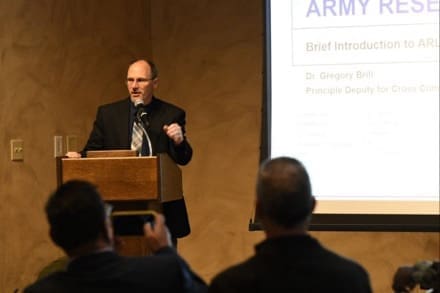
Representatives from U.S. Army Combat Capabilities Development Command’s Army Research Lab and the Civil-Military Innovation Institute briefed attendees on technological developments through the Pathfinder and Accelerating FORCE programs.

“The Pathfinder program’s primary mission is to collect whole problem sets from Soldiers at the tactical level,” said Cody Clevenger, Pathfinder program manager. “And we either pair them with academia — from one of our partner schools we work with — if that level of research is needed to execute a solution, or the other way is with our DIRT labs.”

Clevenger briefed three Design, Innovation, Research and Technology, or DIRT, projects funded by the Army Research Lab, including an updated design for the M-80TR anti-personnel landmine used for training.

He said a 2nd Brigade Combat Team Soldier contributed feedback on the assistant gunner bag and the limited options for attaching it to the rucksack. From this, a prototype was developed to improve operational functionality and optimize weight distribution.

“We want to have Soldiers involved throughout the development of a solution,” Clevenger said. “Soldiers love to talk about the problems they have in the field, and we’re trying to give them an avenue where they can do that directly with us.”

The 10th Mountain Division will have their own problem-solving capabilities when the Mountain Innovation Systems Integration Lab becomes operational at Fort Drum by late summer.

Maj. Michael Fitzgerald, 10th Mountain Division (LI) G-3 knowledge management officer, said the innovation lab is a facility where any Soldier can bring creative ideas to solve problems they encounter through training or on deployments, and they will receive engineering support and guidance.

“Soldiers will have access to equipment such as laser cutters and 3D printers, all at no cost to them because the lab is funded and manned by the Civil-Military Innovation Institute,” he said. “Our partnership with CMI2 will allow us to receive engineering support and collaboration with outside agencies for technologies.”

Fitzgerald said an initial focus will be on projects to further the division’s alpine planning efforts.

“But the sky’s the limit on what problems we can solve, and we encourage everyone here to spread the word on what a great opportunity and resource this will be for Soldiers,” he said.

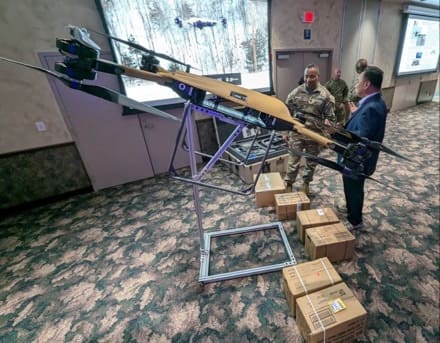
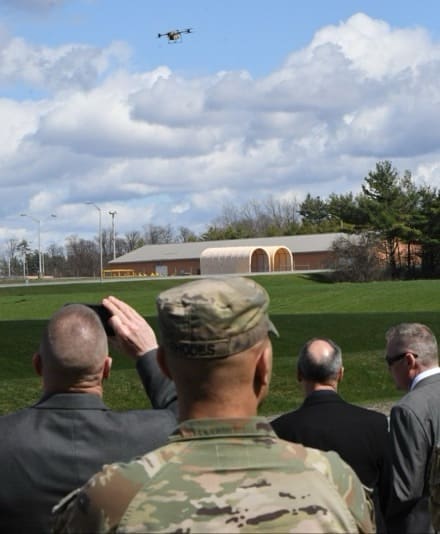
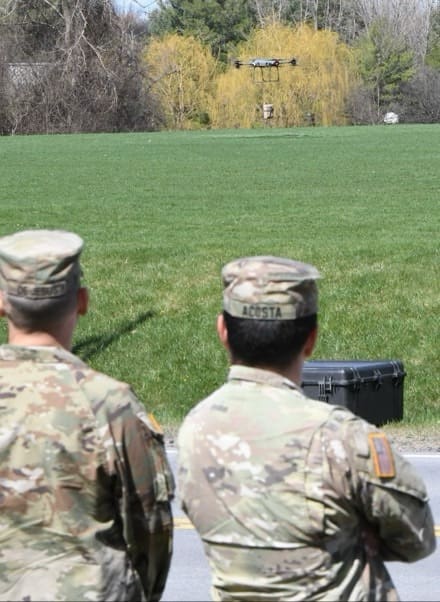
Recently, 10th Mountain Division Soldiers trained on the TRV-150 Tactical Resupply Vehicle and field-tested the drone during the Mountain Peak exercise on post.

The TRV-150 can travel up to 60 miles per hour and can transport up to 150 pounds of cargo, moving in areas that may be inaccessible or too dangerous for vehicles or personnel to conduct resupply missions.

First Lt. Robert Willet, support operations transportation officer with 10th Brigade Support Battalion, 1st Brigade Combat Team, provided feedback as one of the TRV-150 operators. He said seven resupply missions were conducted over four days and they experimented with different payloads to test the drone’s capabilities.

“When used correctly, it’s the fastest method of resupply inside of its radius,” Willet said. “It also had the lowest threat to Soldiers than any other resupply method.”

Willet also noted they experienced high-wind conditions that prevented them from flying one day.

“The TRV-150 is close to getting into Soldiers’ hands, but there is additional experimentation that DEVCOM is making to meet the Army’s intent,” Cruz said.

A Civil-Military Innovation Institute team will further examine the TRV-150 in action when 1st Brigade Combat Team conducts a Joint Readiness Training Center rotation at Fort Johnson, Louisiana, in May.

“They will be there the whole time collecting data,” said Dennis Day, Army Research Lab’s Accelerating FORCE deputy program manager. ‘And it’s not just system data, but [tactics, techniques and procedures] and [concepts of operations] that go beyond the ones and zeroes.”

Day said experimenting with emerging technologies in realistic training environments helps to identify problems and improves the final product.

“What we can do is provide a capability,” he said. “But if the Soldier is experimenting with it, providing us feedback, then we can enhance it and get the best product to the Soldier as fast as possible.”

By Mike Strasser, Fort Drum Garrison Public Affairs

FIrstSpear Friday Focus: TTPOA

Friday, April 26th, 2024

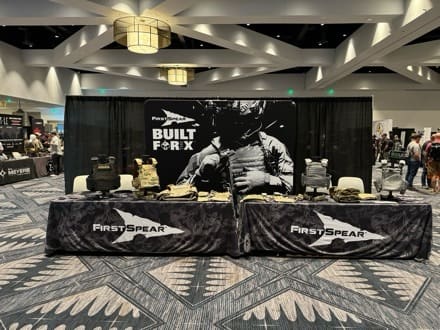
FirstSpear attends Texas Tactical Police Officers Association (TTPOA) in Round Rock, Texas, April 24-28, 2024 and for the second year running, FirstSpear is the proud Vendor Show sponsor.

The mission of the Texas Tactical Police Officer’s Association is to provide an exchange of ideas and information within the field of tactics and operations in police work.

In addition to classroom seminars, TTPOA also offers hands on training courses and live range demos.

Check out TTPOA.org and first-spear.com.

USAF Accepting Applications for Cyber Warrant Officers

Friday, April 26th, 2024

ARLINGTON, Va. (AFNS) —  

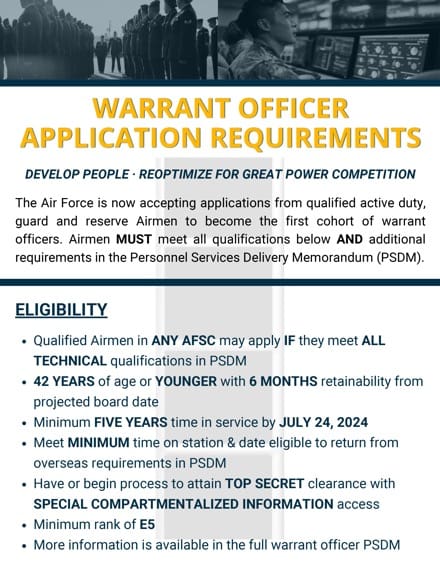
The Air Force is now accepting applications, from April 25 to May 31, for Airmen aspiring to become the inaugural cohort of warrant officers in the information technology and cyber career fields.

Plans to re-introduce warrant officers to the Air Force was announced by Secretary of the Air Force Frank Kendall at the Air and Space Forces Association’s 2024 Warfare Symposium in conjunction with the Department’s plan to Reoptimize for Great Power Competition.

“We need operational units with all the capabilities they need to deter and compete with our pacing challenges and ready to enter a conflict on short or no notice,” Kendall said. “In those units we need the right mix of skills necessary for high end combat and to ensure technological superiority, particularly in information technology and cyber.”

This announcement marks a significant milestone for the initiative and presents an opportunity for up to 60 selected candidates, who will play a crucial role in addressing the multifaceted challenges of today’s dynamic security landscape. This decision signifies a pivotal moment in Air Force history, representing a strategic shift towards bolstering technical proficiency and operational effectiveness.”

This announcement marks a significant milestone for the initiative and presents an opportunity for up to 60 selected candidates, who will play a crucial role in addressing the multifaceted challenges of today’s dynamic security landscape. This decision signifies a pivotal moment in Air Force history, representing a strategic shift towards bolstering technical proficiency and operational effectiveness.

“The reintroduction of the warrant officer career path reflects the Air Force’s commitment to expanding and retaining technical excellence, essential for maintaining a strategic advantage in an era defined by Great Power Competition,” said Air Force Chief of Staff Gen. David Allvin. “By investing in talent management programs that preserve proficiency and competence in our perishable and highly technical skills, the Air Force aims to ensure its readiness to stay ahead of rapidly advancing threats and safeguard national security interests effectively.”

The history and role of warrant officers
The Air Force dissolved its Warrant Officer Corps in 1958 following the creation of the senior master sergeant and chief master sergeant ranks, who took on warrant officer responsibilities. These SNCOs took on specific technical duties, but were never relieved of their institutional requirements.

The reintroduction of the Warrant Officer Corps career path in the Air Force aims to address critical operational needs, while maintaining highly perishable skills, and leverage the unique expertise and capabilities of warrant officers. They will serve as technical experts, functional leaders, advisors, professionals, and risk managers, contributing to the overall proficiency of their organizations.

Application Requirements

This first cohort of active duty, Air National Guard, and Air Force Reserve candidates must hold the rank of at least staff sergeant and have one year of active federal service. Notably, applicants must meet specific experience and proficiency requirements outlined for each warrant officer specialty, ensuring a highly skilled and capable cohort.

The Air Force created two new Air Force specialty codes for warrant officers, reflecting the critical role these officers will play in the realm of cyber and information technology. The first AFSC, 17W – Warfighter Communications & IT Systems Operations, designates individuals as subject matter experts and trusted advisors on the planning, deployment, employment, and securing of enterprise and warfighter communication systems.

These warrant officers will provide technical guidance to commanders and staff, ensuring the efficient operation and management of communication assets at all echelons. Additionally, they will play a pivotal role in mentoring and developing cyberspace personnel, contributing to the overall cybersecurity posture of the Air Force.

The second AFSC, 17Y – Cyber Effects & Warfare Operations, designates individuals as subject matter experts and trusted advisors on offensive and defensive cyber operations assets and personnel. These warrant officers will be responsible for orchestrating, managing, and integrating cyberspace technical capabilities, delivering critical technical recommendations across various military and inter-agency platforms. Their expertise will extend to integrating cyberspace capabilities into warfighting functions to enhance combat effectiveness and maneuvering strategically in the cyber domain.

Although Airmen in any AFSC can apply, they must meet specific functional technical experience to ensure these individuals possess the requisite skills and experience to excel in their duties, contributing significantly to the Air Force’s technical readiness and operational effectiveness in cyberspace operations.

For the Warfighting Communications & IT Systems Operations (17W) AFSC, applicants must possess a minimum of 24 months of documented operational experience with enterprise IT or warfighter communications systems in areas such as voice and data internetworking, local and wide area networks, including terrestrial, satellite, and aerial systems, as well as network planning. Additionally, all applicants much hold a minimum Department of Defense approved industry certification commensurate with the requirements for the Information Assurance Technical Level II certification or higher.

Similarly, candidates for the Cyber Effects & Warfare Operations (17Y) AFSC must hold senior level proficiency in one or more U.S. Cyber Command work roles as defined in the Commands Job Qualification System, or National Security Agency equivalent. Additionally, for those specifically interested in a Cyber Capability Developer work role, must be a certified U.S. Cyber Command Senior Cyberspace Capability Developer or a Computer Network Operations Development Program graduate or have three years of experience in system level programming, i.e. C, Assembly.

Members are encouraged to read the Personnel Service Delivery Memorandum in its entirety to ensure they qualify to apply.

After Applying

The selection board process, scheduled for June 24-28, will identify top candidates poised to assume critical roles as technical experts, functional leaders, and advisors within their specialized domains. Those selected for the first cohort will be notified in late July.

Candidates will undergo comprehensive training at the Warrant Officer Training School starting in the fall of 2024 or early 2025, which will be located at Maxwell Air Force Base, Alabama, and will focus on equipping them with the necessary skills to excel in their new roles.

Upon graduation from WOTS, candidates will be warrant officers and will be reassigned to operational units across the Air Force. Their assignments will align with operational requirements and member preferences to maximize their effectiveness in enhancing technical readiness and operational effectiveness.

“These are highly in-demand, and also extremely perishable, skills in today’s rapidly-evolving landscape,” said Chief Master Sgt. of the Air Force David A. Flosi. “As we navigate the complexities of Great Power Competition, our ability to adapt and innovate hinges on the expertise of our Airmen. Using our Airmen’s full potential is not just a strategic advantage; it’s a necessity for our Air Force’s readiness and effectiveness in the face of a challenging strategic environment.”

For additional information on the requirements of becoming a warrant officer, click here.

Courtesy of Secretary of the Air Force Public Affairs

B.E. Meyers & Co., Inc. Exhibiting at Modern Day Marine 2024

Thursday, April 25th, 2024

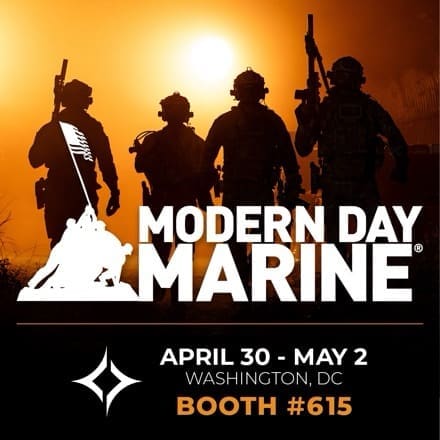
April 24, 2024 (Redmond, WA) – B.E. Meyers & Co., Inc., a defense technology manufacturer specializing in advanced photonic solutions for military, law enforcement, consumer, and aerospace applications worldwide, will be exhibiting at the 2024 Modern Day Marine expo from 30 April – 02 May 2024, booth #615 at the Walter E. Washington Convention Center in Washington, D.C. Modern Day Marine is the largest military equipment, systems, and technology expo specific to the United States Marine Corps.

B.E. Meyers & Co.will be showcasing the U.S. Army adopted BOARS®-M2, (NSN) 1240-01-682-8650, a modular, low-profile optics and accessory mounting solution for the M2 series of .50 Cal crew-served weapons that offers a quick-disconnect with true return-to-zero reattach capability. They will also be showcasing their United States Department of Defense-specific variant of their Modular Advanced Weapon Laser (MAWL), the MAWL®-X1, a high-powered infrared and visible green multi-function aiming and illumination laser designed for individual carbines and crew served weapons. It has been engineered from the ground up to exceed the needs of the modern night fighter. Other products on display will include the KIJI, a Class 3R VCSEL-based infrared laser illuminator that can be rail mounted on a wide variety of systems including individual weapons, shoulder-fired anti-tank rockets (i.e. AT-4) and spotting scopes, as well as helmet-mounted for aid in night vision navigation.  The KIJI can also be used in a handheld configurationin support of aviation applications and has been used by pilots and crew to provide clear and bright infrared illumination to identify ground HLZ hazards and communicate with ground personnel.

To schedule a meeting with a member of the B.E. Meyers & Co. team at Modern Day Marine, please connect with us atinfo@bemeyers.com.

For more information about B.E. Meyers & Co., our products, and our 50-year history, please visit us at www.bemeyers.com.

Hunter Seven Foundation Activities During SOF Week

Thursday, April 25th, 2024

While our mission isn’t focused entirely on Special Operations we do believe in providing equitable healthcare, prevention-based screenings and evidence-based education.

Knowledge is Power.

A few members of our team will be present in the SOF Community Corridor, we’ll also be scattered around discussing early cancer detection, risk mitigation, and current trends with our partners at SOCOM, the nonprofit space and business communities.

On Tuesday, May 7th from 4:30-7:30 at the Westin Tampa Waterside – Channelside Room, we’ll be with Mrs. Christina Sterling, founder of the Sterling Promise Foundation and widow to Army Ranger and Delta Force Operator, SSG Scott Sterling, who passed in April 2021 after a heroic battle against Colon Cancer

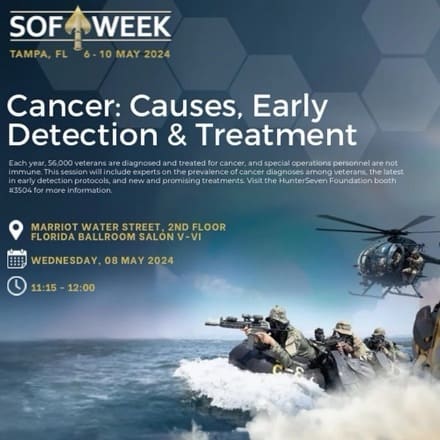
On Wednesday, May 8th, from 11:15 to noon, join us for a discussion on Cancer: Causes, Early Detection & Treatments at the Marriott Water Street. The discussions will be led by SOCOM’s own, Col. April Verlo, cancer survivor and current cancer fighter, along with Naval Special Warfare Development Group K9 Handler and Colon Cancer survivor CMC (ret.) Billy Clark. They’ll be joined by medical providers actively caring for and supporting members of the Special Operations community.

Visit the Hunter Seven Foundation here.