Pirata Series from OTB Boots - Coming March 2026!

Industry Day at the Range Opens Exhibitor Registration and Sponsorships Ahead of 2026 Event

August 17th, 2025

BOULDER CITY, Nev. – August 13, 2025 – SHOT Show® Industry Day at the Range, the premier hands-on media and buyer event held annually the day before SHOT Show®, has officially opened exhibitor registration for its 21st annual event, taking place January 19, 2026, at the Boulder Rifle and Pistol Club in Boulder City, Nevada. In addition to booth space, several high-impact sponsorship opportunities are now available for brands looking to elevate their visibility ahead of the industry’s biggest week.

Industry Day offers exhibitors a unique platform to launch new products, create content with top-tier media and influencers and engage directly with buyers and industry leaders in a dynamic, hands-on environment. The event continues to drive early momentum and engagement that carries into the trade show floor and beyond.

A select number of sponsorships are now available, including:

First Shot: kick off the event through selection of the First Shot honoree with exclusive brand recognition in the opening moments of the day.

App Sponsor: Features the sponsor’s branding prominently within the official mobile app

On-Ground Transportation Sponsor: boost visibility with branded shuttles and signage seen across the venue.

“Each year, Industry Day plays a critical role in helping brands stand out before the SHOT Show floor opens,” said Kelsey Puryear, Industry Day at the Range co-owner. “Exhibitor space and sponsorships are limited, and we encourage companies to take advantage of the opportunity to be part of the industry’s most influential range event.”

Supported by the National Shooting Sports Foundation as title sponsor through 2028, Industry Day at the Range remains the only official range event associated with the SHOT Show. Exhibitor space is limited, and early registration is strongly encouraged.

New exhibitors can register online now to secure their space. Sponsorship opportunities are also available online. For additional details and answers to frequently asked questions, please visit the event website.

For more information about the 2026 SHOT Show Industry Day at the Range visit ShotShowRangeDay.com

The Jump That Changed US Warfare History

August 17th, 2025

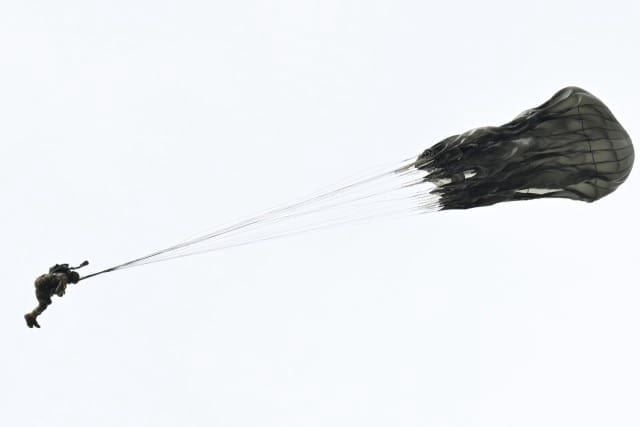
WASHINGTON — Since the inception of airborne warfare, the practice of using parachutes to insert troops into combat zones without land passage has turned the tides of conflicts. Commanders use airborne forces to seize the initiative. A brigade of paratroopers can envelop the ground from the sky in moments, allowing an army to strike deep inside enemy territory to gain key terrain and rapidly build combat power.

Paratroopers today learn their craft in the Basic Airborne Course at Fort Benning, Georgia, where Soldiers leapt into history 85 years ago.

On Aug. 16, 1940, 48 volunteer members of the Army Parachute Test Platoon jumped from a Douglas B-18 Bolo bomber at 1,500 feet. The jump was less than 45 days after the establishment of the platoon and marked the true beginning of U.S. airborne forces.

Paratroopers everywhere now celebrate that date as National Airborne Day, commemorating “the bravery and daring spirit of sky Soldiers,” according to the 2002 presidential proclamation that established the observance.

The Art of the Jump

Ever wonder what it’s like to learn to be a paratrooper? Check out The Art of the Jump on Defense.gov to find out what it’s like for students of the Army’s Basic Airborne Course. Get ready for a crazy ride!

By DOD News

Northern Strike Brings Electromagnetic Warfare to the Front Lines

August 16th, 2025

CAMP GRAYLING, Mich.—In modern warfare, battles are not only fought with rifles, tanks and artillery. Some of the most decisive victories are won across the electromagnetic spectrum.
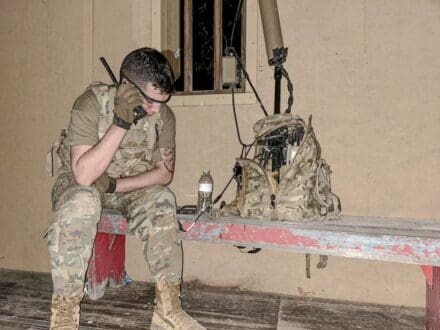
At Northern Strike, the National Guard’s premier readiness exercise held this month at Michigan’s National All-Domain Warfighting Center, Soldiers trained in a high-intensity environment that pushed the limits of electromagnetic warfare, or EW. It tested their skills in realistic combat scenarios.

In classrooms, electromagnetic warfare specialists often train to disrupt, or “jam,” enemy communications, intercept signals and scan for threats. Jamming works by overpowering or confusing an enemy’s radio or data transmissions, preventing them from communicating or coordinating effectively.
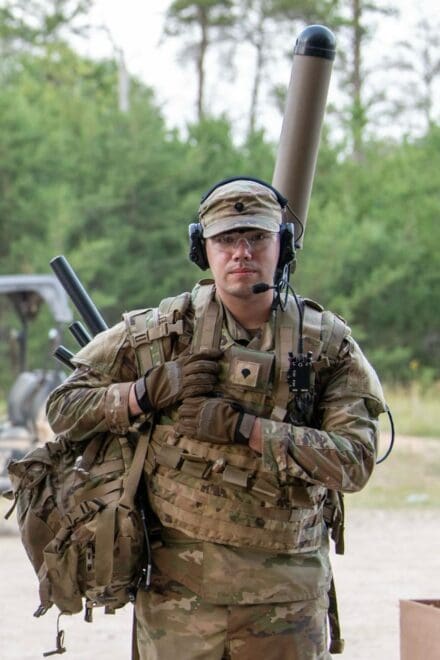
Last year at Northern Strike, the 37th Infantry Brigade Combat Team, or IBCT, launched a pilot program that sent a mobile EW team into the field to disrupt the communication systems of units in training.

This year, the EW teams were embedded in infantry squads to create a more realistic, complex environment for Soldiers.

“This is a rare training opportunity in the National Guard and in the Army as a whole,” said Spc. Robert Bowley, an Electromagnetic Warfare specialist in the 37th IBCT from Columbus, Ohio. “To train with the equipment, you need the funding, and Northern Strike allows for that.”

Bowley was equipped with the Beast+ system, a handheld multi-channel receiver and transmitter designed for Army EW operations. The system scans the electromagnetic spectrum to detect enemy signals, identify spoofing or jamming threats and enhance battlefield awareness.

“The antenna gives you a general direction and signal strength. I can see anything on the [radio frequency] spectrum,” Bowley said. “We also have a power amplifier that lets us jam communication systems.”

Bowley, who also participated in the exercise in 2024, said he acted as “an early warning system. I will be giving the direction of the opposing force and jamming their comms.”

The mission brought together electromagnetic service members from the 37th IBCT, the Royal Irish Regiment and the Latvian National Armed Forces. The teams combined their expertise by embedding an electromagnetic specialist with the Irish regiment and managing signal towers with the Latvian forces to carry out a complex, coordinated operation.

“In my job, you are on the front lines. We are not cyber on computers, we are in the field,” Bowley said.

At 1800 hours, Browley and seven infantry soldiers from the 2nd Battalion, Royal Irish Regiment, British Army, stepped off to the Combined Arms Collective Training Facility, which simulates fighting in urban terrain. Once they arrived, the squad cleared the building and Bowley looked for the best place to set up the Beast+.

“Ideally, it would be on top of a roof,” he said. “But they have drone capabilities, so this [his location] was the next best thing. In the best case scenario you want to be high up and have nothing around you.”

While the Royal Irish Regiment placed obstacles around the building, Bowley found a dark corner with windows on both sides.

“We will be defending from up here. With this spot, I have a window on both sides and am able to get the antenna outside. The main thing that is important is what is being said over the radio. When I see something on my screen, I will know the direction they’re coming from,” Bowley said.

Bowley knew the long night ahead would test his focus. He monitored the electromagnetic spectrum for hours, watching for the slightest signal of an attack and standing ready to jam enemy communications.

“I brought a lot of caffeine,” he said, laughing. “We have the go-ahead to jam whatever. Usually, you have to really go through hoops. The problem with jamming is that it is risky. Turning off comms can do a lot. The things that I will be looking at jamming are important. Like when they call up nine-lines, or before an assault.”

Bowley’s squad was on defense, which required members to stay alert the entire time. At 2200 hours, they experienced probing from a platoon-sized element testing their defenses. A drone tagged four simulated casualties.

At 0300 hours, shouts echoed as infantry teams moved in to assault the objective. With their communications jammed, the attackers yelled to coordinate.

“They realized we were jamming them and immediately got off their comms,” Bowley said.

Moments later, the opposing force stormed into the room and took down the defending squad in the exercise.

Master Sgt. Jason Ross, the electromagnetic spectrum operations noncommissioned officer for the Army National Guard Information Advantage Division, said the exercise was a reminder of why electromagnetic warfare must be integrated into training.

“Communications systems have changed rapidly in recent years and now evolve almost monthly,” Ross said. “The threat has grown significantly. Thinking outside the box is critical, but it’s not always an easy discussion to have.”

This scenario was unique because the communications cell was on the red team, creating an unpredictable training environment.

“It is hard to duplicate what we are doing at Northern Strike. The approval for this type of training is tricky. The support that Michigan has given to this exercise is amazing,” Gilly said. “The reality is when we train on a rifle range, a Soldier knows what to expect. That is not the case with electromagnetic warfare.”

Maj. Tucker Palmatier, a cyber electromagnetic warfare officer and Cyber Electromagnetic Activities officer in charge of the 37th Infantry Brigade Combat Team, said training in electromagnetic warfare is challenging because of federal restrictions.

“The FCC [Federal Communications Commission] law on jamming dates back to 1934, which makes it difficult to realistically train for today’s technology-driven battlefield,” Palmatier said.“Our challenge is maximizing training opportunities without breaking laws or regulations so Soldiers know exactly what to expect when it matters most.”

Despite those hurdles, Palmatier said the operation was a success.

“Our enemy was not anticipating electromagnetic warfare. We were able to degrade their communications, which left them unable to coordinate their attack, allowing a smaller force to successfully defend the position,” he said.

By 2LT Paige Bodine, Michigan National Guard

Terrain 365 DTK-AT Topo

August 16th, 2025

The Dog Tag Knife Returns, Thinner and with Laser Graphics

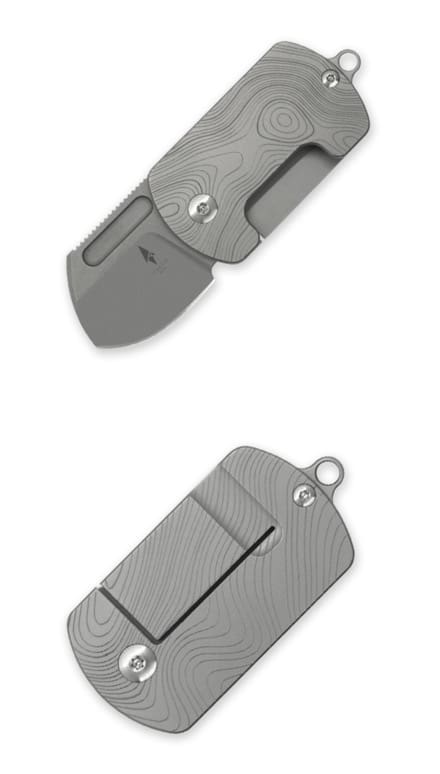
New for August 2025, Terrain 365™ releases the newest variant of their smallest and most compact folding in their lines, the DTK-AT.Featuring their renown rustproof x edge-holding Terravantium™ super alloy blade, all titanium hardware, framelock construction,their thinnest and lightest model, a laser etched topographic map graphic on the handles, and all in the footprint of a standard issue US “dog tag”. Perfect worn around the neck with a ball chain, tucked away in a hide-away pocket or stowed in a pocket survival kit, this small but mighty knife can tackle cutting jobs much bigger than itself. From mountain top, to sea floor and anything in-between, Terrain 365 is Adventure Tools for All Terrains.

The DTK-AT Topo is available with a Terravantium™ super alloy blade, all titanium hardware, titanium framelock and a laser etched topographic map graphic on the handle scales.

Creative Director and Co-Founder Patrick Ma of Terrain 365 states,

“I keep a few of these stashed in the hide-away collar pockets in my jackets, survival kits and tool box. It’s a great little back up knife. This newest variant is even slimmer and lighter than before.”

The DTK-AT Topo is available now for $189.00 from terrain365.com

New Army Reconnaissance Drone Earns High Praise from Soldiers at First Fielding

August 16th, 2025

Fort Bliss, TX – If you’ve seen any footage from the ongoing war in Ukraine, odds are it was video that came from a drone. As the war has expanded since it began in 2022, so too have the usage of drones. The need for armies to reliably gather intelligence, spot dangers, and target enemies without putting Soldiers’ lives at risk has become a paramount concern.

Enter Soldier Borne Sensor, a program under Program Executive Office (PEO) Soldier with the mission of providing Soldiers with an effective Unmanned Aerial System (UAS) aimed to increase situational awareness while reducing detection risk.

After years of progress, the latest iteration of the Soldier Borne Sensor is now officially in Soldiers’ hands.

For three days, Soldiers of the 90th Sustainment Brigade, as part of the Joint Task Force – Southern Border, packed into a hot warehouse less than five miles from the southern border to train with the newly fielded Soldier Borne Sensor reconnaissance drone. The training involved two days of in-class learning of every function and feature, and one day of hands-on field experience learning to fly the drone.

The other units who participated in this training as part of the Joint Task Force were the 2nd Stryker Brigade Combat Team, part of the 4th Infantry Division, and the 89th Military Police Brigade.

This iteration of the Soldier Borne Sensor is an improvement in just about every regard possible from its predecessor. It has a much longer battery life, more durable frame, and a greater operating range.

All of those and other upgrades come wrapped up in one user-friendly reconnaissance drone built from the ground up with Soldiers in mind. It was that high functionality and ease of use that Soldiers took notice of and praised the most.

“It’s super easy to fly,” said one Sergeant who took part in the fielding. “I didn’t expect it to be as simple as it was. It’s definitely something you can pick up in 15 to 20 minutes.”

“On a basis level of being able to get the drone in the air and doing whatever you need to do, it’s very simple and user friendly,” a second Sergeant said. “It’s a great system that I would love to see implemented more… I would love to see these at a squad level, or one per fire team.”

One Soldier who had never flown drones before this training said the system was “very user friendly and easy to pick up and learn.”

As previously mentioned, this version of the Soldier Borne Sensor comes packed with many unique features and systems, all designed to increase a Soldier’s lethality and situational awareness.

And each Soldier there seemed to have a feature they liked the best.

“I liked the zipline feature,” one Soldier reported back. “You can just pick one point and be like ‘hey I want you to go from where you’re at now to this point’… and it will go from the point you’re at now to the point you set. Plus, you can pan the camera and it doesn’t matter which way you face it will keep going to that point you set.”

“The most impressive feature I saw was the different camera features,” said another Soldier. “I could see as clear as day as I can now, but it can also go to different versions of thermal which I found very impressive for how compact the device is.”

This iteration of the Soldier Borne Sensor comes equipped with an improved, high-resolution camera that can alternate between normal view, low-light, black-hot, white-hot, and thermal views at the push of a button.

Unlike previous iterations, which had its daytime and nighttime cameras separated into two different drones, requiring Soldiers to carry more weight, the latest version of the Soldier Borne Sensor wraps all these improvements into one drone.

“For me, the number one feature that I love is fly-to-home,” said one Staff Sergeant. “You’re the beacon for the drone. Instead of manually trying to control the drone to follow you, you set yourself as home.”

More than a few Soldiers had fun testing this feature out, as they paced around the training area with their drone following them wherever they went with no input on the Soldiers’ part.

Overall, the latest iteration of the Soldier Borne Sensor promises to be a valuable tool in the arsenal of our men and women in uniform.

As with all things PEO Soldier, the Soldier Borne Sensor program will only improve further as it learns from and incorporates feedback directly from Soldiers. That feedback at the first fielding has been overwhelmingly positive.

“I have nothing bad to say about the system,” said one Soldier when asked to summarize his time learning about the Soldier Borne Sensor. “It’s extremely versatile and it’s definitely a great asset to have.”

“This is probably going to be the greatest asset to both missions at home and abroad,” said another Soldier. “Instead of sending the actual Soldier in harm’s way, why not use the asset that doesn’t cost the life of an actual Soldier? I think it’s going to be a really good investment. It’s probably going to be the best investment for units, recon, signal, infantry, land survey… I think this piece of equipment checks all the boxes.”

By Zachary Montanaro

Czech Republic Commissions Rheinmetall to Maintain Leopard 2 Main Battle Tanks and Büffel 3 Armoured Recovery Vehicles – Contract Worth Up to €250 Million

August 15th, 2025

The Czech Ministry of Defence has commissioned Rheinmetall to provide extensive service and maintenance work for the Leopard 2A4 main battle tank and the Bergepanzer 3 “Büffel” armoured recovery vehicle. A corresponding comprehensive follow-up service contract was signed in Prague on 11 August 2025. The contractor is Rheinmetall Landsysteme GmbH.

The contract now concluded has a term of seven years. It covers various services and goods for the maintenance of 42 Leopard 2A4 main battle tanks and two Bergepanzer 3 Büffel (“buffalo”) armoured recovery vehicles. The contract value amounts to up to EUR 250 million.

Prague 11. 8. 2025
Photo by Jan Schejbal
www.jan-schejbal.cz

The services include the initial and follow-up supply of spare parts, customer service support, factory and assembly repairs, training services, technical and logistical support, the provision of interim infrastructure, and the corresponding project management.

Rheinmetall Landsysteme GmbH also intends to cooperate with Czech industry in fulfilling the contract and to award corresponding subcontracts. The focus here will be on repair and maintenance support with   , including the necessary transfer of know-how. To this end, a letter of intent was also signed on 11 August 2025 with the Czech state-owned company VOP CZ s.p. in the presence of representatives of the Czech Ministry of Defence.

Under various contracts, the Czech Armed Forces will receive a total of 42 Leopard 2A4 battle tanks and two Büffel (“buffalo”) armoured recovery vehicles. Rheinmetall refurbished and delivered these vehicles for the Czech Armed Forces, partly on behalf of the German Federal Government and partly on behalf of the Czech Government.

(Image above: Leopard 2A4 CZ. Image below: Lubor Koudelka, Director General of the Armaments and Acquisition Division of the Ministry of Defence of the Czech Republic, and Dr Björn Bernhard, CEO of Rheinmetall Landsysteme GmbH, at the signing of the contract) 

Law Enforcement Readiness in Active Shooter Training with Laser Ammo’s CQB in a Box

August 15th, 2025

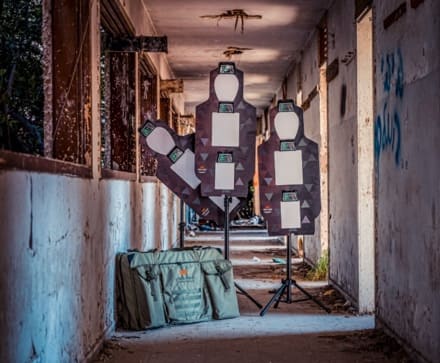
GREAT NECK, N.Y. – August 1, 2025 – Laser Ammo USA Inc. is proud to highlight its CQB in a Box, a cutting-edge system designed for tactical entry, dynamic room clearing and active shooter simulation training. Featuring three adjustable humanoid-sized reactive targets that are portable and easy to set up, the CQB in a Box provides instant feedback to both the shooter and evaluator. This tactical training system can be adjusted to fit a wide range of training needs, offering versatile and realistic drills. As a beneficial training tool for first responders, law enforcement, military and security companies, the CQB enhances officer readiness, safety and preparation of real-life scenarios.

The CQB in a Box is an innovative wireless training system that includes three life-sized, yet lightweight, reactive targets that can be easily configured to different heights and angles to meet diverse training needs. Each target includes three reactive hit zones (head, torso and pelvis), which can be adjusted using the provided shoot zone cards to easily scale difficulty. Additionally, the CQB is equipped with a wireless controller, allowing remote start and stop of drills. The targets wirelessly connect to a Windows computer, so each target can be easily programmed with different light colors to indicate shoot/ no shoot targets, which is ideal for unlimited force-on-force drills. The Windows software allows for drill analytics, which include shot timing and hits.

Whether it is configured to create a basic drill or a complex tactical simulation, the CQB offers the versatility and efficiency needed for modern training environments. The highly responsive system is compatible with both Laser Ammo’s red and infrared lasers. Packaged in a purpose-built carrying case, this training system can easily be transported and used across multiple training locations. As the only life-sized, portable reactive target system on the market, the CQB sets a new standard in tactical training.

“The CQB in a Box is engineered to sharpen precision, accuracy and overall readiness without sacrificing safety or realism.” said Colin Gallagher, Laser Ammo’s Law Enforcement & Military Sales Lead. “It’s a great tool for law enforcement training and gives officers hands-on experience that translates directly to real-world situations. We are proud to support those who serve by providing top-tier training systems.”

Laser Ammo recommends pairing the CQB with Laser Ammo’s recoil enabled firearms, gunSHOTBOX and Shot Body System for a full immersive active shooter simulation training.

Trusted by agencies and used by the United States Deputy Sheriff’s Association in its national training program, the CQB has become a premier training resource for law enforcement. This system provides officers with efficient force-on-force training with laser firearms, refining decision-making skills and tactical responses under pressure. With its unmatched versatility, the CQB is built to develop critical shooting skills proven to boost officer readiness. For agencies seeking to elevate their training programs, Laser Ammo delivers realistic solutions that support critical officer preparation. To learn more about Laser Ammo’s law enforcement training or to speak with a member of its law enforcement team, visit LaserAmmo.com/professional-groups/law-enforcement.

The CQB in a Box is available to purchase for an MSRP of $2,400.00, with single CQB targets available to purchase for an MSRP of $899.00.

For more information on Laser Ammo, visit LaserAmmo.com

SLNT Inc Awarded $1.8 Million SBIR Phase II Contract for H/EMP Protection Solutions

August 15th, 2025

Sheridan, WY – SLNT Inc, the premium signal blocking Faraday accessories brand specializing in high altitude electromagnetic pulse (H/EMP) and RF protection solutions, announces it has been selected by Air Force Global Strike Command (AFGSC) for an SBIR Phase II contract in the amount of $1,799,156.13 million focused on advanced H/EMP protection systems for critical infrastructure generators and HVAC units to address the most pressing electromagnetic threats facing the Department of the Air Force (DAF).

Air Force Global Strike Command issued a competitive, topic-specific Small Business Innovation Research (SBIR) solicitation to which SLNT Inc responded, first winning a Phase I contract that enabled the company to advance to the competitive Phase II selection process. AFGSC utilizes the Small Business Consulting Corporation (SBCC) to support this procurement effort.

With this award, SLNT Inc will continue the journey to create and provide innovative electromagnetic protection capabilities that will strengthen the national defense of the United States of America.

“SLNT Inc is at the forefront of supplying military and government teams with the electromagnetic protection technology they need to safeguard critical infrastructure and maintain operational readiness,” said Aaron Zar, CEO of SLNT Inc. “We are honored to provide advanced H/EMP protection solutions to enable the Air Force and DoD to protect vital generator and HVAC systems in support of our nation’s security and mission continuity.”

“Today’s award announcement is a SLNT Inc milestone and demonstrates confidence in our ability to support the missions of our armed forces,” said Eric Imsland, Director of Business Development of SLNT Inc. “Our proven expertise in Faraday cage technology and electromagnetic shielding positions us uniquely to deliver robust protection solutions that ensure critical infrastructure remains operational during electromagnetic threats, and we look forward to delivering our exceptional innovation and protection capabilities to the Air Force.”



slnt.com

The views expressed are those of SLNT Inc and do not necessarily reflect the official policy or position of the Department of the Air Force, the Department of Defense, or the U.S. government.