

This is a guest post by my longtime friend MSG Larry Vickers, (USA, Ret) or as he’s known by many, LAV. He discusses a situation the Us military has created for itself which he refers to as the “The Caliber Cluster” and by cluster I think he intends it as half a word. I too am concerned with the logistics of so many small arms cartridges and I fear it will only get worse as we continue to chase the next great thing.
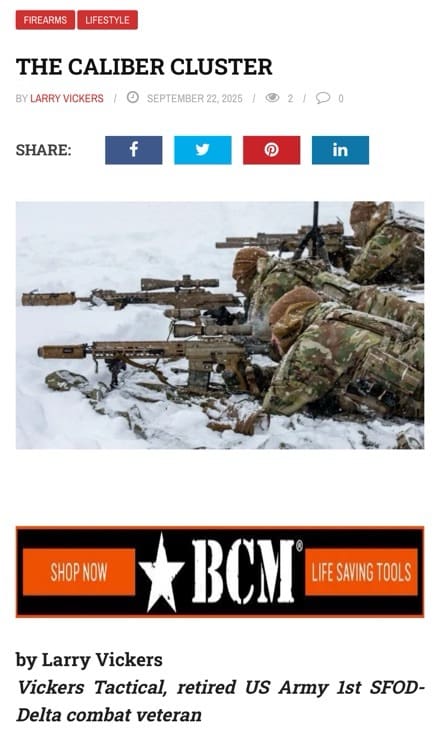
Alright, folks, let’s dive into the absolute train wreck that is the U.S. military’s small arms and ammo situation, specifically with the Army and Special Operations Forces (SOF), and why the current mess of guns and calibers is a logistical nightmare that’d make even a seasoned logistician’s head spin.
We’re talking a situation so convoluted it makes the Germans’ multi-caliber chaos in WWII look like a well-oiled machine. And trust me, that’s saying something.
General Omar Bradley is credited with the saying “Amateurs study tactics; professionals study logistics,” and that hits the nail on the head here. In war, logistics is king. You can have the fanciest tactics and the slickest operators, but if your supply chain is a dumpster fire, you’re done. Interoperability—ensuring your weapons and ammo work seamlessly across units—is critical to keeping the fight going. Right now, the Army and SOF are juggling so many calibers and platforms if they don’t reel them in soon they will have serious problems in any prolonged conflict.
The Caliber Cluster
Let’s run through the ammo mess. The U.S. military is fielding a ever growing number of calibers, each with its own quirks, supply chains, and compatibility issues. Here’s what we’re dealing with, based on my own digging:
5.56x45mm NATO: The bread-and-butter round for the M4 and M16 platforms. It’s lightweight, allows soldiers to carry a ton of rounds (standard combat load is about 210 rounds—seven 30-round mags), and it’s been the standard since NATO adopted it in 1980. But it’s got issues: limited stopping power and range, especially against modern body armor. Stories from the field, like in Afghanistan, have guys dumping multiple rounds into targets with minimal effect unless you hit something vital.
7.62x51mm NATO: The old-school heavy hitter, used in everything from the M14 to modern designated marksman rifles like the M110. It’s got range and punch but weighs a ton compared to 5.56mm—about half as many rounds per soldier due to the weight. Still in use for machine guns like the M240 and sniper platforms, but it’s a bear to hump around.
6.8mm (XM1186): The Army’s new darling, part of the Next Generation Squad Weapon (NGSW) program with SIG Sauer’s MCX Spear (NGSW-R) and MG 6.8 (NGSW-AR). Designed to split the difference between 5.56mm’s portability and 7.62mm’s lethality, it’s supposed to offer better range and terminal ballistics. Problem? It’s a whole new supply chain, and the Army’s betting big on it replacing both 5.56mm and 7.62mm. Good luck with that transition in a war zone.
6mm ARC: This one’s a niche player, primarily tied to the Surefire MGX gun that Delta Force is reportedly messing with. It’s a lightweight, high-performance round for long-range shooting, with better ballistics than 5.56mm but less recoil than 7.62mm. Sounds great, except it’s another caliber to stock, and reliability issues with the larger case diameter have been noted.
6.5mm Creedmoor: SOCOM’s been hot on this one for a while, with new rifles like the Mid-Range Gas Gun-Assault (MRGG-A) and machine guns like the FN Mk 48 Mod 2. It’s got better range and accuracy than 5.56mm, less weight than 7.62mm, and is seeing use in designated marksman rifles and now machine guns. The Secret Service is even sniffing around it to replace their M110s. But again, another caliber, another logistics headache.
Others in the Mix: Let’s not forget .300 Blackout, used in SIG Sauer’s MCX Rattler for SOF close-quarters work. It’s got subsonic options for suppressed shooting and mimics 7.62x39mm ballistics in short barrels. Then there’s .338 Norma Magnum, which the Army’s eyeing for long-range machine guns to outrange the M240. And don’t get me started on the 9mm for pistols and submachine guns or the .50 BMG for heavy snipers like the Barrett M82. Each of these adds another layer of complexity.
This isn’t just a list; it’s a logistical disaster. Every caliber needs its own ammo production, shipping, storage, and distribution. In a high-intensity conflict, you’re begging for shortages, mix-ups, or units stuck with the wrong rounds. The Germans in WWII had a mess with captured weapons and mismatched calibers, but at least they had the excuse of desperation. We’re doing this to ourselves.
The Guns: A Hardware Nightmare
Now let’s talk platforms. The Army and SOF are running a gun show with so many rifles. Here’s the rundown:
M4/M4A1 Carbine (5.56mm): The workhorse of the Army and SOF, with the M4A1’s full-auto capability and SOPMOD kit (rails, optics, lasers) making it versatile. It’s reliable, lightweight, and proven, but the 5.56mm round’s limitations are dragging it down. SOF units like Delta and SEALs still use it, but they’re supplementing with other options.
HK416 (5.56mm): I personally assisted in developing this rifle for Delta Force so yeah, I’m partial to this one, it’s essentially an M4 with a gas piston system for better reliability in harsh conditions. It’s replaced the M4A1 in some SOF units and is used by over 20 nations’ special forces. It’s a stud, but it’s still 5.56mm, so same range and stopping power issues.
SCAR-L (Mk 16, 5.56mm) and SCAR-H (Mk 17, 7.62mm): FN’s modular platform was supposed to solve the caliber debate by letting operators swap barrels and bolts. In practice, it’s a step up from the M4 but heavier, and SOF units love the flexibility. Problem is, it’s another system to maintain, and the 7.62mm version is a beast to carry.
KAC M110 SASS (7.62mm): Knight’s Armament’s semi-auto sniper rifle. It’s accurate but has reliability issues—rounds flying off target by eight MOA or more in some cases. Operators loved its predecessor, the SR-25, but the M110’s been a letdown for some.
HK M110A1 (7.62mm, 6.5mm Creedmoor): A newer semi-auto sniper system based on the HK G28. It’s part of SOCOM’s push to replace older 7.62mm sniper rifles with 6.5mm Creedmoor for better range and less weight. It’s solid but, again, adds another caliber.
Geissele SOF Gun: This is likely the Geissele Super Duty rifle, a high-end AR platform used by some SOF units. It’s 5.56mm, built like a tank, and tricked out with top-tier components. Great for close-quarters, but it’s still tied to the 5.56mm’s limits.
Surefire MGX (6mm ARC): Delta’s experimenting with this lightweight rifle for long-range engagements. It’s cutting-edge, but the 6mm ARC’s reliability issues and niche status make it a risky bet for widespread adoption.
SIG Sauer MCX Spear (6.8mm): The Army’s NGSW-R, meant to replace the M4. It’s a beast with better ballistics, but it’s heavier, and the 6.8mm round means a whole new ammo pipeline. The MG 6.8, the light machine gun version, is also part of this program. Early feedback is promising, but scaling this across the Army is going to be a logistical beast.
FN Mk 48 Mod 2 (6.5mm Creedmoor): SOCOM’s new “assault” machine gun, offering better range than 5.56mm M249s but lighter than 7.62mm platforms. It’s a step toward standardizing 6.5mm Creedmoor in SOF, but it’s yet another system to support.
Why This Is a Train Wreck
Here’s the deal: every new gun and caliber adds complexity. Different parts, different maintenance, different training. In WWII, the Germans struggled with a hodgepodge of captured weapons and calibers, which screwed their logistics when supply lines got tight. We’re doing the same thing, voluntarily.
The Army’s pushing 6.8mm as the future, but SOF is playing with 6.5mm Creedmoor, 6mm ARC, and .300 Blackout, while still relying on 5.56mm and 7.62mm. That’s five major rifle calibers, not counting pistol or heavy rounds. In a prolonged conflict, good luck keeping everyone supplied without cross-unit cannibalization or ammo shortages.
SOCOM’s agile acquisition process is a double-edged sword. They can field new toys fast—6.5mm Creedmoor rifles, .300 Blackout Rattlers—but it creates a patchwork of systems that don’t play nice together. The Army’s NGSW program is trying to streamline things, but it’s years from fully replacing the M4 and M249, and the transition’s going to be messy.
Meanwhile, SOF’s modular platforms like the SCAR are cool but heavy, and the M110’s reliability issues show what happens when bureaucracy rushes a system into service.
Fixing the Mess
If I were king for a day, I’d tell the Pentagon to pick a lane. Standardize on two calibers max for rifles—say, 5.56mm for close-in work and 6.8mm for everything else—and phase out the rest over a decade. Push modularity like the SCAR but simplify the platforms. One rifle, one machine gun, interchangeable parts, done. SOF can keep their niche toys like the .300 Blackout for covert ops, but the big Army needs to stop chasing shiny objects. And for the love of all that’s holy, test these systems to death before fielding them—no more M110-style flops.
The Germans learned the hard way in WWII that too many calibers kill your supply chain. We’re not there yet, but we’re flirting with disaster. Logistics isn’t sexy, but it wins wars. Time to stop playing gear tickler and start thinking like professionals.
Let’s take a page from our grandfathers’ book. The U.S. “Green Machine” in WWII—the only country to fight and win on two fronts did it with just four main calibers: .45 ACP for pistols and submachine guns, .30 Carbine for the M1 Carbine, .30-06 for rifles like the M1 Garand and BAR, and .50 BMG for heavy hitters like the M2 Browning. Four calibers, that’s it. No fuss, no muss. They supplied entire theaters—Pacific and Europe—without the logistical nightmare we’re building today. Those boys didn’t need a dozen rounds to get the job done; they standardized, simplified, and steamrolled. We could learn a thing or two.
LAV out
If you like whether you’ve read, LAV has a regular column over at Firearms Fridays.
Thanks, LAV! The problem, as I see it, is a lack of strategy and how that’s affecting everything down stream. The reason the Marines seem to have small arms under control is that they have a clear pair of strategies that they are working toward. EABO and the Three-Block-War dictate that tail reduction, broader versatility with capability pushed down as far as possible. It’s hard to argue with the M27/38in 5.56 if those are your goals.
Hopefully the charges the ATF levied against him has been dropped or reduced in scope.
Didn’t India win a 2 front war in 1971
Finally, it had to be said.
Hard agree. NATO standardisation is a thing for a reason.
Good points. And the argument can continue – all the various loads of 7.62 for example. So often snipers told me they couldn’t train in the LFX because they didn’t have M118, “if we use de-linked 240 ammo it will destroy our M110s”
No dope for M80
So, countering the dependance from 1 or 2 suppliers or manufacturs is a disadvantage?
My knowledge is that, the armsmarket (white, gray or black) is corrupt to the bone. By its very nature.
Public investigation is just to comb out the not so smart, poor, not (enough) connected ones.
I have no illusions.
The military hasn’t faced LSCO for decades. Note 77.5% of combat casualties in Ukraine are caused by fragments and blast (arty & drones), roughly 15% by mines, and only around 2-3% by small arms.
The small arms eval systems do not take a holistic weighing of value. How far and fast can a platoon move with a suitable organic volume of fire while engaging dynamic targets through varied terrain. Urban, woodland, jungle, steppe, etc.
I’d wager a platoon running through realistic multi-day scenarios (against moving robots) with 5.56 URG M4’s and red dots or LVPO, would smoke the times and scores of a platoon with M7’s. And have more weight and cubes for the batteries, drones, and other more important items.
Weigh, basic load, and handiness of a primary weapon, defacto PDW, matters.
Indeed, weight & cubes, standardization matters in feeding the material requirements of the beast.
Partial solution, modernized steyr AUG, with the quick change barrel and assorted length and chamberings, plus NAS3 ammo.
You’re welcome.
SOCOM will always be the outlier and I think, at least to some degree, makes the problem seem larger than it really is because they get the most coverage. SOCOM buys what amounts to a handful of rifles in the big picture and now the “DoD is invested” in that caliber. I do not know the exact numbers involved when it comes to 6.5CM, Sig Rattlers, etc, etc but my guess is comparatively it’s very small. Does that mean it shouldn’t be reigned in? Yes and no, there was obviously a need for it so let the professionals choose their tools but there does need to be a cohesive goal. The people in SOCOM are smart and understand their own logistics problems for their unique operations and in support of large scale, conventional forces I would see them adjusting their loadouts accordingly.
6.8/NGSW is here to stay and outperforms 7.62 in pretty much everything. 7.62 has soldiered on long enough and can start to be phased out. We have mountains of it (7.62) stockpiled so it’ll be around for some time however and that’s fine, it’s still a capable round obviously.
My personal opinions of 6.8mm as a general issue cartridge aside, Big Army is trying to standardize but at the expense of interoperability with other services and to a lesser degree of concern, NATO. The long game is to get the other entities to acquiesce based on budgetary constraints. Right now is the transition period and you’d expect such a cluster.
If you’re putting 6.8mm at all levels of small unit automatic riflemen and platoon machine gunners then a more capable MG replacement is warranted for weapons platoons. Is it 300NM or something else, I don’t know, but they already exist and bring enhanced capabilities so let’s go all-in. Give us a better tripod too however…
Bonus commentary…Given NGSW advancements in cartridge design and capabilities there may be performance left to wring out of the legacy 5.56 (given a newly designed upper of course) that will “up gun” the soldier while preserving current TTPs and corporate knowledge of how we fight from the last 60yrs with M16s and M4s. Given
Two partial solutions…
Steyr AUG modernized and NAS3 cartridges.
Scar-L? Who is still using the Scar-L? I thought that was put aside years ago.
Regarding calibers and weapons, the onus is on the unit to maintain its own logistics. It’s not like special ops teams are all hard hitting trigger pullers anymore, they are filled with admin and support persons as well.
Lastly, bringing the Germans into it is unrealistic. You can’t compare run down losing war Germany to the modern US military. Heck, it’s not realistic to compare them to a couple years before they started getting bombed. I understand what you are trying to say, but it’s not apples and oranges in my mind.
Don’t comply with 5.56. It’s a king. Light, small and low recoil, flat trajectory, easy to train people with, cheap.
Body armor penetration not needed (if it is, use AP round with tungsten penetrator). 6.8 and 7.62 also do not penetrate with standard projectile.
Stopping power it’s not the best but it’s enough (it kills so many until now). If needed more, use a different projectile. For stopping power standard projectile can be problematic (M855/M855A1). Use standard HPBT projectile and it works (Mk262).
There is also a new alloy case being developed for higher pressure. Fires a projectile much faster. Use these in M4ish (best rifle period) and that’s it.
LAV good article.