

A few weeks ago I put out a plea to industry to not use Artificial Intelligence Large Language Models to create press releases. Something happened the following week which really lit a fuze under me. Not long after, something happened which made me double down.
I was attending SOF Week and happened across a company specializing in AI. Why they use it in an entirely different way than LLMs, I shared the story of running across a PR so egregious that I created my post. A little laugh was had by all.
Not long after, I received that very company’s PR for the show. It was even worse than the one that had set my jaw the week earlier.
I headed back to the booth and as I walked up the head of Marketing knew exactly why I had returned. I showed them the PR and what the back end looked like.
It had been written by their Public Relations Agency and the company I was speaking with contacted that agency to inquire about their product. I too emailed the representative who had sent me the PR to inquire as to whether AI had been used and included a screenshot of the HTML version of the PR in question which was an absolute hot mess.
That evening I received this reply.
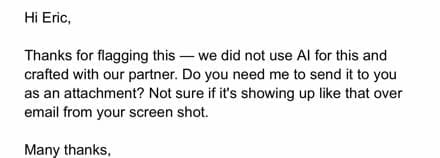
When I read the reply I let out a loud curse. Those of you who have to deal with slop know why.
You see that extra long dash in the email? That’s called an “emdash” and nobody on this planet uses that damnable punctuation mark except for AI. For some reason it’s so insidiously embedded in AI that if you tell an LLM not to use it, it will go back to it very quickly. You see an emdash, it’s 99.9% AI derived slop.
To summarize, I send out an inquiry as to whether or not a document was written using an LLM and the reply I received denying its use was either written using AI, or was a serious prank. Pretty bold move.
The next morning, I returned to the company the PR had been written about to discuss the issue with their head of marketing. Initially, they did not know the significance of the use of the emdash. They then made me privy to an email written in response to their inquiry with their PR agency. That email disclosed that they had indeed used AI to assist in creating the PR. This was at odds with the assertion I had received from my POC.
I don’t like being lied to. I am in my late 50s and the father of six children, I know when someone is BSing me. At that moment, I made a decision to no longer accept any PR submissions from that particular representative, no matter where they went to work, and from that PR agency in general.
I’m not going to throw them under the bus publicly, but hopefully they read this and are ashamed knowing that I’ve got their number.
As for other agencies out there, it’s OK to use an LLM to conduct research or to assist with grammar and readability. But don’t let it do all of your work for you.
Customers read the slop and know that it’s junk. AI agents scour the web, searching for slop and let search engines dough to avoid recommending websites that are full of slop.
While these posts on my concerns regarding the misuse of AI are to a certain degree tongue in cheek, some of you might have missed two Easter eggs in the title. The first is the use of emdash in the title and the second is that rather than adopting the Roman numeral for Two as I would normally, I chose to use “Deux” as in “Hot Shots: Part Deux.” I figured I might as well lean into the dumbing down of America and use a protocol even a member of Congress could get right. Didn’t anyone to think it was part 11, you know.
Now, for the ultimate irony, I used Grok to create the image.
Oddly enough, one firearms-oriented publishing house absolutely _loves_ the em dash and the en dash. Their writer’s guide praises their use at length. However, they would be appalled if someone accused them of publishing AI Slop.
Sad thing is the em-dash has legitimate uses, but because so many LLMs overuse it and misuse it, like in the example, using it at all is likely to get your writing labeled ‘AI slop’.
I’ve used em dashes professionally for nearly 18 years and have always appreciated their ability to create emphasis, insert explanatory information, or alter the flow of a sentence in ways that commas and parentheses cannot. Their use is recognized by the Associated Press Stylebook and numerous other professional style guides, making them a legitimate and well-established editorial tool. In my case, their use is not a product of artificial intelligence but of editorial training and long-established writing conventions. Like any punctuation mark, the em dash is most effective when used intentionally and sparingly.
If you see them in press releases I submit (and have submitted for many years) please don’t throw them out due to suspicion the PR is AI-generated. Pretty please and thank you.
Automatic delete on emdashes at this point.
Emdashes are definitely used in human communication.
So rare as to be completely avoidable.
I’ve been a graphic designer for 40 years, and designed over a 100 typefaces.
I’m a certified, red-blooded human that uses en and em dashes all the time.
They have a place in well crafted visual communication design.
This is the first I’m learning of their over-use in AI.
Graphic design…it looks appealing. There’s no grammar rule requiring use of the emdash or emdash. Quite frankly, I find it distracting when overused and AI overuses it. Its use by AI is well known and discussed by those who actually write for a living.
Unfortunately, everyone defending the emdash will likely be replaced by AI.