Stop by Booth #3907 from October 12-14 to request a hands-on demonstration and explore VIPR’s capabilities with a Wilcox Industries team member.


Stop by Booth #3907 from October 12-14 to request a hands-on demonstration and explore VIPR’s capabilities with a Wilcox Industries team member.
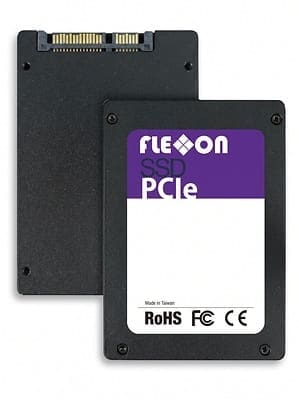
As major semiconductor manufacturers continue transitioning away from legacy NAND technologies, aerospace and defense manufacturers face a fundamentally different challenge than commercial electronics companies. Platforms with 10, 15 or 20-year lifecycles cannot simply redesign every time a storage component reaches end-of-life.
Through its relationship with Flexxon, World Micro can help customers address this challenge with storage solutions designed around long-term availability, fixed-BOM support and continued production of legacy formats. Aerospace and defense organizations evaluating NAND obsolescence, upcoming redesigns or long-term storage requirements are encouraged to engage World Micro early to explore available Flexxon solutions.
“For aerospace and defense customers, component availability isn’t simply a procurement issue—it can become a program continuity issue,” said Vladimir Prevot, VP of Supply Chain. “Our relationship with Flexxon gives us another way to help customers plan around obsolescence and support platforms with lifecycles that extend far beyond those of typical commercial electronics.”
Storage Designed for Long-Life Aerospace Programs
Flexxon’s approach to product longevity is particularly relevant to aerospace and defense applications, where qualification requirements, redesign costs and long program lifecycles make component changes significantly more complex.
Flexxon supports customers with fixed-BOM solutions extending beyond ten years and a commitment to maintaining products while customers continue to require them. This approach provides aerospace and defense manufacturers with an alternative to repeatedly redesigning systems around changing commercial NAND roadmaps.
World Micro works alongside customers to identify these requirements early, helping pair long-term component availability with broader strategies for obsolescence management, supply continuity and lifecycle planning.
Spotlight: Flexxon Radiation-Hardened Storage
One area of particular interest is Flexxon’s RAD-HARD NAND storage portfolio, engineered for aerospace and outer-space data applications where storage devices may be exposed to demanding environmental and radiation conditions.
The portfolio includes Flexxon PCIe SSDs (HIX Series), eMMC (XTRA VII Series), and Memory Cards (FxAdv II Series). Depending on the product family, available capabilities include capacities up to 8TB, hardware power-loss protection, AES-256 and TCG OPAL data encryption, FIPS 140-2 certification, and extended operating-temperature support.
Flexxon’s radiation testing addresses several conditions relevant to space applications, including Total Ionizing Dose (TID), Single Event Effects (SEE), neutron radiation and Total Non-Ionizing Dose (TNID), alongside temperature and vacuum testing.
Potential applications identified by Flexxon include satellites, rovers, telescopes, defense and intelligence systems, weather sensors, communications infrastructure, GPS, IoT and 5G systems.
Combining Specialized Technology with Supply Chain Support
For World Micro customers, the value extends beyond access to the technology itself. World Micro combines Flexxon’s specialized storage portfolio with supply-chain expertise supporting aerospace and defense manufacturers navigating component shortages, obsolescence, long-term availability and demanding program requirements.
Together, the companies provide customers with another option for addressing a question that is becoming increasingly important across long-life programs: How do you design today for technology that still needs to be available years—or decades—from now?
“Flexxon’s long-lifecycle philosophy aligns extremely well with the customers World Micro supports,” added d Dan Ellsworth, President & CEO. “When a platform has to remain operational for decades, continuity matters. We want to help customers identify technologies and supply strategies that can support the full lifecycle of their programs.”
Learn More
To learn more about Flexxon’s radiation-hardened storage solutions or discuss long-term storage requirements for an aerospace or defense program, contact World Micro at info@worldmicro.com.
On this date in 1993, an event occurred which would forever transform US Special Operations. The Battle of Mogadish was fought by a joint organization named ”TF Ranger” deployed to Somalia in support of a UN-led humanitarian mission. Their mission was to dismantle an armed militia led by General Mohamed Aidid which was threatening that aid program.

By October 3rd, the Task Force had several raids, but the events of tahtvday would be unlike anything they had yet experienced. The mission was to capture key leaders of the Aidid Militia in the city’s Olympic Hotel who had been opposing UN efforts to feed the locals.

Unfortunately, during the exfil portion of the raid, a battle ensued which claimed the lives of 18 Americans and wounded another 73. Additionally, CW3 Michael Durant was captured by the Aideed militia after being shot down while piloting his Blackhawk. Fortunately, Durant was later repatriated and went on to retire from the 160th.

Of the men killed that day, two would be awarded the Medal of Honor, Delta Operators Gary Gordon and Randy Shughart, for their selfless efforts to protect Durant after his aircraft, callsign Super 64, was shot down.

A few years ago, the US Army reevaluated the awards presented to the participants of that battle and amongst the Ranger element, upgraded 60 veteran’s awards including 58 Silver Stars and two Distinguished Flying Crosses. The order of battle included other organizations and their Soldiers have received similar upgrades.
If you are unfamiliar with the events, one of the best accounts of the battle is contained in the book, “Blackhawk Down” by author Mark Bowden. Much of the information was serialized prior to the book’s publication in the Philadelphia Enquirer. Later this was made into a movie bearing the same name.
Please take a moment to remember these men and their sacrifice.
Additionally, the 75th Ranger Regiment was created on this day in 1984, along with the stand up of its 3rd Battalion. Four decades later, the Ranger Regiment boasts five battalions of some of the most elite warriors on the face of our planet.
American Rheinmetall’s Maine production facility will manufacture and upgrade thousands of MK93 enhanced softmount systems under a new order supporting U.S. Army requirements through defense contractor ADS Inc and the Defense Logistics Agency. Deliveries are scheduled to begin in 2026 and continue through October 2027.
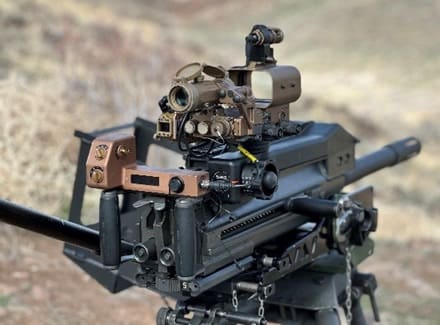
The order includes production of 3,104 new MK93 enhanced softmount systems as well as upgrades to 245 previously delivered mounts, bringing all systems to the current configuration. The total order value is $20.7M (€ 18.05M).
The MK93 enhanced softmount provides a stable, durable, and mission-ready mounting solution for crew?served weapon systems. Its design supports reliability, configuration commonality, and long?term sustainment, ensuring U.S. forces have equipment aligned with modern operational requirements. The program underscores American Rheinmetall’s ongoing commitment to U.S. defense customers through domestic manufacturing and sustainment capabilities.
This order also reflects the strong engagement and support from Sen. Susan Collins, R-Maine, who continues to champion defense manufacturing initiatives in Maine. Her collaboration helps reinforce the importance of sustaining critical industrial capabilities that directly contribute to U.S. force readiness. “American Rheinmetall’s skilled employees in Biddeford are continuing our state’s tradition of manufacturing high-quality, reliable equipment for America’s service members, and I am proud to support their important work,” said Senator Susan Collins. “The Army’s purchase of more than 3,000 weapon mounting systems is welcome news for the York County economy and demonstrates the critical role Maine workers play in our national defense.”
“This award reflects the confidence our U.S. defense customers place in American Rheinmetall to deliver reliable, mission-ready solutions that support the operational needs of U.S. forces,” said Michael Thibault, Director of Business Development, American Rheinmetall. “Our Maine facility takes great pride in producing and upgrading these systems, ensuring they are ready for the demands of today’s missions.”
The order strengthens American Rheinmetall’s role within the U.S. defense industrial base and aligns with broader industry priorities including modernization, standardization, and domestic production. Additional follow?on orders are anticipated, with specifics to be confirmed at a later date.
American Rheinmetall continues to support U.S. defense programs with U.S.-produced weapon system components and sustainment solutions. The MK93 enhanced softmount is also available for commercial sale to eligible customers, subject to applicable regulations and export controls.
About Rheinmetall in the U.S.
The Rheinmetall family of U.S. companies includes American Rheinmetall in Auburn Hills, MI (HQ); Biddeford, ME; Lansing, MI; Lapeer, MI; Plymouth, MI; St. Marys, OH; and Vienna, VA, as well as American Rheinmetall Munitions in Camden, AR; Texarkana, TX (Expal USA); Vienna, VA (HQ); and Windham, ME.

WASHINGTON — About 97 percent of Soldiers have taken the Neurocognitive Assessment Tool assessment, helping medical professionals combat the effects of blast overpressure and low-level blast exposure, the Army’s top leader overseeing safety and occupational health said.
“It demonstrates our commitment to cognitive safety, medical readiness and warfighting capability,” said Assistant Secretary of the Army for Installations, Energy and Environment Jordan Gillis.
The War Department established NCAT as a required cognitive baseline assessment to monitor and track Soldier brain health and support recovery of traumatic brain injuries.
Soldiers in impacted career fields, including those operating heavy weapons systems such as field artillery, combat engineers and explosive ordnance disposal technicians, must take the assessment under a War Department directive.
Troops in these fields must take the NCAT upon entering the military, before deployment and following an injury or suspected concussion. The Army requires Soldiers in high-risk military occupational specialties to complete the assessment annually and for all Soldiers to take the test every three years.
According to studies published by the National Institutes of Health, continuous exposure to blast shockwaves has been linked to TBI.
Gillis, as the Army’s Designated Agency Safety and Health Official, or DASHO, oversees the Army’s safety and occupational health program.
The NCAT is just part of a broader overpressure program that the Army will soon publish in a service wide directive, Gillis said. The core tenets of the program include hazard assessment, risk assessment and exposure tracking, risk mitigation, cognitive monitoring, information management, illness and injury reporting, and training and education.
The Army identified blast overpressure and low-level blast exposure as critical occupational safety and health hazards.
“It affects everyone differently,” Gillis said. “The takeaway is we are trying to take care of Soldiers and monitor their health. And if there is an impact, we’ll be able to treat them.”
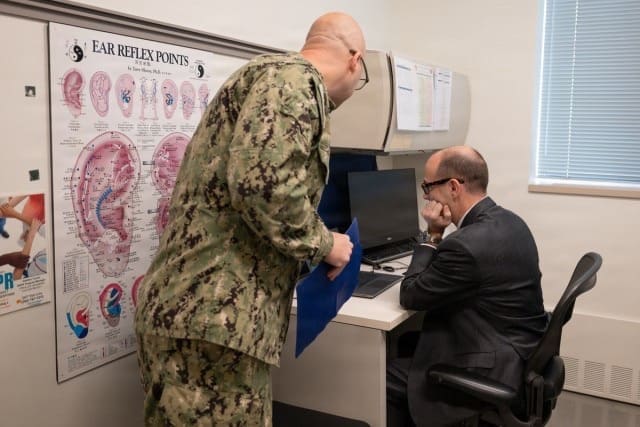
Soldiers from across the force on active duty and in the Army National Guard and Army Reserve must complete the NCAT; they began taking it in 2024. To further set an example for Soldiers, Gillis took the NCAT test himself at the Pentagon Special Missions Auxiliary Clinic on Sept. 18.
“This was the perfect time to be wearing both my DASHO hat and my Army Reserve hat and to meet the requirement that I have in the Reserve but also set the example for everyone across the force,” he said.
Gillis, a lieutenant colonel in the Army Reserve, serves as a field artillery officer, which places him in the high-risk category for blast overpressure effects.
During his years on active duty, he suffered injuries while deployed in support of Operation Enduring Freedom, for which he received a Purple Heart and a Bronze Star Medal. He knows firsthand the impact of exposure to heavy weapons firings and improvised explosive devices.
“I am from the era of Soldiers who grew up in the height of the global war on terror, and many of us were exposed to blast overpressure through things like IED attacks,” Gillis said. “I myself experienced several IED attacks, and so I believe from personal experience that this is important to do.”
Gillis said managing Soldier cognitive health and preventing potential traumatic brain injury and side effects remains a top readiness priority.
“[The NCAT] is an important part of taking care of Soldiers, but what this does is, it sets a baseline for reaction times and for memory,” he said. “By establishing a baseline for all Soldiers, we’re able to monitor brain health, as well as … let medical providers help with treatment, if required.”
By Joe Lacdan, War Media Activity
As part of the NanoLink project, Pierburg Pump Technology GmbH, a subsidiary of the Rheinmetall technology group, will be receiving funding at its Hartha site (Mittelsachsen district) for the development of innovative production processes for the manufacture of high-performance NanoLam™ capacitors. The project is co-financed by the European Regional Development Fund (ERDF) and tax revenues, based on the budget approved by the State Parliament of Saxony. In total, the site will receive funding of around 1.5 million euros from the Sächsische Aufbaubank (SAB).
The NanoLink project focuses on the research and development of innovative production processes and analytical methods used in the manufacture of intermediate circuit capacitors based on NanoLam™ technology. This is a key technological component which, owing to a wide range of technical advantages over the current state of the art, will be used, amongst other things, in next-generation electric powertrains.
The first European demonstration facility for the manufacture of NanoLam™ capacitors is located at Pierburg Pump Technology GmbH in Hartha, Saxony. Unlike conventional capacitors, dielectric layers in the sub-micrometre range are produced here from thermosetting plastics, with the innovative manufacturing process forming the technological basis. The finished product stands out from established polypropylene film capacitors due to their compactness (capacitance density), lower weight for the same capacitance, higher temperature resistance, dielectric strength and thermal conductivity. These properties and performance characteristics open up applications in the field of electromobility that cannot be achieved with conventional capacitor technology.
As part of the NanoLink project, the individual process steps involved in the manufacture of NanoLam™ capacitors are being systematically further developed for large-scale production. With the clear aim of making this technology available to the wider market, the focus is on cost-effectiveness, energy efficiency and automatability, without compromising on quality and reliability.
In addition to Pierburg Pump Technology GmbH, the project partners include AKON GmbH in Geringswalde, Chemnitz University of Technology and the Laserinstitut Hochschule Mittweida (Laser Institute at University of Applied Sciences Mittweida). The NanoLink consortium brings together extensive expertise in the necessary research and development areas. This interdisciplinary approach ensures that the best possible technologies and processes are integrated into the production process planned for the future. This not only helps to strengthen the domestic economy, but also increases resilience in the value chain and positions Germany as a key player in the global production of components for electric mobility. The success of the NanoLink project will drive forward not only the German but also the European automotive industry. Furthermore, it is expected that the introduction of NanoLam™ capacitor technology will enable a wide range of further applications across various sectors. The project, which began on 1 June 2025, will conclude on 31 January 2028.
The XRAY5 is SIG’s newest pistol optic and it packs a lot of innovation.
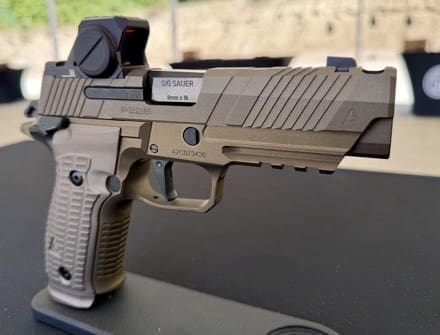
As far as I know, this is the first pistol optic with no moving parts (other than the buttons on the side). There are no internal springs or screws to fail. This is the very definition of solid state and means that they have been able to sustain in excess of 100,000 rounds in testing without failure.
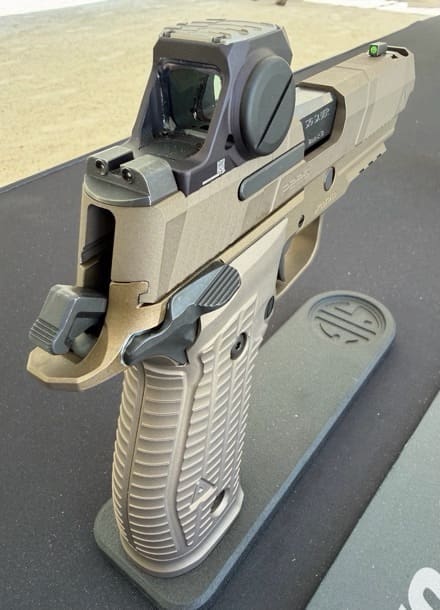
It features a 225 pixel matrix. With only one pixel illuminated at a time, the battery life is comparable to other standard point source emitter red dots.

Unlike other red dots sights, the lens is situated in the roof. This means that the front and rear glass are flat making for a clear sight path. Note the Grade 5 Ti shield on top of the sight which helps protect the lens which is beneath it.
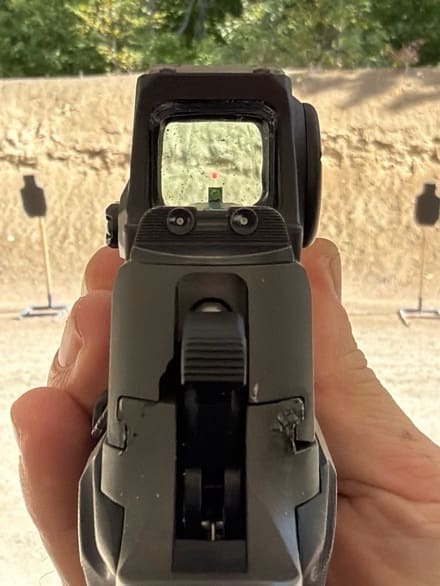
Here you can see the dot. The front and rear glass is flat and very clean.
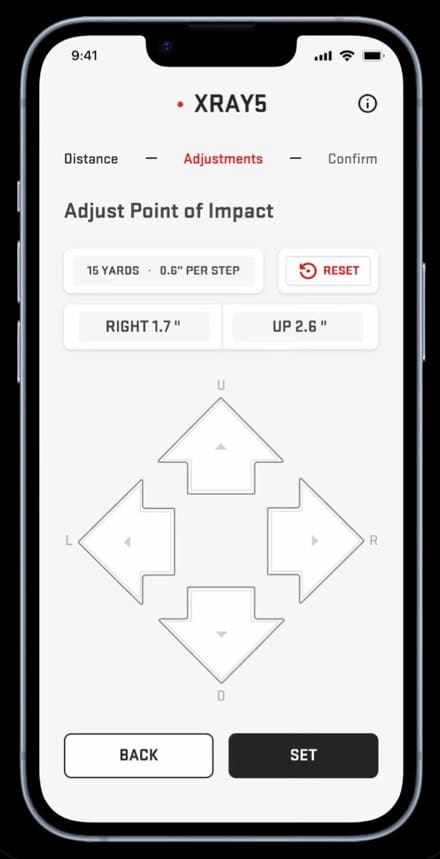
The XRAY5 is controlled through an app that can be loaded on to your phone. It facilitates a quick zero and allows for multiple zero profiles such as for ammo type or distance.
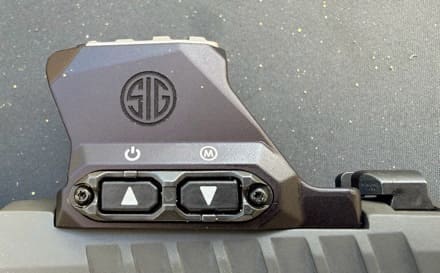
You don’t have to use the app to adjust the brightness or make changes to the zero. You can still use the buttons on the side, which by the way are the only moving parts on the sight.
SIG has also introduced a round counter function to the sight. After a couple of shots, the sight adjusts to the energy associated with a cycle of the action caused by a round being fired and will keep track after that. It can be reset if the sight is moved to another pistol. However, I believe that this as well as other features begin to make a pistol and this sighting technology a system that works together.
LightFight is another new innovation. The optic is paired with the FOXTROT2R-LF. When the weaponlight turns on, the optic automatically increases the brightness of the red dot. When the FOXTROT2R-LF powers down, the brightness of the red dot decreases.
An impressive feat is that they have submerged the XRAY5 to 4 atmospheres (132 Feet) of pressurized depth without failure or loss of zero. I’m told they could have gone deeper, but the pressure was so great that it actuated the buttons on the side. During testing they also dropped the sight multiple times from a height of 8 feet directly onto concrete without failure or loss of zero.
Between the sight and the app, they have a lot of opportunity to grow this technology. For instance, since the XRAY5 serves as a round counter, they can introduce recommended maintenance schedules to the app. Additionally, they could send an update through the app to allow a reticle to be displayed on the sight rather than a simple dot. However, this would lower battery life.
The XRAY5 will be offered in four variants:
XRAY5 Enclosed PRO
XRAY5 Enclosed Compact
XRAY5 SIG-Loc PRO
XRAY5 SIG-Loc Compact
Additionally, you’ll be able to buy these models in conjunction with FOXTROT2R LightFight weaponlight.
As far as footprints go, there are four: Shield RMSC, Delta Point Pro, SIG-LOC Compact, and SIG-LOC Pro.
www.sigsauer.com/electro-optics/red-dot-sights/xray5

FORT BRAGG, N.C. — The character of warfare is changing, and the growing use of unmanned aircraft systems on battlefields around the world is forcing militaries to adapt faster than ever.
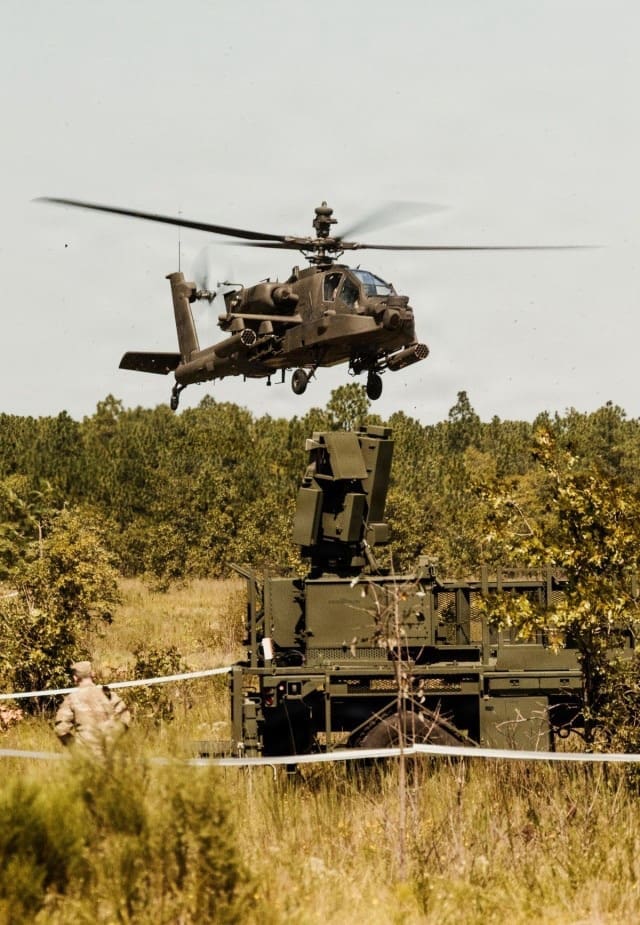
At Fort Bragg, the XVIII Airborne Corps is taking on that challenge through Scarlet Dragon, an exercise that brings Soldiers and industry partners together to test emerging technology in realistic field conditions. The exercise helped the corps evaluate which capabilities can integrate across the force, including systems designed to detect, track and defeat unmanned aircraft threats.
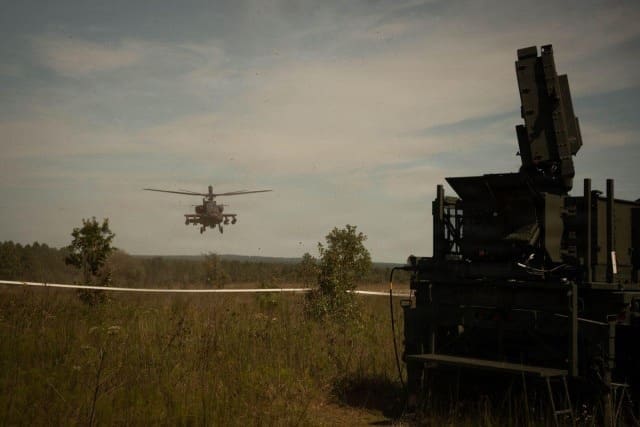
“The Scarlet Dragon exercise has become a validation exercise in the dirt with Soldiers doing integrated, real-world operational-type tasks,” said Col. Tom Monahan, director of the XVIII Airborne Corps’ Joint Innovation Outpost.
The exercise, held Sept. 11-17, 2026, at Fort Bragg, combined Soldiers, military systems, artificial intelligence, resilient data pathways and industry partners to address one of the Army’s most pressing challenges: integrating sensors, electronic warfare, command-and-control and defensive fires against evolving unmanned aircraft threats.
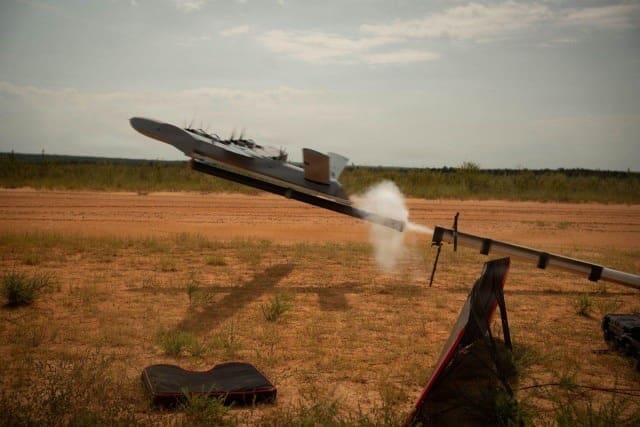
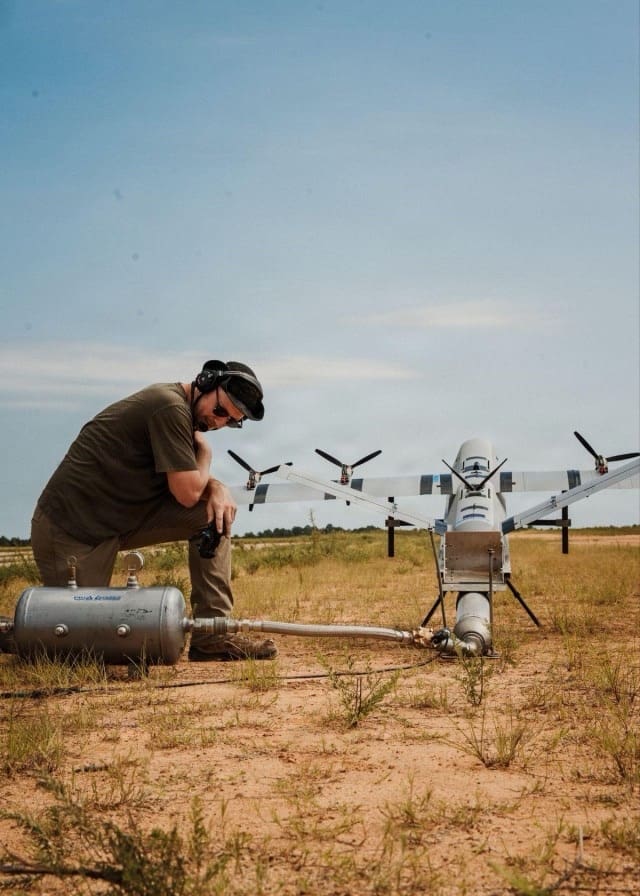
“Basically, transitioning gaps to capability requirements that we need, capabilities that will fill the gaps, and then running them through the exercise and the experimentation to come away with our findings to support the warfighter,” said Col. Paul Staeheli, the XVIII Airborne Corps operations officer.
Rather than testing technology in isolation, Scarlet Dragon places emerging capabilities in an austere field environment where Soldiers can evaluate how they perform against realistic threats and operational problems.

The exercise replicates tactics and capabilities Soldiers could encounter on a future battlefield, including large-scale drone swarms and systems modeled after threats seen in current conflicts. Some scenarios feature swarms of up to 100 unmanned aircraft, giving Soldiers the opportunity to train against the scale and complexity of modern drone attacks.
That threat environment allows the Corps to evaluate not only individual systems, but also how different capabilities work together.
“What we’ve found is that there’s no one sensor to rule them all,” said Col. Rob Kenny, the XVIII Airborne Corps chief of fires. “It takes an integrated, layered approach. Here at the company node, we’re working on: can we sense, can we make sense, and can we pass that information back to give time and space for our Soldiers to act?”

Electronic warfare, sensors, radar, autonomous systems and defensive fires each provide different tools for detecting, identifying and defeating unmanned aircraft. Integrating those capabilities is critical as adversaries continue to evolve their use of drones.
Scarlet Dragon also demonstrates how the Army can work with industry to develop and integrate new technology faster.
Leading-edge technology companies are working alongside Soldiers to identify operational problems, test potential solutions and gather feedback directly from the field. The partnership gives developers firsthand insight into how their systems perform in realistic military environments while giving Soldiers an opportunity to shape the technologies they may eventually use.
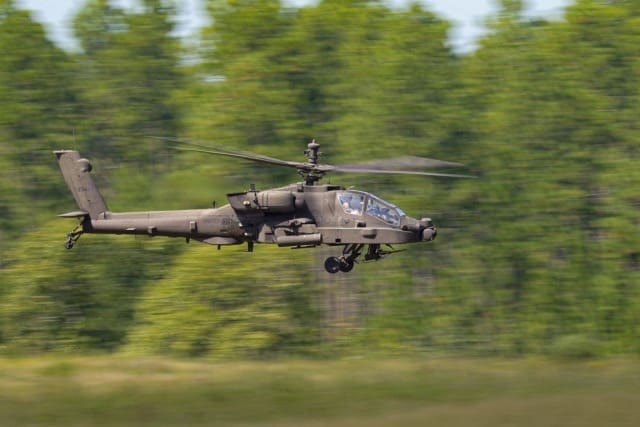
“The vendors out here are different contractors with different companies trying to show the limitations and capabilities of all their systems,” said Staff Sgt. Charles Johnson, noncommissioned officer in charge of the G34 company node. “They’re giving the full scope of what their systems can do and how it can help us in the best way possible.”
The effort extends beyond developing new equipment. The exercise examines the broader counter-UAS challenge, from passive detection technologies such as acoustic sensors and portable radar to autonomous systems and emerging capabilities designed specifically for the UAS fight.

That approach reflects the Corps’ broader responsibility as America’s Contingency Corps.
The exercise also reinforces a larger message about modernization: preparing for the future battlefield requires more than buying new equipment. It requires understanding emerging threats, testing solutions under realistic conditions and rapidly adapting when those solutions fall short.
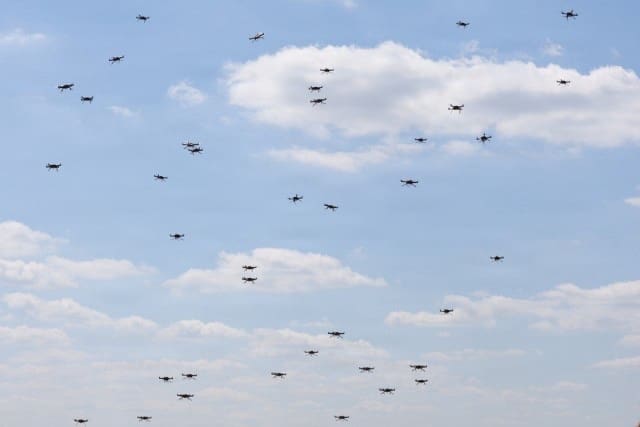
Through experimentation and collaboration with industry, the XVIII Airborne Corps is working to integrate autonomous technologies with legacy systems and address a rapidly evolving unmanned aircraft threat.
The goal is not simply to observe the future of warfare, but to prepare for it.
As unmanned systems continue to reshape battlefields around the world, exercises such as Scarlet Dragon give the corps an opportunity to learn, adapt and develop the capabilities Soldiers will need to maintain an advantage in future conflicts.
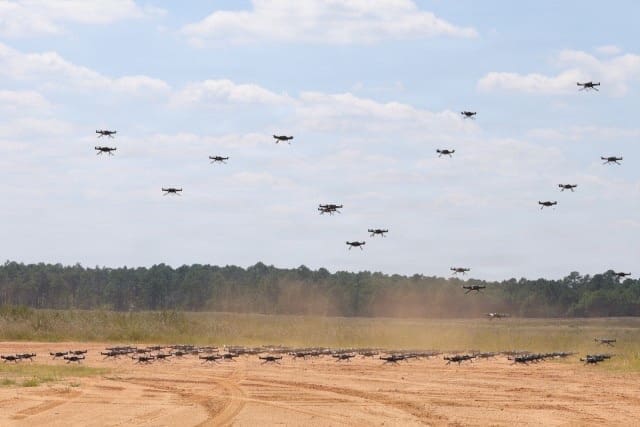
The XVIII Airborne Corps will continue to validate these systems in April 2027 during Scarlet Dragon 27-1, preparing for the larger Summit Strike exercise at Fort Drum, New York, in September 2027.
By XVIII Airborne Corps Public Affairs

















































































































