

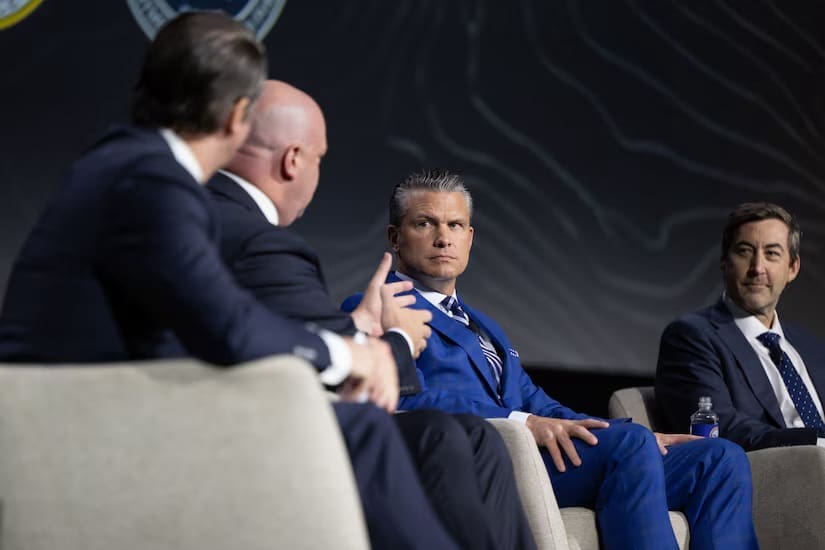
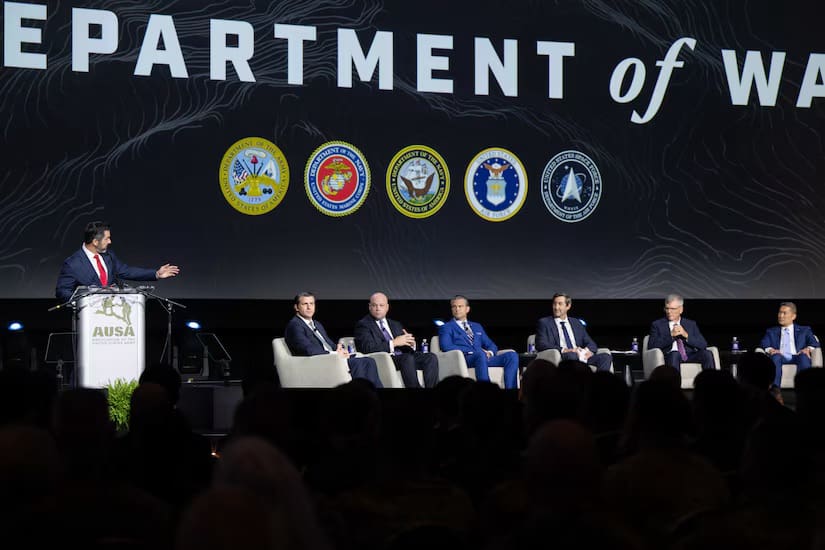
Project Agincourt as a pathway to a four-star-led Autonomous Warfare Command has always been in the cards, Secretary of War Pete Hegseth said today at the 2026 Association of the United States Army annual meeting and exposition.
Last month, Hegseth signed a memorandum detailing the creation of the short-term Project Agincourt, which is charged with laying the groundwork for creating the Autonomous Warfare Command, a new, functional combatant command that will lead the joint force in unmanned autonomous warfare.
“Project Agincourt is the end state of something we focused on since Day 1,” Hegseth told Owen West, the chief executive officer of the Pentagon’s Direct Reporting Portfolio Manager for Unmanned Systems, which leads the project.
“We started with drone dominance almost the minute we got here; [the] president put out an executive order,” Hegseth said. “We got $1 billion of funding on drone dominance, which we put straight into the hands of operators out into the field.”
The department plans to field hundreds of thousands of one-way attack systems this year, Hegseth told the audience. In coming years, he said, that’ll be in the millions.
Drones have been around for a long time, but they haven’t become inexpensive or proliferated across the force, Hegseth said. That’s partly due to the Pentagon’s bureaucracy — something that will change with Project Agincourt and, eventually, the Autonomous Warfare Command. He added that buy-in from the military services and combatant commands plays a critical role in making that happen.
“These services are not fighting us on that concept; they believe in it,” Hegseth said.
The Army, Navy, Air Force, Marine Corps and Space Force are all aiming toward autonomous warfare, and so are the combatant commands. The secretary cited U.S. Southern Command’s recently established autonomous warfare unit, as well as U.S. Central Command’s autonomous surface systems, which rescued two downed Apache pilots off the coast of Oman in June.
To advance the adoption of autonomous systems, Hegseth said, the War Department has made significant progress in modernizing the acquisition process and incentivizing industry partners.
However, he said widespread adoption and mastery of autonomous systems will come from the warfighters using those systems and with experts there to iterate on what’s happening to make them better — both of which are expected to happen with the Autonomous Warfare Command.
“This Autowarcom is what’s going to create that multidomain, that domain synthesis that you need so that, from space to what we’re doing sub-sea in autonomy, is able to work together in a contested environment,” Hegseth said.
Acting Secretary of the Army Adam Telle said just yesterday that the Army announced the creation of the Army’s Futures and Autonomous Systems Command.
“This is our way to make sure that we take all of the great work that’s been happening with the resources that we have today, and we centralize it,” he said. “We’re pushing autonomy down into our units, but when it comes to having and making sure that the left hand in the Army knows what the right hand of the Army is doing, this happens at Fascom; then Fascom feeds up into Autowarcom.”
Telle said Fascom will work with the other services to create scale for purchasing power and share best practices on autonomy.
Acting Secretary of the Navy Hung Cao said his service is now increasing its use of and investment in autonomous systems.
“In the Strait of Hormuz, we used the Corsair … to recover two Apache helicopter pilots,” Cao said. “Then, we also used the unmanned underwater vehicles to demine that area.”
That kind of work, Cao said, can’t be done in a contested area unless it’s done using unmanned underwater vehicles. The Navy is now deploying with even more unmanned systems.
“The [Theodore] Roosevelt Carrier Strike Group just deployed on Oct. 8 with a medium-sized unmanned surface vessel,” he said. “This is the first carrier strike group to ever deploy with a large-size unmanned surface vessel — and this is a force multiplier.”
Cao said unmanned vessels are easier to build and will change the nature of surface warfare because they don’t need the complex systems required to sustain personnel on board.
The Air Force has always been dominated by manned aircraft, and Secretary of the Air Force Troy Meink said it will continue to be so. However, he said unmanned systems will play a big part of the Air Force playbook now, too.
“There’s no question though that there’s a shift coming,” Meink said. “It’s adaptability, scalability and affordability; the only way we’re going to meet the threat is with autonomous systems.”
Affordability is an important consideration for the Air Force, Meink said, adding that autonomy may be cheaper than manned systems.
“We’ve got to make sure this stuff is affordable,” he said. “We’ve got to make sure we’re buying it efficiently. And depending on how you do the comparisons, we’re talking five to 10 times cheaper to field some combat power with these autonomous systems compared to not.”
Meink noted that the Air Force is already integrating autonomous fighters into experimental operations units out at Creech Air Force Base, Nevada.
“[It took] from a year from when they first flew to when we are integrating them into experimental ops units — that’s unheard of, and it only took two years to build the first one,” he added.
With those systems, Meink said, the Air Force is focused on rapid production, scalability and lowering costs.
By C. Todd Lopez, Pentagon News