XC3 Weaponlight

Archive for the ‘Department of War’ Category

Drone Dominance Program Announces Gauntlet II Results

Friday, September 25th, 2026

The Drone Dominance Program (DDP) began its competitive selection with the Qualifier, held from June 8–19, 2026, at Camp Grayling, MI. During the Qualifier, 49 drone companies competed in rigorous day and night operations across two challenging mission areas: Long Range Strike and Tactical Assault in Confined Environments. The event featured highly innovative drone designs from across the industry and set the stage for the next phase of the competition.

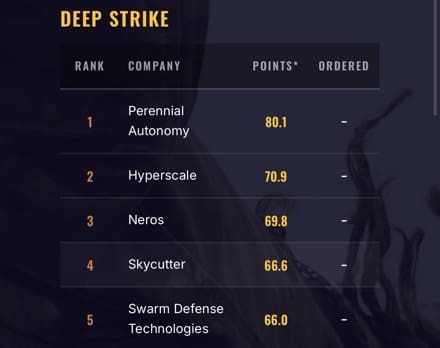
Following the Qualifier, Gauntlet II was conducted in August 2026 at Fort Carson, CO. Building on the earlier rounds, Gauntlet II missions evaluated drones on their primary find-fix-finish objectives, either at 15km stand-off ranges (Deep Strike) or in confined environments (Close Quarters Battle), with a subset of testing repeated at night. Additional test lanes assessed controlled kinetic engagement and electronic warfare (EW) performance, with drones flown against counter-UAS systems.

To qualify for Gauntlet II, all invited drone companies had to fulfill an order of 120 drones equipped with lethality payloads within about five weeks. Each company was paired with one or more lethality providers.

During Gauntlet II, companies were scored based on their performance in the event, evaluations by military operators, and demonstrated production and supply chain capabilities. At the conclusion of the competition, the Drone Dominance Program selected the Top 5 performers in both Deep Strike and Close Quarters Battle mission areas. DDP will place orders for 60,000 drones from these top-performing companies, with order quantities finalized upon contract award.

Full details available on the leaderboard.

Lockheed Martin and Department of War to Accelerate Air Dominance Missile Production Under New Agreement

Monday, September 21st, 2026

DALLAS, Sept. 17, 2026 — Lockheed Martin (NYSE: LMT) signed a framework agreement with the U.S. Department of War to rapidly accelerate the production and delivery of the AIM-260, Joint Advanced Tactical Missile (JATM).

WHY IT MATTERS

JATM is the most sophisticated air dominance missile, capable of deterring and defeating current and projected enemy air threats. This state-of-the-art weapon has increased range and effectiveness over existing air-to-air weapons and provides an asymmetric advantage to the joint force. JATM is compatible with a variety of Air Force and Navy aircraft including the F-22 Raptor and F-35 Lightning II, making it a highly versatile combat system.

EXPERT PERSPECTIVE   

“This agreement builds on years of collaboration to deliver this critical air dominance capability to the warfighter,” said Tim Cahill, president, Lockheed Martin Missiles and Fire Control. “We will deliver JATM at the speed our nation and allies demand while providing value for taxpayers and our shareholders.”

ADDITIONAL CONTEXT

Internal Investment: JATM is produced by Lockheed Martin in partnership with the U.S. Air Force and U.S. Navy. Lockheed Martin will support necessary investments to drive the production increase under this agreement. 

Multiyear Procurement: This agreement forms the foundational agreement for a multiyear procurement contract, pending Congressional approval, that provides long-term demand to strengthen and expand the defense industrial base for the program. 

Global Deterrence:  Australia recently announced a nearly $736 million investment to equip the Royal Australian Air Force with JATM. This agreement strengthens Australia’s air dominance, enhances interoperability, and provides a credible deterrent that supports the security of the United States and its allies.

Acquisition Transformation: This agreement is another direct outcome of the Department of War’s Acquisition Transformation Strategy, one of the most significant reforms to U.S. warfighting acquisition in decades. It reflects years of collaboration to modernize acquisition and deliver critical capability at the speed and scale required by today’s security environment.

DOW Hosts 2nd Interagency Summit to Strengthen Counter-Drone Defense

Saturday, September 12th, 2026

Joint Interagency Task Force 401 hosted its second interagency summit last month to accelerate cooperation against rapidly evolving drone threats.

The gathering brought together more than 200 leaders and experts from 75 departments and agencies to synchronize efforts to strengthen homeland defense against drones.  

The task force is the War Department’s premier counter-unmanned aircraft agency. Building on the momentum following the first full year since it was established in August 2025, the summit emphasized growing interagency partnerships that are rapidly delivering counter-UAS capabilities to warfighters, federal partners and local law enforcement. 

“Drones have fundamentally changed the operational environment,” said Army Brig. Gen. Matt Ross, JIATF 401 director. “To meet this challenge, we must outpace our adversaries by working together to deliver capabilities quickly. This summit is one way we are synchronizing a whole-of-government effort to secure our borders, defend the national airspace and protect the American people.” 

Discussions primarily focused on establishing a unified, cross-domain common operating picture for air traffic in areas critical for national security. Participants also took part in collaborative breakout groups focused on five key areas of counter-UAS integration for homeland defense:  

  • Major-event and critical-infrastructure preparation; 
  • Reporting, jurisdiction and information sharing; 
  • Authorities, policy and legislation; 
  • Capability access and the counter-UAS marketplace; 
  • Testing, standards and integration.  

The summit allowed participants to identify challenges, share best practices and strengthen coordination across agencies, while also highlighting innovations in the counter-UAS marketplace pioneered by JIATF 401.

It also highlighted the War Department’s efforts to transition emerging counter-UAS technologies from testing toward operational employment. The task force is conducting a directed-energy pilot program at multiple military installations to evaluate high-energy lasers, high-power microwaves and other novel technologies in an operational environment. Together, these initiatives demonstrate JIATF 401’s commitment to accelerating innovation, strengthening interagency partnerships and delivering effective counter-drone capabilities to the warfighter. 

“My charge for this summit is for each of you to walk away with specific actions to address problems,” Ross said. “We are all in this together, and it will take all of us working together to effectively counter the threat of drones and keep our warfighters and the American people safe.” 

The summit concluded with a unified commitment to maintain continuous interagency teamwork and information sharing. By aligning efforts across the department, interagency partners and federal agencies, JIATF 401 continues to cut through bureaucracy and rapidly deliver state-of-the-art counter-drone capabilities to warfighters worldwide.

By Army LTC Adam Scher, Joint Interagency Task Force 401

GPS-Free Test Flight Success Marks Critical Advance for Aviation, National Security

Wednesday, September 9th, 2026

The Defense Innovation Unit’s latest quantum sensing milestone shows aircraft can safely and accurately navigate vast stretches of ocean without relying on the same GPS that millions of civilians use to move through traffic.

The groundbreaking flight test was a success for MagNav, DIU’s magnetic navigation program, and is a critical advancement for the future of aviation and national security.

“This is a significant win for the department’s quantum sensing priorities, showcasing that MagNav capabilities are no longer a distant research goal,” said Kyle Norman, deputy director of DIU’s Kill Web portfolio. “We moved from problem sourcing to solicitation to prototype in a matter of months.”

The MagNav program launched in spring 2024 under the name “Transition of Quantum Sensing.” A total of 72 companies submitted applications to the commercial solutions opening, with Honeywell Aerospace ultimately selected to move forward with prototype development.

MagNav systems use quantum sensors to read the Earth’s natural magnetic field, turning the planet’s crust into an invisible, unjammable map that allows pilots to navigate safely regardless of weather, time of day or GPS availability.

The Earth’s magnetic field cannot be spoofed or blocked by hostile forces, Norman said. The new technology also significantly improves on legacy backup options such as radar mapping or visual cues like rivers, highways and cities.

The system was installed aboard an Embraer 170 aircraft to demonstrate real-world capabilities. The route took the aircraft over the Pacific Ocean, from Seattle’s Puget Sound to southern Alaska and back.

After four hours and 23 minutes of flying over the ocean without GPS, the MagNav system improved position accuracy by 89% compared to traditional backup navigation methods. The navigation data streamed directly to the pilots in real time via standard tablets, showing that military personnel can field the technology without a massive overhaul of cockpit instruments.

The test mission also added the complexity of the ocean surface — a featureless, constantly shifting expanse that would traditionally require internal sensors in the absence of GPS.

The problem, however, is that classical sensors drift over time. What starts as a small miscalculation can become a massive, dangerous deviation if left unchecked. By reading the Earth’s magnetic signatures, MagNav gives pilots a highly accurate, continuous map even when no visible landmarks exist.

Honeywell and DIU are preparing to demonstrate the technology on a U.S. military C-17 Globemaster III cargo aircraft later this year. By proving that aircraft can maintain pinpoint accuracy over the featureless ocean without GPS, the War Department is taking a significant step toward ensuring that military and commercial pilots can safely reach their destinations, no matter what happens to the satellite networks above them.

By Defense Innovation Unit Staff

New App Aims to Unify Military Fitness Training Across Branches

Wednesday, September 2nd, 2026

YOKOTA AIR BASE, Japan (AFNS) —  

A newly developed fitness app is giving service members across the Department of War a single tool to build training programs tailored to their fitness test requirements at Yokota Air Base, Japan, Aug. 11.

U.S. Air Force Capt. Zachary Hicks, a family medicine physician and emergency medical services medical director at Yokota Air Base, developed the app to turn fitness requirements into actionable training guidance that service members can use to improve or maintain their readiness. The app goes beyond information and offers actionable guidance that members can use to improve or maintain their fitness. It also assesses a member’s current level, builds a starting program and adjusts over time, with an emphasis on improving weaker areas.

“There are apps for individual branches but none that unify them into one app, and this was something I wanted to solve,” Hicks said.

The idea traces back four years, when Hicks set out to create a more organized, actionable approach to fitness preparation. When updated fitness standards were released this year, he said it was time to build a solution.

“If you are doing well and you want to do great, then this app will help you,” Hicks said. “If you are doing great and wish to maintain that greatness, then this app will help you retain your fitness.”

The app has continued to expand since its development. Its most recent update added guidance for pregnancy and postpartum exercise, and Hicks is now developing nutrition guidance as the next addition.

To ensure the app aligned with official standards, Hicks transcribed each scoring calculator directly from service-specific scoring charts. He also built the training guidance using publicly available military resources, including the Air Force’s Warfighter Fitness Playbook.

“I did not feel the need to reinvent the wheel, but simply made it more accessible,” he said. For Hicks, the app’s purpose is simple: give every member, regardless of branch or starting point, a clear path to becoming stronger, more prepared and ready to reach their next fitness milestone.

By Senior Airman Tallon Bratton

374th Airlift Wing

US Military Affirms SIG SAUER M17 and M18 as “Safe and Reliable”

Friday, August 21st, 2026

Results of unprecedented analysis, including inspection of nearly 114,000 pistols, “reinforce confidence and assurance” in the SIG SAUER firearm

NEWINGTON, N.H., (August 20, 2026) – Following an extensive inspection and analysis of the SIG SAUER M17 and M18, both the Department of War (DoW) and Department of the Air Force (DAF) confirmed the firearms are “safe and reliable.”

On August 7, 2026, DoW confirmed the SIG SAUER Modular Handgun System pistols, including the SIG SAUER M17 and M18, are safe and reliable, saying it underwent extensive testing where more than 1.5 million rounds were fired and “all investigated incidents of alleged ‘uncommanded discharges’ have been traced back to the trigger being pulled, and not due to an issue with the firearm.” The full DoW statement is available on the U.S. Army’s Capability Program Executive website.

Following the inspection of 113,479 M18 firearms, DAF said the results “reinforce confidence and assurance that the M18 remains safe and reliable for DAF missions.” DAF’s inspection found “100% of the inspected weapons exhibited no signs of any condition that could have allowed the weapons to experience an ‘uncommanded discharge.’” The full DAF letter dated January 23, 2026, is available at Soldier Systems.

“The U.S. military analysis further validates the technology, engineering, and performance behind the P320,” said Phil Strader, VP of Consumer Affairs, SIG SAUER. “This was an unprecedented level of inspection, extensive for both the volume of firearms analyzed and for the level of evaluation on each product. Nearly 114,000 firearms were disassembled to methodically examine individual components and reassembled for final functional testing, and the product stood up to the test.”

Following an incident in July 2025, the Air Force Global Strike Command ordered an evaluation of the M18, which is a carry version of the P320 pistol, while the M17 is a full size. The initial evaluation showed that no weapon discharges were attributable to a malfunction. Global Strike Command reinstated the M18 in August 2025, while DAF completed its inspection, which is summarized in its January 2026 letter.

For more information, visit www.P320Truth.com, a website dedicated to accurate information on the P320.

Department of War Orders Research Security Audits at 30 Academic Institutions

Tuesday, August 18th, 2026

The Department of War has issued formal notifications to 30 domestic academic institutions, directing them to initiate immediate and comprehensive reviews of their academic, financial and research collaborations with foreign entities of concern.



These notifications address active institutional ties and collaborations with foreign entities identified under Section 1286 of the FY19 NDAA, as well as organizations associated with rebranded Confucius Institutes. Executed by the Office of the Under Secretary of War for Research and Engineering, this action is designed to protect American taxpayer-funded research investments from unauthorized technology transfer, intellectual property theft and adversarial exploitation.

“The Department of War has zero tolerance for academic partnerships that compromise our national security,” said Emil Michael, Under Secretary of War for Research and Engineering. “Institutions that receive funding from American taxpayers must uphold the highest standards of research security, and these mandated audits will ensure accountability across the board.”

To maintain eligibility for future federal research funding, the notified universities must complete a comprehensive audit of all identified foreign collaborations, assess the exposure of sensitive or export-controlled research, and implement strict mitigation plans, including the termination of problematic partnerships. Institutions are required to report their findings and actions directly to the Department no later than August 31, 2026.

“Universities are critical partners in executing a wide range of Department of War research programs, and the Department must therefore ensure that our research investments are well protected from foreign exploitation,” said Dr. Joseph Jewell, Assistant Secretary of War for Science and Technology.

Through these audits, the Department of War will better anticipate emerging threats, adapt to evolving adversarial tactics and maintain America’s position as a global leader in innovation. The Department is pursuing this effort alongside partners in Congress.?Together with the House and Senate Armed Services Committees, the House and Senate Appropriations Committees and the House Select Committee on the Chinese Communist Party, the Department continues to build a robust research ecosystem that protects critical discoveries from exploitation.