XC3 Weaponlight

Archive for the ‘SOF’ Category

Ask SSD –  Were There Army Special Forces In World War II?

Saturday, September 9th, 2017

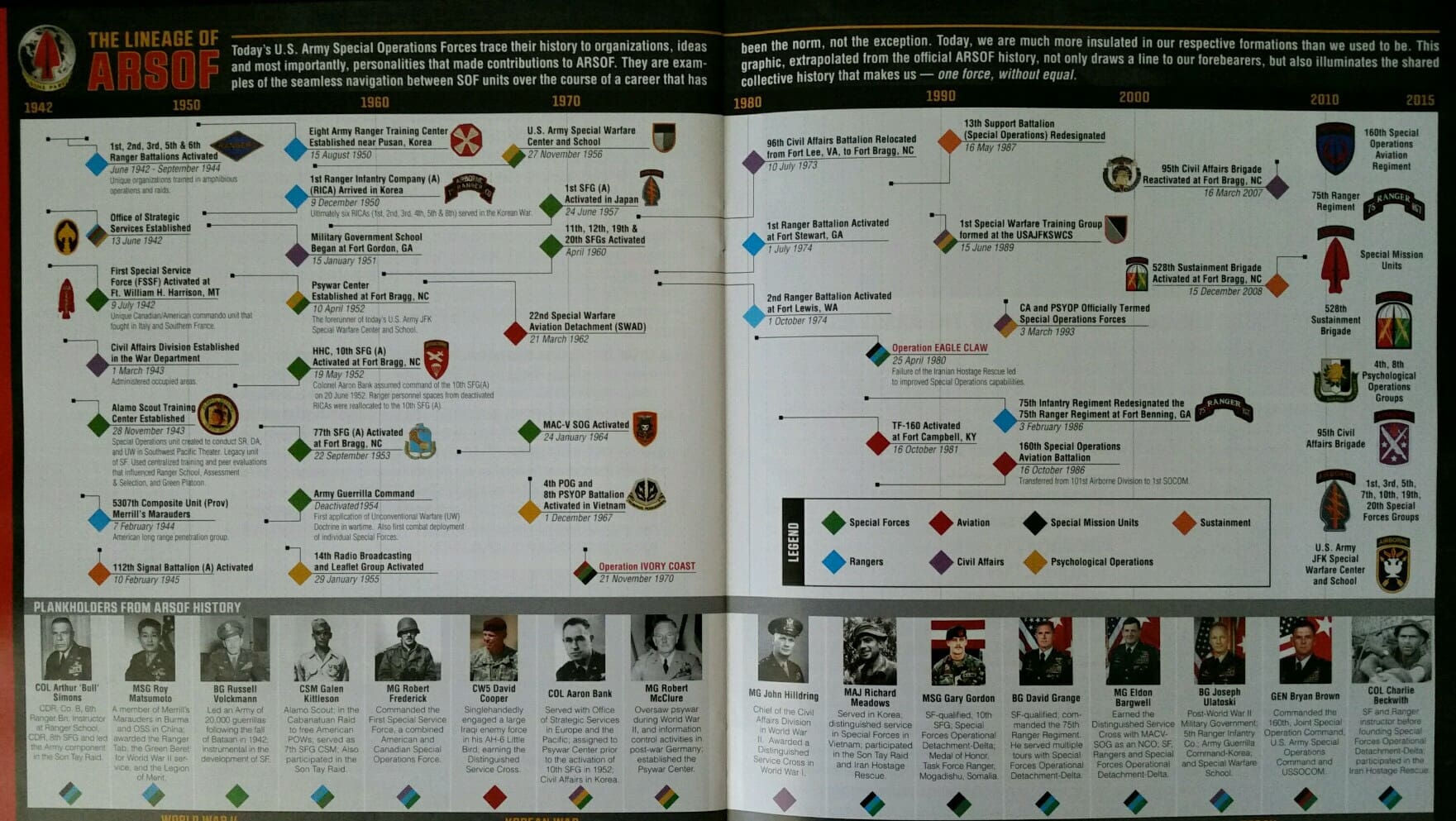
Probably the easiest way to answer this question is with a graphic, prepared by the US Army Special Operations Command.


Click on image, to see it in better detail.

Army Special Operations has a rich history. In particular, several of these organizations form the lineage of current Army Special Forces units.

Ask SSD – “Do SOF Use Whatever Weapons They Want?”

Wednesday, September 6th, 2017

The answer to the recent request for verification of whether or not Special Operations Forces are allowed to use any weapon they choose, is a very simple, “No.”

USSOCOM Seeks High Velocity 40mm Programmable Airburst High Explosive Ammunition

Monday, August 21st, 2017

The United States Special Operations Command (USSOCOM) and the PM A&W have issued a Sources Sought Notice to industry seeking sources within the national technology and industrial base for the following:

– High-Velocity 40mm Programmable Airburst High Explosive Ammunition

– The ammunition shall provide effects against multiple target sets, including enemy forces in that are in the open, standard vehicles, behind defilade, and C-UAS scenarios

– The ammunition shall be compatible with existing MK 19 and/or MK 47 High Velocity Weapon Systems

Full details are available on www.fbo.gov.

Ask SSD – How Do I Write A White Paper?

Monday, August 14th, 2017

We are often asked by various vendors for government solicitations, how they should format a white paper. USSOCOM offers this fictional white paper for its potential vendors as an example.

Entitled, “DUAL-MODE AUGMENTED CANINE TRANSPORT SYSTEM – PROJECT DUCTS”, it is referred to as “Rocket Dog”.

Feel free to use it as a template for white paper development, particularly if you’re submitting one to SOCOM. Download your copy here.

2017 Special Operations Forces Warrior Industry Collaboration & JSOC Capabilities and Technology Expo Solutions Event

Monday, August 14th, 2017

The Program Executive Office Special Operations Forces Warrior (PEO-SW) and Joint Special Operations Command (JSOC) have announced the 2017 iteration of their “Industry Collaboration Days” on 15-16 November 2017. The purpose of this event is to provide industry with an opportunity for a focused engagement with members of PEO-SW and JSOC to share ideas that facilitate the delivery of innovative capabilities to Special Operations Forces (SOF).

The Day 1 (SOFWIC) General Session on November 15th will be open to all interested vendors. The General Session will consist of introductory presentations by Special Operations Forces Acquisition, Technology & Logistics (SOF AT&L) leadership, an overview of PEO-SW war fighting commodity areas, and forecasted contracting opportunities for FY18 and beyond. Following the General Session, the remainder of the day will consist of 60 minute, invitation-only sessions for selected vendors to discuss their White Paper and/or Cooperative Research and Development Agreement (CRADA) Proposal submissions addressing SOCOM’s Capability Needs (see below).

Day 2 (JCTE Solutions Event) on November 16th will be invitation only sessions with selected JSOC industry partners who have reviewed the unclassified or classified Capability and Technology Interest Items list released in conjunction with the PEO-SW sessions at the Special Operations Forces Industry Conference (SOFIC) in May 2017 and have submitted CRADA Proposals addressing those interest items.

This is the the most up to date listing of Capability Needs, listed in priority order by commodity area:

(1) Ground Mobility
a. Drivetrain and locking differentials Ground Mobility Vehicle (GMV 1.1) – Technology that will allow for transaxle replacement to increase reliability.
b. Suspension technology (GMV 1.1) – Suspension upgrades/replacement to increase performance, durability, and reliability. Semi-active seating that ties into the upgraded suspension working together to isolate occupants from terrain induced shock loading.
c. Cost reduction solutions for brakes, suspensions, C4ISR, etc. for Light Tactical All-Terrain Vehicle (LTATV), Non-Standard Commercial Vehicle (NSCV), GMV 1.0 and GMV 1.1 – Novel approaches to reduce the lifecycle costs (namely production and sustainment) associated with braking, suspension, and other vehicular systems. Current C4ISR components (antennas, mounts, cables, etc.) are expensive and long lead in nature. We are targeting reduced costs, improved lead times, and equivalent capability to our current SOF suite of C4ISR (LoS, SATCOM, ECMS).
d. Low Cost, lightweight, rapidly attached/utilized tow bars (10k-20k lbs.) (GMV 1.1, GMV 1.0) – Quality built, sustainable tow bars that are lightweight, low cost, and rapidly attached for use on the medium family of vehicles (10k-20k lbs.)
e. Shock Mitigating seating (LTATV, GMV 1.1) – Novel approaches for LTATV seating and/or seating material(s) that will mitigate the shocks associated with off road vehicle driving.
f. Brake technology (GMV 1.1) – Brake upgrades/replacement to increase performance, durability, and reliability.
g. Visual, Audible, and Thermal Signature Reduction (LTATV, GMV 1.1) – Novel reduction approaches in addressing visual (camouflage), audible (mufflers, sound suppression), and thermal (heat dissipation/reduction) signatures.
h. Low profile Common Remotely Operated Weapon System (GMV 1.1) -Looking for small and light solutions that can utilize a wide range of weapons for a smaller tactical vehicle.
i. Mature 12 Volt battery technology for cold temp start and/or reduced size without degrading Cold Cranking Amperage or AMP hours (NSCV, GMV 1.1) – Mature battery technologies that can withstand cold start scenarios down to -50 F and also extend the timeline for silent watch. Reducing size but not performance is ideal as well.
j. Purpose Built NSCVs (Modular Purpose Built Chassis or common purpose built drivetrain for SUVs and Trucks) – Cost effective solutions for reduced logistics or to allow vehicles that are commercial in appearance to be reset at the end of the lifecycle instead of disposed of and re-procured. This would also allow different bodies to be interchanged on a common chassis to reduce logistical costs. The concept of Purpose Built is governed by the fact that vehicles are not modified commercial vehicles, but rather purpose built vehicles with little to no reliance on commercial vehicles. Vehicles are anticipated to be designed to mimic late model vehicles typically found in central Asia (e.g., Toyota Hilux, Toyota Land Cruiser 200, and Toyota Surf); armored against ballistic threats; 10 year vehicle life (minimum); vehicle designed for one or more resets; 4 wheel drive with heavy duty brakes and suspension to accommodate gross vehicle weight; full skid plates and running boards; diesel engines; and left hand drive.
k. Tire technology and non-pneumatic efforts (GMV 1.1, LTATV) – Novel approaches addressing wheel/tire assemblies to allow for better suitability in soft soils and terrains. Tire technologies to allow for a broader range of environmental terrains (sand, mud, and rock), to include non-pneumatic types.
l. Low Profile Antennas for Line of Sight, SATCOM, and ECMS (NSCV) – Antennas that can be hidden on/in/around the vehicle to appear almost non-existent while still effectively transmitting desired frequencies at specific power levels.
m. Light Vehicle Safety Improvements and Accessories (LTATV) – Improvements to general safety items to include (but not limited to): seating, roll cages, stability control, driver assist functions, etc.
n. Low Visibility Transferable Armor for commercial vehicles (NSCV) – Armor materials/panels, etc., that can be transferred and integrated from one commercial vehicle to another with minimal manpower and in a minimal timeframe.
o. Lightweight Transparent Armor (NSCV, GMV 1.1) – Novel lightweight and cost effective technologies that can replace current heavy transparent armor solutions on vehicle platforms.
p. OEM Electronic Control Unit (ECU) defeat (NSCV) – Solutions for bypasses the inherent safety controls built into OEM ECUs on FOSOV NSCVs to allow permanent disabling of features such as stability control and traction control which impedes use in a SOF environment.
q. Low Cost, High Output Alternators for NSCVs – Targeting both 12V and 28V dual alternator combinations, along with high output single 12V and dual 12V solutions. The 28VDC alternator shall have a minimum of 130A (at 28VDC) output (80A at idle) and shall fit within the current engine compartment. Any single high-output alternator shall have a minimum 260 Amp (12 Volt DC) output rating at idle and engine operating temperature of 220 degrees F. The purpose of this RFI is to determine the availability of solutions to replace the existing package within NSCVs, allowing flexibility for future growth, and to clear real estate in the engine compartment if we can achieve our requirements with a lower cost and smaller solution.

(2) Visual Augmentation Systems
a. Signature Reduction technologies for Targeting Laser (Out of Band and Notional Laser) – Laser designation technologies that are able to be perceived through typical and widely fielded Image Intensification technologies. Notional laser could exist only in virtual reality and be perceived through an integrated augmented reality display inside an eyepiece of NVG.
b. Head-mounted Devices- Looking for weight saving technologies or novel methods to move weight off of the head.
c. Hand Held Devices- Seeking size, weight, and power enhancements on handheld VAS commodities.
d. Weapon Mounted Devices Seeking size, weight, and power enhancements on weapon mounted VAS commodities.

(3) Weapon Systems:
a. Intermediate Caliber- Long Range Machine Gun 2000m- We are seeking a machine gun that has long range (2000m or greater) with weight comparable to the current medium machine gun (24lbs or less).
b. Suppressed Upper Receiver Group (SURG) – Seeking next-generation, modular upper receiver group that is interoperable with current lower receivers and is optimized for full time suppressed operation. Must have advanced heat mitigation technology to counter mirage effect.
c. Signature reduction for Small Arms- Sound, Flash mitigation technologies that are light weight and effective.
d. Advanced/Precision Sniper Rifle- We are seeking a multi-caliber platform that can shoot 7.62x51mm, .300NM, and .338NM. to sub minute of angle.

(4) Ammunition/Demolition:
a. Domestic sources of production for non-standard ammo and weapons- Seeking domestic production for weapons and ammo in the 7.62×39, 7.62x54R, and 12.7×10⁸ categories.
b. Lightweight Ammunition- Seeking ammunition that can reduce weight by at least 30% of the current inventory of common ammunition from 5.56 up to 12.7×99.
c. Toxin Free Ammo- Seeking both lead free and reduced toxin alternative to the current inventory of training munitions- Polymer Short Range training ammo, Blank fire ammunition, man- marking rounds, and short range training ammunition.

(5) Soldier Protection, Survival, and Equipment Systems
a. Armor – Novel technologies and designs that decrease weight while increasing level of protection.
b. Helmets – Novel technologies and designs that decrease weight while increasing level of protection.
c. Special Operations Eye Protection – Laser protection (visible and IR); ability for a single lens to adapt to various lighting conditions near instantaneously.
d. Uniforms – Novel technologies and designs for heated clothing and gloves.
e. Logistics – Financial Improvement and Audit Readiness compliant internet accessible web application (certified mixed/feeder system) for the Special Operations Forces Personal Equipment Advanced Requirements (SPEAR) program capable of property accountability, warehouse management, logistics/supply functions, financial, and personnel management data to include the conversion of measurements to sizes using an approved algorithm for Special Operations Forces-Peculiar (SO-P) individual equipment. Integration with the United States Special Operations Command (USSOCOM) logistics enterprise is mandatory.

(6) Tactical Combat Casualty Care Medical Systems
Novel FDA approved technologies that apply to individual casualty care and casualty evacuation.

(7) Find, Fix, Finish, Exploitation, and Analyze Capabilities

For details on how to submit a white paper, visit www.fbo.gov.

2017 National Scout Jamboree – US Army Special Operations Recruiting Battalion 

Tuesday, July 25th, 2017

During my recent visit to the 2017 National Scout Jamboree in West Virginia, I got to check out some of the military support to the quadrennial event.  On hand was the US Army Special Operations Recruiting Battalion with their Special Operations Semi.


Inside were multiple simulators to give participants a taste of military skills. 


Additionally, SORB gave away the various components of this patch set throughout the day. 

Fuerzas Comando Update

Sunday, July 23rd, 2017

Team USA and Colombia are tied for first place in the CT Competition. There are 3 events left (Team week PT event, Obstacle curse and the ruck march).

Thanks Brendan for the update!

Fuerzas Comando 2017 – Day 3 Standings

Thursday, July 20th, 2017

Fuerzas Comando is a skills competition between around 700 military and police Special Operations personnel from 20 countries in the Western Hemisphere. This year’s exercise is being hosted by Paraguay July 18-27.