

Last week, Army Contracting Command, on behalf of Program Executive Office (PEO), Aviation, released a Sources Sought notice entitled, “Uncrewed Aircraft Systems (UAS) for the United States Army.” It complements an earlier RFI which was issued in April for Purpose Built Attritable Systems (PBAS).

This is great news. While the acquisition system has been slow to adapt to this requirement, Brigade and Division commanders are creating the capability out of hide, using Soldiers who have off-duty experience with drones, paired with 3D printing. Unfortunately, none of it is effectively resourced in manpower, training, or O&M funding. An acquisition of this magnitude will get the Army on its way to learning how to use this capability and incorporate it across the entire formation. Soldiers will adapt quickly and soon be able to employ FPV drones along with other systems to enhance ISR, precision targeting, EW, and low-cost mass effects via swarms.
This new Sources Sought focuses more on cost without the constraints of performance, payloads, and other requirements in the previous announcement. The goal of this Sources Sought is to deliver low-cost UAS solutions into Army formations rapidly and reduce “gold plating.” The Army understands UAS production capacity must expand across the industrial base.
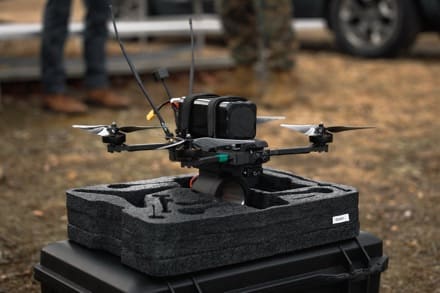
As I mentioned when the PBAS RFI was released, I refer to attritable drones as the “155 shell of the future.” The reason I use that comparison is that a 155mm shell is about $3000. The Army is looking to pay up to $2000 for each of the proposed PBAS but I think that’s a bit low. The availability of these systems, built with US sourced parts (or reliable allied country), is a national imperative.
From the Sources Sought Notice:
“The Army requires low-cost unmanned aerial systems for immediate fielding with up to 10,000 air vehicles within 12 months. The ability to deliver systems at or below our threshold cost is the primary weighted measure. The system performance characteristics will distinguish systems meeting this core requirement. The production capability as well as the ability for Soldiers to modify and repair are additional distinguishing characteristics. The intent for modifications is to ensure Soldiers are able to add simple payloads (such as 30mm mortars, grenades, or other lethal payloads) and non-lethal capabilities based on mission needs without vendor involvement in the field. These systems may also be utilized as targets during Counter Unmanned Aircraft Systems (C-UAS) training and other training exercises. Likewise, Soldier repair is needed to allow units to fully understand their equipment and stay in the fight while waiting for additional systems / spare components.”
The number of 10,000 per month is also significant as it is the low end of the number of attritable drones Ukraine claims it expends each month in operations against Russia. This number can surge to 30,000 per month or even higher. The question is, how can the US Army consume that many drones per month during peacetime? Well, for one, 10,000 is the surge capacity and they don’t pan to get there immediately, although I think the requirement will be far beyond just 10,000 per month of we end up in Large Scale Combat Operations. While FPV drones aren’t as capable as exquisite precision guided systems, they are a fraction of the cost and can be produced in a fraction of the time. Ukraine enjoys federated production of drones in workshops and cellars as much as in factories and produces hundreds each night. Second, the Army will use these drones for Counter Unmanned Aerial System training. So far, there hasn’t been much opportunity to go after live systems. This is an opportunity for the Army (and others in DoD) to conduct some simultaneous live training for both offensive and defensive UAS capabilities.
Accessing to the request, potential vendors of PBAS must be able to deliver the following:
Furthermore, systems must be 2020 NDAA Sec 848, 2023 NDAA Sec 817 and American Security Drone Act of 2023 (2024 NDAA, PL 118-31, DIV A, Title XVIII, Subtitle B, SEC. 1821) compliant or demonstrate a path to compliance.
Most important about this action? Funding is available to achieve this capacity expansion. Lack of capital has held many manufacturers back.
The Army is seeking white papers which are due by 1600 hours CST 18 July 2025.
Visit for sam.gov full details.
I am concerned that there still isn’t a PBAS Interface Control Document which would help both DoD and industry create Modular Open System Architecture drones which become plug and play for the integration of end effectors, comms, guidance, and motors. This would alleviate the concern over which components will work with which drones as everything would work together. Executing this scale of acquisition before establishing these standards is putting the cart before the horse.
Despite my concern, I am very excited about this action and look forward to the Army executing and obtaining an attritable FPV drone capability at the smallest units and all across the formation.
–Eric Graves
Founder
SSD
There is already a bit of standardization and plug and play to it, I worry that if it’s narrowed too far it’ll limit adaptability.
I’m glad they mentioned the external culture not being sufficient. I’d like to see the Army and Marines support it on the civilian side-not the EGames / Drone racing team angle, but actually giving these kids places to fly and spaces to build so they don’t have to worry about police and Karen interactions. It’s like 80’s-90’s skater, parkour, and cyber punk culture rolled up in a ball right now.
Creating an open architecture for UAS as in the context of the PBAS opportunity is fairly simple. Standardize a payload connector, rail for mounting, and software to enable various manufacturers to “hot swap” components for various applications and UAS sized.
Limitless Aeronautics is working with a few groups submitting to PBAS and standardizing payload interfaces and connectors is the fastest way to ensure users can take any drone, have a standardized interface and adapt for their mission as needed without any custom integration. Drones are easy when done in this mindset.
Looking forward to supporting PBAS and bringing mass manufacturable UAS payload attachments for all drone types!
And all of those standards go into an Interface Control Document.