

Last month, the US Army designated the XM8 and issued a national stock number: NSN 1005-01-737-3402. Featuring an 10″ barrel, the XM8 (bottom carbine) weighs 7.3 lbs versus the 8.3 lbs of the M7 carbine with 13.5″ barrel (top rifle). These weights are weapon only and do not include suppressor and optic.
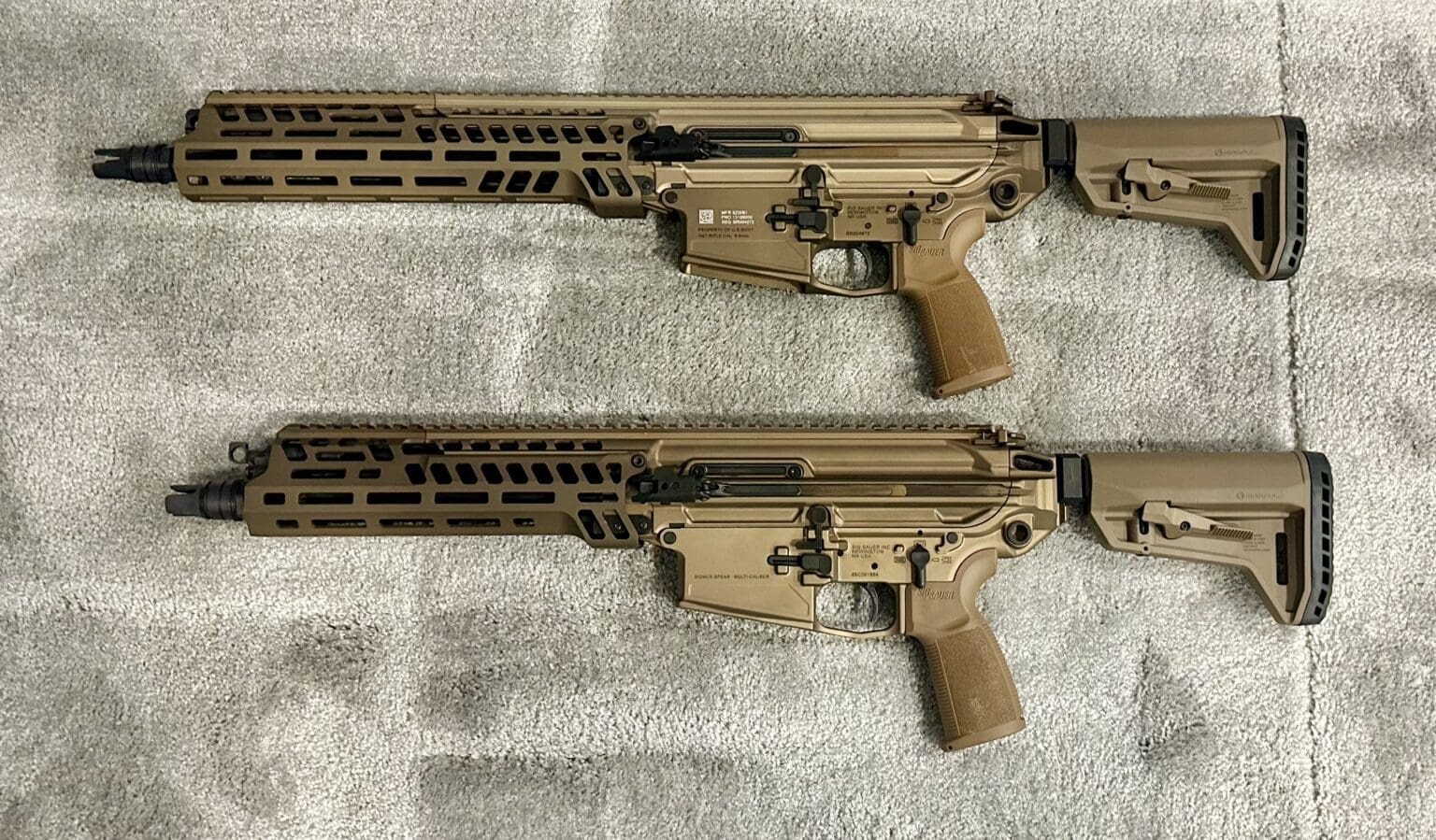
Developed by SIG SAUER as part of the Product Improvement Effort, it is a carbine version of the M7 Rifle. Along with the M250 Automatic Rifle, these weapons are being issued to the US Army’s close combat forces (think infantry, etc) as part of the Next Generation Squad Weapon program. They are chambered to fire 6.8 x 51mm composite case ammunition.
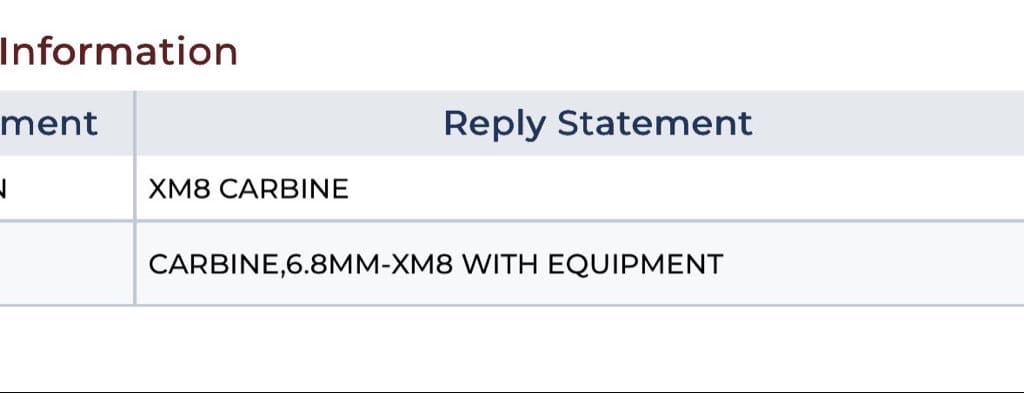
Although the main changes to the XM8 carbine are the shorter, tapered barrel, it also eliminates the side folding buttstock for a fixed, telescoping stock like the M4, and features a few changes in the upper receiver group to eliminate weight.
Many had anticipated the PIE variant to be designated as the M7A1 but this move falls more in line with the M16 and M4 as distinct weapons. Perhaps we will see an M7A1 yet.
Considering the Carbine has been given an M designation it looks like there’s a good chance that it will be adopted for issue to at least some of the force.
Now let’s see them fix the barrel wear issue.
There’s isn’t one.
Shouldn’t be a problem. After all, that super ultra mega power cartridge will now have a lower muzzle velocity.
“Now let’s see them fix the barrel wear issue.”
You mean the one reported by one source of “observed wear” on barrels without providing any evidence of where it was observed (i.e. serial numbers of weapons with alleged wear). You mean the source that didn’t even bother with a cheap harbor freight borescope to check for wear but felt “naked eye is good enough for me!” Is that what you’re citing?
If so, you might want to look for additional references.
There is no fix just Replacement
“There is no fix just Replacement”
***
***
True, that is the only fix for a worn-out barrel, but what I believe the OP was implying when he said:
***
***
“Now let’s see them fix the barrel wear issue.”
***
***
Is that the 6.8x51mm barrels are wearing out earlier than they are supposed to. And since he didn’t see fit to address the feedback I mentioned on what the general issues are that are reported, and why they may not be reliable data, it makes me wonder what his reason for saying it is.
Shooting ammunition with 80,000 psi… The only fix would be a new barrel every 5k rounds
It’s 2026, and the XM8 might once again be adopted by the military….
Well played, well played
How do you make a carbine version of a carbine?
The M7 is a rifle.
A ‘rifle’ in made-up name only, with a barrel length a full inch shorter than the barrel on an M4 ‘carbine’. Remember that a 20″ barrel is the historical definition of a rifle.
Carbine at this point is a hold over term like setting sail or steaming. It’s a doctrinal term now identifying a shorter lighter version of a weapon. Since the M7 is defined as a 13.5 inch barrel weapon the M8 with a 10 inch barrel would meet the definition. Because the M7 is the default configuration and M8 is the derivation. We still call the M4 a carbine because the M16 was the rifle.
Historically a carbine was a cut down rifle designed for cavalry, or artillery use, in the same caliber. The M4 carbine of WWII was departure from that definition, as its used a different cartridge. The M16, today thought of a a large rifle in some quarters, was in fact pretty much a carbine length firearm in a different caliber than the standard of the time. Rifles seem to have shrunk in length since the beginning off the 20th Century. Witness the SMLE, the M1903 , and after WWI , the Mauser 98k; all considered dual purpose rifles in their day.
How, you ask? By choosing a winner before the competition even starts, of course.
Could you expand on this?
Sure, they awarded SIG a contract that was competed upon certain requirements then changed those requirements after having awarded said contract to them.
That’s how you end up with the carbine version of a carbine.
You just described every program of record. And by the way, this was an OTA, so they have a great deal of latitude.
Not by lowering the requirement the entire competition was predicated upon.
Therein lies the problem, that latitude was abused.
“Not by lowering the requirement the entire competition was predicated upon.
Therein lies the problem, that latitude was abused.”
***
***
Abused how? The OTA had to be approved by Congress, who is the fund source for it. All of this is in alignment with the revised acquisition guidelines. If it was abused, I’m fairly certain congress would be laying the smack down on some acquisition officers… but they haven’t. If it was abused like you allege, people would be going to Leavenworth. Acquistion officers have been sent there for waaay less.
The NGSW had MULTIPLE requirements, many of which were adjusted as the program progressed. The program managers aren’t doing this in a vacuum. Making a change like the rifle to carbine means Army Senior Leadership AND CONGRESS are notified: Because a modification of the contract would be required. And I’m fairly certain that the NGSW is at the threshold that making a change of this magnitude wiuld need congressional approval.
So if you have a problem, take it up with the Secretary of the Army and Chief of Staff of the Army. Pretty sure they are the final decision authority on a change of this magnitude for the ARMY. Or complain to your congressman and see how far that gets you.
The Joint Capabilities Integration and Development System (JCIDS) you were accustomed to, and that’s a big ask considering your response, is gone.
In its place is the Warfighting Acquisition System. Expect heavy use of Mid Tier Acquisition tools and acceptance of much more risk.
Go through the stages of grief and come to acceptance. This is happening and so is NGSW.
“Sure, they awarded SIG a contract that was competed upon certain requirements then changed those requirements after having awarded said contract to them.”
So then by this logic, the M4 contract should not have been awarded initially to Colt. There were engineering change proposals submitted to create the carbine version of the M16, but by your line of reasoning, that should have been open competed.
You can’t have it both ways. If it’s good enough for the M16/M4, then it should be okay for the M7/XM8.
That’s a logical fallacy. The M4 contract was awarded 30 years later with the M16 fully fielded, not as a workaround for the rifle they selected.
“That’s a logical fallacy. The M4 contract was awarded 30 years later with the M16 fully fielded, not as a workaround for the rifle they selected”
***
***
So the fact it took 30 years to go from the M16 to the M4, but the M7 to XM8 is started in less than three is a logical fallacy? Sounds like a win to me.
Here’s what Army acquisition is being told by people like you:
Takes 30 years to go from Rifle to Carbine with M16/M4:
“The Army moves like a glacier! Use a .gov credit card at Cabela’s and buy Glocks!”
The Army speeds up their acquisition process, and are told by the same people:
“Whoa whoa whoa! That is too fast! You need to follow the fielding schedule as was outlined for the M16/M4. No new variant for thirty more years!”
The M7/XM8 is apparently Schroedinger’s rifle/carbine: simultaneously fielded too slow and too fast.
Speeding up acquisition of capabilities has been the priority for the NGSW program. The fact that it IS going so fast is a miracle.
You sound like one of the guys who would have been like this in WWII:
“Why are we going with an M1A1 submachinegun? The M1 is perfectly fine! We don’t need a new variant! It hasn’t been fully fielded/ thirty years yet!”
Hearing my argument from this point of view, which side sounds like a logical fallacy now?
Well put
We have the carbines as classroom guns. They’re not as much of a pig as the full-size but they’re still very front heavy with the can on. Kind of annoyed that the mags aren’t anti tilt and jettison the followers when they hit the ground sometimes. Still very weird that they went with the very easy to unlock can for a general issue suppressor which is going to lead to massive problems with them flying off. If the rumors are true about them turning up the chamber pressure to make up for the lack of barrel length then I can’t see the guns lasting very long. Would be good if they would have fielded the GP ammo with the guns instead of RR so we could actually figure that out. The carbine version also feels like it’s spring a lot lighter than the rifle so maybe they’ve done something different with the gassing. I think a more interesting story is how some other units are ditching all things Sig rifle because of constant QC issues. I’d wager we’ll be seeing the same thing here.
Units are ditching them? Under whose authority? Seems a little strange that they’d be ditching experimental weapons that are still being refined.
”
f the rumors are true about them turning up the chamber pressure to make up for the lack of barrel length then I can’t see the guns lasting very long. Would be good if they would have fielded the GP ammo with the guns instead of RR so we could actually figure that out.”
***
***
So you’re suggesting that GP ammo… that has already been made in SIGNIFICANT quantities for the current weapon’s spec and is sitting at the ready… is going to all be pullled back in, it’s projectiles pulled, and powder weight messed with? Not gonna happen. And I’m fairly certain there is GP on-hand… just not for training.
Also, I didn’t realize whatever installation you are (allegedy) at is a testing facility with the ability to provide repeatable results on the long-term reliability of weapons. I’m not sure what you’re going to ‘figure out’ on that front that wouldn’t be done by Army testing for these weapons.
***
***
“I think a more interesting story is how some other units are ditching all things Sig rifle because of constant QC issues. I’d wager we’ll be seeing the same thing here.”
***
***
So you’re claiming units who have been issued the rifle are ‘ditching it’ because of QC issues… I can tell you don’t know anything about the GPF side of things.
GPF units are getting these as REPLACEMENTS for their M4A1/M249. They just got them on their property books, and I doubt TACOM is going to come back and give them back their old weapons. So tell me…What are they supposed to use if they have to go to combat tomorrow?
SOF may have some more leeway in what they are doing, but not much. Because anything they don’t want to use that is provided by big Army (like the M7/8 and M250 are) THEY have to fund out of their money. So that is going definitely impact what their decisions are.
You imply the M7 has QC issues, what are they? Was it ‘barrel erosion’ that can’t be replicated because it was observed naked eye and serial numbers were not recorded? Not the best source of information if so.
it’s a brand new weapons system being produced at scale. It’s going to have some issues to work through. Every single item produced at scale does. To think otherwise just because it doesn’t fit with your world-view is kind of sad.
What M8?!
There is also an M7 PIE variant with the original barrel length that may yet become M7A1.
Yes, that photo features the PIE M7 and the PIE Carbine which is now the XM8. Additional info at the link to the article I wrote about them in October.
We can make it heavier
Seems suboptimal.
The initial goal of NGSW program was the ability to punch though Level IV and potentially future ‘Level V’ body armor.
This was the reason for adopting a magnum battle rifle utilizing high pressure cases to achieve high velocities.
But the other aspect of velocity is barrel length. SIG’s 13″ offering was already on the short end, and now it’s being cut down to 10,” further reducing performance.
I recall reading in a past SSD article that the 135gr did 3000fps from the 16″ M250 vs 2850fps from the 13″ – a 50fps per inch change. So a ballpark of 135gr 2700fps from the 10″ (I’m not sure what the 113gr RR/GP velocities are)
You could crank up the pressure to have the 10″ equal the 13″, but then with this same ammo the 13″ would equal the 16″, the 16″ equal a 19″ etc…
If I had my druthers NGSW would have been the TV RM277 bullpup paired with the SIG M250. The ~18″ barrel would have maximized the armor penetration potential while keeping OAL acceptable, albeit at a higher rifle weight.
“Seems suboptimal.
The initial goal of NGSW program was the ability to punch though Level IV and potentially future ‘Level V’ body armor.
This was the reason for adopting a magnum battle rifle utilizing high pressure cases to achieve high velocities.”
***
***
And if the Army Senior Leadership feel the requirements have changed, they should not make any changes to the weapons. Just stick to the plan because that’s what was agreed to over 8 years ago? That makes a whole lot of sense.
If the Army isn’t allowed to pivot after they’ve determined requirements have changed, Then the Army shouldn’t have adopted the M4 or the M16. “M14’s for EVERYONE!” And ‘Muh iron sights won two world wars’! is essentially what you are saying. Squads can still have that capability potentially, simply by doing an upper swap.
***
***
“If I had my druthers NGSW would have been the TV RM277 bullpup paired with the SIG M250. The ~18? barrel would have maximized the armor penetration potential while keeping OAL acceptable, albeit at a higher rifle weight.”
***
***
I find it amazing the number of bullpup fanboys who have come out of the woodwork since the Sig gun was adopted as the M7, saying it should have been the LoneStar gun. They seem to believe that the bullpup was a modern incarnation of the ‘wunderwaffen’ ‘Gerat 06 STG 45’ that was supposed to win world war II single handedly.
Sadly, the Army didn’t agree with you.
They defined the NGSW as a SYSTEM comprising of: rifle, automatic rifle, and ammunition submitted by one vendor. It wasn’t ‘pick rifle from column A, AR from column B, and ammo vendor from column C.”
I’m pretty sure it was done that way to allow the vendors the best possible chance to optimize their weapons to their ammunition offering. The cost of each of the three vendors having to try and optimize a rifle for three VERY different ammo types would have been astronomical. Moreover, it would have potentially given them all additional reasons to protest the contract award (which did happen anyway).
In my opinion, the LoneStar offering (the bullpup) lost because they didn’t put as much work into their AR offering as Sig did. Anything not belt-fed was going to have to be amazing to convince the Army to move away from a belt-fed gun. And the bullpup AR using Magpul D60 drums didn’t bring enough to the table to justify the adoption of the bullpups overall.
“And if the Army Senior Leadership feel the requirements have changed, they should not make any changes to the weapons. Just stick to the plan because that’s what was agreed to over 8 years ago? That makes a whole lot of sense.”
Well, what made NGSW fairly unique in small arms development was that it had a very clear pass/fail performance metric – penetrating body armor at extended ranges.
Whereas goals like ‘enhanced lethality’, ‘increased range’, ‘overmatch’ etc can be massaged and judged on a sliding scale of improvement, penetrating body armor is much more binary – the ammo either penetrates Level IV plates at X distance or they dont.
Armor penetration is the only use case where a magnum battle rifle round with equal weight and more energy than 7.6×51 makes sense as a service rifle cartridge.
If requirements have changed – either AP is no longer viewed as essential, or a reduced armor penetration distance has been deemed acceptable – then this calls into question the whole rationale for adopting the 6.8×51 cartridge.
I think it’s worth examining if requirements have changed to the point whether 6.8×51 still makes sense. Especially now that we have High Pressure options for 5.56, 7.62×51, as well as a real intermediate cartridge like .264 LICC.
You’re not getting a new caliber.
“Well, what made NGSW fairly unique in small arms development was that it had a very clear pass/fail performance metric – penetrating body armor at extended ranges.
Whereas goals like ‘enhanced lethality’, ‘increased range’, ‘overmatch’ etc can be massaged and judged on a sliding scale of improvement, penetrating body armor is much more binary – the ammo either penetrates Level IV plates at X distance or they dont.
Armor penetration is the only use case where a magnum battle rifle round with equal weight and more energy than 7.6×51 makes sense as a service rifle cartridge.
reduced armor penetration distance has been deemed acceptable – then this calls into question the whole rationale for adopting the 6.8×51 cartridge.”
I think it’s worth examining if requirements have changed to the point whether 6.8×51 still makes sense. Especially now that we have High Pressure options for 5.56, 7.62×51, as well as a real intermediate cartridge like .264 LICC.”
***
***
I’m pretty sure the Army did the math on 5.56 prior to selecting the 6.8x51mm cartridge. And even with the increased velocity that projectile would have, I doubt its terminal performance would be anywhere close to matching the XM8. However, I could see a use case for improving the M4A1’s for the CS/CSS Soldiers who are not currently receiving the NGSW.
Seriously? You are bringing 7.62×51 into the discussion? Even in a high pressure option, it would STILL be ~20 percent heavier than 6.8x51mm. And it’s terminal ballistics wouldn’t be worth the change.
And finally; .264 was basically invented by AMU, so I’m fairly certain its performance characteristics were very well known by the Army.
The Army had the chance to go with ‘.264 American’ in lieu of 6.8x51mm back prior to 2017, and they did not. To change now after investments have been made to change the logistics infrastructure of the Army to add 6.8x51mm to it would lead to significant sunk costs. Congress would not allow a pivot in caliber because “we have the .264 LICC at home.” So in essence, you kill the 6.8x51mm, Soldiers get no improvements in small arms for at least a decade.
Like it or not, the M7/XM8 are growing traction. If the Army does as you suggest, it gains nothing.
‘”Seriously? You are bringing 7.62×51 into the discussion? Even in a high pressure option, it would STILL be ~20 percent heavier than 6.8x51mm. And it’s terminal ballistics wouldn’t be worth the change.”
Well thats one of the most damning aspects of 6.8×51 -its not 20% lighter then 7.62×51. Its actually basically identical in weight at around 23g per cartridge vs the 23-24g of 7.62×51.
6.8 has a 113gr projectile vs the 130gr of the M80A1, but then 6.8 has more grains of powder due to the high pressure which puts them pretty close.
Then throw in that something about the 6.8 required a return to steel magazines over the polymer that was able to be used with modern 7.62, and it’s really a return to M14 weight magazines.
At least with High Pressure 7.62 rifles and LMG’s could be backwards compatible with standard pressure 7.62 stockpiles (based on the SIG Spear being able to run both regular pressure brass and high pressure hybrid ammo).
The same ADVAP secret tungsten AP projectile that 6.8 SP will use is currently being made for 7.62×51, so that aspect is covered.
6.8×51 has lower drag and longer range, but the ever shrinking barrel length being pursued means that maximum range may no longer be a requirement.
As far as the US goes, 7.62 is on its way out. The only reason people are still talking about it is because most long distance ranges are plotted for 7.62. We have an infrastructure problem across the board for small arms ranges and new rounds with longer ranges are exacerbating the issue.
“As far as the US goes, 7.62 is on its way out.”
Is that for Infantry use, or across the board?
ie is the plan to also convert all the vehicle mounted M240’s and aircraft mounted M134 Miniguns to 6.8×51 as well?
Across the board. We are not developing new systems in 7.62, not in any category of small arms.
There is no plan to rebarrel anything. There are courses of action to replace the M240 with a new medium machine gun. The Army has not yet selected one.
Great info, thank you.
Will be interesting to see what replaces the M240.
“Well thats one of the most damning aspects of 6.8×51 -its not 20% lighter then 7.62×51. Its actually basically identical in weight at around 23g per cartridge vs the 23-24g of 7.62×51.”
***
***
Not sure where you’re getting your weights from. According to the following link:
https://share.google/osMvLxHSemy7VmaeD
A cartridge of 6.8x51mm ammo weighs 336 gr (grains, not grams).
336 gr = .768 ounces * 100 rounds / 16 oz./ lb. gives us 4.7875 lb.
M80A1 has a listed cartidge weight from this source:
https://www.thefirearmblog.com/blog/2016/07/23/taking-a-look-inside-the-armys-devastating-new-m80a1-7-62mm-round/#:~:text=I%20should%20also%20say%20that,grains)%20for%20an%20M80A1%20round.
of 366 grains:
366 gr = .837 ounces * 100 rounds / 16 oz./lb. gives us 5.231 lb.
1 – (4.7875/5.2315) * 100 = 8.48 percent MINIMUM difference in weight (not including links).
Converting it to metric (grams) still comes out with 6.8 having a cartridge weight of 21.772 grams vs. 23.716 grams.
1 – (21.772 / 23.716) * 100 = An 8.196 percent MINIMUM difference in weight (not including links).
I showed my math and sources. Let’s see yours.
***
***
“At least with High Pressure 7.62 rifles and LMG’s could be backwards compatible with standard pressure 7.62 stockpiles (based on the SIG Spear being able to run both regular pressure brass and high pressure hybrid ammo).”
***
***
And that gains us what? Apart from possibly more training ammo that doesn’t reflect the ballistics of the war shots it’s being replaced by? Pretty sure that’s the same argument for why we went into WWII with .30-06 rifles instead of .276 Pedersen.
I honestly don’t know what you are trying to suggest here, apart from: “7.62 more gooder!”
“I showed my math and sources. Let’s see yours.”
Thank you for finding the exact weights.
You’re right that the 6.8 is lighter, but it’s also not the 20% lighter of your initial assertion.
The actual weight savings between the 6.8 vs 7.62 is likely to be almost imperceptible to the user:
6.8×51 113gr = 336gr / 21.77g
M80A1 = 366gr / 23.72g
= 1.95g savings
x20rd = 39g / 1.38oz saved
A 5.56 cartridge is 12g, so the 39g weight savings is akin to the weight of a 30rd magazine loaded with 27rd vs 30rd – only a very refined touch would notice the weight difference.
And then this 1.38oz per 20rd weight savings will offset by the use of Steel magazines for 6.8 vs the polymer magazines that were able to be used with 7.62.
Point being for all practical intents, the 6.8 is a return to 7.62 battle rifle weight ammo loadout and capacity that was rejected with the M14.
..
In terms of why 7.62 would be preferable to 6.8, the entire benefit would be logistics and interoperability. If the future is a WW3 type showdown with China in the pacific, supply / resupply may be contested. Being able to use the 7.62 ammo of Japan/South Korea/Philipines/Australia/Singapore/Taiwan etc could be very important.
Likewise if we see domestic sabotage of US / NATO powder supplies (relatively few factories) then being able to rely on our own current stockpiles of 7.62 could be very important. This would decrease in advantage over time as 6.8 stockpiles pile up, but for the next few years we almost certainly have vastly more 7.62 in inventory.
“You’re right that the 6.8 is lighter, but it’s also not the 20% lighter of your initial assertion.
The actual weight savings between the 6.8 vs 7.62 is likely to be almost imperceptible to the user:”
***
***
So I found the official source on their cartridge weights here:
https://jpeoaa.army.mil/Portals/94/MAS/Documents/MASHandbook_2025.pdf?ver=ldx6e69WnWk9ujK5iF55Eg%3D%3D
6.8x51mm GP: 335 grains => 0.7657143 oz.
7.62x51mm M80A1: 374 grains => 0.854857 oz.
A single twenty Round Magazine for an XM8? As you suggest, a Soldier would have a hard time noticing it.
0.854857 oz. * 20 rounds / 16 oz./lb. gives us 1.06857 lb. for 7.62x51mm.
0.7657143 oz. * 20 rounds / 16 oz./lb. gives us .95714 lb. for 6.8x51mm
A tenth of a pound? Might be hard to detect for a single magazine. A combat load of 140 rounds of 6.8mm for the XM8 being carried on patrol… They will DEFINITELY tell a difference between 6.8x51mm and 7.62x51mm:
0.854857 oz. * 140 rounds / 16 oz./lb. gives us 7.4799 lb. for 7.62x51mm.
0.7657143 oz. * 140 rounds / 16 oz./lb. gives us 6.7 lb. for 6.8x51mm
7.4799 – 6.7 = 0.77999875 lb.
Over a 3/4 pound difference…. Just in ammo.
That adds up when you are carrying said 140 rounds in magazines through nasty terrain on patrol.
***
***
“And then this 1.38oz per 20rd weight savings will offset by the use of Steel magazines for 6.8 vs the polymer magazines that were able to be used with 7.62.”
***
***
Last I checked, the M7 uses AR-10 pattern magazines: Meaning polymer magazines should be able to work with the XM8. If you recall, the Lancer magazines were initially used by all vendors in the NGSW competition before down-selected to one vendor. And keep in mind; they had metal feed lips, so I bet weight savings using polymer were not as significant as you would imagine.
Also, The steel magazines offer some benefit over the polymer: They take up less space on Soldier’s kit.
***
***
“In terms of why 7.62 would be preferable to 6.8, the entire benefit would be logistics and interoperability. If the future is a WW3 type showdown with China in the pacific, supply / resupply may be contested. Being able to use the 7.62 ammo of Japan/South Korea/Philipines/Australia/Singapore/Taiwan etc could be very important.
Likewise if we see domestic sabotage of US / NATO powder supplies (relatively few factories) then being able to rely on our own current stockpiles of 7.62 could be very important. This would decrease in advantage over time as 6.8 stockpiles pile up, but for the next few years we almost certainly have vastly more 7.62 in inventory.”
***
***
Well since the 6.8 has only been fielded for 2 years… Yes. There is significantly more 7.62mm in inventory. Economies of scale haven’t kicked in yet.
So once again, we have MacAurthur saying: “we have millions of rounds of .30-06, no .276 Pedersen for you.”
So you’re saying the Army should sub optimize the weapon to a caliber that did not meet the requirements of the NGSW… Strictly for logistics and because we don’t have enough of the new type of ammo that has only been made at scale for the past ~3 years? If that was the case, we should have just gone with the Interim Combat Service Rifle program and been done with it.
If we are dealing with Domestic sabotage of our ability to produce ammo, then that means we have bigger problems because that means the peer threat is already here.
If that happens, I’m fairly certain the ‘easy button’ solution at that point would be to re-issue M4A1’s to the CCF and go back to 5.56mm. We are talking about essentially an invasion of the United States at that point. And production of new weapons is probably not going to be possible because in the situation you’ve outlined, Sig’s factory would probably be rubble as well.
FYI, Army plans to introduce 25 round magazines. That’s why you’ve seen some Magpul mags being used in photos taken during NET. I’ll have more info soon.
So many “experts” that know nothing!
According to GarandThumb’s test, there’s only 50 fps drop in muzzle velocity and it meets army requirement.
Just so everyone knows, I have read none of the above comments but I am wildly against this new gun…mostly because it isn’t in my favorite color…JET BLACK.
Clearly the BEST reason to be against any new army item.
There is nothing like picking up a scalding hot rifle that has been sitting in the desert sun all day and lose skin off your face as your cheek touches the buffer tube and castle nut. These young kids are too soft. They will never know the struggle.
So obviously if this new “carbine” was in JET BLACK with bright write lettering on the pew pew settings, and a chrome bayonet lug…
….then and only then… will it be acceptable for my beloved Army.