


At under 2 kg and nearly half of the cost of US equivalents, it is the most accurate European payload in its class with the longest targeting range, designed for off-the-shelf integration across drone platforms. As Russia’s GPS jamming spreads across the region, laser designation offers the only targeting solution that does not rely on GPS at all.
June 17, 2026 – Vilnius, Lithuania. When GPS guidance fails, a drone can drift off course by as much as 100 km. Over the last month, at least six drone incidents across Europe have been linked to GPS jamming and spoofing – and the problem is spreading. For ordinary Europeans, it means air raid sirens, evacuation orders, and, in Romania’s case, waking up to a drone embedded in your apartment building.
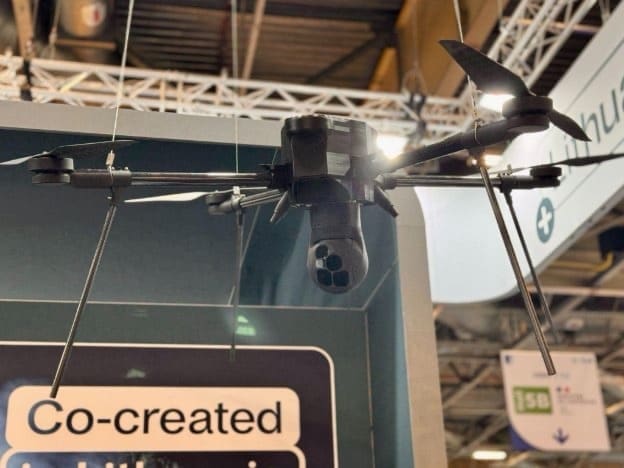
3D-printed plastic prototype of a payload mounted on a real-size drone, Eurosatory 2026 (Source: Tactical Photonics )
Russian electronic warfare (EW) demonstrated the scale of this problem when Ukrainian strike drones were diverted across the region within 48 hours, one striking the chimney of an Estonian power plant.
When a drone is knocked off its course, it does not stop flying. It can wander hundreds of kilometers and deliver whatever payload it carries wherever it happens to land.
However, Europe has an emerging solution to this. Current targeting systems rely on GPS or radio links, both of which Russian jamming has shown it can disrupt. Laser targeting designators don’t need GPS at all. They work on fundamentally different principle: light cannot be intercepted or spoofed. Until now, similar high-tier systems had to be acquired through US-based companies, controlled by the US authorities.
Tactical Photonics, part of Aktyvus Photonics Group, is changing that by presenting the most accurate laser targeting payload in its 2 kg class, with the longest targeting range. To do so, the company joined forces with Lithuanian talents and built a separate entity powered by Aktyvus Photonics laser technology. A key benefit of laser designation is precision strike capability – ensuring guided munitions hit exactly where intended.
The payload functions as a laser designator, it marks targets with a laser spot, which laser-guided munitions then home in on to strike with precision. The payload does not carry or launch munitions itself, but determines exactly where they land.
“We built this because we were asked to – by Ukrainian and Baltic national forces. Europe has invested billions in the next generation of tactical drones, but it has not solved the targeting problem. And the payload is usually what determines whether the drone is useful or not,” says Laurynas Šatas, CEO of Aktyvus Photonics Group.
“Lasers are key here, as they turn a surveillance drone into a precision strike platform, and these are still US-made, ITAR-controlled, and out of reach for programmes that cannot wait for a US State Department approval. There were no commercially viable companies in Europe providing laser payloads, and we intend to change that.”
According to the company, the payload weighs under 2 kg and is designed to hit small moving targets at ranges beyond 3 km. This is enabled by 4-axis mechanical stabilisation – a critical differentiator in this class of system. Most payloads in this weight category rely on 2-axis stabilisation and digital image processing, which limits both range and accuracy. Four mechanical axes maintain a stable targeting lock on small moving targets even as the drone itself manoeuvres, replicating the performance of much larger systems in a fraction of the weight.
4 axes. 3 km range. 2 kg. 1 system. For comparison, the equivalent US system from L3Harris WESCAM weighs approximately 15 kg and costs two times more. With this component, a drone can guide the full range of laser-guided STANAG 3733 NATO munitions.
Beyond precision, the system significantly increases situational awareness for the operator. It enables forces to operate beyond line of sight (BLOS), requires less crew training than comparable systems, and is designed for rapid deployment across multiple drone platforms.
“Military experts ask how can a European company build this better and cheaper than established American suppliers. Well, the answer is where we come from. Lithuania has been a global hub for laser science for decades. Some of the world’s leading laser companies were and are being built here. We have extremely well-trained scientists and engineers. The knowledge is here, the supply chain is here, and the cost base reflects that. It is not a surprise that this technology gets cheaper when it is built in the country that helped invent it,” adds Šatas.
The system is compatible with fixed-wing drones and helicopter-type drones. It can also work alongside loitering munitions – which carry a SAL seeker that homes in on the laser-marked target, rather than marking targets themselves.
European defence investment grew by 14% last year, faster than any other continent, reaching €739 billion, the steepest climb since the 1950s and double the level of a decade ago.
“As spending increases, Europe needs to become more independent in every area and own different parts of the supply chain,” continued Šatas.
“We are not building drones. We are building the part that determines how precise a drone can be, and making that part available in Europe at a price and scale that procurement officers can actually work with.”
The payload made its public debut at Eurosatory 2026, one of the world’s leading defence and security exhibitions, displayed on a small drone at the Lithuanian national stand. Production is set to scale to 600 units per year from 2027.