

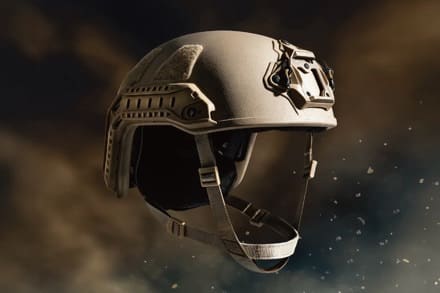
Modern combat helmets are evolving from primarily ballistic protection into a platform for a growing range of technologies. What are some of the biggest changes you’re seeing in how helmets are being designed and used today?
Gentex has a unique perspective because we have served a wide range of warfighting customers for decades. In both air and ground applications, we have seen the helmet evolve from a piece of protective equipment into an integrated headborne system.
The biggest trends we’re seeing are greater integration of communications, hearing protection, visual augmentation (such as helmet-mounted displays that enhance situational awareness), power, and data. In the air domain, we have focused for a long time on integrating these capabilities while keeping the helmet lightweight, stable and comfortable. Many of those technologies have since moved from air combat to ground combat, first with special operations and now increasingly with conventional forces. The Ops-Core RAILINK system is an example of an innovation that has enabled the integration of all these technologies into a cohesive helmet system.
We’re also seeing higher-cut helmets, more stable suspension systems, integrated communications and hearing protection, and greater attention to protecting against blast overpressure. Gentex is working with multiple special operations customers on solutions to monitor and mitigate blast exposure, including sensors that can measure and record potentially dangerous pressure.
As more equipment is mounted to helmet systems, weight becomes a bigger factor. What impact does helmet weight play on the short and long-term health and combat effectiveness of service personnel?
With advanced helmet systems, especially aircrew helmets, weight down to the ounce or even gram matters. Weight and where weight is distributed can have a significant physical impact on the head and neck.
For both air and ground combat users, reducing weight as well as improving balance and center of gravity are important for improving comfort, limiting fatigue andprotecting long-term health. Some ground SOF operators can be carrying helmet systems weighing six pounds or more including accessories, and they mayneed to wear that equipment for extended periodsduring operations. That’s why we look at the entire system, not just the helmet shell. The helmet is where that weight ultimately meets the head, so comfort, stability, adjustability, balance, and a good center of gravity are critical.
Gentex has focused heavily on reducing weight. We have developed the next-generation fixed-wing helmet system currently being fielded with the U.S. Navy, as well as the FAST SF Second Generation helmetsystem, which weighs just two pounds in a size large. The larger challenge, however, is reducing the weight of all the accessories and equipment attached to the helmet as well, as those are a major contributor to overall weight.
How are manufacturers reducing helmet weight without compromising protection or equipment/technology integration?
Advanced ballistic materials are one of the biggest opportunities for reducing helmet weight while maintaining protection. Gentex has focused on using these materials efficiently to maximize protection while minimizing the weight of the shell, but the shell is only part of the equation. With the FAST SF Second Generation helmet, we looked for weight savings throughout the system, including in the pads, ARC rails and Modular Bungee Shroud. Today, many of the things attached to a helmet can weigh more than the helmet itself, so reducing overall system weight requires an integrated approach. That means not only reducing shell weight, but also with VAS and display developers and accessory partners to reduce the weight of the complete system.
Tell us more about ballistic protection. What new threats and injuries are troops facing on the battlefield, and how are helmet systems adapting?
The more things change, the more they stay the same – including combat threats to helmet users. Early steel helmets were primarily intended to protect against fragments from indirect fire. Modern ballistic helmets have expanded that protection capability to include pistol and rifle fire threats.
During the Global War on Terror, major injury threats included IEDs, explosions and direct fire, but with the Russia-Ukraine war, there has been a renewed emphasis on indirect fire, including drone-delivered munitions. At the same time, there is growing awareness of both acute and chronic injuries associated with blast overpressure. That is an area where Gentex is working to better understand, monitor and mitigate exposure, including exposure that can occur during both training and combat.
The U.S. military has been moving towards high-cut helmet designs. What drove that evolution, and what advantages does a high-cut design provide?
The primary driver of the high-cut trend has been the increased use of over-ear hearing protection and communications headsets. In that sense, the Combat Vehicle Crewman, or CVC, helmet that Gentex helped pioneer in the 1950s was an early example of the concept. Its large cutouts accommodated the earcups needed for communications and hearing protection in armored vehicles.
Early in the Global War on Terror, SOF operators made communications headsets standard equipment and began demanding helmets that could accommodate them. The Ops-Core FAST helmet was a direct response, with a higher cut that provided additional clearance for those systems.
We are now seeing the same evolution move into conventional forces as communications and hearing protection become standard equipment. Higher-cut helmets provide better compatibility with those systems and can also reduce weight by removing some of the ballistic shell.
We hear a lot about modularity in the context of gear; what are the hallmarks of modular combat helmet systems, and how does the configuration benefit different users with different missions?
There is a balancing act between modularity and integration, and every helmet system has to find the right point along that continuum. Modularity allows users to replace, reposition, or upgrade components as their equipment and mission needs change. That is particularly important for military users who may have different configurations for different missions or need to replace components in the field.
Ops-Core ARC rails are a good example. They provide a low-profile, universal attachment system for accessories such as lights and headsets while allowing those components to be repositioned, replaced, or upgraded. The key is finding the right balance. Too much modularity can add weight and complexity, while too much integration can make a system difficult to repair or adapt. The best helmet systems give users the flexibility they need without adding unnecessary weight.
How do manufacturers view headborne technology like night vision, communications, hearing protection, and so on? How has design changed as they’ve become a part of the helmet system?
As night vision, communications and other headborne technologies have become essential equipment, the helmet has had to evolve into a more stable and comfortable platform for those systems.
That means designing for things like NVG stability, cable management, and balance – not just ballistic protection. Features such as the Ops-Core Modular Bungee Shroud, integrated bungees, and PowerPath ARC rail help manage and stabilize equipment while reducing cable snags. Counterweight systems can also improve balance when heavy visual augmentation systems are mounted to the helmet. Hearing protection has evolved in the same way. The Ops-Core RAC headset introduced rail-mounted integration that improved stability, comfort and weight distribution. We continued that approach with the AMP headset and RAIL connector.
Ultimately, the goal is to integrate these technologies without making the helmet cumbersome. The helmet must provide a stable, comfortable platform while still giving the user the flexibility to configure it for the mission.
The U.S. Army’s Integrated Head Protection System (IHPS) has been in service for several years. What kinds of future upgrades or improvements are you seeing or anticipating for IHPS?
The IHPS added capabilities over the Enhanced Combat Helmet (ECH), including a ballistic mandible and applique for increased protection against rifle threats. The NG-IHPS added additional ballistic protection in a single shell, but there are still opportunities to improve weight, comfort, and retention.
Gentex has been addressing some of those areas with the LX9 pad set and the IHPS-ARC Rail Kit, which were fielded with 4ID as part of NGC2 this past summer and is now available for commercialpurchase. We have also submitted proposals to bring back the Ops-Core Head-Loc chinstrap system.
Additionally, Ops-Core has provided high-cut NG-IHPS prototypes for evaluation. A high-cut configuration could provide better integration with communications and hearing protection while reducing weight. The opportunity is to build on the protection of NG-IHPS while improving the overall user experience – particularly comfort, retention, weight, and integration with the equipment soldiers are increasingly required to wear.
For the Marine Corps, are there different priorities or requirements driving helmet design compared with other branches? What are you hearing from Marines about how they want their head protection systems to evolve?
The Marine Corps’ renewed focus on its naval expeditionary mission and a more dispersed, self-sustaining approach to operations puts a premium on mobility and efficiency. That makes weight, stability and comfort particularly important.
The Ops-Core FAST XR Boltless/IHS helmet system provides a significant weight reduction compared with the ECH while maintaining a high level of protection. It also gives Marines access to the broader Ops-Core ecosystem of accessories and headborne technologies. As the Marine Corps evolves its mission, lighter weight combined with stability, comfort, and integrated capability will be increasingly important in helmet systems.
Looking ahead, how do you expect combat helmet systems to evolve over the next five to 10 years?
I think we will continue along the innovation path that began in the early 2000s. Advances in materials will gradually reduce the weight required for basic impact and ballistic protection, while close-combat forces will need a balance of protection and mobility.
At the same time, we are approaching a major shift in headborne technology. Digital night vision, AI-assisted augmented reality, and integrated displays will enable capabilities that have been discussed for years but haven’t yet been practical at scale. We will also see more distributed sensing, including chemical and biological detection, along with systems that can identify threats, share data, and connect individual operators to a common operating picture.
The vision has been consistent for a long time, but now the technology is finally catching up to the vision. The next decade should be an exciting one for headborne systems.
About Rafe Bennett:
Rafe Bennett is Vice President of Product and Marketing at Gentex Corporation, bringing extensive leadership experience in product strategy, marketing, and portfolio management across the defense, firearms, and industrial sectors. His military product development background spans over 25 years, including roles in Force XXI, Future Force Warrior, and prior service as a U.S. Army infantry officer.