

McLean, VA — October 8, 2025) FN America, LLC is pleased to announce that it has delivered test and evaluation samples of two all-new weapon systems – LICC-IWS and LICC-AMG – along with ammunition as part of a long-term development contract with the Department of Defense’s Irregular Warfare Technical Support Directorate (IWTSD). FN also conducted new equipment training (NET) and armorer’s training for both systems to demonstrate maintenance at the unit level.
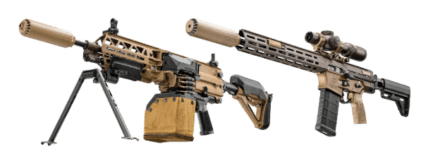
FN America developed the weapon systems with feedback from individual operators, based on the U.S. Government goal of providing overmatch against near-peer threats. The systems were recently assigned National Stock Numbers (NSN), simplifying the acquisition process.
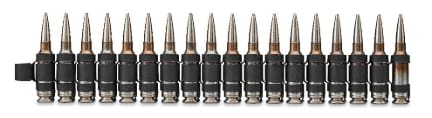
The LICC-IWS program is comprised of the 6.5×43 LICC (Lightweight Intermediate Caliber Cartridge) ammunition, the LICC-IWS (Individual Weapon System) with FN® IPC (Improved Performance Carbine), purpose-built magazine and signature suppressor. The LICC-AMG is based on the success of the prototype LICC ammunition and LICC-IWS system and is comprised of the LICC-AMG (Assault Machine Gun) belt-fed machine gun, signature suppressor, family of common ammunition, and lightweight links. Multiple users will test the operational samples , providing critical feedback to aid FN and IWTSD in the final development of the systems.
“FN’s ultimate goal is to advance from development into production and field a final solution that provides operators a system that is easier to operate, more accurate and more effective than anything available today,” said Mark Cherpes, President and CEO for FN America. “After this test and evaluation phase, our plan is to take user feedback, fine-tune the systems and move into low-rate initial production.”
LICC Weapon Systems and Ammunition
FN designed the LICC-IWS individual weapon system to improve lethality, accuracy, durability, balance and handling over the M4A1. The improved performance derives from a new 6.5×43 LICC lightweight ammunition , based on the U.S. Army Marksmanship Unit’s .264 USA; a 25-round purpose-built, polymer magazine; a signature suppressor, and the FN IPC. The FN IPC features a completely new architecture, well-suited to meet the challenging program requirements and address the feedback from operators who have contributed since the beginning of the program.
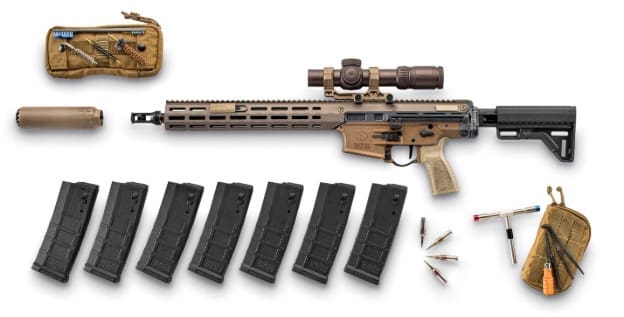
The LICC-IWS IPC handles much like an M4A1 but with key improvements to deliver a fully ambidextrous platform with unique takedown method and highly adjustable buttstock, which allows for user-selectable left- or right-hand side fold capability. It operates from a robust long-stroke gas piston system and features multiple buffers that reduce felt recoil, resulting in an extremely soft shooting weapon.
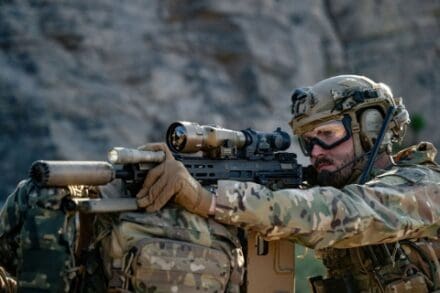
Additionally, it features a unique self-regulating gas system with on-off capability, and newly patented bullet technology developed from efforts to mature the 6.5×43 cartridge, that greatly improve system reliability and accuracy.
The LICC-IWS has been developed and is being tested in three different barrel-length models – a 12.5” Close Quarters Battle option, a 14.5” Carbine option and an 18.0” Designated Marksmanship Rifle option (RECCE).

“Initial test firing results from the U.S. Army Marksmanship Unit and other operators show that the accuracy of the LICC-IWS is consistently two times better than the M4A1,” said Jim Williams, Vice President, Military Programs for FN America. “Additionally, the LICC-IWS handles like the M4A1, yet remains soft shooting when firing the new 6.5×43 lightweight ammunition.”
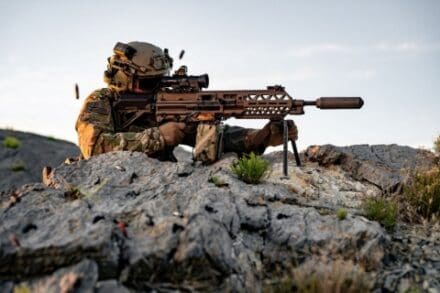
Adapted from the FN Evolys®, the select-fire LICC-AMG is a shoulder-fired, belt-fed lightweight weapon system chambered in 6.5×43 LICC with a continuous monolithic top rail and an innovative side feed featuring a lightweight metallic link. In prototype testing, the AMG was more accurate than the FN MK 48 in full auto mode. Overall, the AMG demonstrated improved performance in lethality, accuracy, durability, balance and handling over the FN M249 and FN MK 46/MK 48 machine guns.
“Creating totally unique weapon systems around a specific caliber is in FN’s DNA,” said John Bungard, Sr. Director, Military Development Programs for FN America, LLC. “As our team worked on the LICC-IWS program, quickly followed by LICC-AMG, we were able to leverage our decades of engineering expertise across multiple weapons and ammunition platforms to come up with the ideal solution for today’s global threats.”
FN’s LICC-IWS and LICC-AMG submissions are ground-floor development efforts based on the IWTSD concept and FN’s unique 6.5x43mm LICC caliber developed with input from the U.S. Army Marksmanship Unit, IWTSD and individual operators. A family of lightweight, stainless steel cased 6.5×43 caliber ammunition was designed to reduce the carried weight of the system by 20% compared to equivalent brass cartridges, while achieving improved results in accuracy, range and performance over current fielded 5.56 ammunition, including M855A1 (5.56x45mm).

Irregular Warfare Technical Support Directorate (IWTSD)
 The IWTSD exists to identify and develop capabilities for the Department of Defense (DoD) to conduct irregular warfare against all adversaries, including Great Power competitors and non-state actors. The IWTSD delivers those capabilities to DoD components and interagency partners through rapid research and development, advanced studies and technical innovation, and provision of support to U.S. military operations. In addition, the IWTSD directly manages bilateral agreements with five partner countries: Australia, Canada, Israel, Singapore and the United Kingdom.
“FN is excited to partner with the IWTSD to begin final testing and evaluation of the new LICC IWS and AMG systems,” said Bungard. “We cannot wait to get additional user feedback, fine-tune the systems and begin production of what promises to be the next groundbreaking FN platform.”
NSNs Assigned to Select Variants
Three variants of the LICC-IWS have been assigned national stock numbers (NSNs) and are available for requisition by Army, Navy, Marine, Air Force and SOCOM elements and activities. The three variants currently available for request are a 12.5” Close Quarters Battle option, a 14.5” Carbine option and an 18.0” Designated Marksmanship Rifle option, along with two suppressors supporting the system. The NSNs are:
NSN 1005-01-729-0039, FN IMPROVED PERFORMANCE CARBINE 12.5 IN CQB WITH BII*
NSN 1005-01-729-0052, FN IMPROVED PERFORMANCE CARBINE 14.5 IN CQB WITH BII*
NSN 1005-01-729-0046, FN IMPROVED PERFORMANCE CARBINE 18.12 IN REECE (sic) WITH BII*
NSN 1005-01-728-9868, SUPPRESSOR, FLOW 264 FOR IMPROVED PERFORMANCE CARBINE
NSN 1005-01-728-9874, SUPPRESSOR, FLOW 7.62 FOR IMPROVED PERFORMANCE CARBINE
*Basic Issue Items
FN and the U.S. Military
Throughout its history, FN has been one of the largest suppliers of small arms to the U.S. military and continues to develop innovative, future technology. The company currently holds contracts for the FN® M240 and its variants, the FN® M249 lightweight machine gun; the FN® MK 46, MK 48, MK 17 and MK 20 SSR for USSOCOM and various other contracts.
For more information about FN’s military product line or current U.S. military contracts, please visit www.FNAmerica.com.
Still have not so much as seen one in person but the controls of this rifle “just make sense” and not just as a set of solutions stuffed into an AR framework. And yet, they’re still familiar enough that they would be intuitive. The bolt catch is akin somewhat to the FAL but more towards an XCR/ACR in execution and I’m a big fan of it. Takedown lever in lieu of captured pins simplifies parts count. Side mounted charging handles, low enough to clear whatever gadget you’ve mounted on the upper, but still close to the shooter for a compact workspace; personally speaking I loathe the HK-style, forward charging handles. Should mean less blowback to the shooter as well.
Eric had an article on here not long ago relating Canadian special operations and an unnamed partner were pushing for NATO acceptance. Other country’s defense budgets aren’t as deep as the US so I’d be hard-pressed to see a widespread adoption of this (or anything else for that matter) over legacy 5.56 for most however.
And because it’ll come up here in the comments, NGSW was built around an entirely different set of ‘specs and wants’ that LICC does not meet. If LICC would be “better” than the M7 and M250 is subjective at best but still a fun topic of conversation. My humble opinion is that it would be better…kind of. My 2 cents is the LICC for riflemen but the 6.8mm/NGSW round is just to potent a beast to abandon altogether. It outperforms 7.62 NATO so a 1-for-1 swap on everything in that caliber. It still bifurcates the primary munitions within the squad and doesn’t simplify logistics but you need different horses for different courses.
I’m lucky enough to have gotten my hands on the LICC carbine at SHOT earlier this year, it is incredibly clever in terms of ergonomics, even the covers for the gas regulator and the way the stock can fold to either side are neat. I’d rather see this than M7/M250 given the issues those are having. My buddy who’s still at 101st has been having a lot of issues with his unit’s M7s and M250s and now their fancy new optics are breaking too. And as potent as the 6.8x51mm round is, it’s killing barrels way too fast. If the LICC doesn’t end up being another self-destructing wonder-weapon I’d like to see this as the next swing at replacing the M4/M249 since Big Army is averse to just doing an M4A1 upgrade that looks like diet-URGI.
For the speed and pressures associated with 6.8mm/NSGW barrel erosion is going to be systemic until there are upgrades in metallurgy, coatings, or possibly even replaceable barrel liners. (It works for artillery, can it have the same economy of scale at the small arms level?) Otherwise, the budget needs to be in place for constant replacement of not only barrels but bolts too.
If you’re able, the Marine Corps Gazette this month has an interesting article written by an Army CPT relating an albeit unscientific assessment of the M7. He stated a bizarre barrel erosion not at the throat or muzzle but closer to mid-bore. As he described it my best guess would be some type of backpressure from the gas system possibly. In addition the CPT writes of observing a company work-up using the M7 and M250 and seeing sustained fire rates could not be maintained due to the basic load. I would anticipate a 25rd mag for the M7 forthcoming which would somewhat alleviate the issue but would still fall short. The M7 is designed around style of fighting compared to the corporate knowledge of the M4.
Some years back the Army hosted an NDIA event where one of their engineers spoke to upgrades in metallurgy for MG barrels that may rewrite timetables for barrel changes. I’ll see if I can find the powerpoint on it. But it’d probably be of use in the M7/M250.
How/why is this program continuing when NGSW contract has already been awarded?
Someone needs another boat?
Simple – its a different contract for different user(s). But for whatever my 2 cents are worth, this package seems to make more sense than the NGSW.
Agreed. Just looking at quick comparison of the two systems this seems like it addresses a lot of the current complaints with the M7 (weight amount of ammo) while still offering improvements over the M4.
This is an irregular warfare purchase. Testing for SOCOM. So while the Army is involved it’s through Special Forces. SOCOM in general has been more interested in 6.5 weapons. My guess is that there are people trying to push the Army to reverse course on 6.8 within that community and pursuing 6.5 is a good way to do that. The Army still has plenty of time to stop ordering NGSWs and start pursuing one of the many 6.5 style rifles. But there’s already a .277 plant in Arkansas. They could probably convert to 6.5 but it’s different ammo so not so easy. Also who knows what the contract between the Army and Sig says.
And again, the Army is not going to change course. If the leadership were dumb enough to ask for money for another program after they told Congress they had solved overmatch, they would tell them to eatadik.
This is an interesting project, the rifle looks very interesting as well as the round it fires. Just feel this will all become history at some point.
We’re living through the 60’s again.
M7 is the M14. The IWS is the M16.
I do think 6.8 and the M250 will stay around though, they make much more sense as 7.62 NATO replacements.
Remember – this is the public information IWTSD will release. Still no further information on NATO STANAG, no mention of other partners for accessories, no mention of who the “other partners” are. OPSEC is important. I bet this is scratching the surface.
Indeed. Something is afoot – and the curiousity is killing me. 😉
Hopefully whatever is afoot is the Army coming to its senses on the M7 and pulling back to a better general purpose bullet.
The Army has an effort afoot to double down on the 6.8 projectile, to create a 6.8×63 cartridge for use in a medium machine gun.
6.5×43 isn’t happening for the US Army. You’re hating to have to go through the stage of grief and accept 6.8×51 and that the Army finally adopted a caliber that provides overmatch for threat small arms.
6.8×63? Oh wow, so we’re revisiting .30-06 in what I’m guessing will be the same cartridge case technology as NGSW? That thing will have some power if so.
But, thinking about it, the additional case capacity on a brass case would allow a MMG sized weapon to generate comparable velocities to the M7/M250 without the drawbacks of the high-pressure NGSW offering. And further makes sense from the sustained rate of fire needed for an MMG as it would be replacing the M240 in the platoon; less wear and tear on the weapon. It’s troubling that this motion also indicates a knowledge of the shortcomings of the 6.8mm/NGSW/M7/M250 in sustained operations. Different tools for different jobs, sure, I get it.
Sticking with 6.8mm is, at best, a peculiar choice however. The same bullet grants economy of scale. However, if designing an entirely new gun and new cartridge then…it’s not mathing out as a true cost savings event.
All the same, interesting news! Would love to know more.
Hold up…
The Army wants to create a new “medium” machinegun round with the a 6.8 projectile and the same case length as 30-06?
What’s the parent case? And what happened to the idea of a .338NM mg?
I’m glad you picked up the .30-06 implications.
They haven’t been committed to .338 for the past two years. That’s why the requirement remains in limbo, the Army doesn’t know what it wants to do.
While the Marine Corps remains committed to a 338NM medium machine gun, it is going to be tough without the Army adopting one as well. The ammo is going to be VERY expensive for a single user.
I realize that I’m likely asking questions that you can’t answer or don’t have the answers to…but this is highly intriguing.
I can see why the Army would be hesitant to jump on the .338NM bandwagon, and I can see the theoretical benefits of a 6.8×63 mg.
– Do you know what the parent case would be?
*For those unaware, both .338NM and 30-06 utilize a 63mm long case, but their dimensions are VERY different, with .338NM having significantly more case capacity.*
– Would it be a hybrid case, or conventional?
– Is the Army looking to develop this 6.8×63 in house, or contracting it out?
-Would they be opening a competition for a matching medium mg?
Thanks again SSD!
They aren’t saying anything publicly about this but it’s well known in industry. So far, it is a cartridge the Army is looking at. If they go that route they’ll use the current projectiles. The Army and SOCOM have been looking into high pressure cases and they have solicited industry for solutions. No idea where this will go really as the Army has developed numerous calibers that were never adopted but experimented with over many years.
Call me when you can find enough privates in the 82nd who are going to be able to shoulder and fire the M7 in a sustained maneuver engagement and actually kill anything. Call me when the M7 stops smoking its own barrels from a few months of moderate use. A 6.5 rifle makes far more sense. More lethal, more accurate, and while it’s slightly less powerful than 6.8, it’s still plenty good to get the job done in terms of overmatch. Why don’t you think the units getting the M250 are seeing any M7s? Because the Army isn’t even rolling it out at the moment. Nobody wants to use that thing.
Unpopular opinion maybe…
The Sig NGSW mg (M250) is a better design than the FN Evolys. The Evolys is basically in the same class as the KAC LAMG…it’s just twice as bulky. The M250 (if they’d ECP in a proper quick change barrel handle) is a true fire team/squad machinegun. It also has several features that the Evolys lacks, as well as superior ergonomics.
Now the script is entirely flipped on the rifles…the M7 may have been the best option out of NGSW, but the FN IWS is clearly superior to the M7 in every meaningful way.
The scope of the M250 vs AMG is different. The AMG is an assaulter, or ultra-light, machinegun, not a light machinegun.
Agreed, which why I said the Evolys is more comparable to the LAMG.
Though, because people will compare the IWS favorably to the M7, I think it’s important to point out that the Evolys isn’t in the same class as the M250 and accordingly shouldn’t be compared favorably.
Just want to point out that the Army is issuing the M250 not as a light machine gun, but as an Automatic Rifle…the only weapon that fulfills the Assault Fire technique of fire, according the US Army Infantry School. So, yeah, the M250 is used in the assaulter role.
Also, not sure if I’m placing this comment in the best spot, but it seems to fit the discussion somewhere around here.
Would love to know what the shape of the NGSW looks like right now in light of SOCOM and others much more interested in 6.5. Is NGSW too big to fail at this point, with M250 deliveries and the Arkansas ammo plant ramping up production? I worry that the M7, even in a lightened package, is going to be too difficult for soldiers to use effectively and will have short barrel lives.
“Is NGSW too big to fail at this point?”
Yes
“I worry that the M7, even in a lightened package, is going to be too difficult for soldiers to use…”
Yes
“…will have short barrel lives.”
Yes
Do you feel that an M240 is too big for a Soldier to use? What an M110 or M110A1? How about the M14 EBRs everyone had to have early in the war in Afghanistan? Maybe the M27 is too big?
The M7 has a longer range and offers greater delivered energy in target than any of those weapons which are common in our inventory.
What makes a weapon too “big” for a Soldier to use?
“What makes a weapon too “big” for a Soldier to use?”
The weight of its ammunition and the quantity that can be carried. I’ll try to keep this brief…
I don’t necessarily have a problem with the NGSW despite believing it’s “too big to fail” at this point and might’ve been improved a bit more in several aspects. It and its ammunition fills the role intended for GPMGs and to a lesser extent SAWs, but I have big problems with the M7 and its cartridge commonality with the NGSW.
The longer range and terminal effect you’re referring to are not necessary in an individual weapon. Range and terminal effect is what your NGSW/GPMGs were designed for. Ukraine is undeniably demonstrating that load-out – most especially in a frighteningly challenging logistics environment – is a determining factor in endurance and sustainability. The Weight saved on the platform and its ammunition means more of it being available to pin targets and kill them with the thing that does 95% of the killing, explosives.
9.9% of that new ultra-mega-energy cartridge in an individual soldier weapon are still not going to hit anything (no…not even with the computer dressed as an optic), just like before. Give them a lighter weapon with lighter ammo they can carry 500+ rounds of and use any excess capacity to make them bearers of the NGSW’s belted ammo. They can support the MG, they don’t need to be the MG.
I see absolutely no need for cartridge commonality.
And every weapon I mentioned aside from the M27, which is a just a heavy pig, is both heavier and has heavier ammunition than the M7 and those rounds have a shorter range and deliver less energy. Your argument falls apart.
What you’re missing is that the point of a rifle isn’t to make noise with ammo but rather to make hits. We’ve gotten used to that lightweight rifle but until the M7 came along, 5.56 was universally derided as anemic in combat.
In the past the Army was reluctant to offer magazine fed weapons to Soldiers because they were worried they would waste ammo. Turns out, much to my chagrin, it’s true. Despite the higher number of rounds available to an M16 series equipped Soldier, the number of rounds expended per EKIA has skyrocketed since the adoption of 5.56.
“And every weapon I mentioned aside from the M27, which is a just a heavy pig, is both heavier and has heavier ammunition than the M7 and those rounds have a shorter range and deliver less energy“
SSD, D Liddle wasn’t arguing that any of the weapons you listed would be a preferable general issue small arm vs the M7.
He was arguing that an actual intermediate caliber rifle/carbine (using a round that WOULD be lighter than 6.8 common) is a better system for general issue to riflemen.
And you know that.
Still, addressing your point on 7.62 NATO being heavier than 6.8 Common…no one (that I’m aware of or seen) is arguing for an M110A1/K1, or an EBR, or anything remotely close to that, to be used instead of the M7.
Much to the point on weight…when the Army last tried this same shtick with ICSR, everyone freaked out because it was a horrible idea that increased weight and bulk (while decreasing ammo count) at unacceptable levels.
I’ve said it before and I’ll say it again. You (as an NGSW supporter) have gold with the M250 and 6.8 Common (especially as an mg or DMR round)…there is no need to continuously defend the BOIP for the M7 with these arguments. No one that dislikes the M7 is in favor of adopting a different battle rifle/full size round.
Would be, but isn’t going to be. Guys, you aren’t getting a new caliber to replace 6.8. I might happen to love 6.5×43 but I’m going to go moping around because the decision has already been made.
The Army did the math and the Army insisted they needed 6.8 at a certain velocity. They put it out to industry and industry responded. They selected the system that best met their requirement. This is how it is. People can throw their bodies in front of the train and if enough folks work really hard they may well kill NGSW. Yay! Now we get NOTHING. As far as Congress and the Army leadership is concerned they solved overmatch and along with it lethality. If they are persuaded this isn’t the answer, they won’t do anything to address individual lethality for at least a decade. They’ll look at the money spent with disgust and not bother again and you’ll go back to complaining about the M4.
I understand your perspective SSD.
But ordnance corps said the same things about the M14 in the late 50’s/early 60’s.
It didn’t turn out that way.
Regardless, I’d “like” a new/better intermediate caliber. “Like”…not need.
Your analysis would be spot on if we didn’t have a good/proven intermediate round and weapon in inventory…we do.
So we don’t need the M7’s square peg-sized BOIP forced into a round hole. We can “choose” to continue using what we’ve got, in addition to the M7 as a DMR/enabler, and the M250/6.8 common as an M249/7.62 NATO replacement (pending this new 6.8×63 round you’re speaking of).
I, for one, am more than happy with the M4.
Side question, has there been any discussion of an ECP to add a proper quick change barrel latch to the M250, and what are your thoughts on Sig’s new ~10” barreled M7?
We don’t have a proven intermediate round in inventory. 6.8 is the path forward.
The Army has a Product Improvement Effort for NGSW going on. I’ll talk about it next week during AUSA as I’ll have access to the final versions.
I’ll say this right now, SIG has developed a quick change barrel for the M250 but it adds weight and the Army hasn’t asked for it. The Army could decide tomorrow to adopt the M250
With a ClQC barrel and two barrel lengths and start replacing the M240s in the Infantry that the M250 outshoots, except, it’s not an MMG and I’m not sure it’s built for the reliable sustained fire we get out of the M240. Heavier than the M60 it replaced it was worth it because it is super reliable.
As for the PIE M7, more on it next week.
The M27 is indeed a dated, heavy rifle. But the Marines making a bad purchase for the rifleman doesn’t mean the Army should make an even worse one. The rifle weight of the M27 is still offset vs the M7 by being able to carry more rounds and shoot a lot smoother from anything other than a prone or supported position. Plus, the M7 is an Army program, and right now the Army has wonderful PIP M4A1s. Which, by the way, makes a lot more sense for the rifleman than the M27 as well.
At no point when carrying an M110K1 did I think to myself “wow, everyone should have this.”
“Everyone” did not have EBRs and the M240 is a crew served GPMG that is indeed, too big for the squad role which is why we have M249s, Mk46s, Mk48s, and LAMGs.
Eric, you know all these things but it sounds like you’re just arguing in defense of your favorite program rather than taking all the factors into account.
And the funny thing is the Army did exactly that very thing. IN my best Oprah voice…”You get a DMR! You get a DMR! Everyone gets a DMR!”
I’ve been perusing articles related to NGSW, LICC, and Surefire’s ICAR, and Eric has always been in the pro-NGSW camp almost to a fault, lol. No offense Eric! I appreciate your content, but I completely disagree.
I’m of a similar mindset with NTX and Joe that the 250 utilizing a 6.8 cartridge is a solid upgrade from the 249. However, I still think the M7 as a line issue fighting rifle is majorly flawed. This feels like a contemporary boondoggle of the M14 fiasco having a baby with the ICSR. Doctrinally, I simply do not believe that our grunts are going to be getting proper training to utilize the M157/6.8 combo to it’s full potential, and I’m still not sold on the idea that the penetrative characteristics of the actual combat issue loading will get the job done with the overall hit to combat loadout in terms of weight per round.
Maybe when they release armor penetration tests to the plebs I’ll be proven wrong. But currently this just doesn’t jive with foundational fire & maneuver doctrine, hell even in Ukraine’s bogged down trenches I think the value proposition of a 6.8 loadout for the average grunt is dubious at best. Every single person that I’ve spoken to defending this program treats it like a personal attack, rather than acknowledging the potential pitfalls with this path forward. I think the 6.8 common has merit, but I also don’t think said merit is best utilized being shoehorned into a general issue infantry fighting rifle.
Interested to see where this goes regardless! I could go for a 6.8 barrel in my MWS.
Indeed I have, because it’s what we’ve got. You can run and around and fantasize about things that didn’t happen, or you can accept reality.
As of October 2025, the reality is that there are still only thousands, not hundreds of thousands, of M7s out there. There’s a ton of real estate left for a more sensible cartridge and rifle to step in. Which is why SOCOM (and NATO) are driving the 6.5 train, trying to make the Army see reason before they buy 200,000 M7s.
One more time…if they stop this, they aren’t doing something else. That’s how this works.
SOCOM selected 6.5 CM before 6.8 existed. Its days within SOCOM are numbered. 6.8 ammo is free while 6.5 CM costs MFP 11 $.
Unfortunately, no one on SOCOM is interested in 6.5×43, the one place I thought it might gain a toehold in the US.
I don’t doubt you that, overtime, 6.8 Common will supersede 6.5CM in SOCOM, especially USASOC. I wonder if LMT is working on a 6.8 Common barrel for the MWS (especially seeing as how they made one for the True Velocity 6.8).
Do you know if the AMU got anywhere with their request for match grade 6.8 Common from last year?
Also, if SOCOM isn’t interested in 6.5×43…why is the ITWSD pursuing it? And what are SOCOM’s plans for an intermediate cartridge in the long term…stay with 5.56?
Why .264? Because the Canadians really wanted it and SOCOM said “yeah, sure.” But that was before COVID. A lot has changed in the interim and those in support of the effort have moved on.
I agree with you, there are several doctrinal issues with NGSW in its current form, and the almost automatic reaction from program-proponents to any criticism or critique…even question, is highly concerning.
With that being said, and in fairness to Eric, I’ve been highly critical of the armor-penetrative effect of NGSW, but he did have an article from a Sig range day a month or 2 back where they demonstrated the ability of EPR equipped Sig-hybrid rounds to defeat Tyr Tactical NIJ IV plates. So the anti-armor of the M7, even with steel tip GP 6.8 rounds, is likely real.
The caveats being that the Tyr plates are under built and not made ti US Mil ESAPI spec, which is heads above NIJ IV/RF3.
The other caveat is that the capability of defeating armor plates really doesn’t improve life or fighting effectiveness of a line company rifleman in the majority of situations….as he’s much more likely to…
A) shoot an enemy combatant in an unarmored area of the body
B) maneuver upon an enemy force to facilitate the use of other weapons
C) pin an enemy down to facilitate the use of IDF/guided explosives
The Army’s biggest problem with NGSW is that they aren’t showing you what it can do. I can tell you what PEO Soldier BG Schneider told me two years ago, “the cadaver testing was devastating.”
I’ve watched an M250 reduce a concrete block wall to dust. I’ve seen what the 6.8 round can do to hard armor. It’s real and it works.
The problem is, Soldiers pick it up and think it’s a heavy M4 because they have no idea what the weapon will do for them.
“The biggest problem with .44mag revolvers is that we haven’t shown you what it can do…Problem is soldiers pick it up and think its a heavy G17 because they have no idea what the weapon will do for them.”
Suppress. Assess. Move. Kill.
Super computer optic on a battle rifle isn’t helping us suppress, limited help in assessing, isn’t hleping us move, and we’ll concede a 6.8 is bigger and faster than a 5.56.
We aren’t issuing .44 mag guns. We have selected a cartridge that no one has any experience with. That’s the problem. People are running around crying about it but they don’t actually know anything about it.
Aside from its weight (it’s lighter and more lethal than 7.62) the most common complaint is that it will eat up barrels. So will 6.5CM when compared to 5.56 and yet no one is crying about its adoption by SOF inspite of that fact that it has anemic terminal ballistic qualities compared to .308. It just shoots flatly and softly so guys love it.
Additionally, you’re conflating the rifle with that optic. I believe the XM157 is not going to survive.
No, the biggest problem with it is that soldiers will not be able to stop from going black on ammo in a fight after more than an hour of contact, nor will they be able to close distance fast and shoulder that thing accurately, nor will they be able to maintain barrel life. It’s a very impressive round, I agree, I just think they put the cart before the horse in actually getting that round into enemies.
I think one of the disconnects here is that there seems to be an un-announced change in doctrine that goes along with NGSW…
Based off of comments by NGSW supporters, the idea is that our existing view of fire and maneuver warfare is on the way out.
You and I and many others cite issues with ammo count/soldier load, and NGSW proponents counter that…
A) NGSW, holistically, will enable soldiers to engage outside of the statistically relevant combat range (300m and in), and that part of enabling that will be the ability of 6.8 common to turn what used to be cover into concealment.
*That argument doesn’t really address what happens when you do, inevitably, end up inside of 300m…especially CQB distances, but that is part of their argument never-the-less.
B) There seems to be an institutional view that current fire and maneuver doctrine (especially post GWoT) leads to excess ammo-wastage, at least partially due to the inability of 5.56 to penetrate intermediate/light barriers.
C) I have a feeling that, long term, we’re going to see an increased focus on non-traditional resupply methods (land/air drones as an example), as well as medium range squad carried munitions ranging from PGS to armed drones and loitering munitions. The idea being that units can be resupplied in field and that additional guided/semi-guided/smart fires will supplant the need to close with an enemy in the traditional “fire and maneuver” sense.
I think there is some truth/value in there, but I still share your concerns about the effect this is going to have, particularly without an immediate whole-of-force change to support it. I also think the view reflects how NGSW proponents want combat to be, not how it is. Further, I have a felling that once serious force on force training events occur between NGSW and legacy weapon equipped units, we’re going to see these issues come into light.
You are absolutely right, contested logistics is absolutely N issue because of the ubiquitousness of sensors. We won’t be able to mass forces, but the leadership hasn’t worked out that the Squad as we know it likely needs to transform. It must become more self sufficient and more lethal. There are a lot of ways to do that.
You’re going to learn some hard lessons about issues you’ve all taken for granted like food and water. Power for your systems may well come down to whether you power a drone, radio or Soldierborne systems. The enterprise is going to have to adapt.
As for small arms, I’ll go back to my position on marksmanship. 140 rounds or 210 won’t matter if we’re not making hits, and collectively, we are not making hits.
Yes. The idea of using an M240 in the rifleman role is absurd.
“Yes. The idea of using an M240 in the rifleman role is absurd.”
Ummm… What?
The M7 and M240 are not even the same animal. I’m not sure what argument you’re trying to present here.
Just a sidenote:
New rifles are cool and i dont deny that as a german i envy your toys. But i dont get why everybody gets lost in an argument about rifles. Wasnt indirect fire the most effective tool in war? Arent drones competing with artillery which is the the most lethal effector in ukraine?
And havent most of you guys seen enough videos of exhausted russian and ukrainian soldiers fighting with kit still too heavy to move easily (especially in trench warfare)?
Id rather fight with my old g36 or an m4 than with rifles that are heavier but farther reaching, especially in a drone saturated environment.
I feel the same way. Most of the fighting in Ukraine is incredibly short range. Interviews I’ve seen talk of 50-meters and in.
The reality in Ukraine is that anybody killed outside of 5.56 range will get killed by a kamikaze drone.
It has been said before, we are planning to fight the previous war. Not the next one.
The problem is that the Ukrainians are incapable of maneuver. Same thing happened in World War 1 and the Iran-Iraq war.
Incapable due to training deficiencies, or due to battlefield conditions?
Nagorno-Karabakh was the same way in the sense that drones mostly annihilated fixed positions, armor, and air defense assets. In fact, Nagorno-Karabakh was the prototype of the Russo-Ukrainian war.
They don’t have the systems in place to enable maneuver. They didn’t go into the war as a NSTO Army and we have vast systems in place to facilitate maneuver. Combined arms, maneuver warfare isn’t dead, they are just incapable of it so they have made the best with what they have.
You know, I have to wonder on the doctrinal side of things.
Perhaps the thinking is that drone assets organic to the small unit would reduce the need to carry as much ammunition. Supplemented by larger or more numerous UAV/UGV available at the company level.
To be honest, I’m not sure we are thinking that far into the future.
I think it’s an interesting comparison given that the G36 saw the issues it did in Afghanistan with sustained fire melting trunions. As I recall, and if I’m misremembering please stop me, that even given the issue the feedback was that the soldiers generally still liked the weapon because it was reliable. It could still reasonably suppress a target while supporting fires were brought to bear.
We didnt have that problem within our platoon and i mostly had the role of an mg4-gunner. The whole story about the G336 is a bit overblown in my opinion. Its still in use today, even though it will be replaced soonish. My point is, that id rather go lightweight.
The question is what the your wars will look like. Nato doctrine is heavily based on air assets to reduce the opponents tactical options and capabilities. Will this still hold truth with upcoming drone technologies?
And then still enemies will survive, because they are entrenched or within urban terrein. At some point infantry will be deployed and i dont suspect that they will be able to snipe the enemy with their new battle rifles. So id rather go light and use other means (drones, grenade launchers, etc.) if the need arises.
Think of it as layering clothes, but with gear. Your basic load can be enhanced if needed. The XM7 is what the Bundeswehr always tried and mostly failed: Eine eierlegende Wollmilchsau or Goldrandlösung. Its supposed to be capable to to everything but at what cost?