

At this year’s annual AUSA show, SIG SAUER displayed versions of the Product Improvement Effort or PIE guns developed in partnership with the US Army.
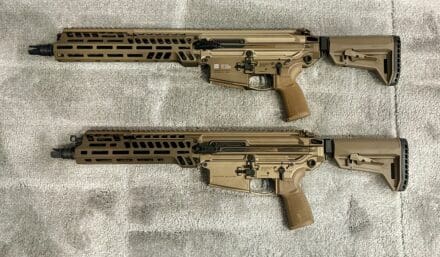
The goal of the effort is to address Soldier recommendations for the M7 and M250 along with program requirements. SIG refers to the resulting weapons as the M7 Enhanced Rifle and M250 Enhanced LMG.
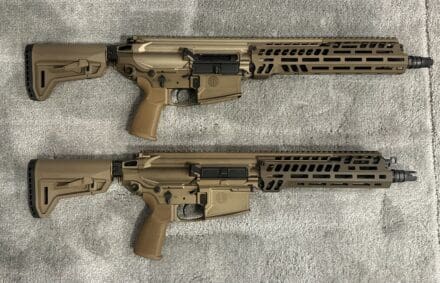
The Army conducted several Soldier Touch Points with SIG and conducted a firing schedule to evaluate the PIE versions of the M7 and M250.
The main concern is weight of the M7 rifle and that is where most of the changes are focused. They ended up developing two versions of the PIE M7, a rifle and carbine. The point of the carbine was to accelerate the evolution of the M16 platform which eventually became the M4 carbine and see where they would end up.
The M7 with 13.5″ barrel currently weight 8.3 lbs dry, without ammo, suppressor, or XM157 FCS. The weights for the two PIE variants are:
M7 7.6 lbs
M7 Carbine 7.3 lbs
Although most of the weight difference between the M7 and the Carbine variant is due to a shorter 10″ barrel and handguard, there were several other changes overall.
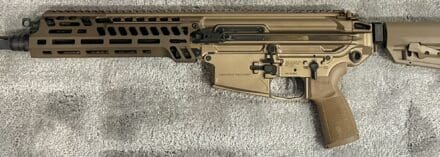
– The side-folding buttstock has been eliminated, but length remains adjustable.
– The upper receiver and operating system have been refined to eliminate weight.
– Tapered barrel.
The handguard facilitated access to the barrel change bolts which have been slightly strengthened.
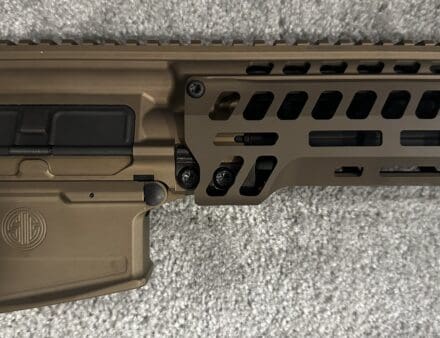
The Army is considering whether the Carbine length barrel meets their lethality requirements.
Additionally, there is a lot of talk on the internet regarding barrel life. The program requirement was for 5,000 rounds which is the same specification as the M4. However, SIG has noted barrel life for the M7 in excess of 10,000 rounds.
As for the M250, the changes have been to accommodate Soldier requirements rather than weight as the Automatic Rifle is already lighter than the M249 SAW it replaces.
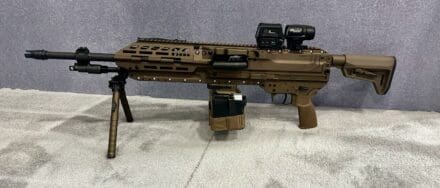
The changes are:
– Streamlined and improved gas system
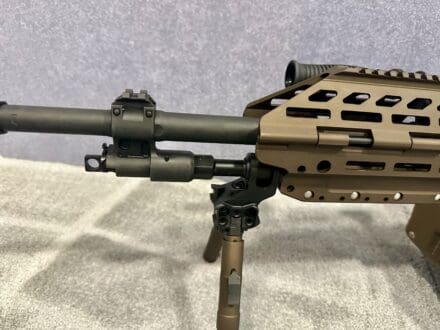
– Improved bipod
– Hinged retainable Handguard to accommodate barrel change
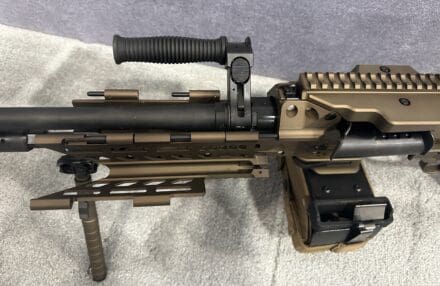
– Quick Change Barrel (although they weren’t shown I’ve seen different barrel lengths)
– Extended pic rail on feed tray (optimized for XM157 Fire Control System)
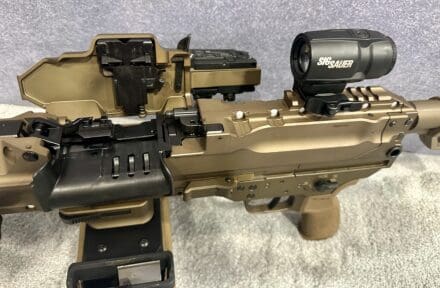
– Cross pins for pintle T&E and mag bloc
– Improved lock and interface for buttstock durability
– Improved magazine which holds the top round in place when it has not yet been fed into the weapon.
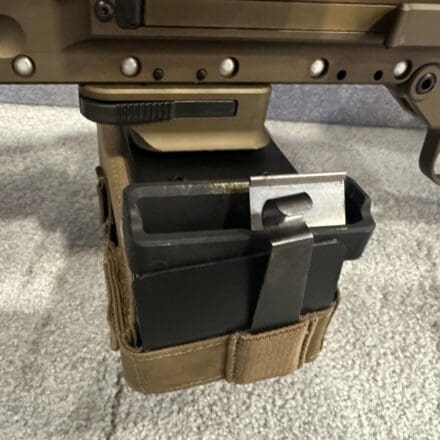
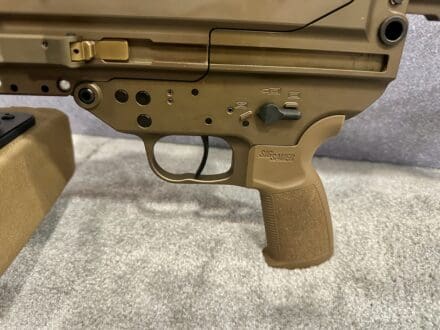
– Opened up trigger guard for gloves
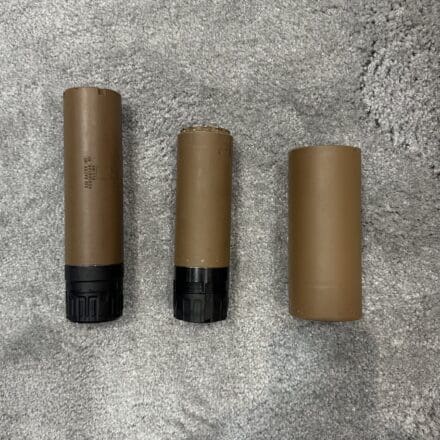
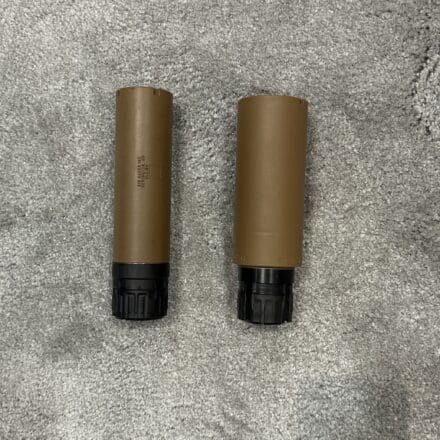
The NGSW weapons are chambered in 6.8x51mm and use a common suppressor. SIG also developed a PIE version which is slightly shorter and has a removable heat shield.
The Army is currently evaluating the PIE variants of NGSW to determine if any of the changes will be incorporated into the program. Regardless, the XM157 Fire Control System remains a part of the program and it doesn’t seem to be shedding any weight.
Well, its encouraging to see that SIG is responding to SM feedback and working to rapidly iterate and improve their weapon system.
This message will influence how I approach challenges in future
Thanks for the breakdown SSD!
I’ll be the first to admit that Sig has done a lot of changes here to improve the weapons…but I have been, and remain, much more of a fan of the M250.
I really hope the captured front hand guard and QC barrel handle make it into the M250’s TDP.
SSD, do you know if the AMU got any responses to their request for match grade 6.8 common last year?
Sig:
“We heard your all of your complaints about the M7’s weight, recoil, and barrel life. So we removed the forward assist and shopped the barrel 3″ shorter!”
Pretty sure the forward assist was removed in the final production version of the M7. I recall seeing comments from people about ‘how will you close the bolt without it?’ at that time.
As to Sig addressing Soldier feedback, they wouldn’t be doing that if they didn’t have some guidance from the Army to do so. Mostly because there is no guarantee they will make any money off of it, and this was not a trivial amount of work done on both weapons. So if the Army is being proactive and addressing Soldier feedback, Kudos to them. It took almost thirty years to go from the M16 to tbe M4; the Army looking at shorter barrels for the M7 at this point suggests a much more rapid feedback mechanism from Soldiers based on these weapons’ performance in the field than I’ve ever seen.
I’d love to see data stating that soldiers are wanting a shorter barrel on an already over-pressured system. This will undoubtedly make accuracy, barrel life, concussive blast and recoil worse- all of which were problems discovered from the 101st’s testing.
The weapon mitigates that with the suppressor and the weapon is designed to be operated suppressed.
“I’d love to see data stating that soldiers are wanting a shorter barrel on an already over-pressured system. This will undoubtedly make accuracy, barrel life, concussive blast and recoil worse- all of which were problems discovered from the 101st’s testing.”
Umm pretty easy to get feedback from the Soldiers actually. If the gun is front-heavy (like it appears to be) and they say they want the center of gravity moved rearward for better handling. Another complaint likely to be heard could be that the gun is too long (with the suppressor) and makes clearing rooms difficult. The project manager would extrapolate from those comments that reduced barrel length would be needed. When Soldiers are asked their opinions, they aren’t informed of what the trades are. That would be biasing the survey.
Also, most Soldiers are going to say these things because it is heavy, not realizing what the trades are for muzzle velocity, pressure, etc. Most wouldn’t care about the increase in pressure so long as it reduces weight and is easier to handle.
As to the concussive blast; pretty sure the M7/M250 are not supposed to be used without the suppressor. Meaning shooting like that where overpressure is a concern would be an edge case versus common.
The only person documented (not bro science “I know a guy” crap) saying there were issues with accuracy/barrel life was CPT Trent. And his reasons for saying what he did were questionable at best: His research was not repeatable nor verifiable since he didn’t document his findings properly; And essentially he was the stooge for the Marine Corps to try and not adopt the M7. No bias there!
If you don’t believe that Soldiers will say that they want a shorter barrel in isolation of understanding what those effects may be, I don’t know what to tell you.
By his own admission CPT Trent did not actually measure the barrel erosion he claims he saw with his naked eye. PEO representatives were unable to replicate his findings.
Obviously it’ll shed velocity compared to the full-sized rifles. 6.8mm Common is gassed up already, it won’t be much in the big picture and hopefully big Army will see the benefit versus the velocity loss. I see this as a major step in the right direction for the M7. Similarly, the M250 would benefit from a shorter barrel for the role it is meant to fill.
No consideration for a 25rd mag? My thinking would be it would have been at least supplied as a gee-whiz to take some of the starch out of the basic load argument.
The questions I have- Will the lightening further reduce durability in a gun that’s already been guestioned for that? Will the velocity loss for the carbine make the 6.8 even worth it as opposed to a 7.62 nas3 case when you factor in the everything? If everyone can get Nas3 M80-a1 with lower pressure, easier existing weapon compatibility, longer barrel life, likely quieter, etc, does the 10″ gun really make sense? If you’re chained at the hip to 6.8 it’s better, but aren’t you whittling away at the capability you were going after in the first place? Isn’t that what we’ve done with the M4? Took a round that was ok in a longer barrel, shortened the guns due to reality, and realized it’s not super great?
No one of any actual importance has questioned the durability of the M7. The Army is currently weighing the ballistic of the shorter barrel and lower weight against what they want to archive against Soldiers complaining their gun is too heavy. I can say that one of the reasons it is so heavy is the XM157. I wish they could put that thing on a diet.
Obviously the core spec of the XM157 is that it is an LPVO. How wed is the Army to it being so and if there is enough concern wouldn’t a shift to a fixed, low power optic with the same digital scalability still meet the same intent? Less lenses, less internal mechanisms, smaller footprint.
Should be re-competed if they are going to compromise on ballistic performance in exchange for a shorter barrel.
That isn’t how this works. You ever heard of the M4 carbine?
Yeah, 30 years later with the M16 fully fielded. Not as a backdoor to lower requirements because the candidate they selected is inadequate.
Of course it’s the same thing. It wasn’t fielded to be that short or light or fire that cartridge. How dare they change systems!
What you’re telling me is that you absolutely nothing about how acquisitions works and hats okay. Just go, “okay, got it” and move out. Otherwise, the people who do know better just look at you like an idiot.
Please don’t be disingenuous, it’s not the same thing.
They are changing the requirements of a weapon system shortly after selecting it because it has shown to be inadequate after user testing.
Ever heard of IVAS? It got re-competed because what they selected turned out to be crap. So is the M7.
The velocity requirement was the fundamental parameter behind this program, which the shorter barrel does not meet. There is no more clear cut case for a re-compete than this.
No, no, no… there’s not going to be another competition. Overmatch has been achieved. Congress knows it even if you won’t accept it and they hold the purse strings. If you lot (who btw, consist almost exclusively of people who will never use NGSW) succeed in killing NGSW, you will succeed in giving the US military nothing. They aren’t going to try over because they didn’t buy what you wanted. It just doesn’t work like that.
Why would they make it lighter? Did you watch SecWar’s speech to the FOGOs? We are weak as a society. The greatest generation kicked ass carrying a 9.5 lbs rifle with a basic load of 88 rounds. That guy weighed about 135 lbs. he was all muscle thanks to growing up during the Depression and then fighting across Africa, Asia, and Europe.
There’s a lot about the M7 I don’t like, including the weight and ammo weight/bulk.
That said, the M7 does provide some increased capability and refining it is a good thing. And the M250 looks like it will be a really great replacement to the 249.
So many detractors have never worked acquisition or DoD R&D programs. Many would be happy to stagnate because the M4 “gets the job done”.
In fairness, the greatest generation soldier succeeded against the enemy of the day because that 9.5lb rifle overmatched the enemy of the day. He wasn’t carrying the equipment his modern counterpart was carrying. How would that same soldier with his M1 Garand fair against a modern equipped foe? (Probably still not bad because the mindset was geared to total war.) Overmatch is solely asymmetry in your favor. The ability of that soldier to assume his best Camp Perry marksmanship position to place that .30cal round at 500yds would be hindered by a modern foe with lighter weapons and greater mobility and an ability mass fires that overmatch the Garand’s power.
That said, 100% agree with your stance that NGSW/M7/M250 is what we have, does what it was asked to do, and provides much capability over the legacy weapon. These moves, which maybe not in their entirety but most likely partially, will create an “M7A1” or “M250A1” are just a progression of a living program and a relatively new program at that. The M7s that will be issued years from now may be totally different yet. We were making mods to the M16s and M4s years, and even decades, after their adoption. All done with the goal of making them better as they continuously should be.
You’ve staked your flag on the NGSW hill since the very beginning, it comes at no surprise you’ll die on that hill. Unfortunately that’s also going to get other people killed.
Congress wanting it is not the convincing argument you think it is, like them and the brass pushing it you want an M4 replacement irrespective of outcome, it’s the shiny new toy syndrome.
Having it re-competed doesn’t mean killing it, that’s a strawman. If Sig’s entry truly is the best then they’ll have no problem winning it with the lowered velocity requirement.
So they should field the 13” M7, given you think weight is not an issue.
Editor’s note. Tom, Fred, pick a name. This isn’t a real person anyway, so why should I bother with you? If you want to have a substantive discussion, use your actual name and your actual credentials. Otherwise, you look like a jackass.
They’re still providing the 13″ barrel version. The 10″ version is additional.
And did you ever think that the Army asked for a version with a shorter barrel and provided a contract mod to do it?
What matters is what’s going to get fielded, issuing a token amount of 13” M7s doesn’t change the substance, just makes a mockery of it. It’s the M27 IAR school of (corrupt) procurement all over again.
The Army didn’t ask for a version with a shorter barrel, they asked to lower the weight after coming to the realization it was too front heavy post user testing. Which of course was conveniently done after awarding the contract and not before, as should have been the case if things were done properly, but that wasn’t the aim here.
As a result Sig came up with the shorter barrel to reduce that weight, nevermind it no longer meets the core requirement of the program they just won.
“Please don’t be disingenuous, it’s not the same thing.
They are changing the requirements of a weapon system shortly after selecting it because it has shown to be inadequate after user testing.
Ever heard of IVAS? It got re-competed because what they selected turned out to be crap. So is the M7.”
The velocity requirement was the fundamental parameter behind this program, which the shorter barrel does not meet. There is no more clear cut case for a re-compete than this.”
Okay, so you get your way and cancel the M7… Congratulations, you killed the NGSW program completely.
IVAS was a suite of tools under one name, just like the NGSW. You kill a program in the DoD, it means the whole program. Also, it was not fielded, which is why they can do a re-compete more rapidly.
NGSW was from the start, a SYSTEM of weapons for the close combat squad. You didn’t see them picking the bullpup from GD, the ammo from TruVelocity, and the M250 did you? That’s because the contract was for one vendor’s rifle/AR/round.
So kill the M7, and the rest goes as well. Which if that’s what you want, fine. But don’t think that the army will be able to pivot to anything else anytime soon since these were fielded. The last weapon that was almost fielded was the XM8. It was killed as a program in 2004 IIRC. It took the Army over ten years to get to the point where they could go back and ask for funding for a new weapon.
The time to do like you suggest was before the Army procured these weapons. That ship has sailed.
Re-competing it doesn’t mean killing it, nor does it mean it will take a decade if they were to do so, just like it isn’t taking a decade with the re-compete of IVAS.
You do realize that it’s the main component that got re-competed with IVAS, right? Also, IVAS was fielded in greater numbers than the M7.
Yes, you’d do it all over again as a system. Although in fairness that’s just an issue for Sig’s entry because the GD/TV bullpup can run with Sig ammo, it just doesn’t need to be loaded to those insane pressures.
Which also highlights another glaring issue with how the winner of this program was chosen, not only are they changing the velocity requirement post award but the ammo submitted with Sig entry never delivered on the weight reduction requirement. Given for all intents and purposes it weights the same amount as its brass equivalent.
“The time to do like you suggest was before the Army procured these weapons. That ship has sailed.”
That’s called a sunk cost fallacy, something the DoD is largely incapable of grasping.
“Re-competing it doesn’t mean killing it, nor does it mean it will take a decade if they were to do so, just like it isn’t taking a decade with the re-compete of IVAS.
You do realize that it’s the main component that got re-competed with IVAS, right? Also, IVAS was fielded in greater numbers than the M7.”
Okay, so if the IVAS was fielded in greater numbers than the M7 as you claim, what’s it’s nomenclature?
IVAS doesn’t have any nomenclature (that I’m aware of) because it was never fielded. It was issued to units temporarily for testing, but never put permanently on their property books.
“Yes, you’d do it all over again as a system. Although in fairness that’s just an issue for Sig’s entry because the GD/TV bullpup can run with Sig ammo, it just doesn’t need to be loaded to those insane pressures.”
So you want to go back through a round of competition? Sig has had fhe most time to work with the 6.8x51mm rounds, and the rounds are tuned to their guns. Any competitor coming in at this point would have to have at least 6 months /1year to get their gun design worked out and then submitted for testing. Looking at another year for developmental testing, along.with getting them into Soldier’s hands for evaluation. Then another year after a down select has been made for the same type of testing (Developmental/Soldier in the loop). Then add on at least 6 months for any protests. All of that time costs money. And you would be likely spreading it across three vendors at the start. So in actuality, that would cost more in money and time.
“Which also highlights another glaring issue with how the winner of this program was chosen, not only are they changing the velocity requirement post award but the ammo submitted with Sig entry never delivered on the weight reduction requirement. Given for all intents and purposes it weights the same amount as its brass equivalent.”
Ummm… the vendor isn’t changing anything without the Army telling them. As for the weight reduction, what are you comparing it to? It’s lighter than 7.62 ammo, which is what the requirement was.
“That’s called a sunk cost fallacy, something the DoD is largely incapable of grasping.”
You are correct It is a sunk cost at this point. However, you are overlooking one key difference between the DoW and a business: They are funded directly by Congress.
If Congress (the same people who can’t do the one thing they are supposed to; pass a budget) are told that NGSW is cancelled, it will get prioritized for other things. That money doesn’t just sit in some Scrooge McDuckian vault labelled ‘NGSW’ waiting for the DoW to spend it. And individual Soldier lethality is not at the top of DoW’s new spending priorities now: it’s ships, aircraft, and drones. If they needed to re-compete the whole thing like happened to IVAS, it should have been done before type classification.
So yes it is a sunk cost, and cutting
This guy can’t decide what his name is and is using more than one to make it sound like he has a better argument. His argument is unsound using any name.
“Yeah, 30 years later with the M16 fully fielded. Not as a backdoor to lower requirements because the candidate they selected is inadequate.”
Ever hear of the M16A2? Pretty sure it was the result of changes to the 5.56mm ammo due to making it NATO STANAG compliant. Pretty sure they didn’t re-compete the whole 5.56mm rifle contract because the M16A1 was “inadequate” with the M855 projectile.
The M16A1 was fielded within three years of rhe M16’s adoption, once again due to issues with ammo that made the M16 “inadequate”. They didn’t re-compete the whole contract then either. And the M16 was not pure-fleeted to the DoD before the switch to the M16A1, which kind of negates the argument you’re making here.
Thinking that tbey would re-compete the contract is wishful thinking at best. Because the reality is if they do that then Soldiers get NOTHING for at least five years likely, as a downselect would have to take place along with additional testing.
It is much more efficient to iterate on the design you have in production than to have to stand up an entirely new production line. Because the reality is, no one else is tooled currently for manufacturing rifles with 6.8x51mm ammo for large scale production
The changes made to the M16 did not invalidate the requirements upon which the award was won, they didn’t lower performance, they increased it.
Iterating on a design that isn’t fit for purpose is called a sunk cost fallacy.
I’m curious what you experienced in the acquisition community is. You want to speak with a great deal of authority on this, and I’m curious as to whether or not you actually have any experience in this business, or are just saying that sound good to you.
Once you’ve answered, I’ll know which direction to take this conversation.
100% agree with that, but it has been questioned and we’re a more or less flat society unlike the Army. I think the 157 could use both a diet and simplification, perhaps a refocus on the modules. It’s hard to say thermal is the end all, but sacrificing the ranging, connect-ability, accelerometers, compass etc to focus on a as needed thermal module would go a long way to simplify, lighten, and eliminate some emissions.
Doesn’t tbe optic also include an IR laser? You might still need a flood but you don’t need a PEQ. that probably helps. Unless I’m mistaken and you still need a PEQ.
Interesting. The 13″ gun now weighs about the same as an M16A2, but the center of gravity will be closer to your body until you mount the can.
My only real criticism of this rifle is that it will be too punchy for the average soldier to fire well. Even with a great optic, in the stress of combat a rifle with that much energy is just not going to land follow-up hits. The M4 was idiot proof. The recoil was minimal and easy to manage. I don’t see the average soldier hitting follow up shots with the M7 in combat scenarios. Feels like they would have been smarter to pursue a 6.5 bullet that shot as easily as an M4. A big bullet alone doesn’t increase lethality… hitting the target does. The Army will say “the 6.8 is hyper lethal, the 6.5 isn’t able to penetrate as well,” to which I’d say, if that’s all that mattered you’d give every 11Bravo a .50 BMG.
Idiot proof? They still aren’t hitting anything in combat with the M4. Look at how many Soldiers can’t even qualify with it in peacetime, at a range where there’s no one shooting at them.
I really enjoy watching guys fall in love with a weapon system they have complained about since the day it was adopted back in the 60s.
For once the Army is making the Infantryman more lethal and you guys don’t want it. “More lethal? Ick!
He does have a point and the M4 is the better option for a good number of CONOPS. I really hope that they let line companies keep the M4 in their arms rooms and allow them to pick M4 or M7 depending on the needs of the mission. We’ll see if that happens.
I promise you that even experienced shooters will struggle with follow-up hits with this relative to the M4.
Practice will overcome deficiencies.
No amount of training can overcome physics.
Tell that to the kid who carried a BAR across Europe.
It was still heavy and to use it effectively they had to use it in the prone or kneeling. The “walking fire” tactic it was originally meant for was almost a pure no go. Watch old training films and they almost exclusively used it in the prone. Many soldiers would remove the bipod it came with to make it just a touch lighter. Also soldiers and marines back then didn’t have an additional 65lbs of light weight gear with them.
The most important lesson I learned in the military regarding marksmanship was that the only effective fire was accurate fire. If you’re not hitting what you’re aiming at, you’re just making noise and wasting ammunition. You want suppressive fire, use a machine gun.
Genuine question SSD,
You’ve said that 210 with 5.56 or 120 with 6.8…combat load doesn’t matter without troops being able to hit things.
Does the Army have any plans to revamp its marksmanship programs/range time and boost the actual shooting skills of the force, as a complement to NGSW?
Absolutely none. They had planned on fixing the issue with technology, specifically the XM157.
At the speed-of-internet, this may very well qualify as a necro-post, but doing it anyway.
Technology won’t fix the problem. Army training books definitely won’t fix the problem. Even “train the trainer” programs won’t fix the problem.
The only thing that will solve the Army’s marksmanship problem is a weapons-training-specific branch (like the Marine’s Weapons Training Battalion, or the Air Force’s Combat Arms Training & Maintenance folks), along with external evaluations and organizational inspection programs to validate and qualify weapons training competence, proficiency, and expertise.
The Army is the only branch of service without a WTB-like organization. When Units are allowed to self administer, proctor, grade, and report weapons qualification in the absence of ANY inspection program, all efforts to fix the problem will fail. There’s ZERO organizational reason to fix the problem, and all efforts will be nametape-driven and evanescent, lasting only as long as said individual holds whatever key position cares about weapons mastery.
Writing new training books is like Chamberlain waving a piece of paper and claiming to have handled 1930’s Germany.
I agree 100%
It would probably come as a surprise to you that majority of ammunition used in combat is used as suppressing fire so your maneuver element can move to a more beneficial position to engage. I’m not saying that BRM skills aren’t useless or should be overlooked but most dynamic shooting for infantry is for fire an maneuver tactics instead of CQB point shooting or precision marksmanship.
You have a point, but the M7 is just going to maneuver/combat units. Not everybody. And if an infantryman can’t handle the M7, their direct platoon leadership should square them away. I agree that a different option probably would have been better for a carbine, like the FN IWS with the 6.5 LICC. But, that’s just not an option because of the way the Army wrote the requirements. So need to make the most of what we get, because the NGSW does have good things going for it.