Wilcox Ind VIPR

Archive for the ‘AUSA’ Category

AM General Building a Strong Foundation with Mission-Ready Technology at the AUSA Annual Meeting 2026

Friday, October 9th, 2026

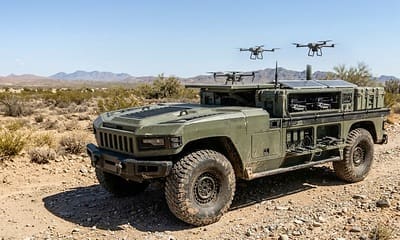
SOUTH BEND, Ind., Oct. 9, 2026 — AM General, global leader in military mobility solutions, will showcase platforms that are building foundational capabilities for Warfighter success at the Annual Meeting and Exposition of the Association of the U.S. Army (AUSA) Oct. 12 – 14, 2026, Booth #1925, Hall B, at the Walter E. Washington Convention Center. The company is featuring the next generation, more powerful, and redesigned HUMVEE platform, the fully autonomous Unmanned Ground Vehicle (UGV) with advanced AI technology, and the JLTV A2 integrated with the latest drone and C-UAS technology.
“I’m looking forward to this year’s AUSA as there is no better time to demonstrate our evolving capabilities to our longstanding customer, the US Army, and how we are adapting to the speed of change in the modern battlefield,” said AM General President and CEO, John Chadbourne. “From a new powertrain to advanced autonomous capabilities and increased lethality, our systems provide a strong foundation for the Warfighter and their mission.”

On display at the show will the AM General UGV with an integration with the defense technology company, XTEND (NYSE: XTND). XTEND Nest is a XOS-powered mobile launch pod designed to enable aerial robotic capabilities to deploy from a fixed or mobile location. XOS is XTEND’s system for Physical AI. On the AM General UGV, the NEST enables the vehicle to carry an aerial system forward and establish a mobile launch point closer to where the capability is needed. This allows Warfighters to stay farther away from potentially dangerous areas. On the floor, the UGV will carry the Scorpio 1000 gesture-controlled system for precise missions in complex or GPS-denied environments and can deliver ISR and reconnaissance with rapid deployment.
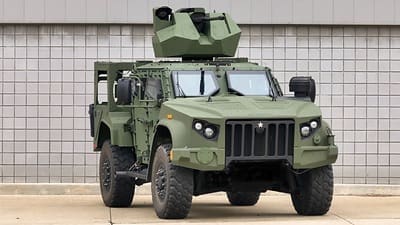
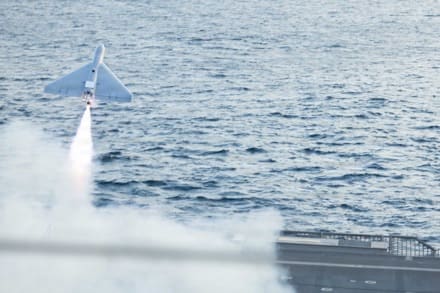
Also at the show will be the JLTV A2 featuring added lethality and C-UAS capabilities from Rafael Systems Global Sustainment (RSGS), LLC. The JLTV A2 is the next generation light tactical vehicle currently being delivered to the US Army and boasts significant improvements from the A1, including a new powertrain, added corrosion control, and more sound reduction in the cabin. At the show, The JLTV A2 will integrate the RSGS Samson 30mm Remote Weapon Station and the Iron Wasp autonomous, vehicle-launched C-UAS aerial drone system. The RWS is part of the combat-proven SAMSON RWS family which has been integrated into thousands of tracked and wheeled vehicles worldwide. The Iron Wasp drone is designed for armored and tactical vehicles to intercept enemy drones and loitering munitions while stationary or on the move and can interface with native or stand-alone sensors. Both RSGS systems can be easily integrated on the flexible JLTV A2 platform and add to the robust capabilities of this formidable vehicle.
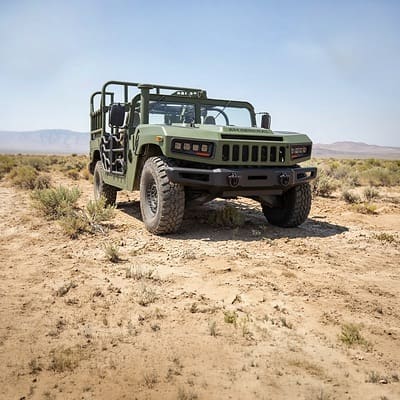
The company is also presenting the next-generation HUMVEE, showcasing the first step in a multi-phase modernization of the iconic tactical vehicle platform. The vehicle features a redesigned exterior, including a new hood and front grille engineered to support an upgraded powertrain, along with a long-travel suspension designed to deliver enhanced mobility and durability across the most demanding terrain. Production for Phase one of three of 3 is planned for late 2027. Subsequent phases will build on this foundation with enhanced crew ergonomics, a modern digital cockpit and vehicle electronics architecture, and integration of advanced autonomous and optionally manned capabilities.

At the heart of the upgraded platform is a new Common Rail Direct Injection (CRDI) engine producing 250 horsepower and more than 500 lb-ft of torque and is paired with a six-speed automatic transmission. This common powerpack is also being integrated across multiple AM General light tactical vehicle programs, including the AMG UGV and HUMVEE Hawkeye 105mm mobile artillery system. In addition to increased power and improved fuel efficiency, the powertrain features wide-ratio gearing and an electronic range selector that simplifies configuration for either left- or right-hand-drive applications. The common architecture is designed to increase performance, expand mission flexibility, and create greater commonality across AM General’s next generation of tactical vehicle platforms.
B.E. Meyers & Co., Inc. to Exhibit at the 2026 AUSA Annual Meeting & Exposition

Friday, October 9th, 2026

B.E. Meyers & Co., Inc.® is proud to announce its participation in the 2026 AUSA Annual Meeting & Exposition, taking place October 12–14 at the Walter E. Washington Convention Center in Washington, D.C. Attendees are invited to visit Booth #4025 to explore the latest advancements in photonics and warfighter?focused technologies.

The AUSA Annual Meeting is the largest land?power exposition and professional development forum in North America. Each year, it brings together military leaders, industry innovators, and international partners for three days of exhibits, discussions, and technology showcases that support the U.S. Army’s mission and modernization priorities.

At this year’s event, B.E. Meyers & Co., Inc.® will feature several new and flagship products, including:

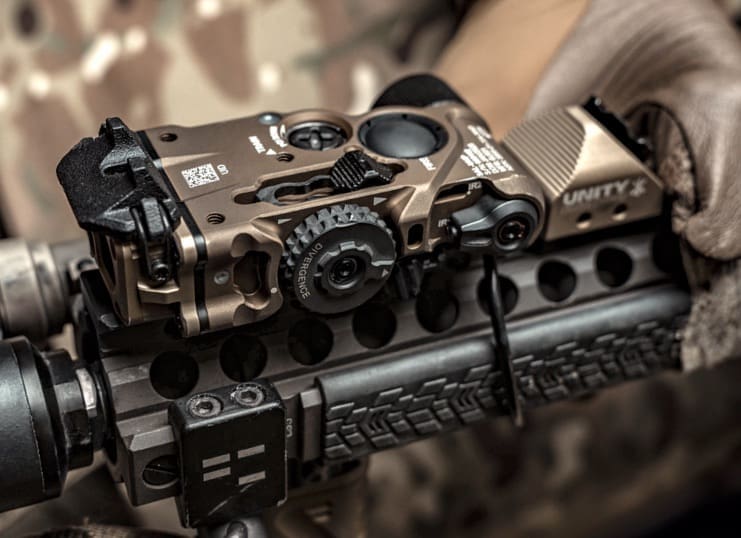
  • DAGIR®?V1 – the newest evolution in multispectral aiming and illumination designed for demanding operational environments.
  • VSLAP® – a compact, next?generation infrared signaling and illumination device engineered for versatility and field durability.
  • Additional operationally proven systems across the company’s laser aiming, illumination, and signaling product lines.

We look forward to connecting with partners, customers, and industry professionals at AUSA 2026. Visit Booth #4025 to interact with our business development and product teams, and learn how B.E. Meyers & Co.® solutions support today’s mission requirements.

DAGIR®-V1

VSLAP®

Visit the Ukrainian Defense Tech Pavilion at AUSA

Friday, October 9th, 2026

This year’s AUSA includes Outdoor Exhibits, in particular I’d like to direct your attention to the Ukrainian Defense Tech Pavilion which will house 17 Ukrainian companies who offer capabilities making a daily difference in their conflict with Russia.

It’s just a short walk from the convention center.

Colt to Attend 2026 AUSA Annual Meeting & Exposition 

Friday, October 9th, 2026

West Hartford, CT — October 9, 2026 — Colt is proud to announce its participation in the 2026 Association of the United States Army (AUSA) Annual Meeting & Exposition, taking place October 12–14, 2026, in Washington, D.C. Colt’s leadership team looks forward to connecting with military leaders, industry partners, customers, and members of the global defense community at Booth #7547. 

“AUSA is where we engage directly with the people shaping the future needs of the warfighter,” said Colt President and CEO Jillair Kubish. “Colt has served alongside U.S. and allied forces for nearly two centuries. Our history gives us a strong foundation, but it does not define the limits of where we can go. We are evolving as a company, and always committed to those who serve.”  

Colt is focused on developing new capabilities for the global defense community through continued investment in engineering, manufacturing, product development and strategic partnerships.  

“We look forward to collaborating with our industry partners, and aligning with the U.S. Army, the Department of War, and our federal law enforcement partners on their lethality needs,” said Thomas Sullivan, Colt Vice President of Government Sales & Programs. “AUSA gives us the opportunity to listen, understand where requirements are heading, and show how Colt can help meet them.”

The 2026 AUSA Annual Meeting & Exposition will take place October 12-14, 2026 in Washington D.C. Attendees are invited to visit Colt at Booth #7547 throughout the event to meet the team and learn more about Colt’s capabilities.

Galvion Showcases Cortex EVO HALO Upgrade Pathway for US Army NG-IHPS at AUSA 2026

Thursday, October 8th, 2026

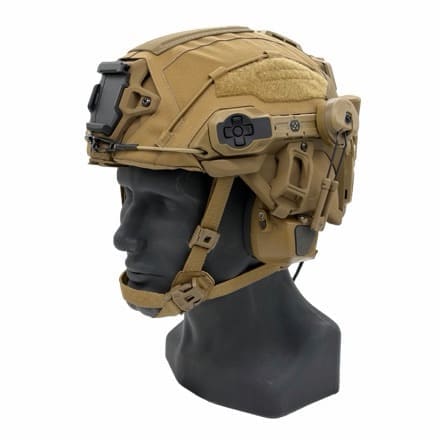
Galvion, a global leader in the design and manufacture of innovative head systems, power and data management solutions, and integrated soldier systems, will showcase a new Cortex™ EVO HALO integration concept for the U.S. Army’s in-service Next-Generation Integrated Head Protection System (NG-IHPS) at AUSA 2026 in Washington, D.C., October 12–14, Hall E, booth 7917.

The NG-IHPS concept marks the latest evolution of Galvion’s Cortex EVO architecture and the first time EVO HALO has been integrated onto a non-Galvion helmet. Designed as an externally mounted implementation of Cortex EVO, HALO provides a potential pathway to introduce advanced power, data and headborne capabilities onto both new and fielded helmet platforms, without requiring replacement of the underlying protective system.

First introduced in its deeply integrated Embedded configuration at SOF Week 2026, Cortex EVO brings protection, power, data and compute together within a unified headborne architecture. The HALO configuration, introduced on Galvion’s Batlskin Caiman® helmet at Eurosatory 2026, extends that same architecture through an externally mounted approach, providing greater flexibility for integration across existing helmet platforms.

Applying EVO HALO to NG-IHPS takes that approach a step further. By adapting the architecture to a non-Galvion helmet, the concept illustrates how advanced headborne capabilities could be introduced to the U.S. Army’s fielded NG-IHPS fleet while continuing to leverage the existing protective platform.

The approach provides a potential upgrade path as soldier-worn technologies and operational requirements continue to evolve.

The NG-IHPS configuration is being developed to support integration with current and emerging soldier-worn technologies, including the Enhanced Night Vision Goggle-Binocular (ENVG-B) and Binod platforms. Through its common power and data backbone, Cortex EVO can support visual augmentation, sensing and awareness technologies, digital communications and other headborne capabilities within a unified system environment.

Galvion’s AlertCentr™ software enables mission-relevant information to be managed at the headborne level, including configurable visual and audio cueing designed to allow operators to access and act on critical information without diverting attention to secondary devices. The open architecture also enables Galvion-developed and third-party technologies to operate within a common system environment.

Jonathan Blanshay, Founder and Executive Chairman of Galvion, said: “Modernization doesn’t always have to mean replacing proven equipment. Embedded EVO shows what is possible when integration begins at the helmet design stage, while HALO provides another pathway for helmet systems already in service. By integrating EVO HALO onto NG-IHPS, we’re showing how an existing protective platform could evolve to support new capabilities as requirements and technologies advance, while preserving the investment already in place.”

Qualcomm Government Technologies and OKSI Announce Collaboration to Deploy OMNISCIENCE Autonomy Software Portfolio

Thursday, October 8th, 2026

Partnership brings AI/ML-enabled autonomous capabilities to defense platforms, optimized for the Qualcomm® QCS8550 and scalable across Qualcomm’s IoT processor portfolio

LOS ANGELES — OKSI and Qualcomm Government Technologies, Inc. (QGOV), a division of Qualcomm Technologies, Inc., today announced a collaboration to deploy OKSI’s OMNISCIENCETM autonomy software portfolio on Qualcomm technologies. OMNISCIENCE delivers AI/ML-enabled capabilities through computer vision — including visual navigation, object detection and recognition, mission execution and more — purpose-built to bring autonomy to unmanned platforms operating in complex, communications-constrained environments. The software portfolio has been optimized for the Qualcomm® QCS8550 processor and is designed to scale across Qualcomm Technologies’ broader IoT processor portfolio, providing platform developers and defense system integrators with a flexible, production-ready path to deploying edge AI capabilities at scale. The collaboration will be showcased at the Association of the United States Army (AUSA) Annual Meeting 2026, taking place Oct. 12-14 in Washington, D.C.?

OKSI’s OMNISCIENCE is offered as either individual containerized capabilities or tightly coupled, interoperable modules providing next-level autonomy and adaptability to virtually any air platform. Users can operate truly autonomous missions. Qualcomm technologies deliver the on-device AI inference, computer vision processing and advanced image signal processor (ISP) capabilities that OMNISCIENCE relies on for real-time autonomous decision-making at the edge.

“With OMNISCIENCE on the Qualcomm QCS8550 processor, autonomy stops being a multiyear development program and becomes a design-in decision,” said Chris HolmesParker, CEO, OKSI. “Platform developers can source at volume against manufacturing infrastructure that already exists. They will be equipped to upgrade autonomy across a fielded fleet or stand up an entirely new product line from the same proven portfolio, moving at the speed of a software release and the scale of a production supply chain.”

The Qualcomm QCS8550 processor’s heterogeneous compute architecture supports dynamic performance and power scaling, enabling optimized size, weight and power (SWaP) profiles suited to space- and energy-constrained deployments. Platform providers leveraging Qualcomm processors with OMNISCIENCE benefit from an open Ubuntu Linux-based software environment with access to Qualcomm acceleration technologies and compatibility with widely used open-source AI and computer vision frameworks — reducing integration complexity and accelerating time to deployment. Together, OKSI and Qualcomm Technologies are enabling a new class of edge-intelligent autonomous platforms designed for reliable performance in the most demanding environments.

“The industry is entering a new era in which intelligent systems do more than respond — they understand context, make decisions and take action,” said Kim Koro, Senior Vice President, Qualcomm Government Technologies, Inc. “Making that vision real requires an ecosystem, efficient edge compute and platforms that can scale across devices and missions. Together with OKSI, Qualcomm Technologies is helping move autonomy beyond demonstrations and toward deployable, mission-ready capabilities that can operate across connected fleets and demanding environments.”

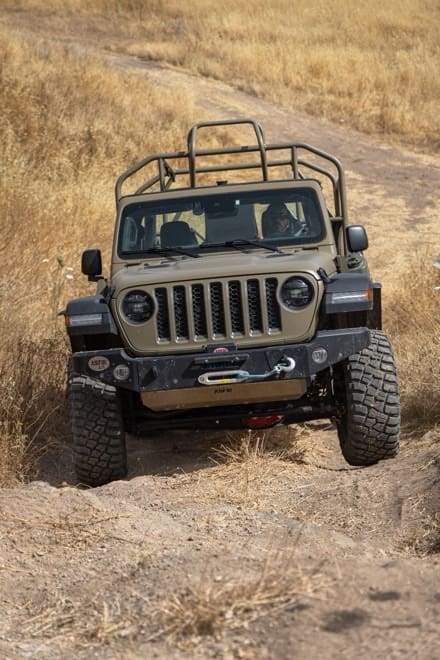
Plasan and Asfir 4X4 to Unveil Stormer: A Light Tactical Special Operations Vehicle (SOV)

Thursday, October 8th, 2026

Designed to rapidly deploy up to 12 personnel with mission-configurable capability

AUSA | Washington, D.C. | September 12-14, 2026 | Booth #2407

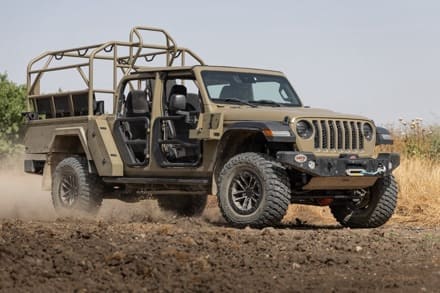
Oct 7th, 2026, Plasan and ASFIR 4X4 will unveil the new STORMER, a highly modular light tactical vehicle designed to meet the evolving requirements of special operations forces, reconnaissance units, rapid-response teams, and other missions where mobility, payload capacity, rapid deployment, and operational flexibility are critical.

Modern military and special operations forces increasingly require a vehicle capable of rapidly transporting larger teams, mission equipment, and casualties across challenging terrain while remaining easy to deploy, maintain, and sustain.

To address this need, Plasan and ASFIR 4X4 developed STORMER, a versatile tactical platform that combines the logistical simplicity of a commercial vehicle with the capability and flexibility required for demanding military operations.

Designed to carry up to 12 personnel and more than 1,000 kg (2,200 lb.) of payload, STORMER combines a proven commercial vehicle platform with a reinforced chassis and driveline, high off-road mobility, and a highly configurable mission architecture. Designed for airborne transport and rapid deployment, the vehicle enables forces to move personnel and mission equipment across demanding terrain.

At the heart of STORMER is a rugged Jeep® Gladiator-based commercial off-the-shelf (COTS) platform, enhanced through Plasan’s automotive engineering expertise. The vehicle is powered by a 280-horsepower, 3.6-liter gasoline engine paired with an eight-speed automatic transmission, providing the power and drivability required for demanding operational environments.

The vehicle’s reinforced chassis and driveline, including upgraded Dana axles, are designed to support increased payload and durability while maintaining the mobility expected of a tactical vehicle. A modular roll-over protection system (ROPS) provides enhanced occupant protection while supporting 360-degree visibility and situational awareness.

STORMER is designed to adapt rapidly to changing mission requirements. Its configurable rear platform can support troop transport, logistics, medical evacuation (MEDEVAC), weapons, and specialized mission equipment, including radar, counter-UAS solutions, communications systems, and an electric winch. A three-position folding rear door enables rapid troop ingress and egress, secure transport of mission equipment, and a stretcher configuration for casualty evacuation.

The vehicle also incorporates a 24-volt electrical system, blackout driving capability, a communications console, and multiple antenna mounting points, supporting the integration of customer-specific mission systems. The extensive use of commercially available components is intended to simplify maintenance, logistics, and long-term sustainment.

STORMER builds on Plasan’s more than 40 years of experience in survivability, vehicle protection, and automotive engineering, as well as its proven track record with the SandCat family, which is in service across five continents. Developed in collaboration with ASFIR 4X4, STORMER combines Plasan’s defense engineering and survivability expertise with ASFIR 4X4’s extensive experience in off-road vehicle systems and components.


“STORMER was developed to address a growing operational requirement for a rapidly deployable platform capable of carrying larger teams and mission equipment without compromising mobility. By combining a proven commercial platform with Plasan’s engineering expertise, we created a highly adaptable vehicle that can be configured for multiple missions while remaining simple to operate, maintain, and sustain.”

Moshe Elazar, CEO, Plasan

“Our collaboration with Plasan enabled us to transform a proven commercial 4×4 platform into a practical and highly capable tactical solution. STORMER delivers the mobility, flexibility, and robustness required by demanding users while maintaining the reliability and supportability of a commercial vehicle platform.”

Tzachi Oz, CEO, ASFIR 4X4

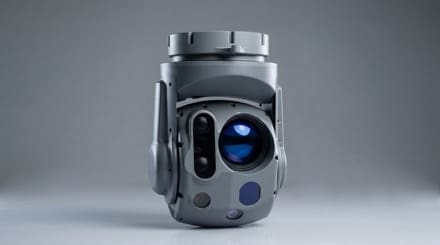
AUSA 2026: Microcon Unveils MICRO-D, a Sub-2 kg Laser Designator EO/IR Payload

Tuesday, October 6th, 2026

New MICRO-D brings target designation and multi-sensor ISR capabilities to small airborne platforms; initial orders secured, with first deliveries expected by year-end

AUSA, Washington DC, October 12-14, 2026, Booth # 2225

05 October 2026 – Microcon Vision, a developer of compact electro-optical systems for small airborne platforms, unveils the MICRO-D, a new lightweight, None-ITAR multi-sensor EO/IR payload incorporating a 30mJ laser target designator. Weighing just 1.9 kg, the system has already received initial orders, with first deliveries expected by the end of 2026.

Designed for small unmanned and other lightweight airborne platforms, the MICRO-D combines ISR and laser target designation in a compact payload. It is particularly suited for platforms operating at lower altitudes, including below cloud cover, enabling them to detect and track targets and designate them for engagement by compatible precision-guided munitions.

The MICRO-D integrates seven sensors and functional channels in a single payload, providing day and thermal imaging, target tracking and laser designation. Its STANAG 3733-compliant laser designator enables the platform to mark targets for laser-guided munitions, allowing small airborne platforms to support the full process from target detection and identification to designation for engagement.

The payload also provides simultaneous video outputs, line-of-sight stabilization, an airborne ISR tracker and inertial navigation capabilities. Optional AI functions include video motion detection and automatic target recognition.

“The growing use of smaller tactical platforms is creating a need for capabilities that until now have largely been available on larger systems,” said Chen Almog, CEO & Co-Founder of Microcon Vision. “MICRO-D was developed to address this gap, allowing smaller platforms to take a more active role in the sensor-to-shooter chain. The initial orders we have received reflect the operational demand we are seeing for this type of capability, particularly in the U.S., where our cooperation withour affiliate CONTROP USA provides U.S. customers with local business presence, effective program execution, local technical and field support, significantly enhancing our ability to serve our customers and partners.”

MICRO-D uses a two-axis gyro-stabilized gimbal and supports Ethernet-based integration, including an SDK and optional MAVLink connectivity. The system is ITAR-free, germanium-free and NDAA-compliant.