

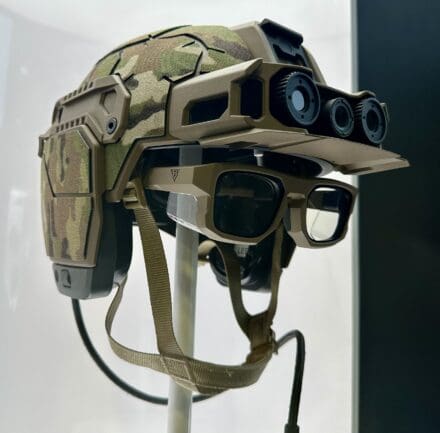
To top off my AUSA coverage I’ve saved the one thing that everyone wants to talk about. Anduril’s Eagle Eye family of warfighter augments is easily the most overhyped defense product release in years. The mainstream press loves it but they don’t know anything about Soldiering or helmet design and manufacture. What’s more, Anduril isn’t offering much in the way of technical specs. Rather, they are relying on a few AI created videos, an impressive list of industry partners, and some static displays as fodder to allow everyone to fill in the blanks with their dreams of what a helmet should be.
When the Army novated the Integrated Visual Augmentation System from Microsoft to Anduril earlier this year I leaped for joy. To be sure, Anduril founder Palmer Luckey knows what he is doing when it comes to Virtual Reality / Augmented Reality. If anybody could get this thing to work, he is our man.
Initially, the Army transformed the IVAS requirement to a Next Gen version but then introduced a completely new opportunity for industry to participate called Soldier Borne Mission Command.
Two companies ended up being selected for SBMC: Anduril who quickly put together a team of industry partners and Rivet which signed on to the Wilcox Industry-led FUSION CLAW consortium.
Concurrently, Luckey took his vision of what he believed Soldiers should be wearing on the battlefield and created the aspirational Eagle Eye system which consists of three physical components:
Heads Up Display (the glasses)
Helmet (what everyone is talking about)
Computer Armor (more on this later)
Underlying everything is Lattice, Anduril’s AI engine which I believe is their greatest asset.
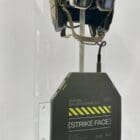
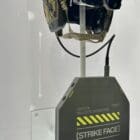
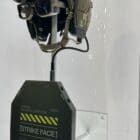
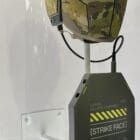
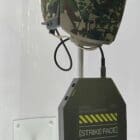
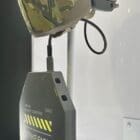
In addition to the HUD and helmet, Anduril went one step further, combining battery and edge processing into a hard armor plate. Some of this has been tried before and hasn’t worked. Quite a bit of it was a materials challenge, but there are also operational reasons why this doesn’t make sense. I’m not going to beat the horse here but if you’ve worn armor for a living you can create your own list. If this thing isn’t stronger, lighter, cheaper, and more efficient than the gear currently used, no one is going to adopt it.
Does Eagle Eye work? According to Palmer Luckey it does but the company hasn’t released any weights, armor aerial density, ballistic performance, or impact mitigation data. Those are the things people who actually wear helmets and armor care about. There’s definitely a cool factor afoot but in the end, if it doesn’t protect as advertised the government isn’t going to buy it and Soldiers aren’t going to wear it.
I for one would like to know more about Eagle Eye aside from some hand built models and even more importantly, I want to see what they’ve done in the SBMC space. The collaborative 3D sand table mission planning capability looks particularly enticing. Likewise, the promise of integrating EW sensors and incorporating a “non-emissive digital laser designator” are huge boons.
I had the opportunity to try an early version of IVAS out years ago. It needed work. Considering Anduril’s Lattice is the Artificial Intelligence backbone that the Army seems to be building its Next Generation Command and Control System around, they’ve got a serious leg up. Remember, the goal of SBMC is to increase situational awareness for the Soldier on the battlefield and provide usable data shared via Android Tactical Awareness Kit within the Soldier’s augmented vision along with data from other sensors, offering a single, clear operational picture.
Show us that and work on the helmet side of things with the industry partners who specialize in the various headborne specialities. For example, the Oakley eyepro is brilliant. Troops love brand names and Oakley is a favorite. If they’re working with Gentex, use more than an Ops-Core suspension and chinstrap. They have been providing helmets to SOCOM for decades now for a reason and Soldiers want what the cool kids got.
Build an innovative helmet, that actually offers improvements over what is currently available and customers will come. The same goes for the compute armor concept.
I can’t wait to see that.
When I asked about their goal for armor protection level all I got was, “They were working to find the right balance.” Which tells me it either does not stop the required threats consistently enough or it’s too heavy to be of practical use.
That being said, if the system ends up being even 50% as good as their hype video claims it will be it will still be a pretty cool system (and 100% better than IVAS 1.2).
Yes, I’m highly skeptical on ballistic ratings. Even the helmet is extremly slim and seems to offer very little compression range.
Given that Meta is involved, there’s a decent chance to consider this as a Chinese-compromised item.
yes, that’s one country connected to Meta we should assume will have access…
Interestingly, Microsoft has been caught using chinese nationals… in China to do some of their cloud engineering services for DoD contracts! I’d wager Meta’s involvement means less Chinese involvement than Microsoft’s IVAS. Not happy about Meta involvement either though.
probably spend some time listening to Lucky and how he talks about the Chinese before making that statement. It’s smug and ill informed.
Indeed. At a minimum listen to the episode with Palmer on Sean Ryan Show.
Sure, but he doesn’t directly control Meta, nor does he have full visibility into how Meta does its business.
Also, Lucky is REALLY good at PR. I don’t believe everything he says.
So, I’ll say I’m intrigued by this. But I’m a tanker and what I see here is replacement for the old CVC. Especially when thinking about the XM30 or the M1E3 the full face shield version coupled with AR might be an excellent tool to improve situational awareness and combat effectivess when buttoned up for long periods.
Btw, I dig the little visor on the sensor suite.
I’m only able to judge based on photos and write-ups, since I wasn’t at AUSA in person this year.
I see this as analogous to a concept car at an auto show. They look really cool, generate lots of excitement, push the boundaries of “what-if” or “wouldn’t-it-be-cool-if”? But never get put into production.
Right off the bat I see several issues:
1. the front mounted sensor suite looks even bulkier than IVAS 1.2 (but yes, the visor is cool)
2. with all that weight and bulk on the front of the helmet, where’s the counter-balance?
3. integrated power-computing-and-armor might sound really cool and sci-fi to a Silicon Valley guy, but its totally impractical for field use. There’s a reason modularity and swap-ability are a thing…
4. name brand eye wear is very cool and all (and kudos to my friends at Oakley), but wearing a pair of beefed up sunglasses under a helmet instead of using a ballistic visor that can be attached to the helmet doesn’t seem like the smartest direction either
So, yeah, while this is a cool concept demonstrator there is still a lot of work to be done to make it practical. At the present time, this makes me think of those cool concepts that were part of the Future Force Warrior program or Revision’s Kinetic Operations Suit… NOT coming to a war zone near you soon.
+1
Palmer went over a lot of that in his latest JRE episode. It’s actually very modular, that’s a part of the reason the glasses were chosen and there are different configurations already for varied jobs , threats etc. . The example you’re seeing there is actually somewhat stripped down.
The battery is in the plate? That just seems like a bad idea, considering how most batteries react when they take serious impact…
I think it’s only the computer/edge device and not a battery, not much better… but maybe a little.
They have claimed to include a battery. In an interview with Joe Rogan, Palmer Luckey suggests you use it as a rear plate to mitigate frag and projectile damage.
Blackhawk Down logic: I don’t intend to get shot in the back
That is of course the most logical place to put it – for cabling reasons as well. BUT, integrating a battery and computer into a plate is just not such a great idea. For one thing, how are you going to recharge or swap out an empty battery on an op, while retaining ballistic protection and computing capability if they’re all integrated? There’s also the very real danger of the battery catching fire when its penetrated or damaged. Even the current CWB with its built-in flame spreading mitigation technology still burns like a blow torch from any punctured cell. Packing a bunch of lithium-ion cells into a ballistic plate with no space for them to vent or expand if damaged or penetrated is not going to be a pleasant experience for the user.
They are using new tech SSB, Lithium Metal Ceramic Anode-Free battery. Since there is no liquid electrolyte, the solid-state battery is non-flammable, non-combustible.
“Your lithium burns & heavy metal poisoning has been deemed to be not serviced related…”
I believe they are using a new battery technology but I don’t know enough about it.
While there’s nothing wrong w/technology that helps the guy on the ground – augmentation is great, but overdependence is not. This is where things start to unravel quickly and where analog training/muscle memory starts to atrophy. A measured approach is something that definitely applies here, but we’ll see how things develop.
Yep the guy will still be taken out buy a fella in flip flops and an AK47
It’s fantastic. Cutting edge design and it will no doubt work.
Take a look at who are the teams Palmer and his pals have working on this project. His particular passion for it – this is his life’s work – I’d say that he IS the BEST man on the planet for this job. Palmer was born for this particular mission, it’s been driving him personally for many years.
The comments? Vet Bro pessimism. Fatigue.
Look, obsolescence happens to every generation of warfighter. Experience is awesome. It can unlock mastery. Few will admit that mastery comes at a cost: the loss of the beginner’s mind. The master is unable to even perceive any novel idea. Instead he has optimized his experience into dogma he must both wield and defend. It is his identity.
The growth mind?
Gone, aged out.
A beginner entertains solutions a master cannot. Guys are aging out, clinging to paradigms with a death grip. They’re not wrong, in the last war.
Tomorrow is a new one. Having fresh minds take a fresh look at unresolved challenges is the epitome of America. Let’s go.
Was this written by AI as a Palmer Luckey promotion?
Per JRE, the plate/battery concept is the rear plate. Dunno if that changes anyone’s thoughts. I’ll say one thing, I gather this is a concept ideation type stage product. As with all technology, dependent on materials science and energy/battery science. Is there something deep in a program in some agency that could bridge those challenges – maybe ?
I am Jassem Roosta — Director and Lead Developer
I am the creator of an advanced military artificial intelligence system designed to enhance soldiers’ decision-making capabilities, operational precision, and overall safety.
This system, mounted on smart combat helmets, integrates computer vision, audio processing, augmented reality, and encrypted communication networks to provide real-time battlefield intelligence.
Its adaptive algorithms can analyze the positions of both enemy and friendly forces, mark targets, issue tactical alerts, and recommend optimal movements or firing solutions.
All mission data is securely encrypted and processed exclusively within command centers to ensure the highest level of military data confidentiality and protection.
The ultimate goal of this project is to develop a self-learning, reliable AI assistant for battlefields, firefighters, border guards, and emergency response units — an intelligent system that learns from human experience and continuously improves tactical performance.
I am currently seeking international partners, institutions, or organizations interested in sponsoring or collaborating with our development team to bring this global defense innovation to reality.
Contact Information:
? Email: jassemroosta@gmail.com
? Phone: +98 917 933 5302
? WhatsApp: +98 936 247 8185
With honor,
Jassem Roosta
It looks like the concept artist of Ron Cobb. He worked with the Institute for Creative Technologies as part of the Objective Force Warrior Program back in 2003. It is an exact copy.