

Today in Guns, 02 October (1979, a Tuesday). October 2nd marks the anniversary of several significant events in weapons, warfare, and equipment history. Foremost among these for this article (though not for the day) is U.S. Patent 4,169,329, which you’ll read about below.
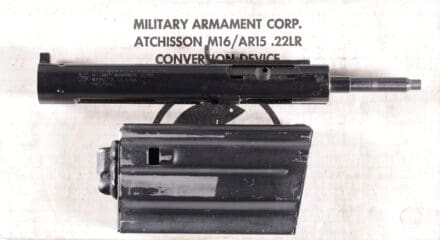
Thanks to Rock Island Auction for this image.
We’ll also look at a 1918 “pilotless aerial torpedo” (a very early incarnation of the OWA-UAS drones we see on the battlefield today) and a very important birthday.
We’ll start with the patent, granted to Maxwell G. Atchisson nearly 50 years ago, for a Weapon conversion apparatus. The “apparatus” in question was designed for “…converting a firearm of a first caliber to fire cartridges of a second caliber.” In short, it was a drop-in conversion system that let an AR-15 or M16 shoot the .22 LR cartridge.
1979’s Conversion: Better Than the ’73
Drop-in sub-caliber conversion kits were by no means a new thing when Atchisson patented his design. In fact, it wasn’t even his first conversion effort. The patent for his “Weapon conversion bolt assembly device” was filed in ’71 and granted in ’73.
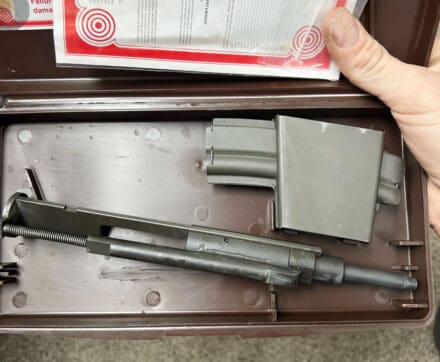
An Atchisson M16/AR15 22LR Conversion Kit via Madison Guns.
The 1979 assembly, however, overcame some deficiencies in the earlier version (and functioned differently). It became the first successful commercial design. We’re still shooting guns and kits descended from it today.
Note: Yes, this is the same Atchisson who developed the AA-12 “Atchisson Assault Shotgun.”
Also on this date…
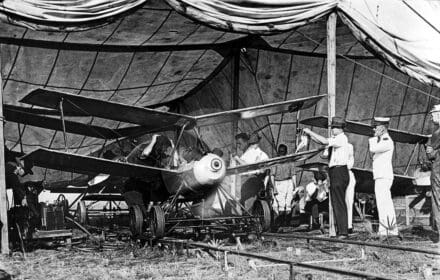
Unmanned aerial vehicles (not counting balloons) first appeared c. WW1. This is the Kettering Bug, contemporarily described as an “aerial torpedo” and currently likened to both cruise missiles and drones. It was first flight-tested on October 2nd, 1918 (it crashed), but was never used in combat. See also the Navy’s Sperry Aerial Torpedo, Siemens Torpedo Glider, and Royal Flying Corps’ Aerial Target.
The Way It Worked
As you might expect, the entire system was predicated on a swap. You removed the host rifle’s bolt carrier group and installed Atchisson’s self-contained assembly. Said assembly consisted of the chamber adapter, guide rails, a blowback-operated bolt, recoil system, and a receiver-end support structure. It also had a select-fire version that engaged the rifle’s automatic sear.
The temporarily converted rifle continued its previous closed-bolt operation, utilizing a blowback rimfire system housed within the host rifle’s upper receiver.
What’s the Significance?
If you’re reading this, you probably already know. Replacing the standard BCG with a rimfire conversion assembly allowed shooters to train at a lower cost, with lower recoil, without sacrificing the familiarity of the host rifle’s manual of arms.
The efficacy and wisdom of that is still debated, but that’s not what we’re here for.
What can’t be debated is the system’s enduring influence. The Atchisson-pattern AR .22 LR conversion system was the foundational design that informed virtually every .22 LR conversion kit we’ve seen since. It has evolved, in some cases been improved (in others, treated very badly) and spawned numerous variants over the years, but the fundamental design remains obvious nearly half a century later.
Which is great for plinkers, companies like CMMG, and many, many wallets.
Also on this date…

Also on this date: this guy made his world debut. If you don’t know his significance to the world of weapons, warfare, equipment, logistics, and technology, you’re probably reading the wrong website. Or you’re a dirty commie. Happy birthday! I hope you enjoy another Old Fashioned today. Or several.
This was a pretty simple overview. If you’d like to learn more, check Frank Iannamico’s article on Small Arms Review, this one by J.M. Ramos on the same site, or this one at Rimfire World. Today in Guns is a desultory series that appears whenever the author gets around to writing an installment.
And that is what happened TODAY IN GUNS.
Happy Birthday Eric! thank you for the value you add to this industry and community day after day, year after year. Cheers!
Happy birthday Eric.
HAPPY BIRTHDAY ERIC!