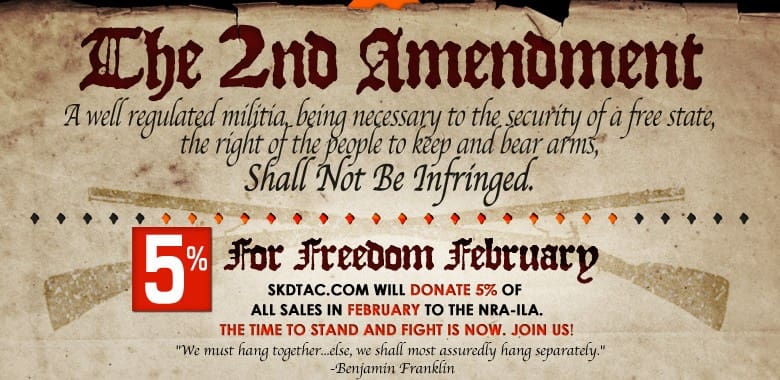
Throughout the month of February, SKD Tactical will donate 5% of their sales to the NRA-ILA. They will accept additional contributions from customers as well.


Throughout the month of February, SKD Tactical will donate 5% of their sales to the NRA-ILA. They will accept additional contributions from customers as well.
I’ve received several messages recently from readers concerned that we have politicized SSD by our coverage of Second Amendment issues. To that I have this to say. Just over a month ago now I was fat, dumb and happy, legally enjoying my right to bear arms when a madman used a firearm to kill innocent children with a gun. He was a criminal and as far as I am concerned, insane. Not even a day passed before anti-Second Amendment forces used this tragedy to begin to say that I shouldn’t have a right to own the type of a gun that was used in that heinous act. Never mind that I, along with millions of my fellow gun owners, have never committed a crime with a firearm. Never mind that the maniac who killed 26 victims on December 14th violated numerous standing firearms laws. Never mind that the American cities with the toughest firearms laws are the most dangerous. No, instead of using reason, the anti-gun movement chose to politicize this tragedy as a means to take away our constitutional rights. As long as there are those that wish to strip our country of our right to bear arms, I will discuss it on SSD.
I’m not going to take this laying down. I’m going to be vocal. I’m going to say, “No!” I’m going to counter their lies with truth. I’m going to ask you to join me. And through it all, I’m not going to apologize for it.
This letter was originally published earlier today on ProfessionalSoldiers.com, a forum for members of the US Army Special Forces. According to PS.com, “1100 Green Berets Signed this Letter. We have a list of all their names and unlike any MSM outlets we can confirm that over 1100 Green Berets did sign. The list includes Special Forces Major Generals & Special Forces Command Sergeants Major down to the lowest ranking “Green Beret”. The letter stands for itself.
Read it and send it everywhere.”
We are current or former Army Reserve, National Guard, and active duty US Army Special Forces soldiers (Green Berets). We have all taken an oath to “…support and defend the Constitution of the United States against all enemies foreign and domestic; that I will bear true faith and allegiance to the same.…” The Constitution of the United States is without a doubt the single greatest document in the history of mankind, codifying the fundamental principle of governmental power and authority being derived from and granted through the consent of the governed. Our Constitution established a system of governance that preserves, protects, and holds sacrosanct the individual rights and primacy of the governed as well as providing for the explicit protection of the governed from governmental tyranny and/or oppression. We have witnessed the insidious and iniquitous effects of tyranny and oppression on people all over the world. We and our forebears have embodied and personified our organizational motto, De Oppresso Liber [To Free the Oppressed], for more than a half century as we have fought, shed blood, and died in the pursuit of freedom for the oppressed.
Like you, we are also loving and caring fathers and grandfathers. Like you, we have been stunned, horrified, and angered by the tragedies of Columbine, Virginia Tech, Aurora, Fort Hood, and Sandy Hook; and like you, we are searching for solutions to the problem of gun-related crimes in our society. Many of us are educators in our second careers and have a special interest to find a solution to this problem. However, unlike much of the current vox populi reactions to this tragedy, we offer a different perspective.
First, we need to set the record straight on a few things. The current debate is over so-called “assault weapons” and high capacity magazines. The terms “assault weapon” and “assault rifle” are often confused. According to Bruce H. Kobayashi and Joseph E. Olson, writing in the Stanford Law and Policy Review, “Prior to 1989, the term ‘assault weapon’ did not exist in the lexicon of firearms. It is a political term [underline added for emphasis], developed by anti-gun publicists to expand the category of assault rifles.”
The M4A1 carbine is a U.S. military service rifle – it is an assault rifle. The AR-15 is not an assault rifle. The “AR” in its name does not stand for “Assault Rifle” – it is the designation from the first two letters of the manufacturer’s name – ArmaLite Corporation. The AR-15 is designed so that it cosmetically looks like the M4A1 carbine assault rifle, but it is impossible to configure the AR-15 to be a fully automatic assault rifle. It is a single shot semi-automatic rifle that can fire between 45 and 60 rounds per minute depending on the skill of the operator. The M4A1 can fire up to 950 rounds per minute. In 1986, the federal government banned the import or manufacture of new fully automatic firearms for sale to civilians. Therefore, the sale of assault rifles are already banned or heavily restricted!
The second part of the current debate is over “high capacity magazines” capable of holding more than 10 rounds in the magazine. As experts in military weapons of all types, it is our considered opinion that reducing magazine capacity from 30 rounds to 10 rounds will only require an additional 6 -8 seconds to change two empty 10 round magazines with full magazines. Would an increase of 6 –8 seconds make any real difference to the outcome in a mass shooting incident? In our opinion it would not. Outlawing such “high capacity magazines” would, however, outlaw a class of firearms that are “in common use”. As such this would be in contravention to the opinion expressed by the U.S. Supreme Court recent decisions.
Moreover, when the Federal Assault Weapons Ban became law in 1994, manufacturers began retooling to produce firearms and magazines that were compliant. One of those ban-compliant firearms was the Hi-Point 995, which was sold with ten-round magazines. In 1999, five years into the Federal Assault Weapons Ban, the Columbine High School massacre occurred. One of the perpetrators, Eric Harris, was armed with a Hi-Point 995. Undeterred by the ten-round capacity of his magazines, Harris simply brought more of them: thirteen magazines would be found in the massacre’s aftermath. Harris fired 96 rounds before killing himself.
Now that we have those facts straight, in our opinion, it is too easy to conclude that the problem is guns and that the solution to the problem is more and stricter gun control laws. For politicians, it is politically expedient to take that position and pass more gun control laws and then claim to constituents that they have done the right thing in the interest of protecting our children. Who can argue with that? Of course we all want to find a solution. But, is the problem really guns? Would increasing gun regulation solve the problem? Did we outlaw cars to combat drunk driving?
What can we learn from experiences with this issue elsewhere? We cite the experience in Great Britain. Despite the absence of a “gun culture”, Great Britain, with one-fifth the population of the U.S., has experienced mass shootings that are eerily similar to those we have experienced in recent years. In 1987 a lone gunman killed 18 people in Hungerford. What followed was the Firearms Act of 1988 making registration mandatory and banning semi-automatic guns and pump-action shotguns. Despite this ban, on March 13, 1996 a disturbed 43-year old former scout leader, Thomas Hamilton, murdered 16 school children aged five and six and a teacher at a primary school in Dunblane, Scotland. Within a year and a half the Firearms Act was amended to ban all private ownership of hand guns. After both shootings there were amnesty periods resulting in the surrender of thousands of firearms and ammunition. Despite having the toughest gun control laws in the world, gun related crimes increased in 2003 by 35% over the previous year with firearms used in 9,974 recorded crimes in the preceding 12 months. Gun related homicides were up 32% over the same period. Overall, gun related crime had increased 65% since the Dunblane massacre and implementation of the toughest gun control laws in the developed world. In contrast, in 2009 (5 years after the Federal Assault Weapons Ban expired) total firearm related homicides in the U.S. declined by 9% from the 2005 high (Source: “FBI Uniform Crime Reporting Master File, Table 310, Murder Victims – Circumstances and Weapons Used or Cause of Death: 2000-2009”).
Are there unintended consequences to stricter gun control laws and the politically expedient path that we have started down?
In a recent op-ed piece in the San Francisco Chronicle, Brett Joshpe stated that “Gun advocates will be hard-pressed to explain why the average American citizen needs an assault weapon with a high-capacity magazine other than for recreational purposes.”We agree with Kevin D. Williamson (National Review Online, December 28, 2012): “The problem with this argument is that there is no legitimate exception to the Second Amendment right that excludes military-style weapons, because military-style weapons are precisely what the Second Amendment guarantees our right to keep and bear.”
“The purpose of the Second Amendment is to secure our ability to oppose enemies foreign and domestic, a guarantee against disorder and tyranny. Consider the words of Supreme Court Justice Joseph Story”: ‘The importance of this article will scarcely be doubted by any persons, who have duly reflected upon the subject. The militia is the natural defense of a free country against sudden foreign invasions, domestic insurrections, and domestic usurpations of power by rulers. It is against sound policy for a free people to keep up large military establishments and standing armies in time of peace, both from the enormous expenses, with which they are attended, and the facile means, which they afford to ambitious and unprincipled rulers, to subvert the government, or trample upon the rights of the people. The right of the citizens to keep and bear arms has justly been considered, as the palladium of the liberties of a republic; since it offers a strong moral check against the usurpation and arbitrary power of rulers; and will generally, even if these are successful in the first instance, enable the people to resist and triumph over them.’
The Second Amendment has been ruled to specifically extend to firearms “in common use” by the military by the U.S. Supreme Court ruling in U.S. v Miller (1939). In Printz v U.S. (1997) Justice Thomas wrote: “In Miller we determined that the Second Amendment did not guarantee a citizen’s right to possess a sawed-off shot gun because that weapon had not been shown to be “ordinary military equipment” that could “could contribute to the common defense”.
A citizen’s right to keep and bear arms for personal defense unconnected with service in a militia has been reaffirmed in the U.S. Supreme Court decision (District of Columbia, et al. v Heller, 2008). The Court Justice Scalia wrote in the majority opinion: “The Second Amendment protects an individual right to possess a firearm unconnected with service in a militia, and to use that arm for traditionally lawful purposes, such as self-defense within the home.“. Justice Scalia went on to define a militia as “… comprised all males physically capable of acting in concert for the common defense ….”
“The Anti-Federalists feared that the Federal Government would disarm the people in order to disable this citizens’ militia, enabling a politicized standing army or a select militia to rule. The response was to deny Congress power to abridge the ancient right of individuals to keep and bear arms, so that the ideal of a citizens’ militia would be preserved.” he explained.
On September 13, 1994, the Federal Assault Weapons Ban went into effect. A Washington Post editorial published two days later was candid about the ban’s real purpose:“[N]o one should have any illusions about what was accomplished [by the ban]. Assault weapons play a part in only a small percentage of crime. The provision is mainly symbolic; its virtue will be if it turns out to be, as hoped, a stepping stone to broader gun control.”
In a challenge to the authority of the Federal government to require State and Local Law Enforcement to enforce Federal Law (Printz v United States) the U.S. Supreme Court rendered a decision in 1997. For the majority opinion Justice Scalia wrote: “…. this Court never has sanctioned explicitly a federal command to the States to promulgate and enforce laws and regulations When we were at last confronted squarely with a federal statute that unambiguously required the States to enact or administer a federal regulatory program, our decision should have come as no surprise….. It is an essential attribute of the States’ retained sovereignty that they remain independent and autonomous within their proper sphere of authority.”
So why should non-gun owners, a majority of Americans, care about maintaining the 2nd Amendment right for citizens to bear arms of any kind?
The answer is “The Battle of Athens, TN”. The Cantrell family had controlled the economy and politics of McMinn County, Tennessee since the 1930s. Paul Cantrell had been Sheriff from 1936 -1940 and in 1942 was elected to the State Senate. His chief deputy, Paul Mansfield, was subsequently elected to two terms as Sheriff. In 1946 returning WWII veterans put up a popular candidate for Sheriff. On August 1 Sheriff Mansfield and 200 “deputies” stormed the post office polling place to take control of the ballot boxes wounding an objecting observer in the process. The veterans bearing military style weapons, laid siege to the Sheriff’s office demanding return of the ballot boxes for public counting of the votes as prescribed in Tennessee law. After exchange of gun fire and blowing open the locked doors, the veterans secured the ballot boxes thereby protecting the integrity of the election. And this is precisely why all Americans should be concerned about protecting all of our right to keep and bear arms as guaranteed by the Second Amendment!
Throughout history, disarming the populace has always preceded tyrants’ accession of power. Hitler, Stalin, and Mao all disarmed their citizens prior to installing their murderous regimes. At the beginning of our own nation’s revolution, one of the first moves made by the British government was an attempt to disarm our citizens. When our Founding Fathers ensured that the 2nd Amendment was made a part of our Constitution, they were not just wasting ink. They were acting to ensure our present security was never forcibly endangered by tyrants, foreign or domestic.
If there is a staggering legal precedent to protect our 2nd Amendment right to keep and bear arms and if stricter gun control laws are not likely to reduce gun related crime, why are we having this debate? Other than making us and our elected representatives feel better because we think that we are doing something to protect our children, these actions will have no effect and will only provide us with a false sense of security.
So, what do we believe will be effective? First, it is important that we recognize that this is not a gun control problem; it is a complex sociological problem. No single course of action will solve the problem. Therefore, it is our recommendation that a series of diverse steps be undertaken, the implementation of which will require patience and diligence to realize an effect. These are as follows:
1. First and foremost we support our Second Amendment right in that “A well regulated militia being necessary to the security of a free state, the right of the people to keep and bear arms shall not be infringed”.
2. We support State and Local School Boards in their efforts to establish security protocols in whatever manner and form that they deem necessary and adequate. One of the great strengths of our Republic is that State and Local governments can be creative in solving problems. Things that work can be shared. Our point is that no one knows what will work and there is no one single solution, so let’s allow the State and Local governments with the input of the citizens to make the decisions. Most recently the Cleburne Independent School District will become the first district in North Texas to consider allowing some teachers to carry concealed guns. We do not opine as to the appropriateness of this decision, but we do support their right to make this decision for themselves.
3. We recommend that Assisted Outpatient Treatment (AOT) laws be passed in every State. AOT is formerly known as Involuntary Outpatient Commitment (IOC) and allows the courts to order certain individuals with mental disorders to comply with treatment while living in the community. In each of the mass shooting incidents the perpetrator was mentally unstable. We also believe that people who have been adjudicated as incompetent should be simultaneously examined to determine whether they should be allowed the right to retain/purchase firearms.
4. We support the return of firearm safety programs to schools along the lines of the successful “Eddie the Eagle” program, which can be taught in schools by Peace Officers or other trained professionals.
5. Recent social psychology research clearly indicates that there is a direct relationship between gratuitously violent movies/video games and desensitization to real violence and increased aggressive behavior particularly in children and young adults (See Nicholas L. Carnagey, et al. 2007. “The effect of video game violence on physiological desensitization to real-life violence” and the references therein. Journal of Experimental Social Psychology 43:489-496). Therefore, we strongly recommend that gratuitous violence in movies and video games be discouraged. War and war-like behavior should not be glorified. Hollywood and video game producers are exploiting something they know nothing about. General Sherman famously said “War is Hell!” Leave war to the Professionals. War is not a game and should not be “sold” as entertainment to our children.
6. We support repeal of the Gun-Free School Zones Act of 1990. This may sound counter-intuitive, but it obviously isn’t working. It is our opinion that “Gun-Free Zones” anywhere are too tempting of an environment for the mentally disturbed individual to inflict their brand of horror with little fear of interference. While governmental and non-governmental organizations, businesses, and individuals should be free to implement a Gun-Free Zone if they so choose, they should also assume Tort liability for that decision.
7. We believe that border states should take responsibility for implementation of border control laws to prevent illegal shipments of firearms and drugs. Drugs have been illegal in this country for a long, long time yet the Federal Government manages to seize only an estimated 10% of this contraband at our borders. Given this dismal performance record that is misguided and inept (“Fast and Furious”), we believe that border States will be far more competent at this mission.
8. This is our country, these are our rights. We believe that it is time that we take personal responsibility for our choices and actions rather than abdicate that responsibility to someone else under the illusion that we have done something that will make us all safer. We have a responsibility to stand by our principles and act in accordance with them. Our children are watching and they will follow the example we set.
The undersigned Quiet Professionals hereby humbly stand ever present, ever ready, and ever vigilant.
If you thought California gun laws were bad, check out this PowerPoint presentation from New York Governor Cuomo’s office.
NY State – Banned Rifle Features by solsys
Sen Feinstein (D-CA) didn’t pull any punches when she named the bill she introduced to the Senate yesterday. The Assault Weapons Ban of 2013 bill is a controversial piece of legislation that is sure to see opposition in the Senate including from members of her own party. Here’s some info on what she has in mind for America.
Assault Weapons Ban of 2013
Mass shootings in Newtown, Aurora, and Tucson have demonstrated all too clearly the need to regulate military-style assault weapons and high capacity ammunition magazines. These weapons allow a gunman to fire a large number of rounds quickly and without having to reload.
The legislation bans the sale, transfer, manufacturing and importation of:
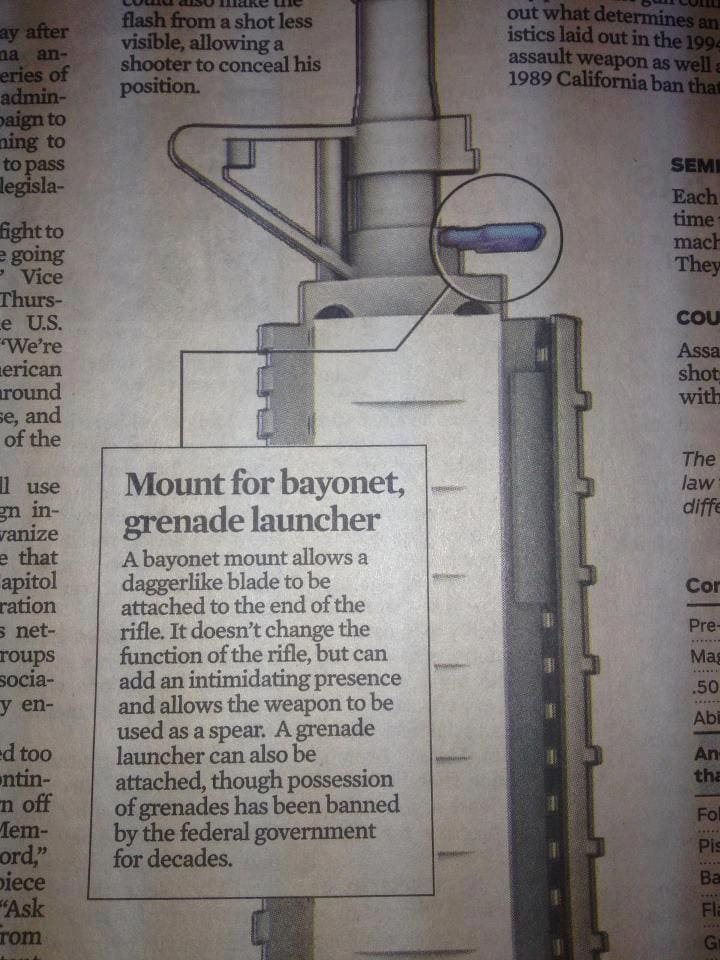
All semiautomatic rifles that can accept a detachable magazine and have at least one military feature: pistol grip; forward grip; folding, telescoping, or detachable stock; grenade launcher or rocket launcher; barrel shroud; or threaded barrel.
All semiautomatic pistols that can accept a detachable magazine and have at least one military feature: threaded barrel; second pistol grip; barrel shroud; capacity to accept a detachable magazine at some location outside of the pistol grip; or semiautomatic version of an automatic firearm.
All semiautomatic rifles and handguns that have a fixed magazine with the capacity to accept more than 10 rounds.
All semiautomatic shotguns that have a folding, telescoping, or detachable stock; pistol grip; fixed magazine with the capacity to accept more than 5 rounds; ability to accept a detachable magazine; forward grip; grenade launcher or rocket launcher; or shotgun with a revolving cylinder.
All ammunition feeding devices (magazines, strips, and drums) capable of accepting more than 10 rounds.
157 specifically-named firearms (listed at the end of this document).
The legislation excludes the following weapons from the bill:
Any weapon that is lawfully possessed at the date of the bill’s enactment;
Any firearm manually operated by a bolt, pump, lever or slide action;
Assault weapons used by military, law enforcement, and retired law enforcement; and
Antique weapons.
The legislation protects hunting and sporting firearms:
The bill excludes 2,258 legitimate hunting and sporting rifles and shotguns by specific make and model.
The legislation strengthens the 1994 Assault Weapons Ban and state bans by:
Moving from a 2-characteristic test to a 1-characteristic test.
(The bill also makes the ban harder to evade by eliminating the easy-to-remove bayonet mounts and flash suppressors from the characteristics test.)
Banning dangerous after-market modifications and work-arounds.
Bump or slide fire stocks, which are modified stocks that enable semi-automatic weapons to fire at rates similar to fully automatic machine guns.
So-called “bullet buttons” that allow the rapid replacement of ammunition magazines, frequently used as a work-around to prohibitions on detachable magazines.
Thumbhole stocks, a type of stock that was created as a work-around to avoid prohibitions on pistol grips.
Adding a ban on the importation of assault weapons and large-capacity magazines.
Eliminating the 10-year sunset that allowed the original federal ban to expire.
The legislation addresses the millions of assault weapons and large-capacity magazines currently in existence by:
Requiring a background check on all sales or transfers of a grandfathered assault weapon.
(This background check can be run through the FBI or, if a state chooses, initiated with a state agency, as with the existing background check system.)
Prohibiting the sale or transfer of large-capacity ammunition feeding devices lawfully possessed on the date of enactment of the bill.
Allowing states and localities to use federal Byrne JAG grant funds to conduct a voluntary buy-back program for grandfathered assault weapons and large-capacity ammunition feeding devices.
Imposing a safe storage requirement for grandfathered firearms, to keep them away from prohibited persons.
Requiring that assault weapons and large-capacity ammunition feeding devices manufactured after the date of the bill’s enactment be engraved with the serial number and date of manufacture of the weapon
Assault Weapon Bans Have Been Proven to Be Effective
The 1994 Assault Weapons Ban was effective at reducing crime and getting these military-style weapons off our streets. Since the ban expired, more than 350 people have been killed and more than 450 injured by these weapons.
A Justice Department study of the assault weapons ban found that it was responsible for a 6.7% decrease in total gun murders, holding all other factors equal.
Source: Jeffrey A. Roth & Christopher S. Koper, “Impact Evaluation of the Public Safety and Recreational Firearms Use Protection Act of 1994,” (March 1997).
The same study also found that “Assault weapons are disproportionately involved in murders with multiple victims, multiple wounds per victim, and police officers as victims.”
The use of assault weapons in crime declined by more than two-thirds by about nine years after 1994 Assault Weapons Ban took effect.
Source: Christopher S. Koper, “An Updated Assessment of the Federal Assault Weapons Ban: Impacts on Gun Markets and Gun Violence, 1994-2003” (June 2004), University of Pennsylvania, Report to the National Institute of Justice, U.S. Department of Justice.
The percentage of firearms seized by police in Virginia that had high-capacity magazines dropped significantly during the ban. That figure has doubled since the ban expired.
Source: David S. Fallis and James V. Grimaldi, “In Virginia, high-yield clip seizures rise,” Washington Post, at http://www.washingtonpost.com/wp-dyn/content/article/2011/01/22/AR2011012204046.html
When Maryland imposed a more stringent ban on assault pistols and high-capacity magazines in 1994, it led to a 55% drop in assault pistols recovered by the Baltimore Police Department.
Source: Douglas S. Weil & Rebecca C. Knox, Letter to the Editor, The Maryland Ban on the Sale of Assault Pistols and High-Capacity Magazines: Estimating the Impact in Baltimore, 87 Am. J. of Public Health 2, Feb. 1997..
37% of police departments reported seeing a noticeable increase in criminals’ use of assault weapons since the 1994 federal ban expired.
Source: Police Executive Research Forum, Guns and Crime: Breaking New Ground by Focusing on the Local Impact (May 2010).
List of Firearms Prohibited by Name
Rifles: All AK types, including the following: AK, AK47, AK47S, AK–74, AKM, AKS, ARM, MAK90, MISR, NHM90, NHM91, Rock River Arms LAR–47, SA85, SA93, Vector Arms AK–47, VEPR, WASR–10, and WUM, IZHMASH Saiga AK, MAADI AK47 and ARM, Norinco 56S, 56S2, 84S, and 86S, Poly Technologies AK47 and AKS; All AR types, including the following: AR–10, AR–15, Armalite M15 22LR Carbine, Armalite M15–T, Barrett REC7, Beretta AR–70, Bushmaster ACR, Bushmaster Carbon 15, Bushmaster MOE series, Bushmaster XM15, Colt Match Target Rifles, DoubleStar AR rifles, DPMS Tactical Rifles, Heckler & Koch MR556, Olympic Arms, Remington R–15 rifles, Rock River Arms LAR–15, Sig Sauer SIG516 rifles, Smith & Wesson M&P15 Rifles, Stag Arms AR rifles, Sturm, Ruger & Co. SR556 rifles; Barrett M107A1; Barrett M82A1; Beretta CX4 Storm; Calico Liberty Series; CETME Sporter; Daewoo K–1, K–2, Max 1, Max 2, AR 100, and AR 110C; Fabrique Nationale/FN Herstal FAL, LAR, 22 FNC, 308 Match, L1A1 Sporter, PS90, SCAR, and FS2000; Feather Industries AT–9; Galil Model AR and Model ARM; Hi-Point Carbine; HK–91, HK–93, HK–94, HK–PSG–1 and HK USC; Kel-Tec Sub–2000, SU–16, and RFB; SIG AMT, SIG PE–57, Sig Sauer SG 550, and Sig Sauer SG 551; Springfield Armory SAR–48; Steyr AUG; Sturm, Ruger Mini-14 Tactical Rife M–14/20CF; All Thompson rifles, including the following: Thompson M1SB, Thompson T1100D, Thompson T150D, Thompson T1B, Thompson T1B100D, Thompson T1B50D, Thompson T1BSB, Thompson T1–C, Thompson T1D, Thompson T1SB, Thompson T5, Thompson T5100D, Thompson TM1, Thompson TM1C; UMAREX UZI Rifle; UZI Mini Carbine, UZI Model A Carbine, and UZI Model B Carbine; Valmet M62S, M71S, and M78; Vector Arms UZI Type; Weaver Arms Nighthawk; Wilkinson Arms Linda Carbine.
Pistols: All AK–47 types, including the following: Centurion 39 AK pistol, Draco AK–47 pistol, HCR AK–47 pistol, IO Inc. Hellpup AK–47 pistol, Krinkov pistol, Mini Draco AK–47 pistol, Yugo Krebs Krink pistol; All AR–15 types, including the following: American Spirit AR–15 pistol, Bushmaster Carbon 15 pistol, DoubleStar Corporation AR pistol, DPMS AR–15 pistol, Olympic Arms AR–15 pistol, Rock River Arms LAR 15 pistol; Calico Liberty pistols; DSA SA58 PKP FAL pistol; Encom MP–9 and MP–45; Heckler & Koch model SP-89 pistol; Intratec AB–10, TEC–22 Scorpion, TEC–9, and TEC–DC9; Kel-Tec PLR 16 pistol; The following MAC types: MAC–10, MAC–11; Masterpiece Arms MPA A930 Mini Pistol, MPA460 Pistol, MPA Tactical Pistol, and MPA Mini Tactical Pistol; Military Armament Corp. Ingram M–11, Velocity Arms VMAC; Sig Sauer P556 pistol; Sites Spectre; All Thompson types, including the following: Thompson TA510D, Thompson TA5; All UZI types, including: Micro-UZI.
Shotguns: Franchi LAW–12 and SPAS 12; All IZHMASH Saiga 12 types, including the following: IZHMASH Saiga 12, IZHMASH Saiga 12S, IZHMASH Saiga 12S EXP–01, IZHMASH Saiga 12K, IZHMASH Saiga 12K–030, IZHMASH Saiga 12K–040 Taktika; Streetsweeper; Striker 12.
Belt-fed semiautomatic firearms: All belt-fed semiautomatic firearms including TNW M2HB.
Here they are. No doom and gloom. Nothing shocking. Nothing unconstitutional or even controversial. Lots of spending. Little impact. Maybe a couple of zingers in there but hard to tell from a one liner. The devil will be in the details.
Several of the actions relate to mental health. A few that cross over between both areas look sticky. There’s even one that pays lip service to protecting schools. Another one that actually proposes enforcing laws on the books (imagine that). Reading through the list, I’d say that NICS has some serious issues and they know it. It should be abolished, with States running their own background check systems. I’d imagine they’d do a better job themselves considering they have to actually deal with the consequences of a gun in the wrong hands. It’s more of a practical concern than the theoretical one the federal government has.
All in all, the list sounds reasonable doesn’t it? But, when you read the document released last Tuesday from the White House press office embedded at the bottom of this article, you’ll be able to put it all in perspective. In the backgrounder issued to the press, he calls for much more and in greater detail. These are themes that the media will use in writing articles and in crafting questions to ask the President and others.
Granted, as far as Executive Orders go, the President could have taken what I call the “Nuclear” option, which is to cut off the importation of all firearms and parts. I’d say, considering executive orders from previous administrations, that would be well within a President’s power. If he had stopped the importation of all foreign produced weapons and parts, it would have hurt in the short-term, but would have resulted long-term in a much stronger American gun industry and might have resulted in trade wars with nations who produce consumer-based firearms. Notice he didn’t do that and that’s what I find curious. If he is as serious about guns as he sounds, why didn’t he? Even if for just so-called “assault weapons” and parts? That’s the question folks. What is this guy’s play?
There are lots of questions here and so far none of us have the answers. Is he just playing to his base? Did the fear of the consequences (at home and abroad) of such action dissuade him? Does President Obama know that he doesn’t have the votes in Congress to pass the gun legislation he claims he wants? Or is this all just another political chess move to try and put the Republican party on the defensive? If the desired legislation doesn’t materialize, who to blame but Congress? His hands remain clean. If he gets it, it was all his doing. If he doesn’t, well it’s all on Congress now isn’t it? It’s classic.
I went one step further and waited to publish this article until after the inauguration. I have looked at his speech backward and forward. Not once in his address that sets out his vision for the next four years did he use the words “Gun” or “Firearm”. Rather, the President made this statement during his short address, “Our journey is not complete until all our children, from the streets of Detroit to the hills of Appalachia, to the quiet lanes of Newtown, know that they are cared for and cherished and always safe from harm.” He mentioned gay rights before he obliquely mentioned something that his been his administration’s top priority for the past month. Considering how adaptable the single nod to America’s children is, weighed against the empty gestures of the Executive Orders which were accompanied by some rather strong rhetoric, I can only come to the conclusion that President Obama is playing to his base and is expecting Congress to do his dirty work. Like him or not, you have to acknowledge that Barack Obama is a very skilled politician and has become more adept at playing a long game. The fight for the gun rights will be in Congress. Even though the President’s bark is louder than his bite, don’t for a minute think that this is over. It’s as important as ever that you stay engaged with your Congressional representation as well as with other voters.
1. Issue a presidential memorandum to require federal agencies to make relevant data available to the federal background check system
2. Address unnecessary legal barriers, particularly relating to the Health Insurance Portability and Accountability Act, that may prevent states from making information available to the background check system.
3. Improve incentives for states to share information with the background check system.
4. Direct the attorney general to review categories of individuals prohibited from having a gun to make sure dangerous people are not slipping through the cracks.
5. Propose rule-making to give law enforcement the ability to run a full background check on an individual before returning a seized gun.
6. Publish a letter from ATF to federally licensed gun dealers providing guidance on how to run background checks for private sellers.
7. Launch a national safe and responsible gun ownership campaign.
8. Review safety standards for gun locks and gun safes (Consumer Product Safety Commission).
9. Issue a presidential memorandum to require federal law enforcement to trace guns recovered in criminal investigations.
10. Release a Department of Justice report analyzing information on lost and stolen guns and make it widely available to law enforcement.
11. Nominate a new director of the Bureau of Alcohol, Tobacco, Firearms and Explosives.
12. Provide law enforcement, first-responders, and school officials with proper training for active shooter situations.
13. Maximize enforcement efforts to prevent gun violence and prosecute gun crime.
14. Issue a presidential memorandum directing the Centers for Disease Control and Prevention to research the causes and prevention of gun violence.
15. Direct the attorney general to issue a report on the availability and most effective use of new gun-safety technologies and challenge the private sector to develop innovative technologies.
16. Clarify that the Affordable Care Act does not prohibit doctors from asking their patients about guns in their homes.
17. Release a letter to health care providers clarifying that no federal law prohibits them from reporting threats of violence to law enforcement authorities.
18. Provide incentives for schools to hire school-resource officers.
19. Develop model emergency response plans for schools, houses of worship and institutions of higher education.
20. Release a letter to state health officials clarifying the scope of mental health services that Medicaid plans must cover.
21. Finalize regulations clarifying essential health benefits and parity requirements within ACA exchanges.
22. Commit to finalizing mental-health parity regulations.
23. Launch a national dialogue led by Health and Human Services Secretary Kathleen Sebelius and Education Secretary Arne Duncan on mental health.
Read this backgrounder from the White House press office released the same day as the announcement. “Embargoing” is used in the media when someone wants you to have it ready to publish but not before they give the OK. Usually, they give you a date and time you can release it.
White House list of executive orders on gun violence. by United Press International
From the Chicago Tribune
Stay Classy Chicago…