Technology Is Redefining Irregular Warfare. Here’s What That Means
There’s no agreed-upon playbook for emerging technology in the gray zone, and no consensus on what’s next. Experts debate competing timelines. The policy community commissions studies that become outdated before publication. And those working in these environments face split-second decisions that involve technologies that didn’t exist in doctrine, dilemmas that weren’t in ethics training, and environments where old assumptions no longer apply. What’s more, for every strategic advantage a new technology offers—whether in the realm of artificial intelligence (AI), autonomous systems, cyber and electronic warfare, crypto, cognitive warfare, biotech, etc.—it also introduces new risks that we don’t always see coming.
By the time institutions have done the analysis, calculated the risks, and agreed on how these technologies have changed irregular warfare and how to respond, the operating environment is already different. It can take decades for defense organizations to change and adapt. Technology evolves in months. The gap is already wide, and it’s only growing. The result is a dangerous reality in which practitioners are forced to make irreversible decisions without clear guidance, but with high-stakes consequences that may not even be fully understood until it is too late.
We can’t close that gap with studies and strategies alone. We need to connect the people closest to the challenges and build a community that learns faster than adversaries adapt.
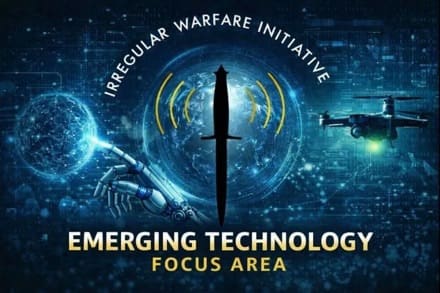
That’s why the Irregular Warfare Initiative is launching a new focus area: the Emerging Technology and Irregular Warfare Focus Area.
What sets this effort apart is both the challenges we are tackling and the people we are engaging. We intend to take seriously the strategic and operational tensions that emerge as new technologies are adopted and embedded in irregular warfare. And we will bring together communities that don’t always talk to each other to grapple with those tensions collectively.
The Challenges We Are Tackling
Technology in irregular warfare creates genuine tensions between competing priorities that aren’t easily resolved. At the heart of these tensions are questions about how to maximize operational advantages while managing expanding risks, and who gets to determine those tradeoffs. While individual technologies introduce distinct risks and benefits, our focus is not on the tools themselves, but on the tensions they generate, and how those tensions play out across different contexts and stakeholders and in exploring new directions and fresh proposals for navigating them. Some of these core dilemmas include:
Decisionmaking & Accountability – Technology enables faster, better-informed and more precise decisions, but only if our existing decisionmaking processes evolve in parallel. But by reshaping decision dynamics in decentralized and ambiguous environments, these tools also introduce new risks related to accountability, civilian harm, and the ability to maintain political control and influence.
Diffusion & Escalation – Dual-use, low-cost, high-impact technologies enable individuals, nonstate actors, and terrorist networks to adapt lethal irregular warfare tactics, evade traditional financial intelligence, and exploit deniability. At the same time, their diffusion accelerates escalation dynamics and demands new concepts and approaches to restraint and control in gray zone conflicts.
Legitimacy & Effectiveness – As artificial intelligence, autonomous systems, and cyber capabilities outpace laws and regulations, tensions arise between operational effectiveness and maintaining public legitimacy, especially when confronting adversaries that reject these constraints. In operating environments where information moves fast and decisions can’t wait, both effectiveness and legitimacy require new approaches to measuring impact, managing risk, and adapting in real-time.
Influence & Trust – Emerging technologies offer new tools for enhancing diplomatic and humanitarian effectiveness, critical components of securing influence among populations in irregular warfare. In contested environments, however, adversaries can exploit these same technologies to undermine public trust through surveillance, algorithmic bias, misinformation, and dependency creation.
The People We Are Engaging
This platform is built for and by everyone working across irregular warfare: government, military, civil society, private sector, humanitarians, academics, development actors, partners, and local communities. We believe experience matters as much as credentials. Ground truth matters as much as theory. And the hard lessons learned in one theater should inform decisions in another, in real time, not years later through formal doctrine updates. Most importantly, we believe the people navigating these challenges can’t wait for perfect answers. They need better options now, founded on clear principles to guide decisions under uncertainty.
How We Work
As we tackle these challenges, this Focus Area will be guided by the following principles:
Problem-driven – Our starting point will be the problems practitioners face on the ground, not technologies in search of applications. We want to identify what works, what doesn’t, and what principles can guide decisions when perfect information doesn’t exist. When doctrine exists but practitioners aren’t using it, we want to figure out why and identify solutions.
Whole-of-Government and Whole-of-Society Perspectives – Technology in irregular warfare doesn’t just affect military operations. It reshapes societies, influences populations, and creates dependencies that outlast any single intervention. These issues demand a coordinated response across the government and a systems approach that recognizes how technology’s societal impacts might reinforce or undermine strategic objectives over the long term.
Future-focused – What’s important in confronting the challenges above is not merely analyzing last year’s conflict, but remaining focused on what’s coming next. Responding adaptively to the emerging technologies, tactics, and dilemmas that will shape tomorrow’s irregular warfare environment will ensure we are staying ahead of the problem, not playing catch-up.
Join the Conversation
As IWI develops this Focus Area going forward, we want to hear from you. Submit an article. Join us on a podcast. Send us an email at EmergingTech@irregularwarfare.org. Engage on social media where these conversations reach beyond traditional circles to developers, humanitarians, local partners, and others navigating the same technology dilemmas.
We’re interested in emerging issues where the problem hasn’t been clearly defined, where consensus is lacking, or where solutions remain elusive. We also want to bridge gaps where doctrine exists but isn’t being applied. Help us understand why and what needs to change. What matters is the quality of the argument, the evidence behind it, and the technology’s impact on irregular warfare, not whether it meets an arbitrary definition of “emerging.” Contributions will not be dismissed on the grounds that a technology is too established, not novel enough, or insufficiently disruptive.
Technology will continue reshaping societies and conflicts at an accelerating pace. The only question is whether we learn fast enough to stay ahead, or whether we’re perpetually reacting to problems that could have been anticipated.
Practitioners on the ground can’t wait for perfect answers. They need better options, clearer principles, and a community learning together in real time. That’s what we’re building. And we want you to help us build it.
February 2, 2026 by Kristina Kempkey, Jeffrey Szuchman
Kristina Kempkey is a senior leader with over two decades of experience working at the intersection of national security and foreign policy in high-risk environments. She has led and advised major efforts with USAID, the U.S. Department of Defense, and the United Nations, working alongside military, diplomatic, and civilian partners across Africa, Eastern Europe, and South Asia. Her work centers on applying emerging technologies to real-world security, stabilization, and institutional challenges. She brings a practitioner’s understanding of interagency operations, coalition building, and decision-making under uncertainty. She has contributed to research with the Council on Foreign Relations and West Point on national security and military strategy. As a Fellow at the ML Alignment and Theory Scholars (MATS), Future Impact Group (FIG), 21st Century India Center at UC San Diego, and the Center for AI and Digital Policy (CAIDP), Kristina informs practical policy recommendations and operational insights for governments and security institutions navigating the risks and opportunities of advanced AI.
Jeffrey Szuchman’s work examines how emerging technologies shape governance and security in fragile and conflict-affected settings. He has held leadership roles at USAID in Washington, DC and in Africa, including as Deputy Director for Democratic Governance, Peace & Security in Kenya, where he managed multi-million dollar grants in security, governance, and peacebuilding, and advised on integrating digital safeguards and responsible AI principles into national strategies. He has also led teams at USAID in Liberia and in Washington, DC, where he served as Acting Director of Policy, leading agency-wide strategic planning and directing cross-functional teams on issues ranging from digital transformation, stabilization, and conflict prevention. Prior to USAID, he was a Professor of Global Studies at Zayed University in Abu Dhabi. He holds a PhD and MA in Near Eastern Languages and Cultures from UCLA.
Main Image generated by ChatGPT using DALL·E, OpenAI (January 2026).
The views expressed are those of the authors and do not reflect the official position of the Irregular Warfare Initiative, Princeton University’s Empirical Studies of Conflict Project, the Modern War Institute at West Point, or the United States Government.