Phantom Lights

Archive for the ‘Training’ Category

Gunfighter Moment – Mike Pannone

Saturday, November 17th, 2012

I have met a number of instructors in the, for lack of a better term, “tactical” world. I have the benefits of being a constant shooter and several years’ experience teaching in classroom settings to form opinions of instruction and training for real-world firearms use. And I have had the opportunity to discuss the effectiveness of various instructional techniques with professional military and law enforcement individuals who were willing to speak frankly and did not hold anything back in their assessments.

All of this has led me to the conclusion that Mike Pannone is one of the most effective and well-rounded firearm instructors in the world. Why?

– He has an extremely impressive military background, one which has given him a level of experience found in only a few modern instructors;

– He has studied kinesiology (the scientific study of human movement) at the collegiate level;

– He has experience as an instructor for federal law enforcement, namely being the head range instructor at the Federal Air Marshals Service school;

– He is very low key – mostly because he does not feel the need to impress anyone;

– He is not a “stick-in-the-mud” – he is always looking to develop new and more effective shooting techniques.

So he knows what is and is not relevant to real-world applications, he can explain in a scientific manner why a certain technique is effective or ineffective, he has the ability to impart this experience and knowledge to students, he does not showboat during classes, and he keeps an open mind about how he does all of this.


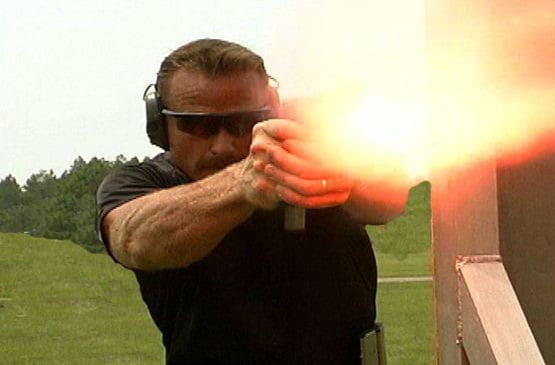
Mike Pannone with a fancy handgun

When I have occasion to discuss the merits of Mike’s instruction with individuals who shoot guns for a living, they express universal praise and admiration. They have no time for BS and while they often receive training from Mike as well as other instructors through work, they also pay for Mike’s classes out of their own pockets.

His training is in constant demand from actual military and law enforcement units. We hear this so often from various instructors that it becomes background noise – Mike actually tries to make this part of his life background noise. He teaches high-speed military and law enforcement units but never, ever talks about it publicly.

It’s almost weird – it would be easy for him to cultivate a following based on personality, but he doesn’t bother with such things. He’s so self-effacing that I feel a constant need to write about him. Part of it is that I consider him to be a friend, sure. The other part is that he is an intellectual and a true badass. That is a rare combination indeed.


This article was first published at Vuurwapen Blog. Reposted at the request of Mike Pannone and with the permission of Vuurwapen Blog.

Mike Pannone retired from the Army’s premier assault force (1st SFOD-D) after an explosive breaching injury. A year after his retirement America was attacked on 9/11 and he returned to help serve his country as the head marksmanship instructor at the Federal Air Marshals training course and then moved to help stand up the FAMS Seattle field office. In 2003 he left the FAMS to serve as a PSD detail member and then a detail leader for the State Department during 2003 and 2004 in Baghdad and Tikrit.

In 2005 he served as a ground combat advisor of the Joint Counter IED Task Force and participated on combat operations with various units in Al Anbar province. Upon returning he gave IED awareness briefings to departing units and helped stand up a pre-Iraq surge rifle course with the Asymmetric Warfare Group as a lead instructor. With that experience as well as a career of special operations service in Marine Reconnaissance, Army Special Forces and JSOC to draw from he moved to the private sector teaching planning, leadership, marksmanship and tactics as well as authoring and co-authoring several books such as The M4 Handbook, AK Handbook and Tactical Pistol shooting. Mike also consults for several major rifle and accessory manufacturers to help them field the best possible equipment to the warfighter, law enforcement officer and upstanding civilian end user. He is considered a subject matter expert on the AR based Stoner platform in all its derivatives.

www.ctt-solutions.com

Gunfighter Moment is a weekly feature brought to you by Alias Training & Security Services. Each week Alias brings us a different Trainer and in turn they offer some words of wisdom.

Is He Doing it “Right” or Not?

Saturday, November 17th, 2012

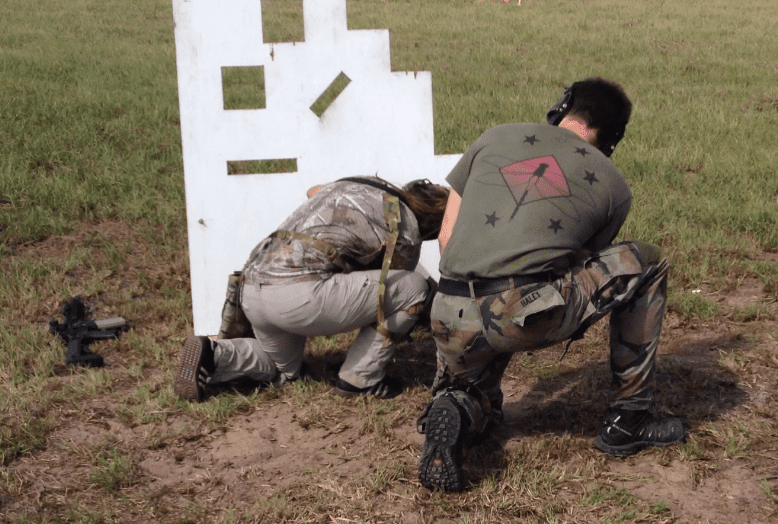
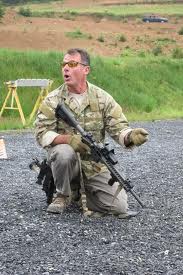
Some readers may look at this photo and say that he is doing it wrong. Sure, he’s got a grip on the magwell and his buttstock is off of his shoulder, but he may just be adapting to the cover.

20121116-223503.jpg

Weapon handling skills are very much up to the individual and should be looked at more from a TTP standpoint than dogmatic adherence to one school of thought over another. Sure, there are definitely ways not to do it, but there are also multiple ways to get rounds on target. Over time, you’ll find something’s work better than others for you.

Gain a wide variety of skills from multiple instructors and then learn how to adapt them to your situation. When I say instructor, I mean that in a rather broad sense. Many if you serve in the military or LE and gain instruction associated with your duty. However, I recommend everyone seek training from a professional instructor whether uniformed or not.

So what do you think? Is the guy in the photo doing it “right?”

Statement from the Range Owner Regarding the Recent Accidental Shooting

Wednesday, November 14th, 2012

Since a lot of readers have been inquiring about it, I am publishing this statement by range owner Len Baxley in its entirety as it provides a great deal of detail on the recent shoot house accidental shooting involving trainer Sonny Puzikas. If anyone has any additional amplification regarding the incident or factual conflicting information please feel free to share it.

Hello,

My name is Len Baxley, and I am the Founder of the Texas Defensive Shooting Academy (TDSA), not to be confused with other TDSA’s. I started the original TDSA in Texas in 1995. The other TDSA firearm training organizations are located in Tulsa, Missouri, Kentucky and Canada. I trained them how to shoot, then taught them how to teach, then allowed them to use the “TDSA” name in a hand-shake business arrangement. With the exception of Kentucky, none of them are associated with me any longer, even though they still use the TDSA designation.

I am also the owner of the TDSA gun range, founded in 1995, located just outside the city of Ferris, Texas.

As many of you have already heard there was a tragic (non-fatal) accidental shooting at my range on Sunday, Nov. 4th 2012.

I have intentionally not commented on this incident for several reasons. I do not know if that decision has been a mistake or commenting now is the mistake.

(more…)

Corrugated DLS Training Furniture

Monday, November 12th, 2012

The new Corrugated DLS Training Furniture is cool on several levels. For one thing, it’s a low cost solution for adding realism to shoot houses. Second, it can be “wrapped” in a variety of finishes to replicate virtually any environment. Finally, that same DLS Wrap has special properties embedded in the DLS Polymer Film that prevents the corrugated material from catching fire from a “ flash bang “ or a “ smoke grenade “ when clearing a room. It’s not only safer than other solutions, but the training furniture will last longer for the Soldier to train on.

www.dlsmilwraps.com

Corps Strength – PT Your Attitude

Monday, November 12th, 2012

In my present job as an instructor at the U.S. Navy’s International Training Center here in Pensacola, we have different levels of physical training for our different courses. Each is specifically designed for each course goals and student makeup. Some are very tough (Marine TBS, Dive school, EOD and BUDS Preparatory). While on the other end are easy entry level stuff, mostly to demonstrate how to set up and conduct basic unit PT, and give the students a chance to workout. As you might guess the physical condition of the students attending also has a wide variance. Some are in serious condition, while others are in very poor shape. While they may not have the high speed PT training programs that we sometimes take for granted in the U.S military, they often surprise me with their unfiltered take on things.

Recently I recently had a student from Antigua (now a Navy Ensign who started out first in their Army) had already been to OCS in the Coast Guard Academy, Army Ranger School, the U.S. Army’s Infantry Officer course and also attended a (brutal) six month Jungle Warfare training school in Guyana. Tall and thin he’s in pretty good shape, but not really the PT stud you would think. I’ve had many conversations with him about all different training he’s been through, and I was (of course) very curious to what he thought about the PT that he had to deal with at these different schools. Some of his answers surprised me. His overall opinion was that 99% of all this PT was mental. He’s observation was that if you have a basic level of fitness, the rest was mental. He witnessed many people in these schools that seemed to be in awesome physical shape, drop out after only a few weeks, or even days. They just didn’t have it attitude wise. I agree totally and this leads me back to where I always go with getting in shape, its all about the way you think about it. You have to get your head screwed on right, or all the special diets, workout routines and supplements won’t matter. I talk about this a lot in my book Corps Strength. If fact I’ve often been accused of harping on it TOO much? I don’t think so, as I think its importance cannot be over stressed, IMO much more important than any specific workout routine.

The bottom line is you’ve got come to terms with the simple fact that getting in good shape and maintaining a healthy bodyweight is work. Its not easy, never was and never will be. But get a grip, its not torture and its not impossible. It just requires some effort, a little discipline AND above all else the right thought process. Put the right thoughts in your “brain housing group” and your on your way, after that all you need is the PT and diet routine that work for your lifestyle and goals. Don’t get too fancy, don’t start out to fast, always think long term and you’ll get there. I’ve seen it hundreds, if not thousands of times. By the way my student thought that Coast Guard OCS was the toughest school. Huh?? Coast Guard OCS tougher than Ranger School, Why? Not because of the PT but because of the tough swim requirements, he isn’t a great swimmer. Again its all about the way you look at it. Good luck and be safe.

Semper Fi
MGunz

HSP 2013 Training Schedule is Live

Sunday, November 11th, 2012

20121110-170516.jpg

www.haleystrategic.com/training

Canipe Correspondence – The Safety Brief

Saturday, November 10th, 2012

Earlier this week, I got into a discussion with two of my buddies about a heated argument they were in over some of the nuances and semantics involved with staying safe on the job. Not long after, as most of you know from an earlier article this week, an instructor shot his assistant multiple times in a well publicized incident. There has been a surge lately of instructors who seem to take pride in being unsafe, almost wearing it as a badge of honor and taking a very in-your-face approach to showing “the real world.” “It’s dangerous, but so is combat…” is another one I hear. I never hear it from guys with a background in that “real world”, but that doesn’t surprise anyone I guess. It’s funny how a training gunshot looks a lot like a real world gunshot. Funny how the Nation’s top tiers of Special Operations units can factor safety into every aspect their training but some guys can’t make a flat range run without waving loaded guns at everyone. Ponder that for a minute. There is no doubt in my mind that an unsafe guy is an unqualified guy. They’re multiplying, and they’re everywhere. That’s another tangent for another day, but for now there are a lot of ways to mitigate risk in your training without sacrificing what can be gained.

A detailed safety plan and accountability of personnel is not nerd stuff. It’s not micromanagement. It does not have to water down training. When I plan safety measures into events I stick to what I know, and that is the military cycle for risk mitigation. We all loathe it, getting the Risk Assessment signed, re-doing it 5 times to add stuff like “inadvertent exposure to genetically enhanced assault bunny rabbits” or whatever other bizarre crap the commander asks for, making dozens copies to file with various offices of no importance, and other various ass-pain. The good news is the cycle and methods themselves are easily applicable on the fly as well as prior to conducting training. The even better news is that it works well, and the reference material is free. If you’re not familiar with it and have an interest in finding a good balance of real vs. safe, Google “FM 5-19”, save it, use it.

Here is a key passage, with an underline for emphasis:

Accept no unnecessary risk. Accept no level of risk unless the potential gain or benefit outweighs the potential loss. CRM is a decision making tool to assist the commander, leader, or individual in identifying, assessing, and controlling risks in order to make informed decisions that balance risk costs (losses) against mission benefits (potential gains)

It’s an easy process, 5 simple steps to prevent the preventable.
1. Identify Hazards
2. Assess and determine risk
3. Develop controls and make risk decisions
4. Implement controls
5. Supervise and evaluate

As an example, a hazard during a CCW class would be accidental shootings. You determine the risk to be high due to a diverse group of inexperienced or poorly trained shooters. You decide to use small relays and a 1:1 instructor to student ratio as controls. On the ground you stick to the control plan, and evaluate its efficiency and adjust as needed. Identifying the hazards and accepting the real possibility of an accident is the key step that seems to be overlooked; otherwise the next steps cannot occur.

Another key element is a medical plan in the event an accident does occur. Know where the nearest treatment facilities are, and have medical supplies as well as multiple qualified users. Have a plan to travel to those facilities, and make sure your communications work. Know your location in a format that local authorities and emergency personnel can use to find you.

You can’t remove all risk from self-defense or tactical training, as there are inherent dangers that are simply a byproduct of that environment. However, they can be controlled to a degree, and the unnecessary risks can be eliminated with a little forethought and planning. Risk is perfectly acceptable when the juice is worth the squeeze, make sure you know where that line is.

Gunfighter Moment – Larry Vickers

Saturday, November 10th, 2012

‘One of my favorite handgun skill drills is called the Test. Also known as the 10-10-10 drill; it goes like this – put a B8 replacement center bullseye at 10 yards and in a max of 10 seconds shoot 10 shots from the low ready position. The goal is to put them all in the black within the maximum time limit – once you become proficient try using the scoring rings and try to score a minimum of 90 with 95 and above being ideal. As my students can tell you this drill is no joke and serves as an excellent yardstick to measure handgun skill by; you can find out where a student is at skill-wise real fast with this quick drill. I got it from Ken Hackathorn years ago and it is a classic.’

-Larry Vickers
MSG, US Army (Ret)

Larry Vickers is a decorated US Army Special Forces veteran and national pistol champion. Mr. Vickers has nearly two decades of special operations experience (1st SFOD-D), much of which was spent as his unit’s Primary Firearms Instructor. In addition to his special operations accomplishments, his competitive shooting has yielded a 10th and 9th place finish in the 1993 and 1994 USPSA Limited Nationals as well as a 1st place finish in CDP class at the 2001 IDPA Mid-Winter Nationals at Smith & Wesson. Mr. Vickers is a founding member of IDPA. In addition to being a highly experienced operator and national pistol champion, Mr. Vickers is also one of the premier 1911 pistolsmiths in the country and his work has been featured in several firearms publications and on the cover of American Handgunner. In addition to all this, Mr. Vickers has served as a consultant and technical expert to the firearms industry. Mr. Vickers is featured on two new firearms, tactics, and accessories focused T.V. shows called Tactical Impact and Tactical Arms.

www.VickersTactical.com

Gunfighter Moment is a weekly feature brought to you by Alias Training & Security Services. Each week Alias brings us a different Trainer and in turn they offer some words of wisdom.