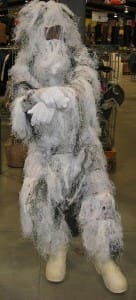
 But these guys are all warm and snuggly in their snow camouflage. Strike – Hold! has put together a great post on various issue and commercial snow camo from around the globe. Enjoy…
“‘Tis the Season – for Snow Camo!”


But these guys are all warm and snuggly in their snow camouflage. Strike – Hold! has put together a great post on various issue and commercial snow camo from around the globe. Enjoy…
“‘Tis the Season – for Snow Camo!”
I know, I know, these things have shown up all over the web. I have been asking and asking PEO-Soldier for pictures and they have politely informed me that they aren’t quite ready to release any photos yet. The UCP-Delta uniforms and equipment have been in theater for awhile now but the MultiCam test items just reached troops within the last two weeks. So I can understand their position. What’s the point of just looking at one side of the equation? I mean someone may see that only UCP-D photos are out there and say that the Army is biased and already made up its mind.
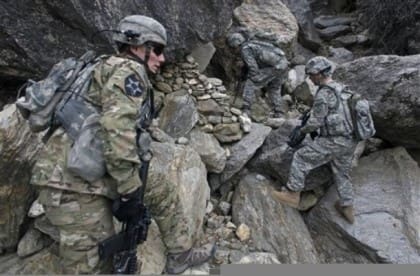
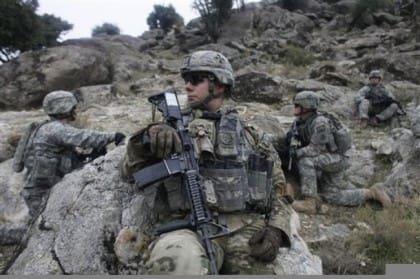
Ironically, we all get to see our first glimpses of UCP-Delta in use on CNN. And then, today, DoD’s Digital Imagery & Video Distribution System releases several photos of US troops in Afghanistan doing what they do; soldiering. It just so happens that some of them are wearing UCP-D.
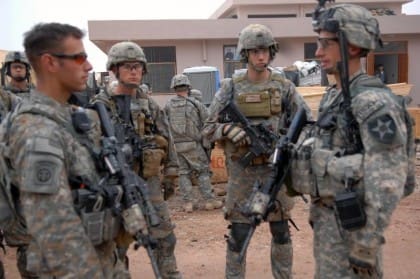
Now, I am sure you have noticed that some of the troops in the photos are from the 82d Airborne Division (2d Battalion, 508th Parachute Infantry Regiment to be exact). No, they were not initially intended to participate in testing. About 1,000 uniforms were made in UCP-D, plus about 200 extras. CJTF-82 made the decision on who would receive test items and not PEO-Soldier. 3-61, being a squadron, rather than a battalion, has well under 1,200 Soldiers and consequently, the decision was made to spread the wealth so to speak. Looks like the paratrooper wearing the Arc’teryx Kneecaps is a Grey Group customer (just sayin’).
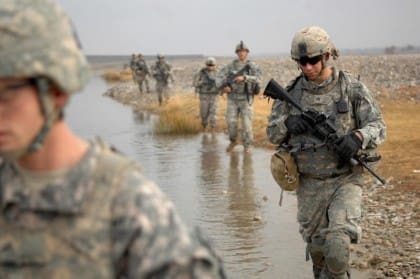
The Tactical Assault Platform (TAP) is in UCP-Delta.
Pictures of 4th ID Soldiers wearing MultiCam ACUs also began to show up. Unfortunately, it seems that their MultiCam TA-50 hadn’t been issued when these were taken.
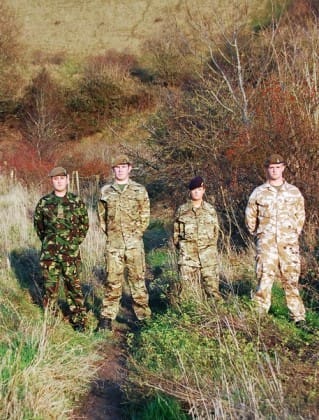
Britain’s Defence Science and Technology Laboratory (Dstl) has released a photo showing the multitude of patterns that were tested in order to settle on the new Multi Terrain Pattern.
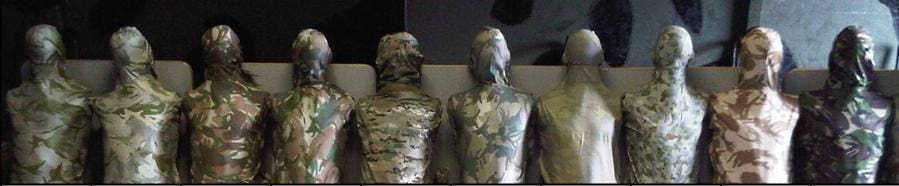
Click on the photo for a larger view
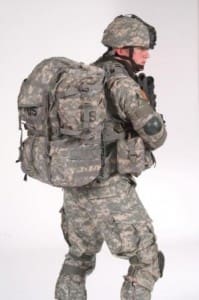 Military.com’s Defense Tech Blog just published a teaser for an article on a new “Medium” pack for use in Afghanistan. The intent is to provide a pack that fits somewhere in between the current 2000 cubic inch Assault Pack and the 5000 cubic inch Modular Lightweight Load carrying Equipment (MOLLE) Rucksack. Interestingly, the initial variant of the current MOLLE pack was of Medium size and only after a couple of years did the Army change out to the current Large pack.
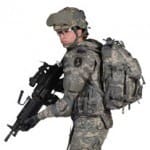 In fact, the Large MOLLE ruck was only developed to support light forces like the 10th Mountain Division and there was a great deal of hand wringing over whether it would be appropriate to replace the Medium on general issue. It can be denoted from the earlier version by the addition of a halfmoon zippered compartment on the bottom which is used to carry the sleep system rather than a separate bag.
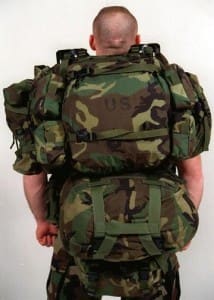 As you can see from this photo (actually an early medical version issued to Navy Corpsman supporting the Marines), the original pack was much smaller but fell in line with the modularity of the overall system. It could be used in conjunction with a variety of additional options including the side mounted sustainment pouches as well as the sleeping bag carrier. Later, with the advent of the Ranger variant of MOLLE a waist pack was added to the mix. When MOLLE was initially envisioned the concept was to provide a variety of modules that the user could add or subtract in order to mission tailor the load. There was concern about devloping a pack that could overload the wearer.
The US military used the All-purpose Individual Lightweight Carrying Equipment (ALICE) system up until the late 1990s which included medium as well as large packs. Both fit on a tubular metal frame so the concept of offering several pack options is nothing new. It seems that more and more often, the Army is learning that the Soldier needs several options in his “toolbox”. For example, SOCOM selected an entire suite of pack sizes for their troops.


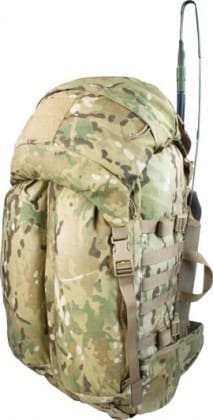 One possible solution is the Mystery Ranch SATL which is issued to SOCOM and integrates MR’s proprietary Bolster Ventilation and Stability (BVS) system which was designed to increase the stability of the pack over body armor. Consider the SATL a daypack on steroids with external pockets to help compartmentalize gear. Its internal frame design helps stabilize teh load yet keep the pack’s weight to a minimum.
As you can see, over time the US has provided multiple pack sizes to its troops. It will be interesting to see how this “new” requirement pans out; whether it is an internal frame, external frame, or a frameless pack and whether it will be adopted into the MOLLE program of record.
Natick has issued a Sources Sought Notice for a Large Airborne Assault Pack. Oddly enough, the actual title of the notice is, “Tactical Load Carriage Equipment capable of being used in a combat environment that are additionally suited for Army Airborne Operations that are based in the United States or U.S. Possessions.” What a mouthful, and what the heck does that even mean? How about just shortening the title to, “Large Airborne Assault Pack?” Then you can get into that it will be used for both combat and training operations in the narrative.
Specific requirements include, “internal storage capacity of 2900 cubic inches. The large assault pack will be made of the same unique fabrics, finishings and findings available in the current Modular Lightweight Load Carriage (MOLLE) Large Ruck-Sack. Additionally the large assault pack must have an integrated single point release system and hook-pile-tape lowering line that is either permanently attached, or is part of the overall design of the assault pack, that is capable of meeting the stringent requirements of rotary and fixed wing personnel airborne operations. The large assault pack must have a storage pocket for the hook-pile-tape lowering line, 18 personnel attaching straps and the single point release handle when the large assault pack is not rigged for airborne operations.”
Please note that this is an assault pack. This means no frame required. On another note, I am personally no fan of permanently attaching air items to a pack that a guy has to schlep around all day, particularly a single point release. Additionally, carting your lowering line around only adds insult to injury.
Interested vendors have until 30 December to answer but have to include a jump ready pack in their answer. It is important to note that whether or not you answer the Sources Sought you may still answer a formal Request For Proposals if one issued, but it is important to the Government that you do answer this current request as the information gathered will help shape any further procurement decisions. They need to know what the state of the art consists of.
A similar project was undertaken in late Summer to support a requirement out of the 82d Airborne Division. Several commercial packs were assessed under conditions which included airborne operations overseen by the Airborne Special Operations Test Directorate (ACE Board) and the Advanced Airborne School. I received information during AUSA that a winner had been chosen and when I spoke to that company they were surprised to hear it. Even now, I have seen no formal award nor announcement on the project by the Army so perhaps this new project has supplanted the earlier work.
Our friend Dom Hyde, posted this article from the UK’s Defence Science and Technology Laboratory (Dstl).
According to the article, which goes into great depth about their goals and methodology, “Dstl assessed whether a multi-terrain camouflage was better than the standard army woodland camouflage disruptive pattern material (DPM) or the desert DPM and if so what is the best pattern, or balance of colours. The two current camouflage schemes were tested alongside an existing off-the-shelf multi-terrain camouflage to see which performed best across various backgrounds that soldiers are likely to encounter across the landscape in Afghanistan.” Sounds an awful lot like what the US is currently doing.
Perhaps, based on the UK experience of adapting the Crye color palette to their pattern, the right answer for the US is to do something similar. It seems that the MultiCam pattern is challenging for the supply chain to sustain due to its complexity in printing. Apparently it is difficult for inspectors to quickly approve material printed in the pattern as they must look over the sample and decide whether it meets spec for color shading and blending. Due to the US obsession with so-called digital patterns, if a pixelated version were created, it would be much easier to print and quicker for the inspectors to proof. However, it would lose some of its effectiveness due to the loss of the fades in the pattern.
The UK MoD has released a photo that shows the new Multi-Terrain Pattern (MTP) with the currently issued Woodland and Desert Disruptive Pattern Material (DPM) patterns.