Wilcox Ind VIPR

Syrian Camo?

September 17th, 2009

*Soldier Systems Daily Exclusive*

We received an excerpt of the 2009 Natick report “PHOTOSIMULATION CAMOUFLAGE DETECTION TEST” in order to determine the origin of the so-called “Syrian” pattern.

The internet has been aflame with concern and indignation that a “Syrian” camouflage pattern is out performing UCP. Still others have taken recent articles printed on other websites as an indication that the Army is considering this pattern for issue but nothing could be further from the truth.

In an effort of clearing the air, Soldier Systems Daily offers these quotes taken directly from the report followed by some analysis. A couple of tidbits from the report:

“Eighteen patterns were included in the imagery collection and observer data collection.

Guidance for pattern selection was given by BG Brown, PEO-Soldier in March 2007. Guidance included patterns of foreign countries, patterns presently available on the commercial market and the UCP. Final pattern selection was controlled by pattern availability. The Woodland and Desert Battle Dress Uniforms (BDU) were not included in this evaluation because, at the time of pattern selection, they were not being worn by the U.S. Army.

All targets wore desert combat boots and a green Advanced Combat Helmet (ACH). Helmet covers were not worn because of the lack of availability of covers for most patterns. Deployment and training schedules limited the availability of observers during the short data collection period. Therefore, to focus data collection on the patterns of greatest interest, the patterns were prioritized into two tiers. When a complete data set was collected on the Tier 1 patterns, which are annotated in Figures 6-10 with an asterisk, observer data collection then began on the Tier 2 patterns.

Although detection data were collected on 18 patterns, five patterns (i.e., Sweden, Spec4 Woodland, Spec4 Urban, North Korea, and Woodland British) were eliminated from the final data analysis. The two Spec4 patterns were not available for desert image collection; therefore, they did not have a complete data set. Sweden, North Korea and Woodland British were eliminated, due to being the worst performers in two out of the three environments. Their similarity to other woodland patterns was further justification, although it must be noted that detection data are available for further analysis, if desired.”

“Given these environment-specific results, five patterns consistently performed better than UCP – Syria, Desert MARPAT, Desert Brush, MultiCam®, and Natural Gear.

Although the performance of the Natural Gear pattern was consistently better than UCP, it is not a viable pattern to consider for possible near-term military use because it does not have military near-infrared properties and the Government has no rights to the pattern. Natural Gear was also the lowest performer of this group of five patterns. Therefore, further discussion is focused on the remaining four uniforms – Desert MARPAT, Desert Brush, MultiCam® and Syria. Syria, although a foreign uniform and not practical for U.S. military use, yielded very favorable results in the environments tested and may be useful in future research on pattern / color effectiveness in multiple environments.“
italics added for emphasis (mine)

As you can see from the study, the now infamous “Syrian” pattern is not under consideration for issue to US troops but rather considered a “lab pet” to be used during future camouflage study.
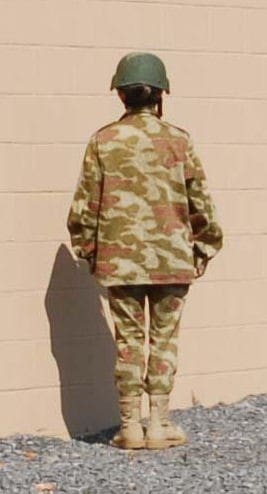
syrian-camo

This is the photograph of the “Syrian” camo from the Natick report. Unfortunately, we still do not know the true origin of this pattern. International camouflage experts have reviewed that photo and determined that it is not on general issue to Syrian forces. Furthermore, it has been suggested that it closely resembles the German Sumpfmuster (Marsh Pattern) issued to the Bundes Grenz Schutz from the late 50s on. This pattern in particular was based on a WW II German Army Marsh pattern and has been also worn by the Libyan military.

Notice that “British Woodland”, beloved Temperate DPM was eliminated due to being among the worst performers in the study but on the flip side, Desert DPM fared pretty well. Interestingly, this will be very big news across the pond as the British military struggles with PECOC and their efforts to field a more effective pattern for operations in the Middle East.
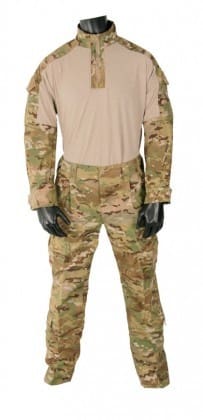
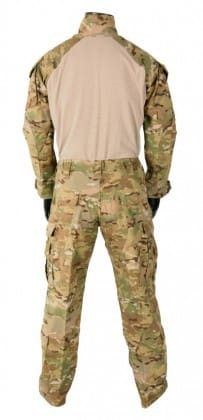
Crye Precision FROG Combat Shirt and Trousers

September 17th, 2009

*Soldier Systems Daily Exclusive*

Propper International has partnered with Crye Precision in a licensing agreement to manufacture and sell the Crye designed USMC Flame Resistant Operational Gear (FROG) combat shirt and trouser for Military and Government customers. Many don’t know that the FROG uniform was designed by Crye Precision based on lessons learned from their successful Combat Uniforms and this is exactly the same fighting ensemble issued to the Marines but in a wider selection of colors. The FROG combat shirt and trouser which are already available in Desert MARPAT are also planned to be available in Multicam, Tan, Green, Black, AOR1, AOR2, Army Universal, and Digital Tiger Stripe.

FROG Ensemble Produced in MulticamFROG Ensemble Produced in Multicam

Propper has been manufacturing the combat shirt and trouser for the USMC since 2006 and looks forward to bringing this battle proven product to additional customers in different markets. Distributors, government agencies, and military acquisitions personnel are welcome to visit the Propper booth for further info at the Infantry Warfighting Conference and Modern Day Marine for more information.

Infantry Warfighting Conference, Booth # 1110
Sept. 22-23

Modern Day Marine, Booth # 1553
Sept Sept 29 – Oct 1

Gov/Mil Sales Contact: Greg Graves
GSA purchase information will be available soon.

Note: Propper is not taking individual commercial orders at this time but as product becomes available through distributors they foresee availability coming to retail customers.

News Flash – Military Helmet Designs Contribute To Brain Damage

September 16th, 2009

As if we needed a report to tell us that the current helmet design contributes to brain injuries. The current pattern is after all a compromise designed so that a Soldier can breath, smell, hear, and see. All pretty critical capabilities on a battlefield. Based on the cut, it isn’t any big surprise that blast waves enter the helmet. What is interesting is how one protective feature of modern helmets is protecting our troops, it is also putting them at risk to TBI.

The study entitled “Skull Flexure from Blast Waves: A Mechanism for Brain Injury with Implications for Helmet Design” discusses traumatic brain injury [TBI] and how it may be caused by skull flexure from even non-lethal blasts and without actual head impact.

Ultimately, what we are seeing is a similar phenomenon to what we have seen with body armor. Personal protection technology has developed to the point where they protect a Soldier from death in many attacks that would have killed them in previous conflicts. Consequently, we have seen a marked increase in burn, amputation, and brain injuries. These are effects that weren’t considered major requirements, if at all when the current family of PPE was under development.

In particular this report cites the air gap between the Soldier’s head and the inside of his helmet. Once again, with earlier technologies, the helmet shell’s material would not have been sufficient to protect the Soldier from most blasts and the accompanying shrapnel. Current and emerging shell technologies do a much better job at protecting from shrapnel injuries and so TBI is now being found in blast survivors. Unfortunately, the air gap in the helmet protects the wearer from blunt trauma injuries associated with back face deformation of the shell’s ballistic material. The ACH maintains a 1.3-cm gap between helmet and head; in simulations involving a 5-pound bomb exploding 15 feet from a Soldier’s head, blast waves washed into the helmet through this gap. “The helmet acts as a windscoop, so the pressure between the skull and helmet is larger than the blast wave by itself,” study co-author Michael King said. While the ACH’s pads mostly prevented this underwash, they also passed on forces to the skull.

King suggested that the pads’ stiffness could be optimized to “take the best of both worlds; it doesn’t allow the blast in there, and it doesn’t transfer [forces] from the helmet to the head.” He stressed that when making changes to the helmet, preserving its ability to reduce impacts and fend off bullets was paramount. “You’d have to be careful to make sure it doesn’t interfere with what the helmet does very well, which is stopping fragments and bullets,” he said. “The whole idea why there was a big gap between skull and helmet in the first place, is it makes it more likely for the soldier to survive if a bullet hits the helmet.”

Tactical Office

September 16th, 2009

FOB life hasn’t been this complicated since the Viet Nam war. Command and Control from semi-permanent positions in austere environments calls for a unique set of solutions. Furniture has to be lightweight in case of movement yet sturdy and durable. Throw in the increasing requirement for conditioned power and tools to command, control and communicate with deployed forces and there aren’t many off-the-shelf solutions available. However, Energy Technologies Incorporated’s Tactical Officeâ„¢ may just hold the answer. Tactical Office is a deployable office system that includes a Tactical Deskâ„¢ that can be equipped with a Global Power Conditioner, Global UPS, Notebook PowerStationâ„¢, Tactical Task Light, Tactical Computer Workstation which is built into a drawer. You can even use solar panels to charge the UPS.

Tactical Office Desk

The shipping weight empty is 100 pounds but features two heavy duty wheels to make it easier to move around. The Tactical Officeâ„¢ also includes field chairs that can be folded and stored in the lids and unlike that stool that came with your old WW II-style GI field desk, these have chair backs.

Tactical Desk Folded for Shipping

For more information visit Energy Technologies Inc.

What’s the Frequency Kenneth?

September 15th, 2009

A funny thing happened the French on the way to fielding their new Future Soldier System FELIN (Fantassin à Équipement et Liaisons Intégrés, English Integrated Equipment and Communications Infantryman). It seems that in 2013, the French Government is going to sell off the frequency spectrum used by FELIN. I Love it when a plan comes together. The FELIN information network sub-system operates in the 802 – 862 Mhz range which is scheduled for sale in 2013. Yes, that says “sale”, as in someone else will own it and the French Army will no longer be authorized to use it. This means that prime contractor Sagem will have to alter the software of the radio and no one has yet publicly disclosed how much this will cost. Sagem is currently filling orders for 5,045 FELIN systems to be delivered through the end of 2010.

Another issue beyond cost is performance. The current radio has a range of 1km in open terrain, 600m in urban areas, and only 100m indoors. Concerns have been expressed that a new, higher frequency range will be further inhibited in areas of high biomass such as jungles.

The RIF or information network sub-system consists of a radio with integrated global positioning system (GPS). This voice and data network connects the Soldier to others in the section and to the section commander, who is connected to the SITEL battle management system in a combat vehicle. SITEL, also developed by Sagem, is being fitted to all French Army vehicles. The RIF relies on the Thales Communications PR4G VS4 frequency-hopping radio for tactical internet connectivity and links to the vehicle’s SITEL.

FELIN

Recent versions of FELIN have boasted a new Tenue Combat (combat uniform) that more resembles the loose “Guerilla” suits of the 50s and 60s than the current issue tight fitting uniform. Additionally, the camo pattern seen in the photo above was an affectation of Sagem and will not be a part of the FELIN which will retain the current issue CCE pattern. CCE is similar in coloration to the old US issue Woodland pattern.

Afghanistan Camo Testing Announced

September 15th, 2009

*UPDATED* Natick has been busy developing several new variants of UCP which retain the base pattern but replace individual colors. Word has it that some of them are down right ugly. It has recently been revealed by Brig. Gen. Peter Fuller, PEO-Soldier that the new “UCP-Delta” which integrates Coyote Brown into the pattern along with Multicam will be evaluated in Afghanistan beginning in October. In response to the Congressional directive to field a new camo pattern for operations in Afghanistan two Battalions worth of uniforms will be tested.

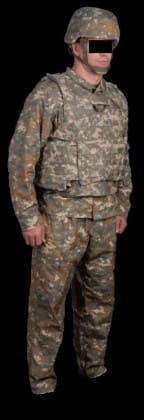
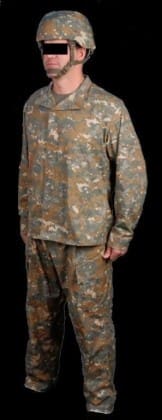
Below are two photos of UCP-Delta. One with an IOTV and one without.
UCP Delta with IOTV UCP Delta
Photos courtesy of PEO-Soldier

According to sources at Natick, 30% of the pattern of the UCP-Pattern is Coyote Brown. One advantage exhibited in the photos is that UCP Delta offers the perception that current UCP field equipment will not need to be replaced.

Pro Patria Awarded Shotgun Enhancement Contract

September 14th, 2009

The United States Army Special Operations Command awarded contract H92239-09-P-0113 for 1,102 Mission Enhancement Kits for the Mossberg 500/590 to Pro Patria, Inc a Service-Disabled Veteran-Owned Small Business. The kit has been refined over a three year development process and contains an M-4 carbine-style collapsible butt stock, a sling system, a Picatinny rail equipped forearm, a shotgun retention system, a Picatinny rail, and a breaching barrel. Previously, 10th SFG(A)’s shotguns were enhanced by Pro Patria. Now, all Special Forces Groups both Active and National Guard will be similarly equipped.

Pro Patria Shotgun Enhancement kit

Interested parties should contact Pro Patria for more information.

Flight Deck Jerseys

September 14th, 2009

USN Deck Jerseys.

Deck Jerseys; the kind you see on the Airedales rushing to and fro on a carrier deck. Oddly enough, they are an item taken for granted. They aren’t very easy to find and a simple internet search will turn up more guides on their wear than sources of supply. However, Tidewater Tactical offers made in the USA Flight Deck Jerseys in a variety of colors. What’s more, they are 100% cotton meaning no melt, no drip.