TYR Tactical

Archive for the ‘Load Carrying’ Category

MATBOCK: Ready to support EOY Requirements

Wednesday, September 9th, 2026

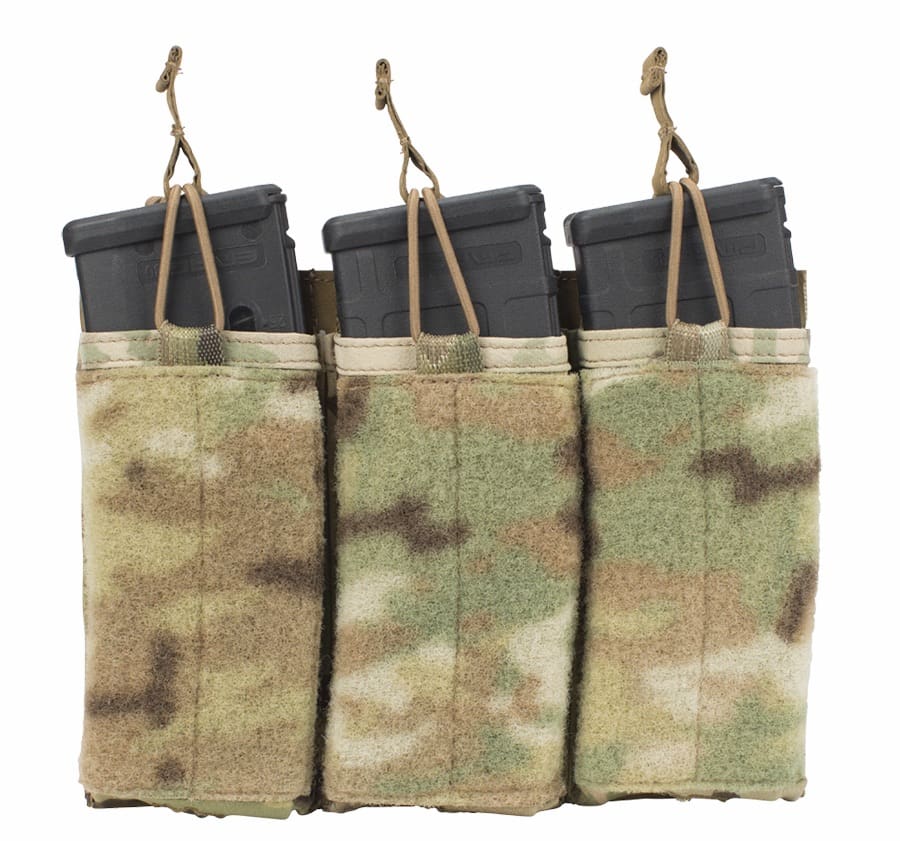
We have invested heavily in inventory and production capacity to reduce our lead times for the end-of-year push; we currently have over 200 – Multicam® Front Raider Pouches in stock.

Here is a full breakdown of our current lead times.

Anything not listed above will take 4-6 weeks.

Please reach out to sales@matbock.com to get a quote today or call (757) 384-1338 for assistance.

BFG Monday – Why MOLLE/PALS Compatibility Matters

Monday, September 7th, 2026

MOLLE/PALS compatibility allows users to mount pouches and accessories across plate carriers, chest rigs, battle belts, packs, and other load carriage platforms without being locked into a single brand or proprietary system.

That compatibility matters because most military units, law enforcement agencies, and individual users are not building complete loadouts from scratch. They are improving equipment that has already been purchased, fielded, configured, and trained with.

A new pouch may be lighter or more capable, but those improvements mean little if the pouch does not work with the equipment already in use. The best upgrades improve a proven system rather than forcing the user to replace it.

Blue Force Gear® has spent years developing lighter load carriage equipment while maintaining compatibility with the MOLLE/PALS standard. Technologies including Helium Whisper®, MOLLEminus®, and ULTRACOMP® reduce unnecessary material and weight without requiring users to abandon their existing platforms.

What Is the Difference Between MOLLE and PALS?

MOLLE stands for Modular Lightweight Load-carrying Equipment. It refers to the broader load carriage system used to carry and organize mission-essential equipment.

PALS stands for Pouch Attachment Ladder System. It is the grid of horizontal attachment points found on plate carriers, chest rigs, belts, packs, and other tactical equipment. MOLLE-compatible pouches attach to this grid by weaving their attachment straps through the pouch and the platform.

The terms MOLLE and PALS are often used interchangeably, but they do not mean exactly the same thing. PALS is the attachment grid. MOLLE is the larger load carriage system that uses it.

The distinction is less important than the practical result: a properly designed MOLLE-compatible pouch should attach securely to a correctly constructed PALS platform, even when the pouch and platform come from different manufacturers. This open compatibility is one of the primary reasons the system remains widely used across professional load carriage equipment.

Why Does MOLLE/PALS Compatibility Matter?

MOLLE/PALS compatibility gives users the ability to configure and improve their equipment without replacing the entire load carriage system.

A military unit may already have hundreds or thousands of issued plate carriers, belts, chest rigs, and packs in service. A law enforcement agency may have established equipment requirements, training procedures, and standardized pouch placement. An individual user may have spent years refining a loadout around a specific mission or job.

Moving to a proprietary attachment system can create additional costs, training requirements, logistical challenges, and equipment limitations. A compatible solution allows the organization or user to upgrade individual components while keeping the rest of the system in place.

That provides several practical advantages:

• Pouches can move between compatible carriers, belts, chest rigs, and packs.

• Users can upgrade individual components as requirements change.

• Organizations can modernize equipment in phases.

• Familiar pouch placement and established procedures can remain intact.

• Existing equipment investments do not have to be abandoned.

• Users can select equipment based on capability rather than ecosystem restrictions.

Compatibility does not prevent innovation. It makes useful innovation easier to adopt.

How Blue Force Gear® Improved the MOLLE/PALS Standard

Traditional MOLLE construction typically relies on multiple layers of fabric and sewn webbing. That approach provides a proven attachment surface, but the added layers, stitching, hardware, and individual components also create weight and bulk.

Blue Force Gear approached the problem differently. Instead of replacing MOLLE/PALS with a closed attachment system, BFG® developed materials and construction methods that reduce unnecessary weight while remaining compatible with existing equipment.

The foundation of that approach is ULTRACOMP, BFG’s high-performance laminate. ULTRACOMP combines structural stability, abrasion resistance, and strength in a lightweight material that resists stretching and water absorption. It allows BFG to replace heavier assemblies made from multiple layers of nylon, fabric, and webbing with a more efficient construction.

That material technology supports two complementary BFG systems: Helium Whisper and MOLLEminus.

What Is Helium Whisper®?
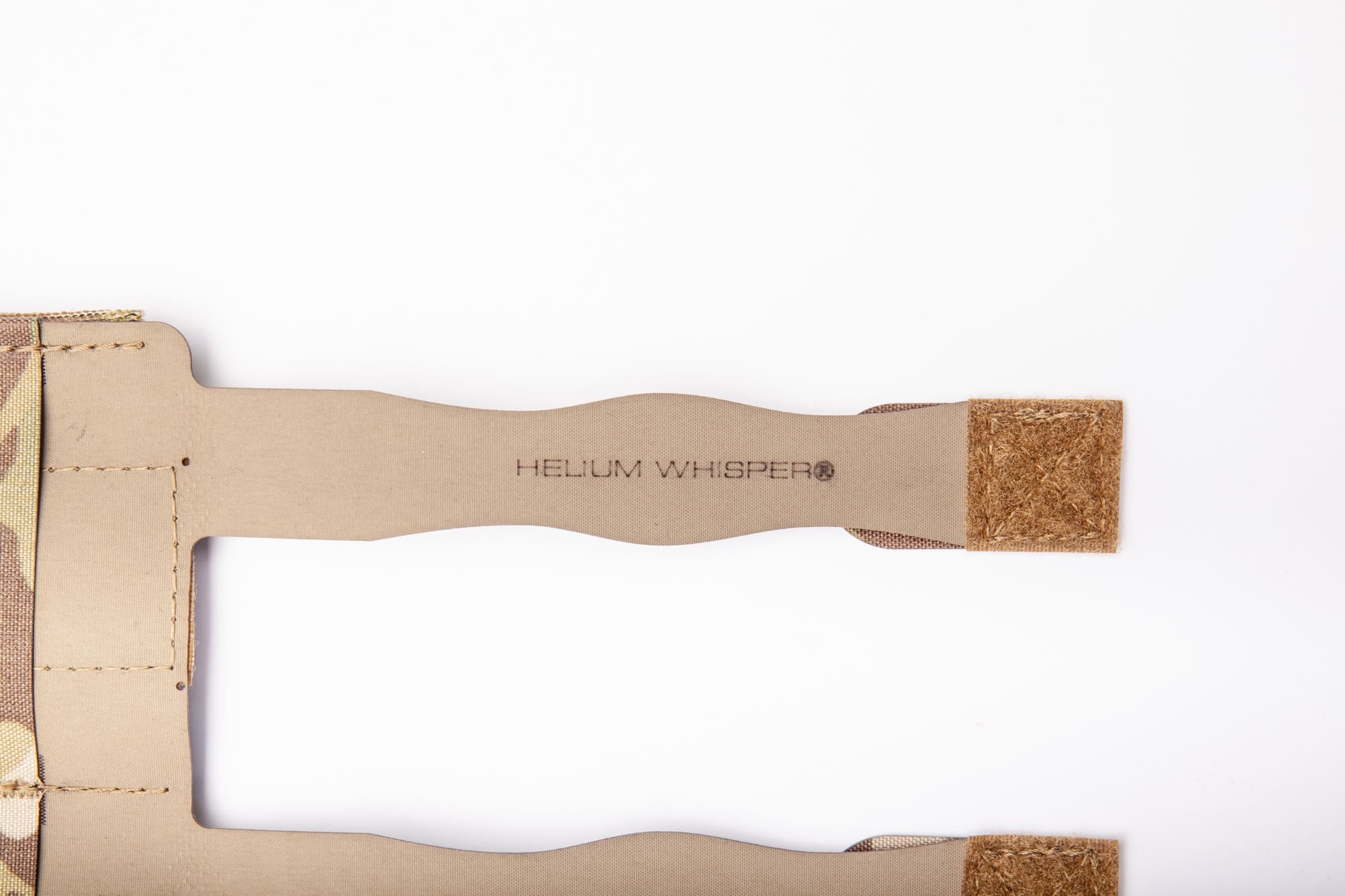
Helium Whisper is Blue Force Gear’s patented MOLLE pouch attachment system.

Traditional pouch backers can require numerous layers, straps, stiffeners, snaps, and pieces of sewn webbing. Helium Whisper replaces that construction with a laser-cut ULTRACOMP backer that uses fewer parts while remaining fully compatible with MOLLE/PALS platforms.

The Helium Whisper system reduced a legacy pouch back panel from 27 individual parts to six and reduced the listed back-panel weight from 83.3 grams to 44.2 grams. No additional proprietary platform is required to mount a Helium Whisper pouch to a compatible carrier, belt, vest, or pack.

For the user, the benefit is straightforward: the pouch mounts where a traditional MOLLE pouch would mount, but the attachment system carries less unnecessary material.

Helium Whisper can be found across BFG’s magazine pouches, medical pouches, utility pouches, and other load carriage products.

What Is MOLLEminus®?
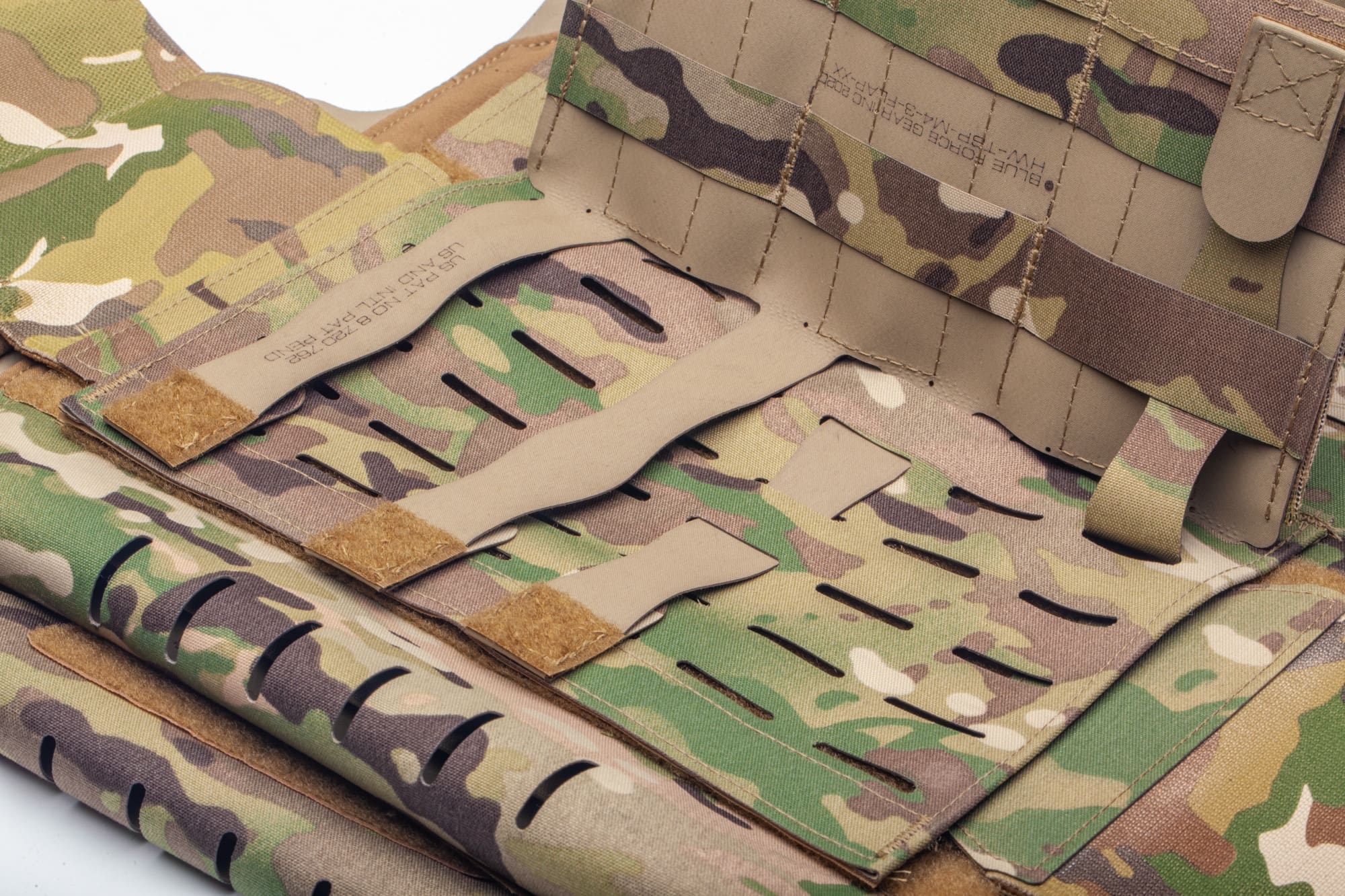
MOLLEminus applies the same weight-reduction philosophy to the platform itself.

Rather than sewing rows of webbing onto a fabric base, MOLLE attachment points are laser cut directly into a single layer of ULTRACOMP. This removes layers of material while maintaining compatibility with Helium Whisper and traditional MOLLE attachment systems.

MOLLEminus is used across BFG plate carriers, chest rigs, belts, and other load carriage platforms. It gives users a lightweight attachment surface without restricting them to MOLLEminus-specific pouches.

A MOLLEminus platform can accept Helium Whisper pouches, traditional MOLLE pouches, and other properly designed MOLLE-compatible equipment. The user gains the weight and bulk reduction of a modern platform without giving up access to the existing MOLLE/PALS ecosystem.

Can Helium Whisper® Pouches Fit Traditional MOLLE Platforms?

Yes. Helium Whisper pouches are designed to mount to standard MOLLE/PALS platforms, including compatible plate carriers, chest rigs, tactical belts, packs, and vests.

A user does not need a MOLLEminus platform to use a Helium Whisper pouch. The pouch can be added to existing equipment as an individual upgrade.

The reverse is also true. MOLLEminus platforms remain compatible with traditional MOLLE pouches. Users can keep current pouches, add new ones over time, or combine attachment types based on their requirements.

This interchangeability prevents the upgrade from becoming an all-or-nothing decision.

How Do You Know Whether a MOLLE Pouch Will Fit?

Before adding a pouch, verify that the platform has enough available rows and columns for the pouch’s attachment footprint. The pouch width, platform dimensions, and attachment method should all be considered.

A properly designed MOLLE-compatible pouch should attach to a compatible PALS platform when enough mounting space is available. Attachment straps should be woven through both the pouch and the platform to create a secure connection.

Users should also consider whether the pouch location interferes with other equipment, movement, accessibility, armor, vehicle seating, or mission requirements.

How Compatibility Supports Incremental Modernization

Replacing an entire load carriage system at once is not always practical. Equipment may be tied to existing contracts, fielding schedules, approved product lists, training requirements, or unit procedures.

MOLLE/PALS compatibility gives organizations a more realistic path forward. Heavier legacy components can be replaced as budgets, equipment life cycles, and mission requirements allow.

An organization could begin with frequently used components such as magazine pouches, medical kits, or general-purpose pouches. Those products can integrate with equipment already in service. Additional components can be upgraded later without making the original improvement obsolete.

Individual users gain the same flexibility. A lighter magazine pouch, medical kit, or general-purpose pouch can be added without rebuilding the entire loadout.

The user keeps the carrier, belt, or chest rig that already works while reducing weight where it makes the most sense.

Compatibility Preserves Equipment Placement

Compatibility also helps preserve consistent equipment placement.

Users develop familiarity with the location of magazines, medical equipment, communication tools, and other mission-essential items. Equipment placement is often reinforced through repetition, organizational requirements, and training.

Moving to a completely different attachment system can require more than replacing hardware. It may change how equipment is positioned, accessed, and managed.

A compatible pouch allows the user to reduce weight or improve capability while keeping critical equipment in a familiar location. The pouch changes. The established setup does not have to.

Lightweight Gear Should Work With What You Already Have

Modern equipment should reduce the burden on the user, not create a new one.

That is why MOLLE/PALS compatibility remains important. It gives military units, law enforcement agencies, and individual users the freedom to select better components without committing to a closed system or replacing equipment that continues to perform.

Blue Force Gear developed ULTRACOMP, Helium Whisper, and MOLLEminus to make proven load carriage systems lighter and more efficient while preserving the compatibility professional users depend on.

The goal is not to replace everything. It is to remove unnecessary weight from the equipment already trusted to do the job.

Frequently Asked Questions

What Does MOLLE Stand For?

MOLLE stands for Modular Lightweight Load-carrying Equipment. It is the broader modular load carriage system commonly used with PALS attachment grids.

What Does PALS Stand For?

PALS stands for Pouch Attachment Ladder System. It is the attachment grid used to mount compatible pouches and accessories to tactical platforms.

Are MOLLE and PALS the Same Thing?

No. PALS is the attachment grid, while MOLLE is the broader equipment system that uses it. The terms are often used interchangeably when discussing tactical pouches and platforms.

Will MOLLE Pouches Fit a MOLLE-Compatible Plate Carrier?

Yes, provided the carrier has a properly constructed PALS field with enough rows and columns for the pouch’s attachment footprint. Users should verify the available mounting space, pouch dimensions, and attachment method before purchasing.

Are Helium Whisper® Pouches MOLLE Compatible?

Yes. Helium Whisper pouches are designed to mount to compatible MOLLE/PALS carriers, belts, chest rigs, vests, and packs without requiring an additional proprietary platform.

Can Traditional MOLLE Pouches Attach to MOLLEminus®?

Yes. MOLLEminus is compatible with Helium Whisper and traditional MOLLE attachment systems.

Do I Need to Replace My Carrier to Use a Helium Whisper®Pouch?

No. A Helium Whisper pouch can be mounted to an existing compatible MOLLE/PALS platform, allowing individual pouches to be upgraded without replacing the carrier.


FirstSpear Friday Focus: MultiMag Rapid-Adjust Pocket

Friday, September 4th, 2026

Most magazine pockets are built around one magazine. The FirstSpear MultiMag Rapid-Adjust™ Pocket is built around any magazine. Featuring patented adjustment and retention hardware, the MultiMag allows the operator to quickly dial in retention to fit a wide range of firearm magazines and similarly sized items without inserts, tools, or reconfiguration. It runs right out of the box, weighs just over two ounces, and mounts via the ultralight 6/9™ system with full MOLLE/PALS backward compatibility.

Features:

  • BOA® FIT SYSTEM — PRECISE MICRO-ADJUSTABLE RETENTION
  • NO INSERTS REQUIRED — RUNS OUT OF THE BOX
  • FITS AN ARRAY OF RIFLE, PISTOL, AND PDW MAGAZINES
  • ULTRALIGHT 6/9™ — WEIGHS JUST OVER 2 OZ

At its core, the MultiMag Rapid-Adjust™ Pocket integrates the Boa® Fit System, allowing the operator to achieve precise micro-adjustability from a compact HK MP7 all the way up to a full-size HK 417 magazine with a single adjustment. Compatible platforms include Beretta M9, Glock 17/19/20/21/22/23, HK G36, Sig Sauer 226/229/P320/M17, M4, MP7, and 1911. Optional speed reload inserts for two pistol magazines or a single M4, removable pull tab, and bungee kit are available separately. Available in Black, Coyote, Manatee Grey, Multicam, Ranger Green, and Frogskin.

Built for military personnel, law enforcement officers, and prepared professionals who demand reliable equipment, the MultiMag Rapid-Adjust™ Pocket delivers precision retention across a wide range of magazines in a single ultralight pocket. FirstSpear is the premier source for cutting-edge tactical gear for military, law enforcement, and those who train. To request an estimate, visit First-Spear.com/Request-For-Estimate. For more information, visit First-Spear.com.

MATBOCK Monday: ARES Drone Pack Operator Loadout

Monday, August 31st, 2026

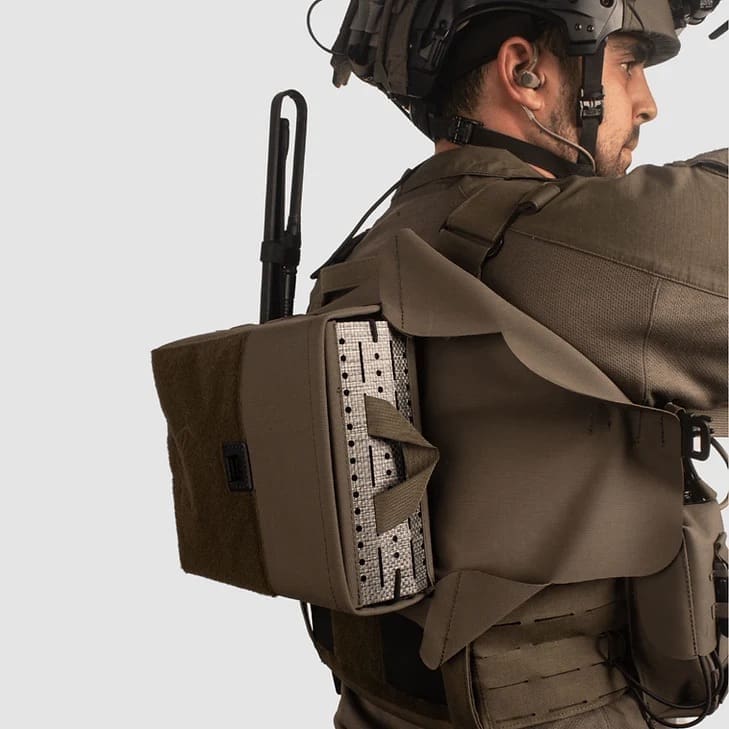
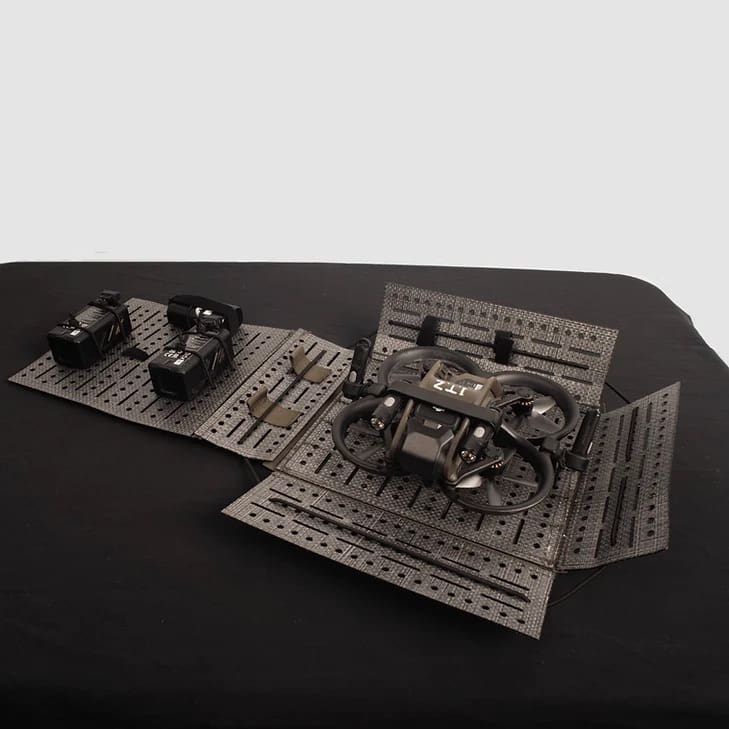
Back in June, we told you about the ARES Drone Series: two purpose-built packs designed to support drone operators.

Operators are using the “ARES Drone Assault Pack” as their Pilot Bag. The “ARES Drone Sustainment Pack” has become the Bird Bag. 

Airframes ride securely in the Bird Bag, controllers and goggles are staged in the Pilot Bag, and the whole system can zip together or split apart depending on how the mission is task-organized.

The Pilot Bag and Bird Bag are both made from Ghost® material and modular, operator-driven design that built the Graverobber™ — just pointed at a different mission set now that drone operators have.

Check out the full ARES Drone Series at www.matbock.com/collections/packs/Drone and reach out to sales@matbock.com to get a unit quote started today.

BFG Monday: What Training Immediately Reveals About Your Equipment

Monday, August 31st, 2026

I start every active shooter response course by placing my students a football field away from the objective.

No matter how experienced they are, the first thing I do is put distance between them and the building, throw a flashbang, and yell, “Go.”

The sprint is primarily about introducing stress. It is the closest I can come in scenario-based training to replicating what someone may feel crossing a parking lot toward gunfire or closing on a structure with a rifle and plate carrier, not knowing what is waiting on the other side of the door.

Heart rates spike. Fine motor skills begin to deteriorate. That is the environment I want my students operating in before they get on the X.

The sprint also serves another important purpose: the kit shakeout.

Standing Still Tells You Nothing

Somewhere along that hundred-yard sprint, gear almost always starts falling off.

Med kits. Tourniquets. Magazines. Sometimes entire pouches.

I call it a “yard sale.” An ant trail of equipment marks the path the student ran, like a trail of breadcrumbs made from pieces of their own kit.

Some of it is expensive gear that looked great in the locker. Some of it comes from overloaded carriers where a student attached everything they could think of instead of moving half of it into a backpack. Other times, it is department- or agency-issued equipment that no one has truly tested under movement and pressure.

The source does not matter. Equipment can look perfect while someone is standing still, but you will never know whether it works until you put it through the paces.


Students usually laugh when it happens, and watching someone trace their sprint path to collect scattered gear can be funny. But the lesson underneath it is not funny at all.

When It Matters Most

The real problem becomes clear a few minutes later.

The student enters the structure, engages the simulated threat, and encounters a casualty bleeding on the ground. They reach for the med kit on their belt or plate carrier, and it is gone.

It is sitting in the grass a hundred yards behind them.

Now they must run back to find it and then cover the same distance again to reach the casualty. In a real emergency, those are seconds that may determine whether someone survives a gunshot wound.

I do not mind when equipment fails during training. In fact, I welcome it because failure creates an unforgettable learning point.

It is better to learn that you should assume nothing works until it has been pressure-tested in a controlled environment. A kit shakeout in training may cost someone a little embarrassment that their teammates will not let them forget. A kit shakeout during a real armed response could have far more serious consequences.

One case has always stuck with me.

A student and friend arrived at a course wearing what I can only describe as an “Amazon special.” His medical pouch looked the part but had never been run under stress.

It did not survive the sprint.

His equipment failed in front of his peers, and he immediately understood the gravity of that happening during a real emergency. He adjusted his setup, retested it, and moved forward.

Today, he runs a Blue Force Gear® GRID® Battle Belt outfitted with a Micro Trauma Kit NOW!® Nano ES built for law enforcement.

That is exactly what a professional should do. Identify failure. Correct it. Test the solution.

One Setup Does Not Fit Everyone

Gear setups are personal.

Body type, job, environment, and mission all influence what works. There is no single correct belt, carrier, or rig for every operator or officer.

Looking at someone else’s setup can provide useful ideas butcopying it without accounting for your own mission is where problems begin. What works for someone teaching on a flat range may not work for an officer spending a shift inside a patrol vehicle. A setup built for short-duration operations may not work for someone moving long distances over difficult terrain.

Do not build your equipment around appearance. Build it around what you may actually be required to do.

My Recommended Kit Shakeout

1. Build for Your Mission

Set up your equipment around your job, body, environment, and responsibilities.

Talk to colleagues about their setups. Study how experienced professionals configure their equipment. Use those conversations for ideas but evaluate every decision against your own requirements.

Ask the hard questions:

• Can you reach your medical kit with either hand?

• Can you access it while sitting or wearing gloves?

• Does your belt remain stable while running, climbing, or changing positions?

• Can you move through doorways, vehicles, and confined spaces without snagging?

• Is your sling adjustable enough to stabilize a longer shot or move the rifle behind you when you need to go hands-on?

• Is every item on your kit necessary, accessible, and secure?

If you cannot explain why something is on your equipment, it may not need to be there.

2. Test It Through Realistic Training

The first time you truly test your equipment should never be during a real response.

Scenario-based training through your department, unit, or professional course will expose problems quickly. Events such as The Tactical Games can also reveal what happens to your setup once movement, fatigue, repetition, and pressure are introduced.

Do not limit the test to a flat range. Run in it. Climb in it. Get into and out of vehicles. Work from awkward positions. Access your equipment with either hand and while wearing gloves.

Standing still only tells you how the kit looks. Movement tells you whether it works.

3. Adjust and Retest

Never stop refining your setup.

If something shifts, bounces, snags, blocks another item, or cannot be accessed when you need it, change it. Then run the test again.

Equipment is only one part of proficiency. It cannot replace judgment, fitness, medical knowledge, or consistent training. But when the moment comes to use it, that equipment must remain secure, accessible, and functional.

Why I Run Blue Force Gear

I have been running Blue Force Gear for years, and the reason is simple: it is lightweight, low-profile, and built for movement.

When I stand next to people wearing bulkier, industry-standard equipment, my setup often looks small by comparison. That is exactly what I want.

Snag-free, low-profile gear allows me to move faster and cleaner when sprinting, climbing, working around vehicles, or entering a structure. It gives me the capability I need without adding unnecessary bulk.

Water resistance also matters. On a long movement in the rain with a 70-pound rucksack, added weight matters. Equipment that absorbs water gains weight and fights you for the rest of the movement.

My BFG® equipment remains close to the same weight wet or dry, and it has held up through years of hard use. More importantly, it stays where I put it when movement, weather, fatigue, and pressure are added to the problem.

That is when equipment earns your trust.

Pressure-Test Your Setup

Before you trust your kit during a real response, answer these questions under movement and stress:

• Can you reach critical equipment with either hand?

• Can you access it while wearing gloves?

• Does anything shift, bounce, snag, or interfere with movement?

• Does your equipment remain secure while running, climbing, kneeling, or changing positions?

• Does one item block access to another?

• Can someone else locate and access your medical equipment?

• Does your setup still work inside a vehicle or confined space?

• Have you tested it while tired, wet, and under pressure?

If you cannot answer yes to every question, your setup still needs work.

Your equipment does not earn your trust because it looks right, comes from a familiar brand, or was issued by your agency. It earns your trust after you have run in it, climbed with it, worked around vehicles in it, accessed it with either hand, andconfirmed that it remains where you need it under pressure.

Build it for the mission. Test it realistically. Fix what fails. Then,test it again.

Always Better®

By Kyle Sproles
Founder, Active Shooter Response Solutions
Visit Active Shooter Response Solutions

When The Mission Leaves The Ground

Monday, August 24th, 2026

The BFG® Integrated Stealth Harness (ISH™) Combines Three Critical Systems Into One Certified Platform

A gun belt carries the equipment needed to do the job.

A restraint system keeps a professional connected during aircraft operations.

A climbing harness provides certified protection when the mission moves into vertical terrain.

Traditionally, those have been three separate pieces of equipment.

The Blue Force Gear® Integrated Stealth Harness, or ISH™, brings them together.

The patented ISH combines a combat gun belt, rotary-wing restraint system, and independently certified Type C sit harness in one lightweight platform. It allows trained professionals to carry their equipment on the ground, remain connected during approved restraint applications, and deploy a complete sit harness when the mission goes vertical.

No belt change.

No separate harness buried in a pack.

No need to rebuild the equipment layout when the operating environment changes.

One System. Three Critical Roles.

• Combat gun belt

• Rotary-wing restraint system

• UIAA 105 Type C certified sit harness

The complete system weighs just 1 lb. 9 oz. It is Berry Compliant. Made in the USA, independently certified to UIAA 105 Type C, and compliant with EU EN 12277+A1:2018.

This is more than a tactical belt with additional hardware. It is a completely certified harness system built for professionals whose work requires movement from the ground to an aircraft, an edge, a rope, or an elevated objective without advancewarning.

THE VERTICAL PROBLEM USUALLY STARTS ON THE GROUND

Most vertical missions do not begin with someone already on rope.

It begins with ground movement, vehicle operation, building entry, aircraft approach, search assignment, or traversingthrough difficult terrain.

A military team may be carrying weapons, magazines, medical equipment, communications, and other mission essentials. Specialized law-enforcement units may be moving through a structure or approaching an elevated position. Search and rescue professionals travel across miles of ordinary terrain before reaching a cliff, damaged structure, steep slope, aircraft, or confined space.

The need for vertical capability may not appear until the mission is already underway.

That creates a basic equipment problem.

If the harness is stored in a pack, vehicle, aircraft, or equipment cache, it must first be retrieved. The user may need to remove or reposition other equipment, put on another system, verify the fit, and reconnect mission gear before moving forward.

The ISH changes that sequence by building certified harness capability into the equipment already being worn.

The removable leg loops can remain connected and staged around the waist. When the complete sit-harness configuration is required, trained personnel deploy the leg loops without removing the gun belt or retrieving a separate harness.

The capability stays with the user instead of being separated from them.

BUILT AS A TRUE COMBAT GUN BELT

The ISH did not begin as a recreational climbing harness with tactical features added later.

It was built around the curved architecture of the BFG® CHLK® Belt and incorporates the MOLLEminus® load-carriage platform for mounting holsters, pouches, medical equipment, communications gear, and other mission essentials.

That starting point matters.

A professional gun belt must remain stable while carrying equipment. It must follow the body, support an operational load, and maintain access to critical gear as the user moves between standing, kneeling, seated, and prone positions.

The ISH retains core load-carriage capability.

On the ground, it functions as the user’s combat gun belt. Equipment remains mounted in the familiar position where the user trains and operates. When the environment changes, that same platform becomes the foundation for aircraft restraint or the complete certified sit-harness configuration.

One belt.

One fit.

One equipment layout.

Three operational roles.

ROLE ONE: COMBAT GUN BELT

For many users, the first role of the ISH will also be used most often.

The MOLLEminus® field provides a low-profile platform for carrying compatible holsters, magazines, medical equipment, communications, and other mission gear. Its curved belt architecture follows the body rather than forcing a flat structure around the waist.

The user can configure the ISH around the mission and retain that equipment layout when transitioning into another approved role.

There is no separate ground belt to remove before putting on the harness.

The gun belt is part of the harness.

ROLE TWO: ROTARY-WING RESTRAINT

Aircraft operations create different requirements.

Personnel operating around open aircraft, ramps, doors, or other exposed positions may require an approved means of restraint based on the mission, aircraft, organizational procedures, and applicable training.

The ISH incorporates certified front and rear attachment points for approved applications, allowing the system to function as a rotary-wing restraint platform without replacing the user’s combat gun belt.

The professional can move from ground operations into the aircraft while retaining the same belt, fit, and equipment configuration.

That is the second role of the 3-in-1 system.

ROLE THREE: UIAA 105 TYPE C CERTIFIED SIT HARNESS

When the mission requires vertical access, the attached leg loops deploy to complete the sit-harness configuration.

The ISH is independently certified as a UIAA 105 Type C harness and compliant with EU EN 12277+A1:2018. The complete system is classified as Category III personal protective equipment under applicable European regulation for protection against risks with very serious consequences, including falls from height.

This is not simply a belt described as climbing capable.

It is a certified harness system.

The certification applies to the complete ISH system, including the belt and leg-loop assembly. The ISH is sold and must be used as a complete system. The outer belt and individual components should never be treated as standalone life-safety equipment.

That distinction is central to what the ISH is.

It is not a conventional battle belt with an attachment point added to it. It is not a restraint belt being presented as a climbing harness. It is a complete, independently certified harness that also performs the roles of a professional gun belt and rotary-wing restraint system.

INDEPENDENTLY CERTIFIED. BUILT FOR PROFESSIONAL USE.

In life-safety equipment, materials, and appearance are not enough.

Certification matters.

The ISH has documented system and component specifications that include:

• UIAA 105 Type C harness certification

• EU EN 12277+A1:2018 compliance

• Sewn belay loop rated to 15 kN

• COBRA® buckles rated to 18 kN

• Custom-blended Dyneema webbing with a 5,000 lb. breaking strength

• Certified front and rear attachment points

• Berry Compliant construction

• Made in the USA

The complete 1 lb. 9 oz. system consists of a 3 oz. inner belt, 10 oz. outer belt, and 12 oz. leg-loop assembly.

Those numbers give military, law-enforcement, rescue, aviation, and government procurement teams measurable information for evaluating the system.

They also reinforce the difference between equipment that looks like a harness and a complete system that has been independently certified as one.

BERRY COMPLIANT AND MADE IN THE USA

For military and government customers, domestic sourcing is not simply a marketing statement.

The ISH is Berry Compliant and Made in the USA, placing its domestic manufacturing story alongside its independently verified harness certification.

That combination matters.

The market contains tactical belts. It contains climbing harnesses. It contains restraint products.

Far fewer systems combine all three roles while also offering UIAA 105 Type C certification, Berry-compliant construction, and an equipment-carrying platform designed around professional use.

The ISH was built for organizations that need capability, certification, domestic sourcing, and mission-equipment integration in one complete system.

DESIGNED FROM OPERATIONAL EXPERIENCE

The thinking behind the ISH did not begin in the marketing department.

Retired U.S. Air Force Pararescueman Ishmael Antonio drew on a 20-year career to reconsider how a professional harness should work and why vertical capability must remain with the user when conditions change.

His experience helped shape a system that could carry equipment on the ground, support applicable aircraft-restraint requirements, and convert into a certified harness without forcing the user to stop and rebuild their setup.

The point is not that every mission will require every capability.

The point is that the professional may not know which capability will be required next.

The equipment should account for that uncertainty.

Watch Ishmael Antonio and Chris Sizelove explain the operational thinking behind the ISH and why a harness that remains with the user can matter when conditions change.

WATCH THE ISH™ STORY

LEG LOOPS THAT DO MORE

The modular leg loops allow the ISH to transition from combat gun-belt configuration into its complete Type C sit-harness configuration.

They can remain attached and staged around the waist rather than being stored separately in a pocket or pack. When vertical capability is required, the user deploys the leg loops to complete the harness.

When configured according to approved instructions, the leg-loop assembly also supports additional applications, including:

• Autoblock friction-hitch configuration for rappelling

• Emergency tourniquet application using the integrated windlass points

• Pelvic stabilization

• Two-person litter carry

These capabilities do not replace dedicated medical equipment, approved rescue systems, professional judgment, or training.

They reflect the larger philosophy behind the ISH: equipment carried into demanding environments should provide greater utility without forcing the user to carry multiple disconnected systems.

BUILT FOR PROFESSIONALS ACROSS MULTIPLE MISSIONS

The ISH was developed around demanding military requirements, but the problem it addresses is not limited to one community.

Defense and Public Safety

Military personnel, special operations units, SWAT teams, emergency service units, federal response teams, and aviation personnel may move between ground operations, aircraft, elevated positions, rappelling, technical access, and rescue requirements during the same mission.

The 3-in-1 design keeps equipment carriage, applicable restraint capability, and a certified harness together on the professional.

Search, Rescue, and Disaster Response

Search and rescue teams, technical rescue personnel, and appropriately equipped disaster-response organizations operate in environments where ordinary access can quickly become vertical access.

Steep terrain, damaged structures, cliffs, towers, confined spaces, unstable surfaces, and industrial environments can all create situations where the harness must be available immediately rather than stored somewhere else.

The ISH allows trained personnel to keep a certified sit harness integrated with the equipment already being worn.

Remote and Technical Operations

Wildland and remote-area responders, maritime units, technical-access personnel, aircraft crews, and infrastructure teams may move between equipment carriage, restraint, rescue, and vertical work during different phases of an operation.

The ISH is not a replacement for agency-specific PPE, dedicated rescue systems, approved procedures, or application-specific training. It gives responsible organizations a certified platform to evaluate roles when those capabilities need to remain with the user.

THE HARNESS YOU NEED IS THE HARNESS YOU HAVE WITH YOU

A separate harness only helps if the user has it, can reach it, and has time to integrate it with the equipment already being carried.

The ISH closes that gap by keeping the complete system on the professional. It functions as a combat gun belt, supports approved restraint applications, and remains ready to deploy into its certified sit-harness configuration.

The user does not have to predict exactly when the mission will leave the ground.

The capability is already there.

PROFESSIONAL EQUIPMENT REQUIRES PROFESSIONAL TRAINING

The ISH is professional life-safety equipment.

It must be used only by properly trained or otherwise competent persons, or under the direct supervision of trained or competent personnel.

Users must read and understand the complete instruction manual, inspect the system before use, test all associated equipment for form, fit, and function, and verify that the harness is correctly rigged before any activity at height.

Certification does not replace training.

A 3-in-1 system does not remove the need to understand each role.

The value of integration is that a trained professional can carry those capabilities together in one purpose-built platform.

ONE SYSTEM. THREE CRITICAL ROLES.

The Integrated Stealth Harness represents a different approach to professional equipment.

Instead of forcing the user to carry one belt for equipment, another system for restraint, and a separate harness for vertical access, the ISH consolidates all three roles into one lightweight, Berry Compliant, independently certified platform.

Combat gun belt.

Rotary-wing restraint system.

UIAA 105 Type C certified sit harness.

One belt.

One equipment layout.

One complete system that remains with the user when the environment changes.

Because the mission does not stop when the ground does.

Neither should your equipment.

Learn more about the BFG® Integrated Stealth Harness and watch the complete system in action.

EXPLORE THE ISH™

FirstSpear Friday Focus: General Purpose Pockets

Friday, August 21st, 2026

Every loadout has gear that doesn’t fit neatly into a magazine pocket or a radio pouch. The FirstSpear GENERAL PURPOSE POCKET family is built to handle exactly that, providing durable, modular storage solutions that mount cleanly to any 6/9™ or 6/12™ compatible platform and adapt to whatever the mission requires. Whether you are organizing medical supplies, tools, admin essentials, or mission-specific gear, the GP Pocket family gives you a purpose-built solution in three distinct configurations, each designed around a different capacity and use case.

Features

  • 6/9™ AND 6/12™ ATTACHMENT — MOLLE COMPATIBLE
  • THREE SIZE-SPECIFIC CONFIGURATIONS
  • DUAL ZIPPER AND G HOOK CLOSURE SYSTEMS
  • CORDURA MATERIAL CONSTRUCTION — LIGHTWEIGHT AND DURABLE

The Structured GP Pocket, Small is a compact, streamlined solution built for smaller items, featuring a dual zipper closure and a low-profile footprint that minimizes bulk on a tight loadout. The General Purpose Pocket, Medium is constructed from 500D Cordura material and features an elastic daisy chain on both interior sides, with an additional belt attachment option. The General Purpose Pocket, Large is a flat pocket measuring 7″ x 7″ x 2″ with a zippered mesh internal compartment, dual zipper and G Hook closure, and a button hole at the top for routing a hydration tube or communication wire. The General Purpose Pocket, Large is available in Black, Coyote, MultiCam, Foliage Green, and Ranger Green. The General Purpose Pocket, Medium is available in Black, Coyote, MultiCam, and Ranger Green. The General Purpose Pocket, Small is available in Black, Coyote, MultiCam, and Ranger Green.

Built for military personnel, law enforcement officers, and prepared professionals who demand reliable equipment, the FirstSpear General Purpose Pocket family delivers modular, mission-ready storage across three configurations to fit any loadout. FirstSpear is the premier source for cutting-edge tactical gear for military, law enforcement, and those who train. To request an estimate, visit First-Spear.com/Request-For-Estimate. For more information, visit First-Spear.com.

Eureka Molding – PALICE Frame

Tuesday, August 11th, 2026

An improvement over the venerable ALICE frame the new injection molded, Polymer PALICE from Eureka Molding is lightweight, yet strong.

Offered on Coyote, Ranger Green and Black, you can get the frames from Raptor Tactical, Tracer Tactical, Platatac, Twinneedle, and Valhalla Tactical.