The BFG® Integrated Stealth Harness (ISH™) Combines Three Critical Systems Into One Certified Platform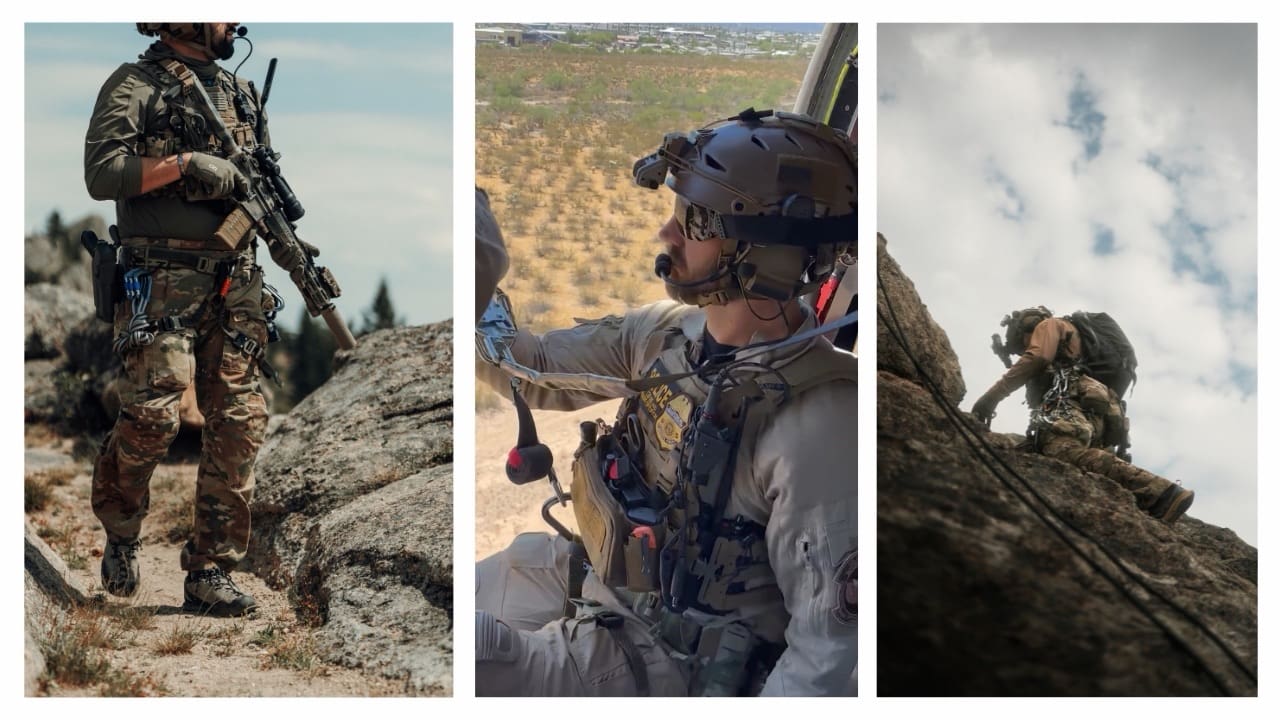
A gun belt carries the equipment needed to do the job.
A restraint system keeps a professional connected during aircraft operations.
A climbing harness provides certified protection when the mission moves into vertical terrain.
Traditionally, those have been three separate pieces of equipment.
The Blue Force Gear® Integrated Stealth Harness, or ISH™, brings them together.
The patented ISH combines a combat gun belt, rotary-wing restraint system, and independently certified Type C sit harness in one lightweight platform. It allows trained professionals to carry their equipment on the ground, remain connected during approved restraint applications, and deploy a complete sit harness when the mission goes vertical.
No belt change.
No separate harness buried in a pack.
No need to rebuild the equipment layout when the operating environment changes.
One System. Three Critical Roles.
• Combat gun belt
• Rotary-wing restraint system
• UIAA 105 Type C certified sit harness
The complete system weighs just 1 lb. 9 oz. It is Berry Compliant. Made in the USA, independently certified to UIAA 105 Type C, and compliant with EU EN 12277+A1:2018.
This is more than a tactical belt with additional hardware. It is a completely certified harness system built for professionals whose work requires movement from the ground to an aircraft, an edge, a rope, or an elevated objective without advancewarning.
THE VERTICAL PROBLEM USUALLY STARTS ON THE GROUND
Most vertical missions do not begin with someone already on rope.
It begins with ground movement, vehicle operation, building entry, aircraft approach, search assignment, or traversingthrough difficult terrain.
A military team may be carrying weapons, magazines, medical equipment, communications, and other mission essentials. Specialized law-enforcement units may be moving through a structure or approaching an elevated position. Search and rescue professionals travel across miles of ordinary terrain before reaching a cliff, damaged structure, steep slope, aircraft, or confined space.
The need for vertical capability may not appear until the mission is already underway.
That creates a basic equipment problem.
If the harness is stored in a pack, vehicle, aircraft, or equipment cache, it must first be retrieved. The user may need to remove or reposition other equipment, put on another system, verify the fit, and reconnect mission gear before moving forward.
The ISH changes that sequence by building certified harness capability into the equipment already being worn.
The removable leg loops can remain connected and staged around the waist. When the complete sit-harness configuration is required, trained personnel deploy the leg loops without removing the gun belt or retrieving a separate harness.
The capability stays with the user instead of being separated from them.
BUILT AS A TRUE COMBAT GUN BELT
The ISH did not begin as a recreational climbing harness with tactical features added later.
It was built around the curved architecture of the BFG® CHLK® Belt and incorporates the MOLLEminus® load-carriage platform for mounting holsters, pouches, medical equipment, communications gear, and other mission essentials.
That starting point matters.
A professional gun belt must remain stable while carrying equipment. It must follow the body, support an operational load, and maintain access to critical gear as the user moves between standing, kneeling, seated, and prone positions.
The ISH retains core load-carriage capability.
On the ground, it functions as the user’s combat gun belt. Equipment remains mounted in the familiar position where the user trains and operates. When the environment changes, that same platform becomes the foundation for aircraft restraint or the complete certified sit-harness configuration.
One belt.
One fit.
One equipment layout.
Three operational roles.
ROLE ONE: COMBAT GUN BELT
For many users, the first role of the ISH will also be used most often.
The MOLLEminus® field provides a low-profile platform for carrying compatible holsters, magazines, medical equipment, communications, and other mission gear. Its curved belt architecture follows the body rather than forcing a flat structure around the waist.
The user can configure the ISH around the mission and retain that equipment layout when transitioning into another approved role.
There is no separate ground belt to remove before putting on the harness.
The gun belt is part of the harness.
ROLE TWO: ROTARY-WING RESTRAINT
Aircraft operations create different requirements.
Personnel operating around open aircraft, ramps, doors, or other exposed positions may require an approved means of restraint based on the mission, aircraft, organizational procedures, and applicable training.
The ISH incorporates certified front and rear attachment points for approved applications, allowing the system to function as a rotary-wing restraint platform without replacing the user’s combat gun belt.
The professional can move from ground operations into the aircraft while retaining the same belt, fit, and equipment configuration.
That is the second role of the 3-in-1 system.
ROLE THREE: UIAA 105 TYPE C CERTIFIED SIT HARNESS
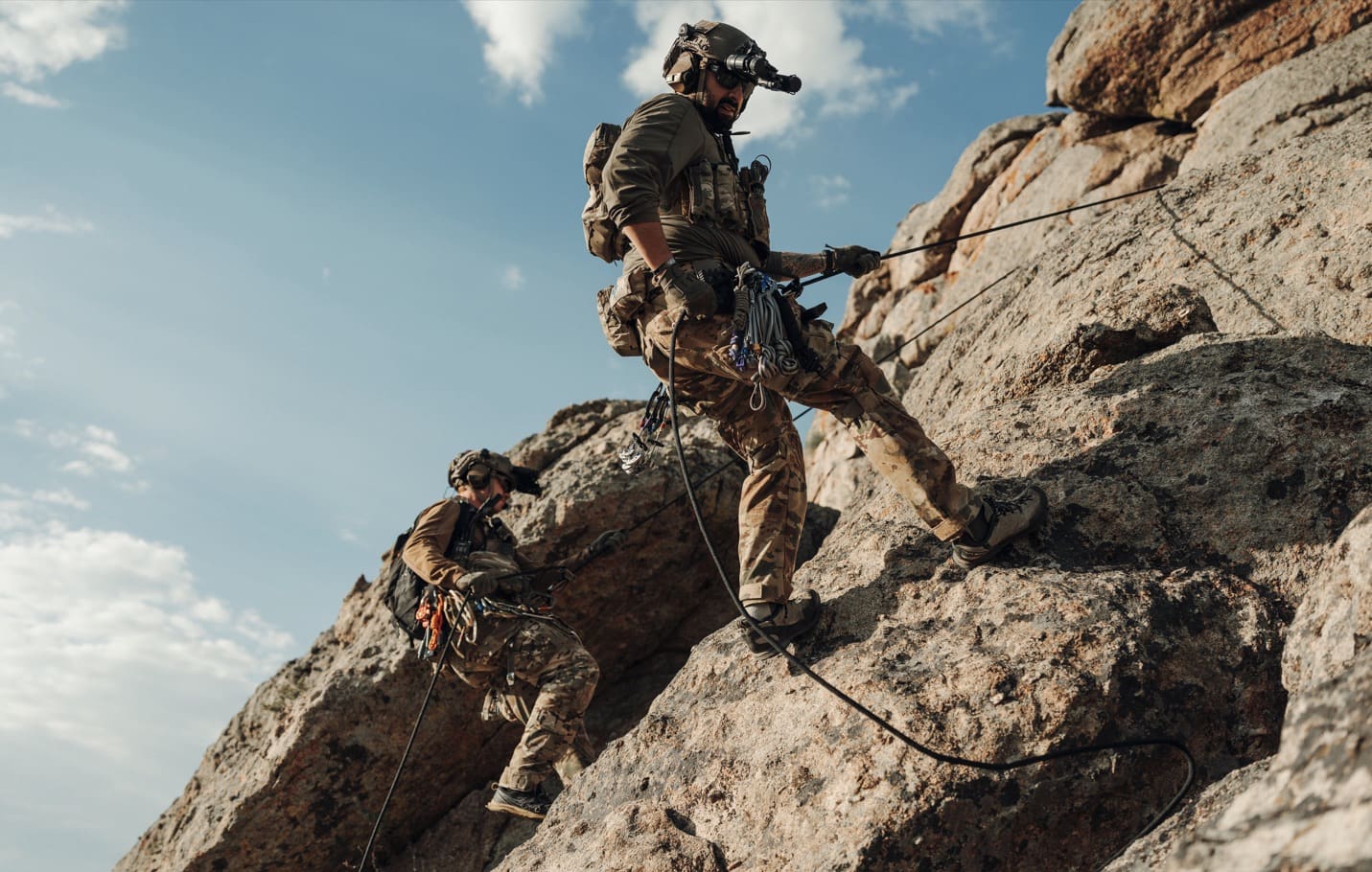
When the mission requires vertical access, the attached leg loops deploy to complete the sit-harness configuration.
The ISH is independently certified as a UIAA 105 Type C harness and compliant with EU EN 12277+A1:2018. The complete system is classified as Category III personal protective equipment under applicable European regulation for protection against risks with very serious consequences, including falls from height.
This is not simply a belt described as climbing capable.
It is a certified harness system.
The certification applies to the complete ISH system, including the belt and leg-loop assembly. The ISH is sold and must be used as a complete system. The outer belt and individual components should never be treated as standalone life-safety equipment.
That distinction is central to what the ISH is.
It is not a conventional battle belt with an attachment point added to it. It is not a restraint belt being presented as a climbing harness. It is a complete, independently certified harness that also performs the roles of a professional gun belt and rotary-wing restraint system.
INDEPENDENTLY CERTIFIED. BUILT FOR PROFESSIONAL USE.
In life-safety equipment, materials, and appearance are not enough.
Certification matters.
The ISH has documented system and component specifications that include:
• UIAA 105 Type C harness certification
• EU EN 12277+A1:2018 compliance
• Sewn belay loop rated to 15 kN
• COBRA® buckles rated to 18 kN
• Custom-blended Dyneema webbing with a 5,000 lb. breaking strength
• Certified front and rear attachment points
• Berry Compliant construction
• Made in the USA
The complete 1 lb. 9 oz. system consists of a 3 oz. inner belt, 10 oz. outer belt, and 12 oz. leg-loop assembly.
Those numbers give military, law-enforcement, rescue, aviation, and government procurement teams measurable information for evaluating the system.
They also reinforce the difference between equipment that looks like a harness and a complete system that has been independently certified as one.
BERRY COMPLIANT AND MADE IN THE USA
For military and government customers, domestic sourcing is not simply a marketing statement.
The ISH is Berry Compliant and Made in the USA, placing its domestic manufacturing story alongside its independently verified harness certification.
That combination matters.
The market contains tactical belts. It contains climbing harnesses. It contains restraint products.
Far fewer systems combine all three roles while also offering UIAA 105 Type C certification, Berry-compliant construction, and an equipment-carrying platform designed around professional use.
The ISH was built for organizations that need capability, certification, domestic sourcing, and mission-equipment integration in one complete system.
DESIGNED FROM OPERATIONAL EXPERIENCE
The thinking behind the ISH did not begin in the marketing department.
Retired U.S. Air Force Pararescueman Ishmael Antonio drew on a 20-year career to reconsider how a professional harness should work and why vertical capability must remain with the user when conditions change.
His experience helped shape a system that could carry equipment on the ground, support applicable aircraft-restraint requirements, and convert into a certified harness without forcing the user to stop and rebuild their setup.
The point is not that every mission will require every capability.
The point is that the professional may not know which capability will be required next.
The equipment should account for that uncertainty.
Watch Ishmael Antonio and Chris Sizelove explain the operational thinking behind the ISH and why a harness that remains with the user can matter when conditions change.
WATCH THE ISH™ STORY
LEG LOOPS THAT DO MORE
The modular leg loops allow the ISH to transition from combat gun-belt configuration into its complete Type C sit-harness configuration.
They can remain attached and staged around the waist rather than being stored separately in a pocket or pack. When vertical capability is required, the user deploys the leg loops to complete the harness.
When configured according to approved instructions, the leg-loop assembly also supports additional applications, including:
• Autoblock friction-hitch configuration for rappelling
• Emergency tourniquet application using the integrated windlass points
• Pelvic stabilization
• Two-person litter carry
These capabilities do not replace dedicated medical equipment, approved rescue systems, professional judgment, or training.
They reflect the larger philosophy behind the ISH: equipment carried into demanding environments should provide greater utility without forcing the user to carry multiple disconnected systems.
BUILT FOR PROFESSIONALS ACROSS MULTIPLE MISSIONS
The ISH was developed around demanding military requirements, but the problem it addresses is not limited to one community.
Defense and Public Safety
Military personnel, special operations units, SWAT teams, emergency service units, federal response teams, and aviation personnel may move between ground operations, aircraft, elevated positions, rappelling, technical access, and rescue requirements during the same mission.
The 3-in-1 design keeps equipment carriage, applicable restraint capability, and a certified harness together on the professional.
Search, Rescue, and Disaster Response
Search and rescue teams, technical rescue personnel, and appropriately equipped disaster-response organizations operate in environments where ordinary access can quickly become vertical access.
Steep terrain, damaged structures, cliffs, towers, confined spaces, unstable surfaces, and industrial environments can all create situations where the harness must be available immediately rather than stored somewhere else.
The ISH allows trained personnel to keep a certified sit harness integrated with the equipment already being worn.
Remote and Technical Operations
Wildland and remote-area responders, maritime units, technical-access personnel, aircraft crews, and infrastructure teams may move between equipment carriage, restraint, rescue, and vertical work during different phases of an operation.
The ISH is not a replacement for agency-specific PPE, dedicated rescue systems, approved procedures, or application-specific training. It gives responsible organizations a certified platform to evaluate roles when those capabilities need to remain with the user.
THE HARNESS YOU NEED IS THE HARNESS YOU HAVE WITH YOU
A separate harness only helps if the user has it, can reach it, and has time to integrate it with the equipment already being carried.
The ISH closes that gap by keeping the complete system on the professional. It functions as a combat gun belt, supports approved restraint applications, and remains ready to deploy into its certified sit-harness configuration.
The user does not have to predict exactly when the mission will leave the ground.
The capability is already there.
PROFESSIONAL EQUIPMENT REQUIRES PROFESSIONAL TRAINING
The ISH is professional life-safety equipment.
It must be used only by properly trained or otherwise competent persons, or under the direct supervision of trained or competent personnel.
Users must read and understand the complete instruction manual, inspect the system before use, test all associated equipment for form, fit, and function, and verify that the harness is correctly rigged before any activity at height.
Certification does not replace training.
A 3-in-1 system does not remove the need to understand each role.
The value of integration is that a trained professional can carry those capabilities together in one purpose-built platform.
ONE SYSTEM. THREE CRITICAL ROLES.
The Integrated Stealth Harness represents a different approach to professional equipment.
Instead of forcing the user to carry one belt for equipment, another system for restraint, and a separate harness for vertical access, the ISH consolidates all three roles into one lightweight, Berry Compliant, independently certified platform.
Combat gun belt.
Rotary-wing restraint system.
UIAA 105 Type C certified sit harness.
One belt.
One equipment layout.
One complete system that remains with the user when the environment changes.
Because the mission does not stop when the ground does.
Neither should your equipment.
Learn more about the BFG® Integrated Stealth Harness and watch the complete system in action.
EXPLORE THE ISH™