TYR Tactical

Archive for the ‘Camo’ Category

Saab Reveals Barracuda Poncho – Camouflage Protection for Soldiers

Wednesday, May 13th, 2026

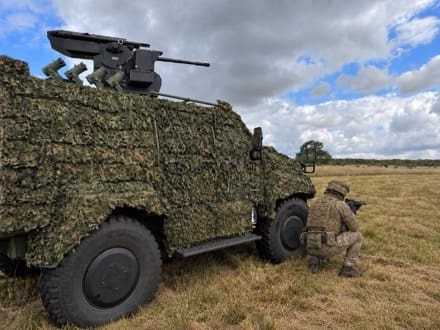
Saab has introduced its latest iteration of camouflage solutions, a poncho to protect individual soldiers from being detected by sensors operated by opposing forces across a variety of environments.  

Barracuda Poncho is Saab’s latest addition to complement its existing Barracuda range of advanced camouflage solutions. The purpose of Barracuda Poncho is to hide the user from thermal and, in the arctic version, UV sensors while providing the freedom of movement to act swiftly and quietly. Its light weight of just above 1 kg makes Barracuda Poncho easy to deploy, wear and adjust. 

Barracuda Poncho provides visual and thermal protection across varied environments, including woodland, stony desert, and arctic conditions. Its reversible design enables a night and day configuration on each side, with enhanced thermal protection for night.

“Barracuda Poncho is our answer to the recent rise in UAV-based surveillance on the battlefield, where a mission can be compromised if the soldier even briefly leaves a camouflaged vehicle or position. Building on the positive response from our Soldier System, the new Barracuda Poncho solution provides an alternative camouflage solution, focusing on wearability while retaining the exceptional multispectral protection,” says Henning Robach, head of Saab’s business unit Barracuda.

The poncho will be on display at Saab’s stand G180, Hall 6 at Eurosatory 2026.

UF PRO Introduces Woodland Camouflage to Its Clothing Lineup

Wednesday, May 13th, 2026

KOMENDA, SLOVENIA (12 May 2026)

UF PRO expands its clothing portfolio with the introduction of Woodland camouflage across several established products.

Few camouflage patterns carry the same legacy and recognition as the iconic Woodland pattern, also widely known as M81. Introduced in the early 1980s as the standard camouflage of the United States Armed Forces, the pattern quickly became one of the most recognisable military camouflage designs worldwide. Over the decades, Woodland evolved far beyond its original military role, finding its place across special operations units, law enforcement teams, training environments, and the broader tactical community.

Its characteristic four-colour composition, developed for temperate woodland terrain, became closely associated with an entire generation of military operations and tactical equipment. Even decades after its introduction, Woodland remains one of the most requested camouflage patterns among professional users and enthusiasts alike, valued both for its operational heritage and enduring field relevance.

The camouflage pattern is now available on the Striker XT Gen.2 Combat Shirt, a breathable and fast-drying combat shirt designed for demanding operational use, combining durable sleeve construction with a lightweight torso material for improved comfort under body armour and load-bearing equipment.

It is also available on the Hunter FZ Gen.3 Tactical Softshell Jacket, a lightweight, windproof, and water-repellent softshell jacket developed for changing weather conditions, offering mobility, breathability, and reliable protection during active use.

The Woodland addition further extends to the P-40 Gen.2 Tactical Shorts, lightweight tactical shorts designed for warm-weather operations and range use, combining comfort, freedom of movement, and the functional pocket configuration characteristic of the P-40 line, as well as the Striker Gen.3 Boonie Hat, a lightweight field hat engineered for hot-weather environments, providing sun protection, ventilation, and reliable comfort during prolonged use in the field.

The Striker X Gen.2 Combat Pants, available later this year, will further expand the Woodland offering. Developed for demanding operational environments, the combat pants feature durable materials, ergonomic construction, and an integrated knee protection configuration for extended field use.

The rollout focuses on extending proven and field-tested UF PRO systems into one of the most anticipated camouflage additions within the brand’s portfolio. Each product maintains the same materials, construction, and functionality already established across the existing lineup, including ergonomic fit systems, durable fabric constructions, and mission-focused features developed for demanding operational environments.

With the addition of Woodland camouflage, UF PRO continues to expand its clothing portfolio in response to long-standing demand from operators and tactical professionals worldwide.

Learn more: ufpro.com

UK Defence Textile Collaboration Formed Between Pincroft Dyeing & Printing and Toray Textiles Europe Ltd

Thursday, April 30th, 2026

Adlington, United Kingdom: As the UK Government looks to secure a resilient domestic supply chain, Pincroft Dyeing & Printing and Toray Textiles Europe Ltd have responded to the need for printed woven technical textiles for the UK defence sector. Both companies are established suppliers to NATO military programmes and are now well positioned to support UK defence requirements.

Strategically located in the Northwest of England, Pincroftoperates one of Europe’s largest fully integrated textile processing, printing and finishing facilities. Exporting to more than 80 countries and with an annual production capacity exceeding 50 million metres, the company has built a strong reputation in military printing and flame retardant finishing. Armed forces around the world already wear uniforms made with fabrics processed at Pincroft.

Toray Textiles Europe Ltd is a leading technical textile manufacturer specialising in the weaving, dyeing and finishing of synthetic fibre textiles across defence, medical and industrial applications. A recent investment of more than £15 million in advanced looms and process machinery has further strengthened its capability to support future demand.

Paul Farrell, Group Sales Director at Pincroft, said: “Leveraging our combined expertise and innovation, alongside our UK-based operations and supply chains, Pincroft and Toray are well placed to support the shared goals of strengthening national security, driving economic growth and improving sustainability.”

Paul Daynes, Sales Manager at Toray Textiles Europe Ltd, added: “Pincroft and Toray operate at a scale capable of delivering national programmes while manufacturing a high-quality UK product. This collaboration supports employment across the manufacturing sector and helps build a resilient domestic supply chain for our armed forces.”

Both businesses were honoured to receive a visit from HRH The Princess Royal as President of the UK Fashion & Textile Association in 2025 which underscored the significant investment they have both made in their respective weaving, dyeing, finishing and printing capabilities, as well as increasing capacity at both sites.

Adam Mansell, CEO of the UK Fashion and Textile Association has welcomed this new defence textiles collaboration and said: “The UK already sells to major forces across the world, from the Netherlands, Germany and France, across to Australia and New Zealand, so why not the UK? The UK MOD and other UK procurement agencies need to be incentivised, or required, to source more of their products from reliable UK sources and see the bigger UK industrial picture.”

PenCott-GreenZone A220 Mammoth Shirt from Arktis

Tuesday, April 28th, 2026

PenCott® camouflage patterns are at their best when they’re paired with professional kit that’s built to last – like the new A220 Mammoth Shirt from Arktis.

An evolution of their iconic original Mammoth Shirt, the A220 has been refined for operators who need dependable reliability in harsh conditions. Among its standout features is a concealed hood that packs into the collar and deploys instantly when temperatures drop and wind, drizzle, or snow squalls roll in without warning.

Behind the water-repellent GreenZone™ ripstop exterior, Arktis has paired a rugged fibre-pile lining that’s warm, tough, and field-proven. The fit has been updated too — broader in the body for layering, with improved shoulder and sleeve movement. Body armour compatible as standard.

Key features:

  • Concealed emergency hood
  • Water-resistant PenCott® GreenZone™ ripstop outer
  • Fibre-pile lining
  • Two-way side ventilation zips
  • Document compartment & hand-warmer pockets
  • Velcro-adjustable cuffs
  • Body armour compatible

Available now from Arktis in sizes XS–XXXL: store.arktis.co.uk/products/mammoth-shirt-with-concealed-emergency-hood-3

Check out the full collection of GreenZone products from Arktis at: store.arktis.co.uk/collections/pencott-greenzone

6-Color Desert: The Classic Is Back at Helikon-Tex

Tuesday, April 28th, 2026

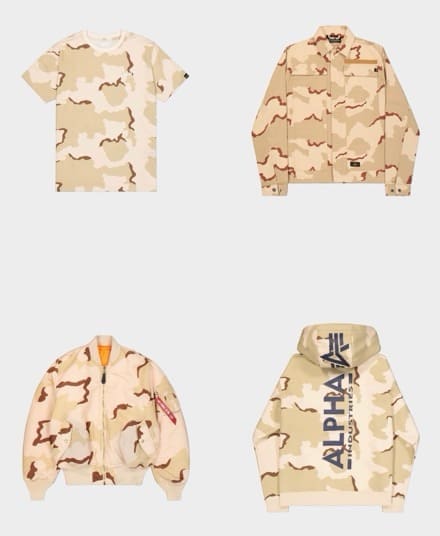
As we previewed during Enforce Tac, our friends at Helikon-Tex have introduced an entire lines of clothing and equipment in the classic 6-Color Desert camouflage pattern synonymous with Operation Desert Storm.

Lovingly known by the troops as “Chocolate Chip” due to its distinctive rock-like shapes embedded in the pattern, it was developed during the early 1970s by the US Army using terrain in the American Southwest. Helikon-Tex has done an amazing breakdown of the history of the pattern which is available here.

Helikon-Tex didn’t just make copies of old issue equipment. Instead, they’ve applied this classic pattern to their designs. I am a big fan of their Raid Shirt. You can see it paired above with their UTP Pants as well as below. Both are made from Helikon-Tex’s polycotton ripstop stretch weave to move with you yet remain sturdy

Another favorite is the Tracer Anorak. Featuring their polycotton ripstop stretch weave, it’s just as practical in the field, on the range, or running around town.

It’s important to note that while these and other items are available in 6-Color Desert, they’ve got multiple other pattern and color options.

Their Mk II Boonie is a great way to top off an ensemble for wear in the desert. For those of you who prefer ball caps, they’ve got a Trucker Cap as well.

Check everything out at helikon-tex.com.

Ruggedised Second Skin Enclosures for Fujinon SX Camera Range

Tuesday, April 21st, 2026

Hereford, UK – The International Special Training Facility development cell is releasing the first 3D printed deployment-ready rugged second skin enclosures, manufactured from our specially developed resin to withstand harsh environments for the Fujinon SX Camera Range.

This innovative product is designed to enhance operational capabilities, ensuring reliability and protection for critical equipment in demanding environments:

Since 2011, The International Special Training Facility has provided covert tactical and technical training, products and design to Special Forces, Law Enforcement CT-TSU and Government Security Services & Agencies.

ISTF is an independent organisation, with no affiliation, partnership, or ownership ties to any related entities, by policy ISTF does not provide its services to the private sector.

Our expertise has ‘silently’ enhanced the effectiveness of small teams operating in complex Rural and Urban environments, ensuring their success when executing covert manoeuvres.

We provide tactical and technical training, products, and design services. For further information, please contact us at info@istf-co.com

Army Sniper Course Tests Signature Management Tech to Enhance Health, Safety

Monday, April 6th, 2026

FORT BENNING, Ga. — The U.S. Army Sniper Course at Fort Benning is working to improve sniper survivability and lethality in large-scale combat operations by evaluating and integrating advanced signature management technology into training.

“What we’ve seen in the last few years in recent conflicts has been a lot of drone activity and having to hide from and defeat thermal and drone systems,” said Staff Sgt. Brett Bollinger, a USASC instructor. “That’s what really drove us to develop these plans because those are the type of assets our near-peer adversaries are going to have in large-scale combat operations.”

Bollinger further explained that boosting sniper effectiveness remains pivotal to military success even as modern warfare has changed traditional battlefield practices.

“Snipers are a critical asset to any commander on the battlefield. If the air is contested, and you can’t fly friendly drone assets, you still must have the ability to insert small, two- to three-man teams to conduct surveillance and then place accurate fire onto the enemy if needed,” Bollinger said. This observation has played out time and again in the Russia-Ukraine War where drones are playing a significant role in battle.

USASC’s new initiative, being done in collaboration with the Small Unmanned Aircraft Systems Master Trainer course and industry partners, seeks to reduce the likelihood of detection across the electromagnetic spectrum, thereby helping Soldiers blend into their backgrounds when viewed by enemy systems and sensors.

According to Bollinger, the course has been testing multispectral thermal-defeating mitigation technologies provided by various companies.

“The materials we’ve been evaluating are full spectrum signature management camouflage systems,” Bollinger said. “We’ve been evaluating products with the objective of defeating thermal sensors, whether it be aerial or ground systems.”

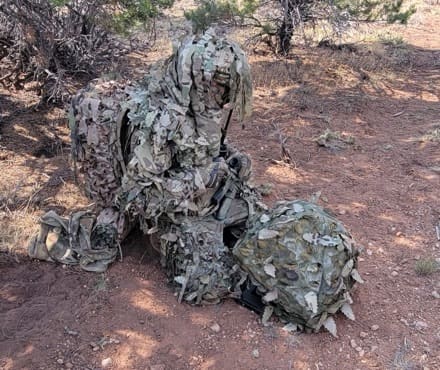
The camouflage systems USASC has been working with look similar to camouflage nets, added Bollinger. They are designed to mask the visibility of a sniper’s movements.

The course gained interest in evaluating advanced signature management technology in early 2025 following an exercise with drones, according to Staff Sgt. Craig Mordaunt, also a USASC instructor.

“We had Soldiers from our sister company come out with drones and that’s when we started conducting tests of how students would react and adjust to air assets flying overhead during practical exercises for our stalk lanes,” Mordaunt said.

USASC has done much of their testing during stalk lanes, which prepare snipers for real-world missions. In these exercises, snipers must use elements of surrounding natural vegetation to further camouflage their ghillie suits and make their way through obstacles to eliminate a target while remaining undetected.

Bollinger said USASC began integrating thermal-defeating systems into stalk lane exercises following a presentation at a Fort Bragg, North Carolina, sniper class last summer from industry partners on their specific spectrum signature management camouflage systems.

“We had a local representative from one of those companies come out a few months ago with camouflage systems for instructors to use and they conducted the stalk lane as if they were the students and they were able to get quite close to the observer’s vehicle while remaining undetected,” Bollinger said.

In January, USASC, along with instructors from the Reconnaissance and Surveillance Leaders Course, tested additional signature management products provided by the same company.

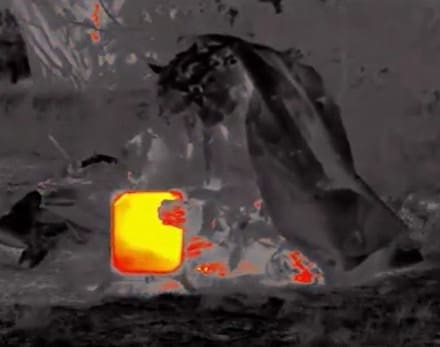
“We were able to camouflage a vehicle, set up a static hide site and then observe it with thermal products they brought out to see what such a scene would look like and how effective their technology is,” Bollinger said.

The Sniper Course is still in the early stages of integrating these new products into their training, tactics and plans, and is actively looking at developing and testing them further to keep pace with evolving battlefield technologies.

“For every measure that the world comes up with, there’s a countermeasure to it. And for every countermeasure there’s a way to counter that, so it’s just an ever-evolving circle of defeating new systems,” Mordaunt said. “We’re just trying to increase the survivability of our Soldiers that we send out to the force.”

By Daniel Murnin

US Marine Corps Seeks Multispectral Camouflage Overgarments

Wednesday, March 18th, 2026

In a recent Sources Sought Notice, Marine Corps Systems Command (MCSC), Program Manager Combat Support Systems (PM CSS), Product Manager Combat Service Support Equipment (PdM CSSE) reached out to industry to identify potential vendors capable of developing a Multispectral Camouflage Overgarment (MCO).

This photo of the Noble booth was taken during last year’s AUSA Annual Meeting and depicts multispectral cloaks from Ametrine, FibroTex, Ghosthood, and Stealth Products Group.

According to the notice, “The MCO is intended to provide individual signature management for Marines by mitigating detection across the visual (VIS), near infrared (NIR), and short-wave infrared (SWIR) spectrums as well as suppress thermal signatures in the mid-wave infrared (MWIR) and long wave infrared (LWIR) to reduce the likelihood of detection by thermal sensors.

There are very specific performance parameters for various wavelengths and while they are not classified, I have chosen not to share them here.

The Overgarment will essentially be a cloak. The Marines are looking for a single-piece, generously-sized, draped design constructed to provide full-body coverage, including individual gear and equipment. They want to be able to quickly don and doff the cloak within 15 seconds. They also want them to be connectable with one another to make larger covers for fighting positions, shelters, and vehicles. Additionally, the Marines want a garment weighing no more than 3.5 pounds but would prefer something less than 2.0 pounds.

It will need to last for at least 90 days in operational use and have a shelf life of at least three years. It also has to be launderable and survive 25 wash cycles at a minimum.

Understandably, the MCO is not intended for routine garrison wear.

Ultimately, they plan to buy 61,222 MCOs but will buy them over several years.

Interested parties have until 22 April, 2026 to respond. For full details visit Sam.gov.