I live by 2 very easy to follow gun handling rules: #1 keep the pointy end of the death machine in a safe direction. #2 if you’re eyes are not connected to the sights then the trigger finger is connected to the frame of the gun. For the AR-15 I add rule 2a if the eyes are not connected to the sights the rifle is on safe and some positive pressure up on the selector lever. These rules have served me very well in every situation.
When this segment on reloads went on Trigger Time TVs youtube channel It got a lot of push back in regards to putting the rifle on safe during a bolt lock reload, as well as when I posted it to my company Facebook page.
Here is my detailed response to why I believe in doing it:
I’m more than happy to explain everything I do. Everything I do and believe in has a reason behind it. I’m also very open minded to new ideas and thoughts on how to do things better. I was a Green Beret for 8 years before I changed to my current rifle reload procedure. I was taught that it was OK to keep the rifle on fire during a bolt lock reload and when I was the Primary Instructor for the Special Forces Advanced Urban Combat Course I also taught it that way. It never felt right to me when one of my guys would ask me “do we keep the rifle on fire during the reload?” and I would say yes. I justified it in my mind by saying it’s OK because at that point we are still in the engagement. Through my entire Army career since I was 18 years old it has been programed into me to keep the rifle on safe when not shooting.
When I was going through the Special Forces Qualification course I developed another habit with the M-4. I put my thumb under the selector lever and push up against the selector lever as an extra measure of safe gun handling. I think it was some sort of subconscious thing that happened to prevent my gear or all the brush I was walking through from effecting the selector lever and firing the gun. I also press my trigger finger into the frame of the rifle when my eyes are not connected to the gun. These extra safety measures have never cost me even a tenth of a second getting the gun into operation and getting an accurate hit.
So I was watching some YouTube one day in 2012 and saw Pat McNamara talking about how he does rifle reloads. Pat puts the rifle on safe during the bolt lock reloads. Pat retired from the 1st Special Forces Operational Detachment (D) and was the marksmanship instructor for his unit for awhile. After hearing pretty legit dude like Pat talk about it I decided to try it. It took me about 20 deliberate reps to program getting the gun on safe into my bolt lock reload. Since that day in October 2012 I haven’t lost even a tenth of a second on a bolt lock reload due to putting the rifle on safe during the reload. In my courses I will start the reload session with a competition. I have the guys set up for a bolt lock, 1 round in the gun and an empty mag. I compete against the whole class 1 shooter at a time. I let the other guy start, he shoots first and starts his reload to another shot. After his first shot I shoot, get bolt lock put the gun on safe and work my reload to another shot. I’m around 98% on getting 1 shot reload 1 shot on target before the other who had about a 1 second head start and they aren’t putting their gun on safe. I’m not saying that I’m magic, I’m a fan of proven reliable mechanics and very efficient mechanics at that. I do it this way to make a point that what I’m saying works and that getting the gun on safe won’t cost anything.
Pat’s term is “Always an enabler, never a disabler” in regards to the selector lever, and I completely agree and dig it the most. I’m not a fan of scenarios and “what ifs”. I am a fan of solid fundamentals and programing them to a point where you instantly apply those fundamentals to any situation you find in order to solve problems without overthinking. There are however some what ifs that can make it make sense when I say that the world could change in the amount of time it takes to reload a rifle. Let’s look at one of many scenarios that support putting the rifle on safe when the eyes are not connected to the sights. If I were deployed with my team and during a bolt lock reload I didn’t put the rifle on safe, I get the mag in then the bolt forward then get shot in the head and fall down and a rock or something fires the gun and my rifle shoots our only 18D in the head. That’s a pretty sad face day right there for a whole ODA that could have been avoided by a very easy mechanical function. As I said you can what if stuff to death but at then end of the day, it’s too easy to put the gun on safe during a reload and I’m gonna keep on doing it because I believe in it and based on my experience it works.
-Frank Proctor
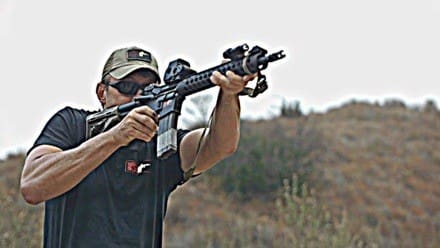
Frank Proctor has served over 18 years in the military, the last 11 of those in US Army Special Forces. During his multiple combat tours in Afghanistan & Iraq he had the privilege to serve with and learn from many seasoned veteran Special Forces Operators so their combined years of knowledge and experience has helped him to become a better operator & instructor. While serving as an instructor at the Special Forces Advanced Urban Combat Course he was drawn to competitive shooting. He has since earned the USPSA Grand Master ranking in the Limited Division and Master ranking in the IDPA Stock Service Pistol division. He learned a great deal from shooting in competition and this has helped him to become to become a better tactical shooter. Frank is one of the few individuals able to bring the experiences of U.S. Army Special Forces, Competitive Shooting, and veteran Instructor to every class.
All this experience combines to make Frank Proctor a well-rounded shooter and instructor capable of helping you to achieve your goal of becoming a better shooter.
Gunfighter Moment is a weekly feature brought to you by Alias Training & Security Services. Each week Alias brings us a different Trainer and in turn they offer some words of wisdom.