

Published in late May, the US Marine Corps guidance for the wear of PPE, restricting it to only issued items which have undergone testing and are on approved use lists. This ends the use of private purchase and commercial off the shelf items unless on the approved lists detailed in the message.
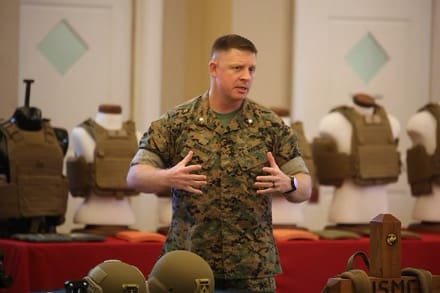
Below is the message followed by a video explaining the policy. We have redacted the email addresses and phone numbers of the POCs but they are easily found via Google search for this message.
R 201307Z MAY 25
MARADMIN 237/25
MSGID/GENADMIN/CMC PPO POF WASHINGTON DC/FOO2//
SUBJ/MARINE CORPS POLICY ON THE WEAR AND PURCHASE OF BODY ARMOR AND PERSONAL PROTECTIVE EQUIPMENT (PPE)//
REF/A/MSGID: MSG/CMC WASHINGTON DC PPO/YMD: 20070417//
REF/B/MSGID: GENADMIN/CMC WASHINGTON DC PPO: 20090416//
REF/C/MSGID: GENADMIN/CMC WASHINGTON DC PPO: 20090710//
REF/D/MSGID: GENADMIN/CMC WASHINGTON DC PPO: 20170327//
REF/E/MSGID: GENADMIN/CMC WASHINGTON DC PPO: 20181127//
REF/F/MSGID: GENADMIN/COMMMARCORSYSCOM: 20240509//
REF/G/MSGID: GENADMIN/COMMMARCORSYSCOM: 20240807//
REF/H/MCO 6260.3A SD: 20160926//
NARR/REF A IS MARADMIN 262/07, Marine Corps Policy on the Wear and Purchase of Body Armor and Personal Protective Equipment
(PPE). Ref b is MARADMIN 254/09, Marine Corps Policy on the Wear of Personal Protective Equipment (PPE). Ref c is MARADMIN 415/09, Establishment of Body Armor Protection Levels.
Ref d is MARADMIN 151/17, change 1 to Marine Corps Policy on the Wear and Purchase of Body Armor and Personal Protective Equipment (PPE). Ref e is MARADMIN 667/18 Marine Corps Policy on the Wear and Purchase of Body Armor and Personal Protective Equipment (PPE). Ref f is the Safety of Use Message for the Enhanced Combat Helmet and High Cut Enhanced Combat Helmet Suspension Systems. Ref g is the Safety of Use Message for the Enhanced Combat Helmet with Hearing Enhancement Device. Ref h is the Marine Corps Hearing and Conservation Program.//
POC/E.T. Clark/COL/PPO POF/Branch Head/
POC/E.A. Benson/CIV/PPO POF/Dep Branch Head/
GENTEXT/REMARKS/1. The Commandant of the Marine Corps directs the following policy for Marines and Sailors assigned to USMC and joint commands, on the wear and purchase of body armor and PPE. This MARADMIN supersedes references (a, b, c, d, and e). PPE refers to Marine Corps approved body armor, helmets, goggles, gloves, clothing, and other gear designed to protect the wearer’s body from battlefield injuries. The equipment and
training information for service-approved PPE systems can be found at https://app.mcboss.usmc.mil searching via program office: PMM-154.3 and via Marine Net course # mcsppe0306 – Proper use of Personal Protective Equipment
2. Individual Marines/Sailors may not use commercial PPE in lieu of government tested, approved, and issued PPE as outlined in the product information sheets referenced in paragraph 1.
Commanders are not authorized to utilize unit funds to purchase commercial PPE items that have not been approved for use by Marine Corps Systems Command.
3. Ballistic spectacles and goggles authorized for use are listed on the authorized protective eyewear list (APEL) and are compatible with the universal prescription lens carrier. While the Marine Corps will continue to issue a single spectacle and a single goggle, units may purchase other authorized ballistic eyewear on the APEL through the defense logistics agency or the post-exchange. The latest APEL can be found at:
https://www.peosoldier.army.mil/equipment/
approved-eyewear-qpl/
4. All forms of hearing protection devices are considered PPE, and the Marine Corps issues Hearing Enhancement Devices (HED) (TAMCN C01142F) and High Noise Hearing Enhancement Devices (HN-HED) (TAMCN C00142F). Commanders must ensure Marines comply with ref (f) or ref (g) for helmet configuration and ref (h) guidelines to select appropriate hearing protection devices.
HEDS shall be evaluated at least twice per year for appropriate use and to replace any worn/deteriorated seals per ref (h).
Commanders will consult navy medicine occupational audiologists or industrial hygienists to determine from sound pressure measurements appropriate hearing protective devices for their operational needs, ensuring Marines have the correct single or dual hearing protection when necessary. Per ref (h), the safety objective is to protect Marines’ exposure to any steady-state noise having an 8-hour time-weighted average noise level greater than or equal to 85 decibels: or a single exposure to impulse and/or impact noise of 140 decibels peak or greater, regardless of duration.
5. Marine Corps Body Armor Protection Levels (APLS).
5.a. A service-level policy defining specific armor protection levels has been established with the intent of standardizing APLS, enabling commanders to tailor armor protection based on their estimate of the situation or based on guidance from service/joint/theater combatant commanders. Higher APLS provide increased ballistic protection through the addition of modular armor components, increasing the areas of coverage and/or ballistic protection. Higher APLS correspond to greater weight, increased thermal loading, and reduced mobility, thus degrading individual and unit performance over extended periods of time.
5.b. The following APLS are established and apply to all Marine Corps-issued armor systems. Read in two columns:
APL Description
Level 0 No body armor worn
Level 1 Marine Corps-issued plate carrier with soft armor only (defeats handgun and fragmentation threats)
Level 2 Marine Corps-issued plate carrier with soft armor, and front and back hard armor plates (defeats rifle and fragmentation threats)
Level 3 Marine Corps-issued plate carrier with soft armor, front and back hard armor plates, and side hard armor plates (defeats rifle and fragmentation threats).
Removal of the soft armor from the plate carrier compromises the ballistic protection of the issued armor systems. Soft armor must be worn in conjunction with ballistic plates in the issued plate carrier – failure to do so may result in severe bodily injury or death. There are currently two variants of ballistic plates fielded to the Fleet Marine Force: the Enhanced Small Arms Plate Insert (ESAPI) (TAMCN C30202E) and the Lightweight Plate (LWP) (TAMCN C01342F). Commanders may choose to utilize either variant based on the threat.
5.c. The Marine Corps-issued helmets authorized for operations include the Enhanced Combat Vehicle Crewman Helmet (ECVCH) (TAMCN C49942F), Enhanced Combat Helmet (ECH) (TAMCN C01202E), High Cut Enhanced Combat Helmet (HC ECH) (TAMCN C02222F), and the Integrated Helmet System (IHS) (TAMCN C02222F) which were designed to provide both ballistic and blunt impact protection across the full spectrum of operational environments. The helmets consist of a shell, a suspension system (pads), a retention system (chinstrap), and include other accessories such as a night vision device mounting bracket and rail systems.
The ballistic protection of these systems is provided by the construction and materials of the shell. The blunt impact protection is provided by the construction, materials, and configuration of the suspension system. The suspension system must have pads in an approved configuration. In accordance with ref (f) or ref (g) the issued suspension system cannot be replaced with commercial pads. The screws in the helmet support the ballistic integrity and shall not be replaced with commercial screws. Unit leaders will ensure initial training is conducted for Marines upon issue of the helmet. Commanders shall ensure approved helmets are worn in an approved configuration.
5.d. Diving life preserver and buoyancy compensator listed in the authorized for navy use (ANU) are not authorized for ballistic protection until the configuration has been certified and approved by Marine Corps Systems Command. Commanders interested in requesting diving life preserver and buoyancy compensator for certification must follow the universal needs
process. Information can be found at: https://www.cdi.marines.mil/units/cdd/universal-needs-process/
5.e. Protective attachments may be worn with
Marine Corps-issued body armor. It is impractical to establish APLS that incorporate every possible configuration in which these attachments may be worn. Commanders will designate the wear of Marine Corps approved helmets; ballistic eyewear; and groin, neck, and throat protection as required by their units’ mission, the threat, and local environmental considerations.
5.f. The lightweight helmet (TAMCN C32152E) and the small arms protective body armor (stocklist-3 item of TAMCN C35012E) are only authorized for use by training command.
5.g. Ballistic protection vendor samples are not authorized for use without Marine Corps Systems Command oversight and approved safety releases for limited user evaluations.
6. Authority
6.a. Operating force commanders at the Lieutenant Colonel (O-5) level or higher are authorized to determine the required level of PPE (or APL when established) for wear by assigned personnel within the Marine Corps Systems Command approved systems. This determination will be made based on mission(including during training), unit type, threat, and environmental factors.
6.b. Combatant, Joint Task Force (JTF), and service component commanders retain the authority to prescribe the level of protection worn by all assigned personnel. In cases where combatant, JTF, and/ or service component commanders have established a required level of PPE that is more restrictive than that set by Marine Unit Commanders, Marines will adhere to the highest level. In cases where the APL is not designated, the Marine Corps service policy places the authority to designate the APL on commanders, Lieutenant Colonel (O-5) and higher.
6.c. Based on their unique mission requirements, Marine Special Operations Command (MARSOC) personnel may, within published MARSOC policies and subject to their commanders’ approval, wear special operations command-approved special purpose body armor.
6.d. Installation commanders are authorized to use government funds to purchase commercial off-the-shelf (COTS) body armor and PPE only for use by Military Police performing law enforcement duties aboard Marine Corps installations. COTS body armor must, at a minimum, meet National Institute of Justice (NIJ)-certified level RF2 as listed on the NIJ website.
https://www.nij.gov/topics/technology/body-armor/pages/compliant-ballistic-armor.aspx. COTS body armor purchased for installation law enforcement duty will not be worn by Marines as a substitute for Marine Corps approved body armor and PPE in a combat zone or theater of operation.
7. Marine Corps organizations that do not receive class II PPE materiel support from the Logistics Command should direct all materiel requirements to DC, IL, IP.
8. Release authorized by MajGen J. L. Morris, Assistant Deputy Commandant for Plans, Policies, and Operations.//
Remember when the DOD issued ear plugs that didn’t work and gave everyone hearing damage?
So you’re saying that this armor and helmet doesn’t work?
No, he’s saying Marines have been (rightfully) skeptical of issued PPE due to previous failures of issued equipment, leading to them spending personal funds on objectively better gear that has actual testing data behind it.
So you’re saying yeah, “this gear isn’t trustworthy.” Got it. Guess Ops-Core helmets and FirstSpear carriers with proven armor inserts aren’t safe. Likewise all of the APEL eyepro.
Truth is, what the average Marine Infantryman has access to these days is better than what Recon had when the GWOT began.
Well FMF has not had a neer-peer conflict since the implementation of the APLS. So like Levi and Jacob said. There’s always skepticism with new DoD approved gear. None of it has been tested against neer-peer adversaries. Now if it has I’ll be glad to be wrong.
You’re telling people that the entire suite of Eye-Pro on APEL is deficient without any evidence. Meanwhile, the government conducts extensive testing. I have a serious problem with this.
Frag from a 152 shell set off via radio control is no different than frag from a 152 shell delivered the old fashioned way.
This kind of thinking is what kills combat effectiveness. DOD doesn’t buy the best equipment for its personal, so what’s wrong with someone buying equipment that allows them to operate at a higher level then what is issued? So long as the equipment has proven data behind it and the person can justify that it makes them more lethal I say more power to the fighters.
The problem is, many were buying knockoffs because they wanted the look but didn’t understand the importance of actual performance.
There should be an avenue for Marines to select and purchase, with their own funds, publicly available ear and eye protection and also be removed from the payout of any potential settlement or severely decrease any payout from a settlement for faulty/below standard hearing or eye protection equipment issued to military members.
Also Eric, I see your point. Not ALL issued gear is dogshit. But it sure feels like it when you’re wearing it, so I’m of the belief that you have to try out a lot of different equipment to find the best equipment suited to either you personally or the largest number of people possible.
This is not Ops Core and not First Spear to be fair
Well, the helmets are high cut helmets manufactured Ops-Core parent company Gentex and the vest was designed with input from FirstSpear and includes FS licensed technology.
Facts!
I have a funny feeling “Chesty” is laughing right now with the words “Marines only need a rifle, a KA Bar, and a good cigar!”
Glad to see the next generation getting updated and safer gear!
Semper Fi Marines
I would say that since the late 90s, Marines have had good equipment and in several aspects have led development of new individual equipment.
The body armor I understand, the helmets are kinda logical. Blocking eye pro and ear pro is absurd. The stuff I was issued got me $25k from the settlement for hearing damage, and the eye pro we had wasn’t rater for the lasers we used and I have retinal damage from being flashed by PEQs.
I purchased my own ear and eye pro after those incidents and now they say “we only give you the best”. Yeah, okay there. I guess the VA was worries that without a forever war we wouldnt have 100% disabled people anymore.
What year were you issued this substandard gear?
Like the originals Kevlar Helmets that were issued circa 1983-84; many were found to be defective. IIRC, the manufacturers skimped out by putting too little Kevlar on top.
Or Cammies that tore out in the crotches.
You can’t always rely on Issue Gear.
One more time, tell me what is wrong with the current Marine gear?
Honestly i don’t blame soldiers for going out and buying thier own gear when most plate carriers you can buy at clothing and sales aren’t more then maybe $100 to $200 they weigh like 1/8th what the iotv the army issues weighs and honestly only thing in the whole plate carrier or iotv that’s stopping the rounds that are goijg to take your life is gonna be the plates the military issues you as long as you got those in your safe as hell you won’t get fatigued as fast and overall will probably be more comfortable so lethality goes up. As for the helmets when you give most soldiers helmets that weigh like 15 pounds to wear and it ends up hurting thier necks over long periods of time not to mention the pads you issue that cause migraines its no wonder soldiers run to cheaper alternatives its so they are more comfortable and going back to it more lethal at the end of the day due to being able to last longer. If you truly cared about soldiers you wouldn’t spend all this money on equipment that you would never issue to sf guys in the first place how much does the army spend on thier rfi issued tan gloves that feel rough as hell vs navy seals and sf guys wearing mechanic gloves that are a few bucks at O’Reilly auto parts? If they are wearing those and they are lethal as hell bet that soldiers are gonna buy what the big dogs are buying if you tell them no then clearly you don’t care if they live or die so the soldiers are just gonna do what they do and that’s worry about themsleves at the end of the day I’ll trust the equipment I spent my money on and research over what the Army thinks is best only because I’ve used military grade for years and all that basiclaly means is trash equipment that some how refuses to die and keeps working forever. Id rather have better equipment that’s lighter and costs less to replace that performs better. BTW another issue we having is the dinosaur computers we still using wanna take millions of man hours off the militaries back take all the old computers throw them in the nearest trash can and replace them with brand new laptops. No reason to have a co.puter that’s 20 generations old and expect it to work just fine with websites that have been updating to keep up with new computer parts and upgrades over the years. My civilian laptop turns on I can enter my password load google and log onto ippsa in around 2 minutes while my government laptop at work takes 5 minutes to login another 10 minutes to finish finalizing all the apps then 4 more minutes to load the web page of my choice before finally another 2 to 5 minutes loading Google then 2 minutes for the search another 3 minutes to load ippsa welcome page after clicking to load the website through the advanced options because government computers don’t trust a government website for some reason and hope to the high heavens your cac shows when you click the login button or you gotta close everything to reopen ippsa to login. Now imagine that process but doing it for awards, schools, counselings, and all sorts of “fun” things the Army wants us to do. BTW they wanted to lesson the amount of PMCS we do in the military to remove so many hours but did big army follow that? Nope we still do the same amount of PMCS every day just like we’ve always have. So at the end of the day im going to do whatever is within my best interests for myself and my soldiers I will find all ways around every regulation to make our lives as easy as possible because unless the rule makers are down here wearing the same equipment and doing the same back breaking things the way they expect it to be done I will take it all with a grain of salt.
For those looking for objective data to share with your command or for personal purchase, we’ve tested and reviewed issued and commercial plate carriers side by side for years. You can check out our Best Plate Carriers 2025 technical overview article here:
https://www.qoreperformance.com/blogs/military-insights/best-plate-carriers-2025-technical-review?_pos=2&_sid=b4df61ef3&_ss=r