

SCHOFIELD BARRACKS, Hawaii (April 21, 2026) – With instrumental support from industry partners, the 25th Infantry Division accelerated its digital kill chain in just three months using advanced AI-driven technologies.
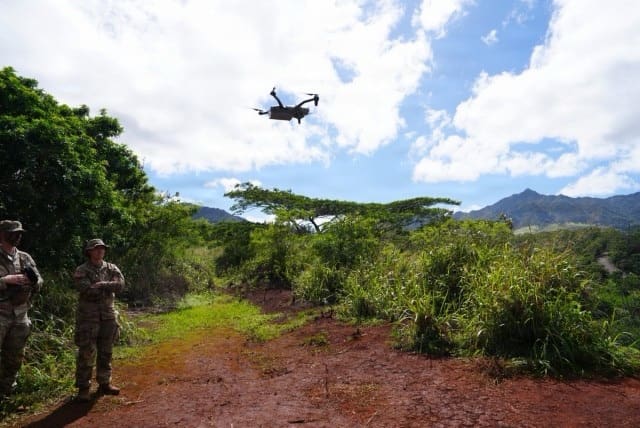
As part of the Army’s Next Generation Command and Control (NGC2) “commercial first” effort, the division joins the 4th Infantry Division (4ID) to prototype modern technologies that make data more usable and accessible to commanders across all the warfighting function technologies.
NGC2 provides a “full stack” capability ecosystem, comprised from the top-down of Apps, Data/AI, Infrastructure, and Transport capabilities. Integrating AI into the NGC2 stack will enhance the Army’s competitive advantage, however, Army leaders emphasize that at no time will commanders lose their autonomy while conducting missions.
“AI will continue to be a decision aid, and accelerate the decision cycle, not replace commanders, who will make the final judgement calls,” said Brig. Gen Shane Taylor, Capability Program Executive Command and Control Information Network (CPE C2IN).
Through a series of operational exercises, Ivy Stings for the 4ID and Lightning Surges for the 25th Infantry Division (25ID), Soldiers continue to identify in real time which technologies aid the mission, and which need improvement.
“The Soldier’s feedback is the most important product we generate,” said Lt. Col. Andrew Batule, 25ID Innovation Officer. “The Soldiers in the TOC [Tactical Operations Center] and on the gunline are the ones who tell us, in real time, if this is making us more lethal. Their direct input is what informs every single software update and ensures we are building the right tools for the fight.”
During the time between Lightning Surge 1 and Lightning Surge 2, division leadership, artillery (DIVARTY), and technical staff stated they achieved a digital end-to-end workflow that accelerated the fires process by integrating four key commercial capabilities within the NGC2 stack: An advanced data platform supported by an AI mission system; modern, automated target workflow software; enhanced electronic warfare capabilities and 5G data transport.
“From a technology perspective, ‘commercial first’ means the tech is available to everybody,” Taylor said. “It’s only as good as our ability to rapidly inject it, train it, field it and then replace it with the next solution right behind it.”
This full-speed-ahead iteration and integration approach is ensuring the Army arrives at best-of-breed commercial solutions tailorable to any unit’s mission, including the contested environment across the Pacific theater’s tyranny of distance.
“We have to move out very quickly and iterate fast,” said Maj. Gen. James Bartholomees, 25ID commanding general. “That’s exactly why our model is—experiment with it, train with it, and then deploy it forward into the terrain with our allies to both assure them and deter our adversaries.”
Refined data, modern fires app
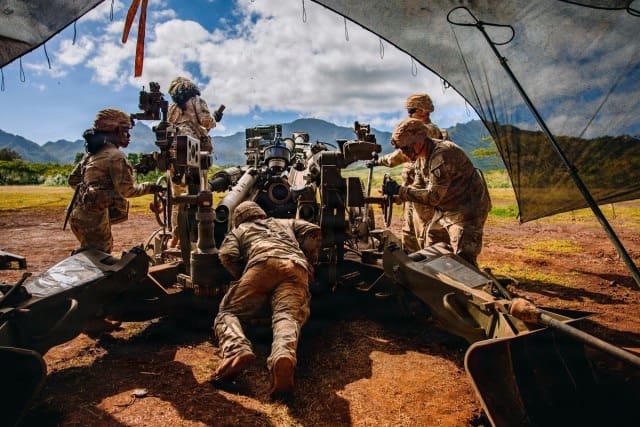
The division’s call for fires chain consists of forward observers identifying a potential target and transmitting target data to the Fires Direction Center, allowing the fires direction officer to calculate if, when, and how to engage kinetic fires.
Industry teams and division personnel collaborated to accelerate this process by establishing a prototype, AI-aided data platform integrated with the Army’s new app-based, data-centric fires command and control system, called the Artillery Execution Suite, or AXS.
During the event, forward observers used hand-held devices to extract data from the edge sensors – both on the ground and in the air – which was ingested into the data platform and then simultaneously into AXS. New algorithms calculated the specific type of data ingested from the sensors to publish to the DIVARTY common operational picture.
“We are now at a place where we are feeding all the data into the data platform,” said Maj. Rebecca Borrebach, 25ID G6 data officer. “Our data is accessible, and now an application can subscribe to the data it needs.”
Controlling the electronic spectrum
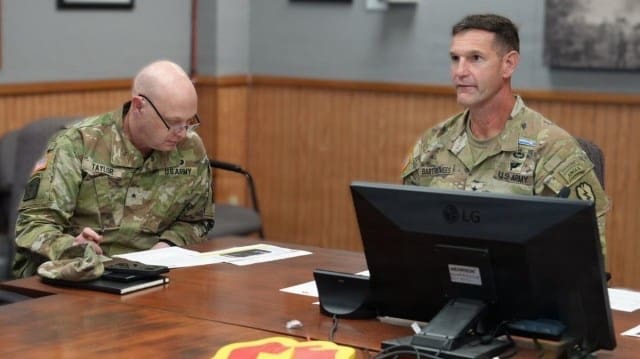
Before the forward observers can confidently share information on a potential target, the commander must conduct an Electromagnetic Warfare (EW) assessment to identify and understand what signals an adversary may be transmitting to interrupt the mission.
“Almost all warfighting functions need access to EW data,” said Cpt. Curtis Hart, assistant product manager for the Electronic Warfare Planning and Management Tool (EWPMT).
“Aviators want to know where they can fly without their GPS navigation being degraded. Artillerymen want to know where they can employ precision-guided munitions without interference. Ground maneuver forces want to know where they can expect radio transmissions to be unreliable,” he said.
NGC2 allows this data, previously only readily available to the CEMA [Cyber Electromagnetic Activities] cell, to be widely disseminated and used by these sister warfighting functions, he said.
“With the eventual addition of AI, I feel confident that the data my EW team aggregates will inform commanders and their staffs throughout the division,” said CW2(P) Kris Perez, Electromagnetic Warfare Technician, 25ID. “This will enable them to make more timely, informed decisions, which will increase the division’s lethality.”
5G-Transport Diversity
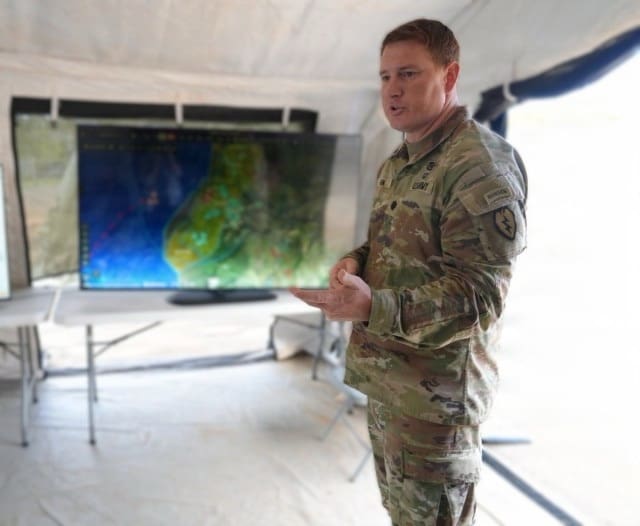
Unlike the 4ID, which is prototyping NGC2’s full stack, the 25ID is primarily prototyping the data and application software on top of its previously fielded modern “C2 Fix” transport and infrastructure. However, the NGC2 prototype effort provided flexibility for the unit and industry teams to experiment with desired capabilities, based on the division’s missions, including the need to operate in the degraded environments often encountered in the Indo-Pacific.
“Our focus for Lightning Surge 2 was the ‘first mile, last mile’ challenge,” said Lt. Col. Adam Brinkman, 25ID G6. “We used what we learned from our last event to upgrade the launchers and guns with better radios and private 5G, which gives the commander more resilient options to get a fire mission from the sensor all the way to the shooter at the tactical edge.”
For the first time in the Army, private 5G served as the primary pathway to travel from the fires direction officer to the guns, with modern satellite radios available as the secondary transport.
“We are implementing incremental lessons learned from the 4ID, where its personnel viewed the fires chain using 5G in one of its previous NGC2 Ivy Sting events,” said Lt. Col. Clarke Brown, product manager for Network Modernization, Capability Program Executive Command and Control Information Network (CPE C2IN). “Pushing the capability to actually transport the call for fires down to the field artillery Soldiers was an exciting accomplishment for the unit.”
Conclusion
The Lightning Surge and Ivy Sting exercises continue to leverage data and AI technologies that deliver information across all warfighting functions to enhance commanders’ decision making.
According to Bartholomees, the Lightning Surge events are more than exercises; rather, they are “rehearsals” as he leads his division into multi-national Indo-Pacific exercises to train in real-life electromagnetic, cyber, distance and denied environment challenges.
“We exercise in the Hawaiian Islands across the archipelago so we can then project those forces into the first island chain within the Philippines,” Bartholomees said. “Our next Lightning Surge series will be in conjunction with Philippines joint and combined exercises, in which we’ll be able to put all this together and really test out the concepts that Next Generation C2 is delivering.”
By Kathryn Bailey, CPE C2IN Public Communications Directorate