SIG SAUER - Never Settle

Archive for the ‘Army’ Category

First Army Taps AI to Enhance Command and Control

Thursday, December 14th, 2023

ROCK ISLAND ARSENAL, Ill. — First Army is leveraging the potential of artificial intelligence during large scale mobilization exercises and other missions.

Lt. Col. Melissa Sayers, First Army operations research systems analyst, or ORSA, said the first use will come during the 2024 iteration of Pershing Strike, First Army’s annual exercise to validate the Army’s ability to mobilize forces in support of large-scale combat operations.

The use will be limited but by the following year, the plan is for it be an integral part of the exercise and other First Army operations. It is forecasted to eventually be a routine part of how First Army does business. The hope, Sayers said, is that, “not only do will we have a simulation that we can run a million scenarios on but it’s part of our everyday operations, helping us get to decisions faster.”

Artificial intelligence is the use of computer systems to perform tasks that traditionally require human input and do them much faster. For First Army, faster information would lead to a boost in efficiency during operations that move a multitude of Soldiers and equipment to an assortment of locations across the country for training and mobilization.

“The machine can’t do it without the human,” Sayers noted. “Say we had a large-scale mobilization operation and we had all these units ready to head out the door and the medical unit shows up at 50 percent strength. With AI, we have the ability to pre-calculate solutions. We estimate what is going to happen if you make this decision, and we can go ahead and run it and calculate all those different decisions and have the best three or four recommended to the commander. The commander still makes the decisions but we can get there a lot faster if we have it pre-calculated and ready to run when something happens.”

AI is used in all manner of situations, from customer service to medical diagnoses to traffic patterns. At First Army, the plan is for it to create more efficient operations in exercises and mobilizations, including a large-scale mobilization operation if such an event arises.

“That’s what First Army cares about,” Sayers said. “We want to be able to push out the Reserve Component in a timely manner in event of a large-scale conflict. Once you have the model created, you can start playing with it. It helps leaders at very high levels figure out what levers to pull and what resources to apply to maximize what’s happening on the ground.”

Sayers noted the positive impact this can have for units of any size and the individual Soldiers.

“We have units full of people that need to be processed,” she said. “They need to arrive at their home station, they need to make sure they have all their equipment. What does it take to get the equipment fully maintained? What does the shipping network look like? How many observer coach/trainers should we have and of what flavor — do we need aviation, medical, infantry? How many medical stations? What if one of those stations goes down? What if one shows up at only half-strength? What happens at that location and what are our options to react to that problem. We can plot all this out.”

Partially due to the value of AI, First Army added an ORSA this year. “Anytime First Army has needed to do advanced analytics, it’s had to outsource it,” Sayers said. “They’ve never had anyone inhouse to advise the command and do the work.”

It’s a microcosm of what’s talking place across the Army.

”The ORSA role has exploded in the last couple of years,” Sayers said. “We’ve been limited on what we’re able to provide to the commands because the amount of data was not there to do deep qualitative analysis. Suddenly all this data is able to be collected because we have the hardware to be able to store it and we have the hardware to be able to collect it.”

Because of that, First Army and its partners will be better equipped to provide combatant commanders with trained and ready Reserve Component Soldiers.

By Warren Marlow

Next Generation Squad Weapons Tested by Ft Campbell Infantry, Rangers

Monday, December 11th, 2023

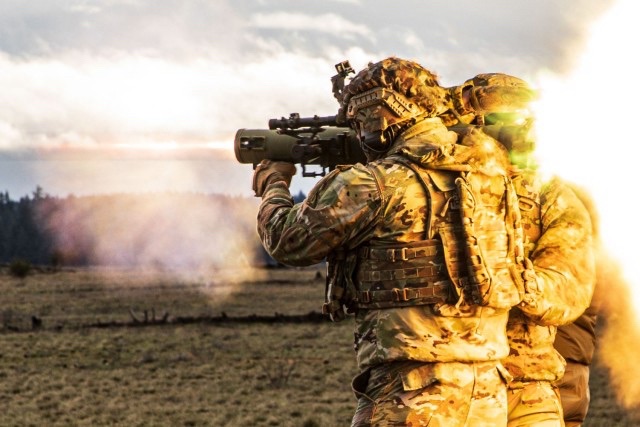
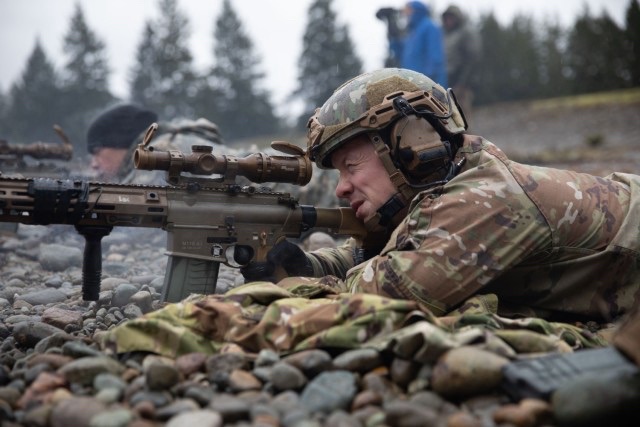
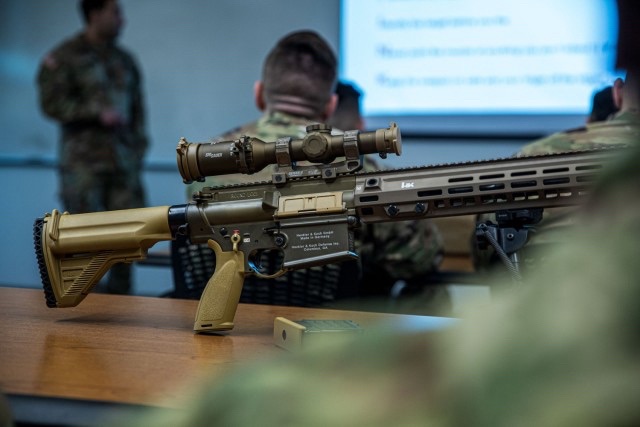
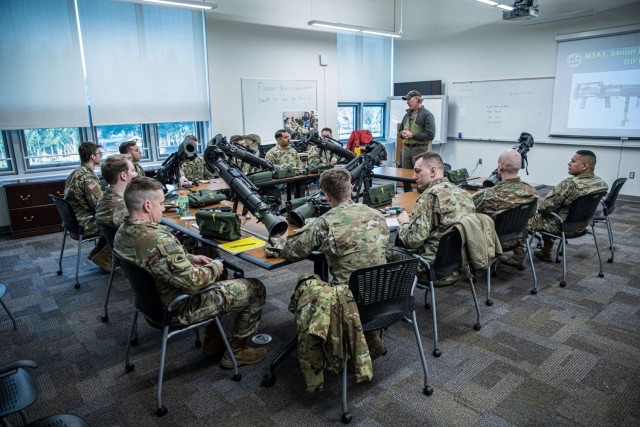
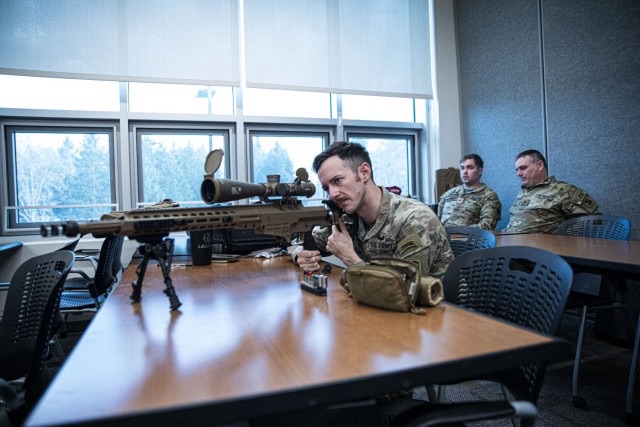
FORT CAMPBELL, Ky. — Screaming Eagle Division Soldiers here just completed training and testing the Army’s 6.8mm family of Next Generation Squad Weapon-Rifle (NGSW-R), NGSW-Automatic Rifle (AR) and the NGSW-Fire Control (FC) systems.

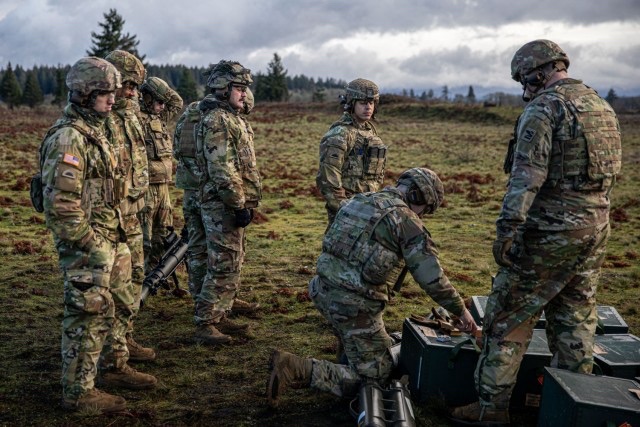
Troops of Alpha Company, 2nd Battalion, 502nd Infantry Regiment, 2nd Brigade, 101st Airborne Division (Air Assault) and members of 1st Battalion, 75th Ranger Regiment, undertook New Equipment Training on the NGSW.

“The New Equipment Training gave the Soldiers a good base before coming out and using the NGSWs,” said Infantryman Sgt. Jack Scott, a team leader in Alpha Company.

Their training covered the similarities and differences between the new weapons and the legacy 5.56mm M4A1 Carbine and M249 Squad Automatic Weapon systems, focusing on enhanced lethality.

“We did a lot of training with both static and maneuver ranges, so the product of Soldier you get now, during the live fire, is high quality due to all of that training,” added Scott.

Once complete with new equipment training, Soldiers tested the NGSW in a Limited User Test, or LUT, in a crawl-walk-run method to ensure all operational data is collected on the weapon, as well as user integration with the new equipment.

Alpha Company and 1st Battalion, 75th Ranger Regiment initially conducted static qualification and variable distance ranges with legacy weapon systems and NGSW, to compare performance of both and give Soldiers repetitions and familiarity with the NGSW.

Alpha Company 1st Sgt. Justin Babb appreciated the benefits of participating in an operational test and the opportunity for his junior Soldier’s feedback to contribute and impact Army modernization.

“The candid feedback that the Soldiers and NCOs provided during focus groups and surveys will provide the Army with perspective from the lowest level of user that will actually use the system,” said Babb.

Major differences between the legacy M4, M249 systems and the NGSWs were immediately noticeable by the Soldiers.

Spec. Maximiliano Arguindegui, an automatic rifleman with 1/75th Ranger Regiment, said, “Overall, I feel faster with the M249, but I prefer the NGSW-AR because it makes me more lethal.”

Scott added, “Stopping power with the 6.8 round is a big improvement compared to the M4 and M249 and having the ability to use with or without the suppressor is a huge feature for the support by fire element.”

Leaders of Alpha Company also said participating in a test with the Operational Test Command enabled them to get after their internal readiness.

Alpha Company Commander, Capt. Jordan Mares, said, “Being a part of the NGSW test absolutely supported our company readiness. The LUT gave us opportunities to hone our craft, practice lessons learned with feedback from subject-matter experts, and the ability to conduct a lot of repetitions to practice small unit tactics.”

Staff Sgt. Ivan Alvarez, a Squad Leader with Alpha Company, was initially skeptical of the NGSW.

“When we first started the LUT, I was very against the NGSW-R,” he said. “I’m used to the M4 — it’s lighter — I’m used to the recoil, the engagements, everything the M4 has to offer. But, as we went through the LUT with the NGSW-R, I can see the capabilities that it brings to an infantryman, especially at a longer distance.”

Alvarez also said testing the new weapons gave his squad added training opportunities.

“We got after a lot of training that we would normally have to wait months to set up and accomplish,” he said. “We were able to get more marksmanship time, more range time, and were able to train under various environmental conditions.”

Another squad leader with the Rangers provided his observations on the training benefit while participating in an operational test.

“We were able to get reps in on a new weapon system as well as our legacy equipment,” said Sgt. Joseph Martin. “We were able to train on many basic things that we want to train on every year, but condensed to get more repetitions, as well as live fire iterations for our younger, inexperienced Soldiers.”

Story by Maj. Rodrick A. Polk, test officer, Maneuver Test Directorate, U.S. Army Operational Test Command

Photos by Mr. Mark Scovell, Visual Information Specialist, U.S. Army Operational Test Command

Army Concludes Network Modernization Experiment 2023

Sunday, December 10th, 2023

JOINT BASE McGUIRE-DIX-LAKEHURST, N.J. — The Army completed its annual capstone Network Modernization Experiment, or NetModX, after 10 weeks of experimentation spanning 62 technologies.

Across three locations in New Jersey and Maryland, the Army’s Command, Control, Communications, Computers, Cyber, Intelligence, Surveillance and Reconnaissance Center and partner organizations experimented with a broad spectrum of network-related capabilities in an operationally realistic, threat-informed environment. The C5ISR Center is an element of the Combat Capabilities Development Command.

Because of the Army network’s vast reach, NetModX 23 encompassed 17 focus areas and five modernization priorities: Future Vertical Lift, Long-Range Precision Fires, Network, Next Generation Combat Vehicle and Soldier Lethality.

“As an enabler for multiple Army technologies, the network and its performance in multiple dimensions becomes critical to overall mission success,” said Joe Saldiveri, NetModX 23 lead strategic planner.

NetModX 23 featured projects leveraging a live, virtual and constructive environment that enables experimentation in a distributed manner. LVC assists the NetModX project management team to provide an all-inclusive service by combining real and simulated capabilities to simulate technologies under experimentation. The LVC environment fills in gaps where real systems are too expensive or too scarce to include.


“The C5ISR Center offers a critical service to the C5ISR community by providing the environments and engineering expertise to experiment and inform complex C5ISR integration decisions. LVC is a tool that enables us to answer more complex questions with greater fidelity and more efficiency. We continue to invest and work with our partners in building out our LVC capabilities — to ensure we are pushing the state-of-the-art boundaries,” said Seth Spoenlein, assistant director for system integration.


As part of NetModX, the C5ISR Center routinely partners with a fellow Army R&D organization, DEVCOM Analysis Center, to create an operationally relevant experimentation environment. This environment is vital to experimentation as it exposes emerging technologies to realistic threats for greater learning.

In addition to the work of Army scientists and engineers, the event included Soldier participation from the 75th Innovation Command, 101st Airborne Division and Fires Capabilities Development and Integration Directorate. This allows real-time Soldier feedback on how emergent technologies affect mission threads and performance within those threads.

“Soldier participation in NetModX allows technology developers to gain insights into how Soldiers would interact with the technology in an operational setting, providing valuable lessons across a broad range of technology readiness levels,” said Noah Weston, chief of C5ISR Center’s Strategic Experimentation Office.

New this year was Innovation Week, a two-week extension of NetModX with a focus on sensor-to-shooter experimentation, augmented by LVC capabilities to enhance realism. The intent was to explore high-risk, high-reward experimentation, to push the boundaries of learning by exercising a common sensor-to-shooter mission thread using uncommon technologies and network architectures.

Innovation Week resulted in a series of firsts for the Army network enterprise, providing a basis of knowledge for further exploration, Weston said.

“Leveraging initiatives such as Innovation Week, the Army can discover potential leap-ahead technologies or architectures that are distinct advantages over currently deployed systems. Innovation Week is focused on reducing risk for both our internal science and technology programs and, more importantly, our transition partners. It provided an operationally relevant “safe to fail” environment to conduct systems of systems experimentation,” he said.

By Dan Lafontaine, DEVCOM C5ISR Center Public Affairs

Some photos by James Lee, RJ Regars, and John Tang, DEVCOM C5ISR Center

Pioneering Communications Demo Starts US Army Exercise

Friday, December 8th, 2023

SKOPJE, North Macedonia — Soldiers with the 509th Strategic Signal Battalion, 2nd Theater Signal Brigade were the first in history to facilitate en route mission command outside of the U.S. while in-flight with Stryker vehicles as a tactical command post aboard a military aircraft, which kicked off the U.S. Army Europe and Africa exercise, Brave Partner, Dec. 1 at Skopje International Airport.

Brave Partner is a “short notice action planning exercise” that aims to enhance regional partnerships and increase U.S. force readiness and interoperability in a realistic, multinational training environment, including roughly 180 U.S. Soldiers from the 2nd Cavalry Regiment with support from 30 service members from the Army of the Republic of North Macedonia, Dec. 1-10, 2023 at Skopje International Airport and Krivolak Training Area, North Macedonia.

“I find it exceptionally phenomenal to have the opportunity to field equipment and work with partner units as well as partner nations,” said Capt. Shenelle Stallings, 509th SSB Headquarters and Headquarters Detachment commander. “The cohesion and the trust we’re building with one another — because I’m from the 509th, and we’re providing comms for 2CR, and we’re in North Macedonia — so all those pieces coming together and seeing how these things work makes it all the more worthwhile.”

Stallings said her team is making history by validating en route mission command that’s first-of-its-kind on a strategic network, and they’re setting a foundation and building it from the ground up in their area of operation. They achieved excellent signal speeds that exceeded their expectations with minimal latency. They faced snow and heavy clouds, which had the potential to degrade signal transmissions. She explained that taxiing and takeoff were the most important parts of the test while transitioning between equipment from ground to air, and that was also successful.

“I was on a video chat the entire time, and it was crystal clear,” said Stallings. “We use the Voyager 8 and the KAFMA antenna that allows us to reach back to our strategic network in Italy, and then we’re also able to come here with our Starlink and transition to that seamlessly.”

One of Stallings’ Soldiers, Cpl. Deandra Winston, is an expert on communications equipment and prefers the Voyager 8 transit case to bulkier equipment she’s used in the past. She explained that tactical signal equipment is becoming increasingly innovative and mobile. Being able to connect users without waiting for equipment to be set up on ground is key.

“It will create an ease of understanding between troops that are coming and going and a faster understanding of the mission that needs to be executed,” said Winston. “New technology comes out every day, and it’s best to not be scared to try new tech. Everything takes time, and I understand that, but it’s time to get rid of the old and use the new.”

As part of USAREUR-AF’s Tactical Mission Data Platform, 2CR’s Stryker vehicles were a command post aboard a C-17 aircraft, demonstrating innovation and speed in exchanging information between commanders en route in the sky and warfighters on the battlefield.

As this initial event for Brave Partner took place, the charter plane carrying a majority of the 2CR Soldiers was also arriving at Skopje International Airport.

Army of the Republic of North Macedonia Sgt. Maj. Igor Petrovski, airport liaison officer, was on-site and coordinated the C-17’s arrival as well as the charter plane’s arrival that carried most Soldiers who arrived for Brave Partner. He has a wealth of experience facilitating flights for NATO partners, including C-17s, C-130s and charter flights for the U.S.

The Republic of North Macedonia has a partnership with the Vermont National Guard, and Petrovski explained that his country’s military hosts international exercises with NATO countries, including the U.S. Army and especially the Vermont National Guard.

“We are brothers in arms with the Vermont National Guard,” said Petrovski. “The partnership is leveled up year by year.”

Army of the Republic of North Macedonia Lt. Col. Vladimir Cvetkovski, chief of the Host Nation Support Coordination Center, explained that North Macedonia is new to NATO with three years of membership, but they’ve taken many steps to maintain standards, and they are committed to training with the U.S. as well as keeping good relations with all of NATO.

“The U.S. is our strategic partner,” said Cvetkovski. “We have very good support from the U.S.”

A majority of Brave Partner is scheduled to involve live-fire ranges for 2CR Soldiers to train with Stryker armored fighting vehicles. Cvetkovski explained that Krivolak Training Area has the best terrain and facilities for that type of training. He said the training area accommodates a variety of military vehicles, aircraft and munitions.

“We have a very good training area here,” said Cvetkovski. “KTA is in the top 3 of all training areas in all of Europe.”

By Capt. Maria Salcido

US Army Hosts Joint Counter-IED Exercise at Premier Pacific Northwest Training Center

Thursday, December 7th, 2023

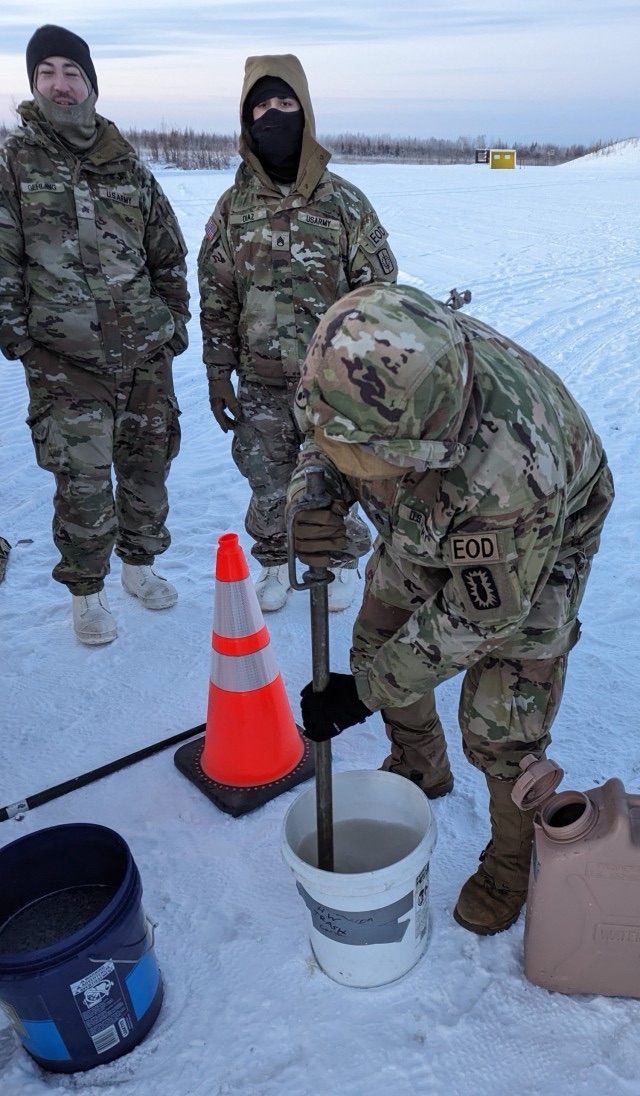
YAKIMA TRAINING CENTER, Wash. — U.S. military explosive ordnance disposal technicians and civilian law enforcement bomb squad personnel trained to combat advanced improvised explosive devices at the premier U.S. Army Pacific Northwest training venue.

The U.S. Army 53rd Ordnance Company (EOD) hosted the joint, multicomponent and interagency training with the Washington National Guard 319th EOD Company, Oregon National Guard 142nd Flight Wing Civil Engineer Squadron, U.S. Air Force 92nd Civilian Engineer Squadron and U.S. Navy EOD Mobile Unit 11 Detachment Northwest on Yakima Training Center.

FBI Special Agent Bomb Technicians and agents from the Bureau of Alcohol, Tobacco, Firearms and Explosives also participated in the training.

The counter-IED training event provided valuable experience using alternative shaped charge and water-based tools in addition to disruption tools.

U.S. Army 1st Lt. Quinton R. Reese, a platoon leader with the 53rd Ordnance Company (EOD), said the joint EOD techs discussed tactics, techniques and procedures with service-specific gear that usually only gets employed during joint advanced IED training.

“This was a great event with a much wider audience showcasing each tool that we as a total EOD force use to defeat an IED,” said Reese. “This training allowed some of our most junior team members the opportunity to see what their tools can actually do when used properly — so the first time they see one in action it’s not on a live device.”

While Army, Navy, Air Force and Marine Corps EOD techs leverage their capabilities for different missions, they also have overlapping capabilities that complement each other. Reese said experiences are also different among EOD team leaders in the same service.

“The role of Army EOD teams varies from mounted patrols through an urban environment to dismounted Special Operations Forces support,” said Reese. “The experiences of one team leader to the next could be vastly different based on the mission sets.”

“By getting the various experiences and viewpoints of both junior and senior EOD technicians from all services and components as well as civilian counterparts, we can help bridge the gap and provide a forum for increasing the tool set both literally and in the problem-solving process for all EOD technicians, regardless of service,” said Reese.

Reese started his uniformed service as an enlisted Army geospatial imagery intelligence analyst before graduating from the U.S. Military Academy at West Point and becoming an EOD officer.

A native of Coeur d’Alene, Idaho, Reese said he was inspired to serve as an EOD officer by a mentor from the 53rd EOD Company, the same company he serves in now.

“His stories of the complex problem solving and the highly technical aspects of the work appealed to me,” said Reese. “As a prior enlisted Soldier, knowing that I would go through the same training as the Soldiers I would lead was a unique opportunity I could not pass up.”

Reese said he has also witnessed the importance of noncommissioned officer leadership during a downed aircraft response on Yakima Training Center.

“Thankfully, the crew walked away from the wreck that night,” said Reese. “Getting to see the difference that we as EOD can make as well as seeing my platoon sergeant effectively take control of a scene as a team leader was awe-inspiring and made me proud to be a part of this highly specialized field.”

The 53rd EOD Company, “Fighting 53rd,” is part of the 3rd EOD Battalion, 71st EOD Group and 20th Chemical, Biological, Radiological, Nuclear, Explosives (CBRNE) Command, the U.S. military’s premier CBRNE formation.

American Soldiers and U.S. Army civilians from the 20th CBRNE Command deploy from 19 bases in 16 states to confront and defeat the world’s most dangerous hazards.

Capt. Logan T. Morris, the commander of the 53rd EOD Company, said the training event gave the joint EOD and civilian bomb squad techs the opportunity to share their knowledge about functions, capabilities and branch-specific explosive tools and techniques.

Originally from Redmond, Oregon, Morris became an EOD officer after being mentored by his ROTC commander at Oregon State University, then Lt. Col. Eric Larsen, who was an EOD officer.

Morris said the Yakima Training Center is the ideal location for large-scale training events. The 327,000-acre training center can accommodate brigade-sized units for maneuver exercises.

The Eastern Washington State training center is more than two and a half hours away from Joint Base Lewis-McChord, Washington.

“Yakima Training Center boasts nearly limitless opportunities for training to scale with the demands of units requirements,” said Morris. “YTC frequently hosts Canadian, Singaporean, Japanese, Korean and other Pacific Theater aligned joint and national training events and it is a bastion for brigade-level and below training with nearly no limitations.”

By Walter T. Ham IV

TacJobs – Program Officer Acquisition with Project Manager Electronic Warfare and Cyber

Tuesday, December 5th, 2023

Project Manager Electronic Warfare and Cyber (PM EW&C) has a job opportunity announcement open on USAJobs for a Program Manager (Program Officer Acquisition), NH-0340-04. This position serves as the Associate Director for the DoD Ground Based CREW Single Manager Program Office at Aberdeen Proving Ground, MD. This opportunity is open to the public to apply through end of day 05 December 2023.

For additional information and to apply, visit lnkd.in/gqVguzx2.

We just got this, sorry for the short fuse.

FORSCOM Commander’s Forum Outlines the Future of Army Formations

Tuesday, December 5th, 2023

FORT LIBERTY, N.C. — Commanders and command sergeants major from across the U.S. Army Forces Command footprint gathered at Fort Liberty for the FORSCOM Commander’s Forum, Nov. 29-30, 2023. The conference brings together senior leaders from all Forces Command corps and divisions as well as the Army National Guard and Army Reserve for focused training and conversations on leading warfighters on the battlefield.

Gen. Andrew Poppas, FORSCOM commanding general, welcomed the group and explained there was much to cover over the two-days. He continued by explaining his “4-Wins:” Win Trust and Empower Leaders; Win the First Fight; Win the Future Fight; and Win as a Balanced Total Army.

“The framework we’ve laid out is the 4-Wins,” said Poppas. “This is the framework in which we move forward. And I will tell you that at every touchpoint within each one of these domains, I feel we’ve made great success. In the way we are building the team, in the way we’ve embraced it … strengthening the relationships we have and engaged leadership.”

He continued by expressing his vision of a warfighting force and professional warriors. Warriors need the mindset of always moving forward; the warrior spirit to hone yourself to be physically and mentally fit; and training methodology focused on building formations to their greatest capability, he said.

“The strength of that formation is that they rely on each other,” Poppas said. “It’s the person to your left that’s carrying the shield that protects you. It’s the strength of the formation that moves forward.”

Poppas explained the number one priority for the Army chief of staff is warfighting and FORSCOM owns warfighting. As he looked around the room, he acknowledged that the leaders sitting there were in the positions they are in due to their strong backgrounds as leaders, warfighters, and Soldiers.

This year, the 41st Chief of Staff of the Army, Gen. Randy George, was the guest speaker for the forum. George has served as the Chief of Staff of the Army since Sept. 21, 2023. He began his discussion by acknowledging that world today is a very complex place. The Middle East, Ukraine, Taiwan and Africa were cited as just a few of today’s global hot spots the U.S. Army has interests. In addition to these topics, George recognized challenges with recruiting efforts, equipment and parts delay and budget stability.

As he continued, George shared with the group the questions he asked to his staff at the Pentagon: what can we stop doing or change; how do we adjust our processes; how can we push down authority and funding; and are we making the right trade-offs?

“I generally don’t talk about 2030 because I don’t think we have that much time,” said George. “2030 is too far down the road. We are going to be a lot different before that, I can guarantee you. We are going to be a lot different in the next four years.”



The Army chief of staff continued the conversations, outlining his some of his priorities — such as warfighting, delivering ready combat formations, adjusting the approach to military construction projects, and production of a new mobile app to help inform Soldiers and families of quality of life programs available to them.

Focusing on continuous transformation, George explained that transformation is more than just purchasing new equipment. Transformation also includes changes to processes, training and how Army formations look.

“I want our leaders to decide what our formations will look like, not a bunch of us sitting inside the [Pentagon],” explained George. “I can certainly do that, I definitely have my own opinions on a lot this, but I want everybody involved in what we’re doing.”

The topic of strengthening the profession was saved until last to emphasize the point. George shared an example from his time as a division commander. Underlining how he and other division commanders would share advice and lessons learned with each other to help increase lethality and warfighting capabilities.

“I remember when I was a captain and pulling the drawer open and Armor Magazine and Infantry Magazine were there, and they were very helpful,” said George. “I’m asking for your help in making sure people are writing about our profession. We should be talking about our profession.”

By Adam Luther

Army Publishes First Doctrinal Manual Dedicated to Information

Monday, December 4th, 2023

FORT LEAVENWORTH, Kan. — The Army has released its first doctrinal publication dedicated to the topic of information and its role in multidomain operations on the Army Publishing Directorate website, Nov. 27, 2023.

Army Doctrine Publication 3-13, Information, codifies the Army’s approach to the military uses of data and information, and recognizes all activities generate informational effects that can contribute to, or hamper, achieving objectives.

“Information is central to everything we do. It is the basis of intelligence, a fundamental component of command and control, and the foundation for communicating thoughts, opinions and ideas,” said Lt. Gen. Milford Beagle, Jr., commanding general, Combined Arms Center and Fort Leavenworth. “As a dynamic of combat power, Army forces fight for, defend, and fight with information to create and exploit information advantages — the use, protection, and exploitation of information to achieve objectives more effectively than enemies and adversaries.”

Authors from CAC’s Combined Arms Doctrine Directorate, the organization charged with writing the new manual, acknowledge that changes in the security environment necessitated an update to doctrine. Adversaries are already using informational power to try to gain regional influence and control well ahead of potential armed conflict. These actions make the competition for information and ideas continuous and persistent.

Key to achieving objectives in a contested environment like this means gaining an information advantage, a new term now defined in doctrine. An information advantage is “a condition when a force holds the initiative in terms of situational understanding, decision making, and relevant actor behavior.”

“Our new doctrine makes it clear that everyone plays some role in achieving information advantage,” said retired Army colonel and CADD Director Richard Creed. “And similarly, commanders need to consider information from a combined arms perspective because all Army capabilities create effects in the information dimension of our operational environment. We can’t make it the sole purview of a single staff section or certain specialties and expect success during operations. Operations now require leaders to consider how information enables operations, how to protect friendly information, how to employ information against an enemy or adversary, and how to attack the enemy’s ability to use information effectively.”

To facilitate that process, ADP 3-13 gives leaders a framework for developing information advantages during operations and at home station. It also spells out how commanders can leverage aspects of information that enable command and control; protect data, information, and networks; inform audiences; influence threats and foreign relevant actors; and attack the threat’s ability to use information.

The publication of ADP 3-13 is just the start of a sustained education campaign from CAC. As with the release of FM 3-0, CADD is developing a series of products to help Soldiers understand the new doctrine. Articles, videos and podcasts devoted to ADP 3-13 are in the works and will be announced via CADD’s social media channels. The team will also work closely with the Centers of Excellence, Army University and the combat training centers to ensure this information is incorporated into professional military education and training. In addition, mobile training teams will visit select installations and organizations to further integrate the ideas outlined in the manual.

“ADP 3-13 provides the intellectual underpinnings that describe how Army forces will gain, protect, and exploit information advantages; however, doctrine is only the beginning. The hard work starts when we begin to internalize these ideas into leader development, education, and training,” said Beagle.

To learn more about ADP 3-13 and other doctrine, visit the Combined Arms Doctrine Directorate website.

By Randi Stenson, MCCoE Public Affairs