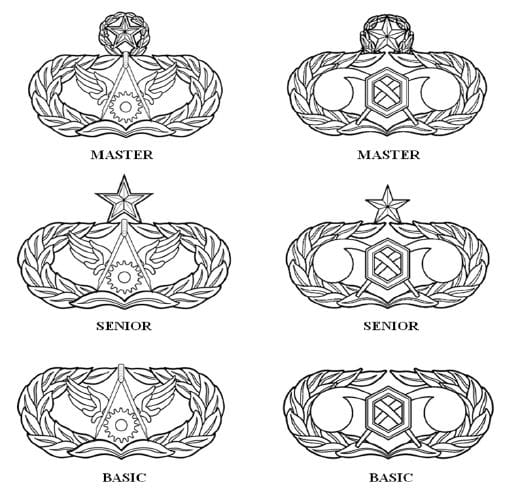
Air Force Specialty Code 3E9 (Emergency Management) has been known By other names over the years. For example, when I was a kid, I remember they were called Disaster Preparedness. Interestingly, they are kind of like EOD in that they are part of Civil Engineering even though it isn’t a good fit and this is recognized with a special careerfield badge that reveals their true focus, bugs and gas. They are the CBRNE specialists of the USAF.
Specifically the careerfield, “Prepares, plans, trains, educates, and equips Air Force personnel to respond to, maintain mission capability, and recover from the full spectrum of physical threat events including major accidents, natural disasters, weapons of mass destruction, and wartime chemical, biological, radiological, nuclear, and high-yield explosive (CBRNE) attacks. Provides technical expertise to commanders during full spectrum threat response operations. Performs detection, monitoring, warning, and reporting of chemical, biological, radiological, nuclear (CBRN) events.”
If you were in the Air Force prior to the current conflict you were probably pretty familiar with them. We regularly trained in MOPP 4 conditions (even in SOF) and Ability to Survive and Operate (ATSO) was an important part of Operational Readiness Inspections. Maybe it was all institutional momentum from the Cold War, but it was drilled into Airmen enough that they could do it.
Now, NRA’s Life of Duty has prepared a report focusing on this small community of specialists and why they are more relevant now than ever. Here is a teaser.
While this isn’t an EOD project, it is a counter-IED exercise pairing the US Army’s 42nd Route Clearance Company and the Bundeswehr’s 441st Mechanized Infantry Brigade Rout Clearance Team in a classic Engineer mission.
Although in typical AFN fashion the clip is short on details, it does remind us how important our engineer forces are in providing route clearanceIt also shows that new equipment has been developed for this mission and some of it was adapted from EOD.
Thanks from SSD to all the folks in the Counter-IED business!