Phantom Lights

Archive for the ‘History’ Category

BCM Gunfighter History : Travis Haley – An Exercise in Compromise

Tuesday, October 6th, 2015

IMG_2783

Hanging in my office is a clone of the rifle I carried on two combat tours (Iraq and Liberia). It’s a reminder of where I came from, where I stand today, where I am going and why I am going there.

While serving in 2nd Force Reconnaissance in the late 1990’s and early 2000’s, my unit started seeing radical advances in small arms and light weaponry via the SOPMOD program. Suddenly, carbines could quickly be fine-tuned for specific missions by mounting night vision systems, laser aiming devices, weapon lights and red dot optics to the 1913 Picatinny Rail Systems on the upper receiver and handguard.

IMG_2795

These technologies opened up whole new tactics, techniques and procedures that could be employed to prosecute our mission of specialized reconnaissance, ambush and direct action raids.

Despite the additional capabilities the SOPMOD program delivered, opinions were sharply divided on the program. Some saw these tools as a burden, adding a lot of “crap” that would only increase the amount of weight our Marines carried on mission for little tangible benefit. A maxed out M4 could run up to 14 pounds, but we didn’t need every component for every mission.

Two Pounds of Metal
The SOPMOD accessory package that my platoon ended up running included almost two pounds of weight in mounting interfaces alone. When I challenged this, I got a typical Marine Corps answer, “Because that’s what you are issued, now quit asking irrelevant questions, Too Speed.” (Too Speed was my call sign.)

I couldn’t accept that answer. It was an institutional answer that repeated a party line and the lives of my teammates were, and will always be, more important than not rocking the boat.

IMG_2806

After some trial and error, the first mod I made was to ditch the Surefire M951 Weapon Light and replace it with a Surefire 6P in a shotgun tube light mount that I scored at a sporting goods shop near base. After swapping the 6P tail cap for the M951 remote switch assembly, I then ran the tape switch on the left side of the 203 so activating the light wouldn’t impact my weapons manipulation.

Getting a weapon light in tight with a rail and shaving weight off the interface was something I would spend the next 10 years fiddling with before I had a eureka moment and Haley Strategic Partners released the Thorntail Adaptive Series of light mounts, currently in use by military, security contractors and law enforcement worldwide.

This was a defining moment for me, as it was when I first started tweaking and eventually building original components for my platoon based on the unique requirements of our missions. These experiences of shaving weight, improving ergonomics and finding a balance between capability and utility, would drive the development of so many of the components I have commercialized in my post-service career.

IMG_2811

The Rifle I took to War

Colt M4 with 14.5” Barrel
Colt M203 40 mm Grenade Launcher
Knights Armament RAS Handguard
PEQ-2 IR Aiming Laser
Surefire Classic 6P with a custom “Simply Dynamic” mount
Boone & Packer Redi-Mag
Simply Dynamic Multi-Mission Sling (commercialized by Magpul as the MS3)

Load Out
Prior to the invasion of Iraq, Force was trained up for both Green Side (reconnaissance) and Black Side (direct action) missions, with the assumption we would be tasked to one or the other. However, when we entered Iraq, our platoon found ourselves doing a combination of both at the same time. Force Recon is a special operations unit that prepares the battlespace and gathers intelligence for the MAGTF (Marine Air Ground Task Force) and then prosecutes specialized targets as directed.

With a few days under our belts, the entire platoon started striping gear and mags, looking for that perfect balance of speed, utility and capability. If you can’t move, you can’t be effective. Most of the Marines went from 13 rifle magazines to between five or six. I ended up with four on my vest and two taped together on my carbine with riggers tape and offset with a stick.

IMG_2792

Force Recon ran low signature load outs, often working out of vehicles (mil and civilian), and running a double mag on the carbine meant I had 60 rounds at the ready. When I saw the “Redi-Mag” in a copy of Shotgun News, I ordered it and had it delivered to me overseas. Despite the weight, the Redi-Mag was more versatile than the old riggers tape and stick, and cut my carbine reloads to sub-one second.

I no longer run a Redi-Mag, because there are so many excellent belt mounted magazine pouches available today that I can reload at almost the exact speed as from a Redi-Mag. That said, you will sometimes find them on my house and car guns, as I do not expect to be kitting up if someone breaks into my house or I find myself engaged with an active shooter around vehicles in the streets.

IMG_2791

M203
The M203 is a vital component to small and agile units, like Force, who operate in small units in semi-and-non-permissive settings. It becomes even more essential in worst-case scenarios where the mission is compromised or the unit is outright ambushed by an enemy force.

We prepared for scenarios where 203s could be employed for a hasty breach, in instances where a short count/stack was not possible, as well as a posturing tool to achieve immediate fire superiority in the face of an ambush. Finally, we practiced employing them to suppress fortified enemy positions in buildings by putting accurate fire through windows or open doors.

In fact, in the first gunfight I was involved in during OIF, I put this into practice, pumping 40mm HEDP(High Explosive Dual Purpose) rounds through windows of enemy positions 50 meters out. This fire created instant hate and discontent on target, where crew served weapons and M4s did not offer as much of an immediate positive effect. We had never trained to fire the M203 at such a close distance for safety reasons, but I held at the top of the window frame with my Aimpoint and the round went straight where I wanted it.

IMG_2801

MEUSOC 1911
The MEUSOC 1911 has an almost legendary reputation among 1911 and handgun enthusiasts. One of the most high performance handguns ever built, the MEUSOC 1911 we ran was hand built by Marine Armorers from the Precision Weapons Section at MCBQ (Marine Corps Base Quantico). They fine tuned our 1911’s, hand selecting barrels, link pins, sear springs, ejectors, firing pin stops, mainspring housings and mainsprings. Slides were custom built by Springfield Armory with beavertail safeties and recoil spring guides by Ed Brown, Novak rear sights, Wilson Combat extractors + mag release buttons, and King’s Gun Works ambi thumb safeties.

Force ran the 1911 specifically in direct action raid or ambush missions. It was not a primary and would only come into play if our carbines had run dry or malfunctioned. We carried 10 round magazines with 230 Grain 45 ACP. More than enough to deal with any immediate situation and then refocus on the carbine to get it back into action.

On DRP (Deep Reconnaissance Patrol) Missions, I personally chose my Beretta M92, which was our only 9mm alternative at the time. The flatter trajectory at range of the 9mm and the larger magazine meant more bullets to deal with more problems in the event my carbine was down or permanently disabled.

When I later worked as a security contractor on Ambassador Bremmer’s detail with Blackwater, we would run Glock 17s. But in the end, the mission drives the gear – more importantly, the mission drives the man.

The Mission Drives the Man
When I first started making gear, I was doing it to help keep my guys alive. When I started my first company, Simply Dynamic Tactical, I wasn’t in it to get rich. I was doing it to pass on what I learned in combat and to provide tools that would stack the deck in the favor of the men and women who were going overseas or out on our streets as warfighters, law enforcement or private citizens.

Surviving war is an awesome responsibility. For those who have been in combat, you never forget the brothers you lost. When you are one of those who made it back, you carry a weight that is difficult to put into words. I was lucky to have known such great men in my life. I was lucky to have a second family closer than any people I will ever know.

As I approach the 5th year in business with Haley Strategic Partners, we have tried to bring this industry together and to stay focused on that one mission. Enable brave men and women to complete their missions as safely as possible. Through training, through gear and through mindset.

Stay Sharp and be safe.

Travis Haley

October, 2015

haleystrategic.com

Presented by Bravo Company USA

www.bravocompanyusa.com

Terry Baldwin – On Leadership And Training

Saturday, October 3rd, 2015

I was a freshly minted Infantry Staff Sergeant in the spring of 1981 attending the 25th Infantry Division’s Basic Non-Commissioned Officers Course. We had a 2-Star guest speaker one day. I admit I don’t recall his name or job title. But I do remember something he said about leadership. He said “I learned everything I know about leadership as a 2nd Lieutenant but it has taken me 30 years to understand what I learned”. I thought that was such an odd statement that it has stuck with me all these years. It simply didn’t make sense to me. How can you learn (know) something and not understand it? But as time passed and I moved into positions of greater responsibility I came to realize that he was absolutely right.

How can that be? Over centuries militaries have collected and codified time tested “principles of leadership”. In the US Military NCOs and Officers are formally taught and retaught at every level HOW to lead. They learn the principles and read historical examples of successful and less-than-successful leaders. But all of that fine education still doesn’t deliver or guarantee understanding. It is much like the old saw about pornography. You only know leadership when you see it. Leadership is truly an art not a science. And like any art the fundamentals of the craft can be taught in a classroom. But true understanding requires context derived from experience. In other words, in order to begin to understand leadership you have to lead…more than once. And from each small success or failure you become a little more knowledgeable on the subject. Eventually you start to grasp the hardest part of the equation. That is fully understanding WHY leadership works (or doesn’t) in any given situation.

I’m still trying to get there. But I have had more than my share of opportunities to lead. And I have had the good fortune to serve with countless exemplary leaders of all ranks. I can tell you up front that I learned the most from the very best leaders. But I learned the most important lessons from the worst leaders I encountered. And I also came to realize that when it comes to leadership we aren’t all ever going to be Picassos. But almost all of us – with a little effort and training – can be competent artists. But will the audience on this site find any value in my ruminations on the subject? I don’t know. SSD has graciously allowed me the chance to conduct an experiment to find out. So I am going to share some of my experiences and perspective in these areas, and you tell me. I original wrote and shared a somewhat shorter version of the piece below with some still serving friends in the summer of 2011 as I was beginning my retirement transition. TLB

A “grey man” is a cadre term used at the Special Forces Qualification Course (SFQC) to describe a student who seems to expend most of his energy trying to blend into the background. And although he never causes any trouble for the cadre and generally “meets the standard”; he also fails to distinguish himself, studiously avoids risk, and rarely contributes anything of value to his student team or the mission at hand. A “grey leader” is a term I just coined and it refers to someone who displays the same characteristics but is in a leadership position or by virtue of seniority (NCO or Officer) is expected to lead. Admittedly, the terms are somewhat vague like the men and women they can be used to describe. Grey man is not exactly derogatory…but it is also clearly not complimentary. I can assure you that being the “gray man” in a group is certainly not desirable.


In November of 1976 I was in the 18th month of my initial 4 year enlistment. And at that moment, things were not going well for me. I was standing outside my Infantry Company Commander’s office waiting to report to him. Earlier in the week I had been in a very public and heated altercation with a “hard stripe” sergeant, E-5 in the unit motorpool. I had not started the argument, but once it was initiated I participated enthusiastically. I had been wearing “acting jack” sergeant stripes for almost 8 months and wasn’t about to back down. It was the most recent in a series of minor but less than positive incidents I had been involved in. I had also not bothered to hide the fact that I was not happy with being in a mech infantry unit that spent 90% of its collective time performing maintenance on M113s. I reminded everyone who would listen that I had joined the army to be an Infantryman not a mechanic. In short, I had identified myself as something of a problem soldier or troublemaker for my leaders. I was definitely not a grey man.

Almost as soon as I positioned myself in front of my CO’s door, my First Sergeant and Platoon Sergeant had come out of the office and rather unceremoniously replaced my sergeant’s strips with specialist (E-4) rank. I was shocked. I had been really proud of those stripes even though they were temporary and I had not thought that I would lose them over this particular incident. I had little time to dwell on my “demotion”. Moments later I had reported to my Commander and stood at attention before him awaiting my fate. My Lieutenant and Platoon Sergeant stood stoically on one side of the Captain’s desk with the First Sergeant on the other side but only the Captain talked.

He pushed two documents forward on his desk. One was an ART 15. I knew what they looked like since we usually had 3 or 4 new ones posted on our company bulletin board almost every week. The other was a Request for Transfer to the Divisional Pathfinder Detachment that I had previously discussed with the First Sergeant. The Captain glared at me and proceeded to explain that I had left him only two choices; either impose an ART 15 or endorse my Request for Transfer. He listed in excruciating detail the reasons why I didn’t deserve a second chance and how I had failed miserably to perform up to the standard expected of an NCO. Had there been any more tension in the room I would have wet myself. The Captain ended his “lecture” by saying “Baldwin, you are exactly as much trouble as you are worth”. Then, without any further comment, he signed the transfer document.

The Captain was right. At that point in my development I was not the soldier or leader I needed to be. But I wasn’t a truly a bad soldier either. I was misaligned and a poor fit for that assignment. My Platoon Sergeant and First Sergeant had seen me struggling and they had convinced the commander to take a chance that I could be salvaged in a different unit. I’m not sure if the Captain saw much potential in me, but he took the risk and sent me on my way. He also demonstrated some level of confidence that I could “soldier out” of my current challenges. And now, after a colorful and relatively successful 36 year career I hope that I have justified some of their trust in me. None of those men were grey leaders. Grey leaders wouldn’t have made the effort. It would have been easier for them to simply continue to pound the square peg soldier (me) into a round hole that I was ill suited to fill.

Bad leaders, including grey leaders, at best see soldiers as tools to be used to further his or her career. At worst they see soldiers as potential career ending hazards to mitigate and suppress. Bad leaders do not trust their subordinates. Good leaders see soldiers as precious National resources not to be exploited, but to be mentored, cultivated, nurtured and employed wisely. Good leaders not only trust their subordinates but empower and develop them to their full potential. Good leaders leave a legacy of strong units and strong subordinates. Bad leaders leave disillusioned soldiers and damaged units in their wake. The worst leaders we now aptly refer to as “toxic” and the Army is taking some initial steps to better identify and eliminate those individuals. Grey leaders aren’t as obvious. But I would argue that even though they do less immediate damage their effect is more insidious and does greater long term damage than the more noticeable toxic leader.

My career began just as the Army was transitioning itself from a draft based to a volunteer based manning system following 10 years of war. Today we face a similar transition. My experience in the mid-70s was that many of our combat veteran NCOs and Officers had difficulties transitioning back to a “peacetime” Army mode. Many of the best and most talented voted with their feet and the Army made little effort to retain them. That was unfortunate. Moreover, many of those NCOs and Officers that stayed and thrived in a non-combat environment were mediocre at best. Consummate grey men they were good at following the rules and unfortunately rarely gave cause for elimination. The Army struggled for many years with these conformists who took up space, routinely moving up in the ranks but contributing very little. These Grey leaders even inflicted longer term damage to the Army beyond their individual tenures. Since leaders tend to promote subordinates who look like themselves, grey men tend to beget more grey men. Grey leaders love their subordinates to be grey men. Grey men never take chances; never make waves, and always obey all the rules.

The Army obviously does need disciplined personnel. But the Army needs as many bold, innovative, risk talking soldiers and leaders as it can get. The people we assess with this kind of talent are often more challenging to lead and retain but, when properly shaped and directed, are infinitely more valuable than the grey man. The timid conformists and risk adverse types fill slots but provide little real value. Zero defects policies associated with a “one strike and you’re out” methodology will certainly not engender boldness…but rather encourage and reward the grey men and grey leaders in our ranks. I’m certainly not against enforcing standards or in applying appropriate disciplinary measures to soldiers who need correction. However, I believe it should be in the context of making those individuals better soldiers, not as an easy force sizing tool that defaults to elimination for every offense.

Human nature being what it is, it is very tempting for leaders (even relatively good ones) to simply eliminate anyone who is a “problem” if the system allows them to. Rather than take the harder route of shaping that soldier into something better. The Army is talking a lot now about “managing talent”. But the fact is the mechanisms – and the mindset – are not there. Even after almost 40 years of a volunteer Army we still treat people essentially the same way we did when we had the draft, i.e. interchangeable and easily replaceable. That “one size has to fit all” methodology limits our ability to deal with people as individuals and to effectively leverage their respective talents in support of our mission. In most cases SOF units do better. But even we are often hamstrung by archaic personnel management tools that hurt anyone’s career that doesn’t move with the herd. Just as we have moved to a more information based operational environment, we must move to a more individual based personnel management system. And that system cannot be exclusively “up or out” and certainly not “one strike and you’re out.”

An Army whose ranks are filled only with gray men would be terrible. An Army that is also led by grey leaders would be a disaster. As we move forward with painful but mandated force reductions, I would strongly suggest that the Army would be better served by keeping as many of those so-called “trouble makers” in the ranks as possible. Leaders may have to work harder to productively harness the energy and talent of those individuals, but we will be the stronger for it. And our leaders will be better for making the effort. After we have eliminated the small minority of truly toxic leaders and the few absolutely unsalvageable soldiers, I say cull the grey men next – starting with grey leaders.

LTC Terry Baldwin, US Army (RET) served on active duty from 1975-2011 in various Infantry and Special Forces assignments.

DSEI – SAS Diary

Wednesday, September 16th, 2015

IMG_7290.JPG

I ran across the coolest thing while walking the halls of DSEI. “The SAS War Diary” covers 1941-45 and was published to commemorate the 70th Anniversary of the Special Air Service, raising funds for the Regimental Association. Sure, it’s an extravagance but it’s chock full of formerly classified documents detailing the wartime history of the Regiment collected by a former unit member who didn’t want to see their daring deeds forgotten. Plus, it’s massive at 25 lbs and 17″x12″x4″.

SAS War Diary

Click to view .pdf

www.saswardiary.co.uk

Frankford Arsenal Phila. 1942

Monday, September 14th, 2015

  
Our friend Joe T sent us this a photo of this interesting display with the caption, “Brass was scarce in 42 used steel cases.”

Dazzle It App

Friday, September 11th, 2015

IMG_4127

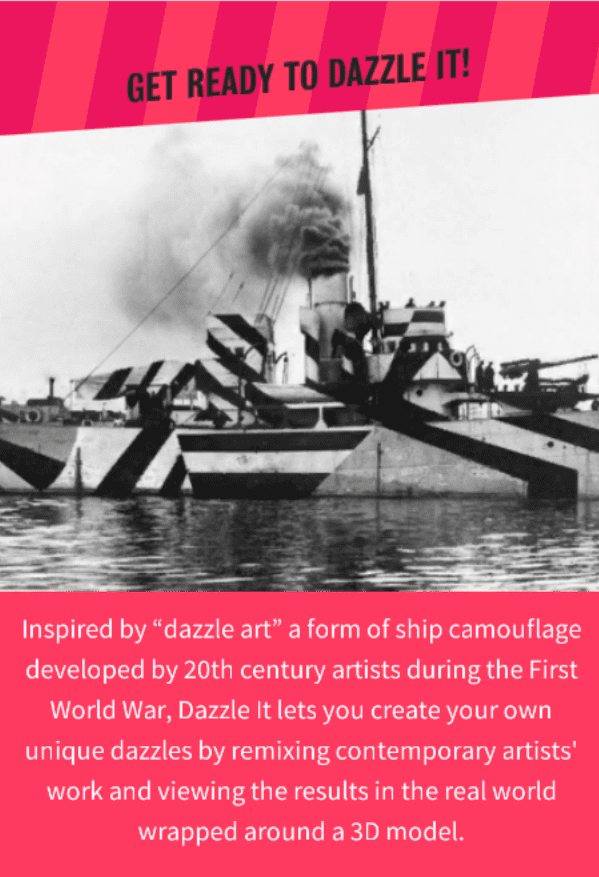
You may be wondering why we’re covering a mobile device app inspired by and featuring the recent work of Sir Peter Blake, celebrated pop artist. Well, it all has to do with a bit of history in the application of camouflage.

320px-USS_West_Mahomet_(ID-3681)_cropped

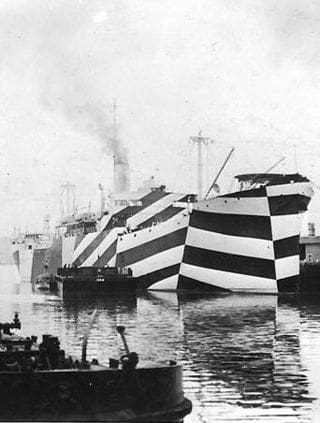
This is an image of the USS West Mahomet, painted in Dazzle camouflage, which involves complex patterns of geometric shapes in contrasting colors, interrupting and intersecting each other. It was used by the British and United States principally during WWI, and was designed to make it difficult for enemy vessels to estimate a ship’s range, speed, and heading.

IMG_4130

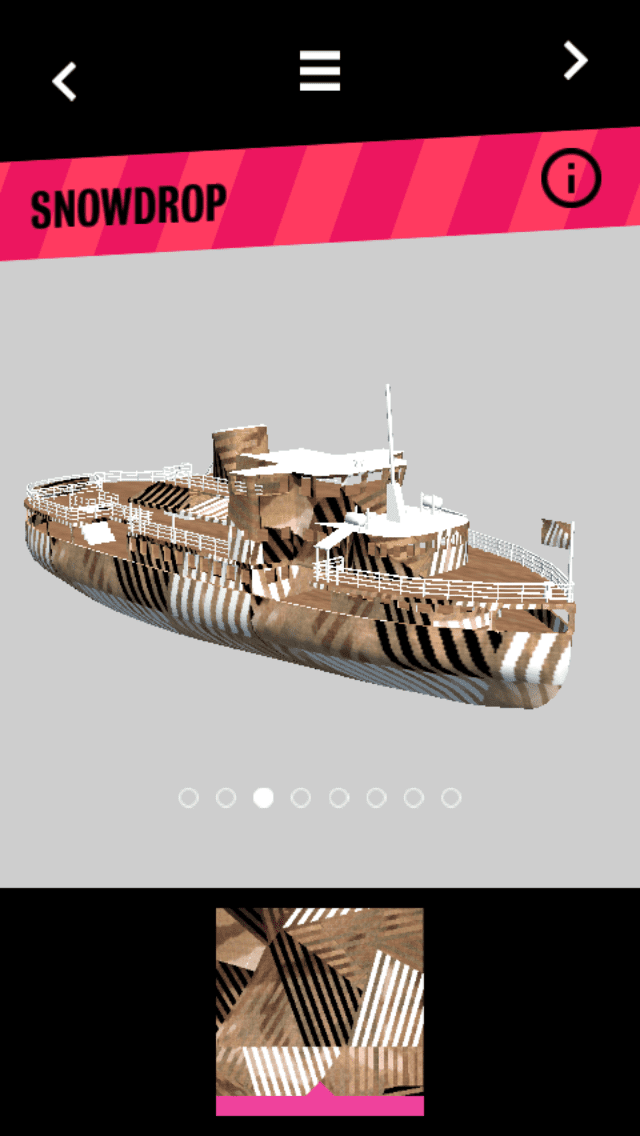
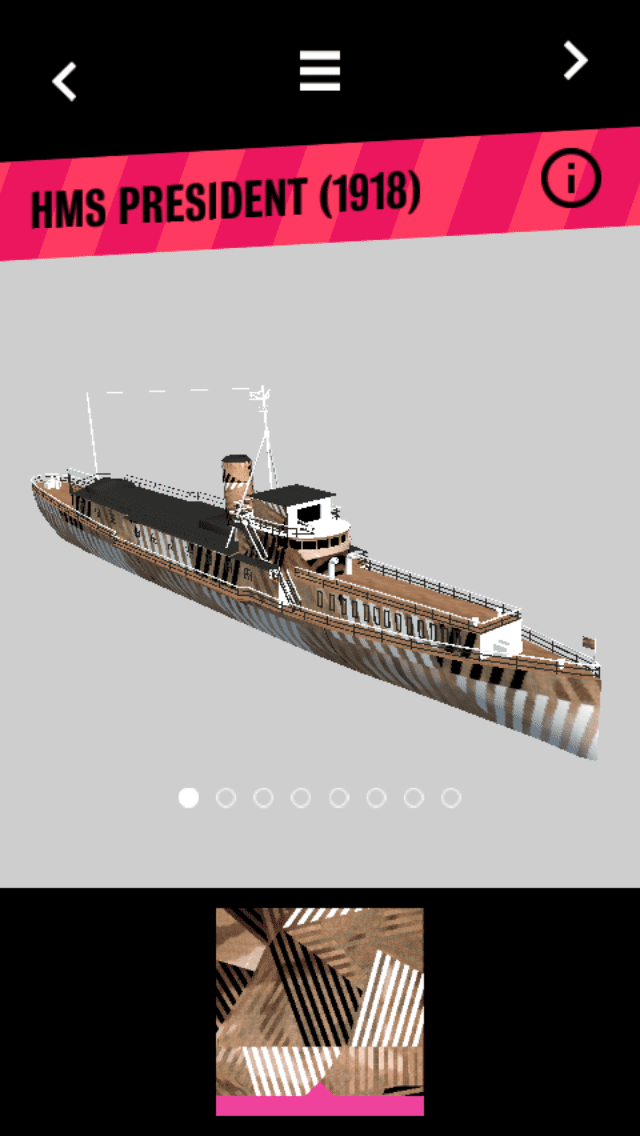
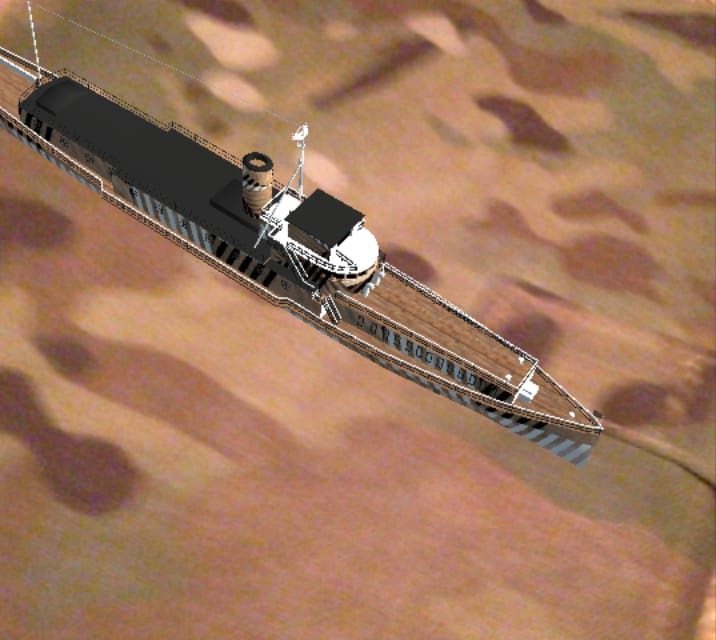
The Dazzle It app allows users to ‘Dazzle’ any image available on their phone, or taken by their camera, by putting it through any one of various filters. This new camouflage pattern can then be applied to a variety of virtual ships and other watercraft which displays as a 3D model. As you can see in the images, we decided to go a bit more contemporary, utilizing a MultiCam base and putting it through a ‘Kaleidoscope’ pattern.

We then applied this pattern to various ships, including the HMS President.

FullSizeRender

There’s even an augmented reality aspect of the app, which allows you to anchor the ship of your choosing to a live background. We found this to be a little wonky in practice, but that might have something to do with trying to place a camouflaged ship on a camouflage background.

The Dazzle It app is available through both iTunes and the Google Play store for free.

itunes.apple.com/us/app/dazzle-it/id1022780620

play.google.com/store/apps/details?id=co.uk.corporationpop.dazzleships

I Feel Cheated

Saturday, August 22nd, 2015


This would have been so cool, but imagine the mid-air collisions.

Who Remembers This?

Thursday, August 13th, 2015

SMLM

Click to view .pdf

The Baldwin Articles – Buttpacks

Saturday, July 25th, 2015

Special Forces Veteran Terry Baldwin is continuing his series on the history of US Military equipment with the field pack, more commonly known as the buttpack.

P1010002

I’m sure most everyone knows that the US Military once developed and issued load carrying accessories officially called Field Packs. “Buttpacks” is the more familiar nickname they immediately acquired. Here are some additional facts. Field Packs attach to the USGI web belt with slide keepers. There is no such thing as ALICE Clips. Slide Keepers were first fielded with the M1956 Load Carrying Equipment (LCE) which included the M1956 Field Pack. That was 18 years before ALICE. Buttpacks work best with H-harnesses and were never meant to interface with the ALICE Y-shaped Individual Equipment Belt Suspenders. No buttpack was ever a component of ALICE. The ALICE Medium and Large Rucksacks were intended to completely eliminate the need for buttpacks. And therefore USGI buttpacks were never designed or originally intended to be worn with a rucksack.

In the last months of WW II the US Military fielded the M1945 Field Pack. It replaced the general issue M1928 Haversack and the M1936 Musette Bag that was most widely associated with paratroopers. The M1945 gear delivered some needed improvements but was not well liked by soldiers during the conflict in Korea. Especially the pack. Which led to the development of the M1956 LCE. The H-harness that came with that system distributes and stabilizes the soldier’s load much better than its predecessors. The slide keepers kept items like canteens from bouncing the way they had with the earlier wire hanger attachment system. And moving the Field Pack to the rear of the soldier on the belt line better offset the weight of loaded ammunition pouches and frag grenades on the soldier’s front side. While not putting any additional strain on the shoulders as earlier packs had. For all those reasons, the M1956 system and the associated buttpack were very well received.

Some improvements were made in 1961 which included enlarging the Field Pack slightly, incorporating a waterproof collar and extending the pack cover. The grommets on both canvas versions were designed to be used to attach smaller items like the bayonet or wire cutters which still had the wire hanger system. However, since the same items could be attached directly to the belt, this feature was not often utilized. The M1961 version of the buttpack was the most widely produced and most common. There was a nylon version of the M1961 buttpack developed as part of the fielding of the M1967 Improved LCE. The M1967 gear was produced in limited quantities and only intended to replace the M1956 gear for troops being deployed to Vietnam. Some of the features of that system like new 30 round M16 magazine pouches were very popular. And experience with the M1967 gear clearly influenced the designers of the ALICE Load Carriage System some eight years later. So if you were ever issued or bought yourself an issue nylon buttpack it was legit. But it came from remaining stocks of the M1967 gear and not from ALICE.

Strictly speaking, the canvas buttpacks that we are all familiar with should not have been worn much past 1978-79 (four years after ALICE rucksacks were adopted). But it didn’t work out that way. First, the traditional military supply system had a standing Basis of Issue (BOI) of one buttpack per individual. Apparently that was never rescinded and many supply rooms and CIFs kept issuing buttpacks as long as they had serviceable inventory of the item. Second, there was an easy work around to make wearing the buttpack compatible with the ALICE Packs and it was even Army approved. TM 57-220, Technical Training of Parachutists, describes how to rig M1956 and later ALICE LCE to be worn under the parachute and parachute harness. It called for the soldier to unbuckle the pistol belt and adjust the rear of the LCE harness to droop down enough so that it rode comfortably below the body of the parachute. And the same procedure worked just as readily for packs of ALICE Large size or smaller. Note: this technique did not work nearly as well for more elongated packs with padded hip belts like the Lowe designed CFP 90 or the Gregory SPEAR pack. I think it is safe to say that is one of the reasons that those packs were not very popular with the troops at the time.

But clearly the most important reason the buttpack stayed in service so long was that “field soldiers” of all services liked them. A lot. So even after they were no longer being issued local surplus stores and manufacturers stepped up to supply the continuing demand. In the late 80s some components of ALICE like the suspenders and ammo pouches were replaced with the Load Bearing Vest (LBV). But since the LBV was basically an H-Harness design it mated even better with the buttpack than the ALICE Suspenders ever had. So buttpacks remained a fixture on LCEs / LBVs well into the 2000s. Even today, many modern versions of the buttpack are being produced. Although sometimes they are now referred to as waist packs or fanny packs and can be worn separate from LCE if desired.

Along with the fielding of the LBV, something called the Field Pack, Training was also introduced. It was noticeably larger than the earlier buttpacks. Too large in my opinion. Unfortunately that “super sizing” of buttpacks subsequently became something of a trend. With plus sized “Recon Packs” and “Optimized Buttpacks” being produced by various manufacturers. These usually consisted of a main pack that was about the volume of the Training Pack plus two, three or even four extra external pouches. What resulted was a near backpack sized load being mounted low on the soldier’s back. This tends to make the soldier’s LCE or vest uncomfortably unbalanced and rear heavy. It is simply not a good way to carry any substantial weight. Buttpacks were just never meant to be backpacks. In short, if you intend to carry something bulky or heavy then an Assault Pack or 3-Day Pack or even a full sized rucksack would be the better choice than an overloaded buttpack.

The reverse is also true. Some pouches can be too small to be legitimately called buttpacks at all. Or in other words, if it is too tiny the “pack” mounted on your lower back is really just a mid-sized utility pouch. I have two examples of pouches that I have tried that I consider on the borderline. One is LBT’s Mini-Buttpack, and the other was made by HSGI (and to be fair was not intended to be a buttpack). They are just barely big enough to carry what I would consider an appropriate minimum buttpack load of gear: i.e. poncho (emergency shelter), change of socks and some emergency rations. I prefer a little more room so these would not be my first choice but would be better than doing without. I would say that a modern pack with approximately the same volume as the M1961 buttpack would be the Goldilocks solution, not too big and not too small (TAG used to make one that was just about right). But you might decide otherwise.

Of course MOLLE / PALS, body armor and GWOT each added different functional factors to the equation. Buttpacks of any kind, even the smallest that I mentioned, can be a real pain if you are predominately involved in mounted (vehicle based) operations. There isn’t much room inside fighting vehicles and doors and hatches are narrow snag monsters. Achieving the slimmest profile you can manage: front, back and sides is highly desirable if you are working out of vehicles. Buttpacks are just not helpful in that scenario. That is why buttpacks were never, ever popular with tankers. However, if you are primarily doing dismounted operations than a buttpack might be well worth considering for your mission. Not attached directly onto body armor with PALS. That would definitely interfere with any backpack you might be using for extended operations. But if you are utilizing one of the modern H-Harness systems over slick armor than you can adjust the harness as I described above to make it work*. Bottom line: buttpacks will never again be as ubiquitous as they once were but in some cases they are still just right.

*It doesn’t look to me like the issue FLC vest can do that very effectively because of its design but someone can tell me if I am wrong.

Next: Ponchos and shelters.

-LTC Terry Baldwin, US Army (RET) served on active duty from 1975-2011 in various Infantry and Special Forces assignments.