SIG SAUER - Never Settle

Archive for the ‘Robotics’ Category

Robots To Drive Polaris RANGER At DARPA Robotics Challenge

Wednesday, May 6th, 2015

Darpa_1-1

Polaris Industries has announced that their DARPA Polaris RANGER XP 900 EPS and GEM electric vehicles will be featured at the DARPA Robotics Challenge Finals.

Polaris DRC RANGER 01

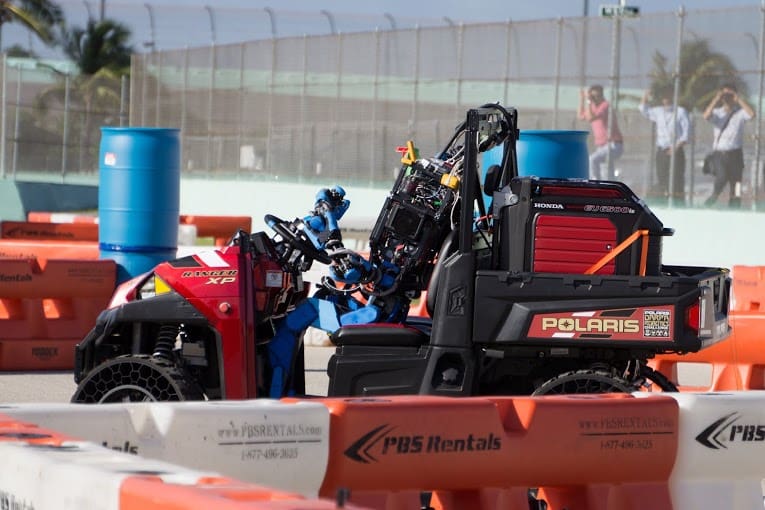
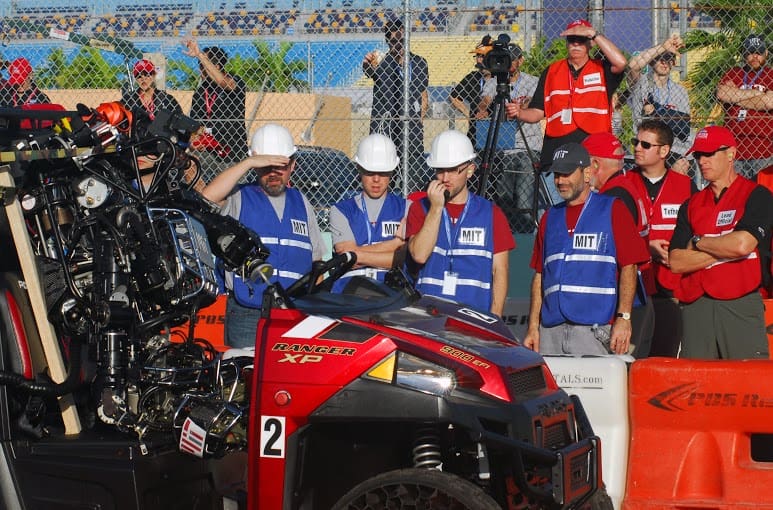
The DARPA Robotics Challenge was created to spur development of robotic tech that can help humans better respond to dangerous conditions and disasters. The Challenge Finals will have robots performing multiple tasks in a continuous course, which will be a simulation of obstacles and challenges that might be encountered in a real disaster situaion. During the Finals, the driving task will require participating robots to drive the RANGER XP 900 EPS on a roadway and weave around obstacles. It will also have to egress the vehicle and attempt to intervene in a mockup disaster site which is too dangerous for humans to perform tasks.

Polaris DRC RANGER 03

“We are excited to continue our relationship with DARPA after the successful DRC Trials in 2013,” said Rich Haddad, general manager of Polaris Defense. “Off-road vehicles are some of the most useful vehicles in disaster relief, and our specialized RANGER vehicles were built to accommodate the robots and provide mobility for the driving task. In the future, the versatility of the RANGER platform would allow a robot to transport tools, equipment, supplies and power around a disaster site, while traversing the difficult terrain often found in disaster situations.”

Polaris DRC RANGER 04

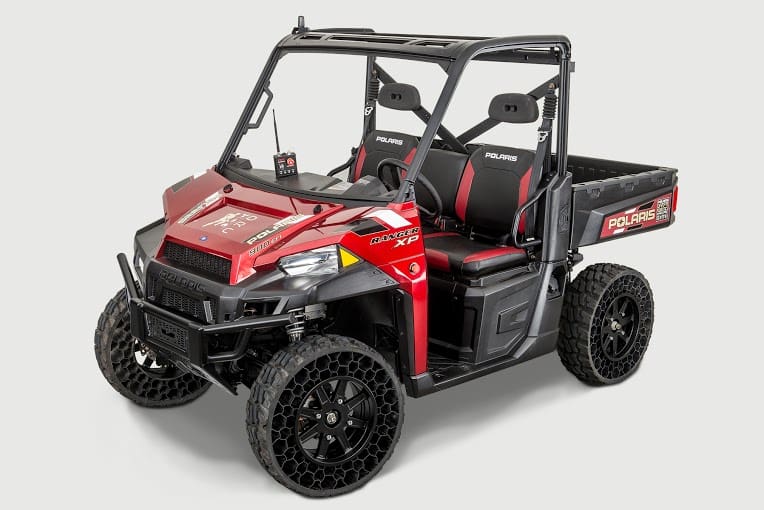
The DARPA RANGER XP 900 EPS was specially customized for the event, featuring a remote SafeStop electronic throttle kill, brake actuation tehcnology, and a 1000lb capacity bed for the robot’s power supply. The cab features a bench seat, and tilt steering for ample room for robots to operate the vehicle. The vehicles also have TERRAINARMOR airless tires for maneuvering in diverse terrains without the risk of a flat tire.

In addition to the RANGER XP 900 EPS, Polaris GEM vehicles will also be in use at the Finals. They will be used to transport the robots after completion of their tasks, as well as working as VIP shuttles, and transporting goods and people throughout the campus.

The DARPA Robotics Challenge Finals will be held on June 5-6, at the Fairplex in Pomona, California.

www.polaris.com/en-us/home

Darley Defense Days – Helical Robotics

Wednesday, June 4th, 2014

20140604-153005.jpg

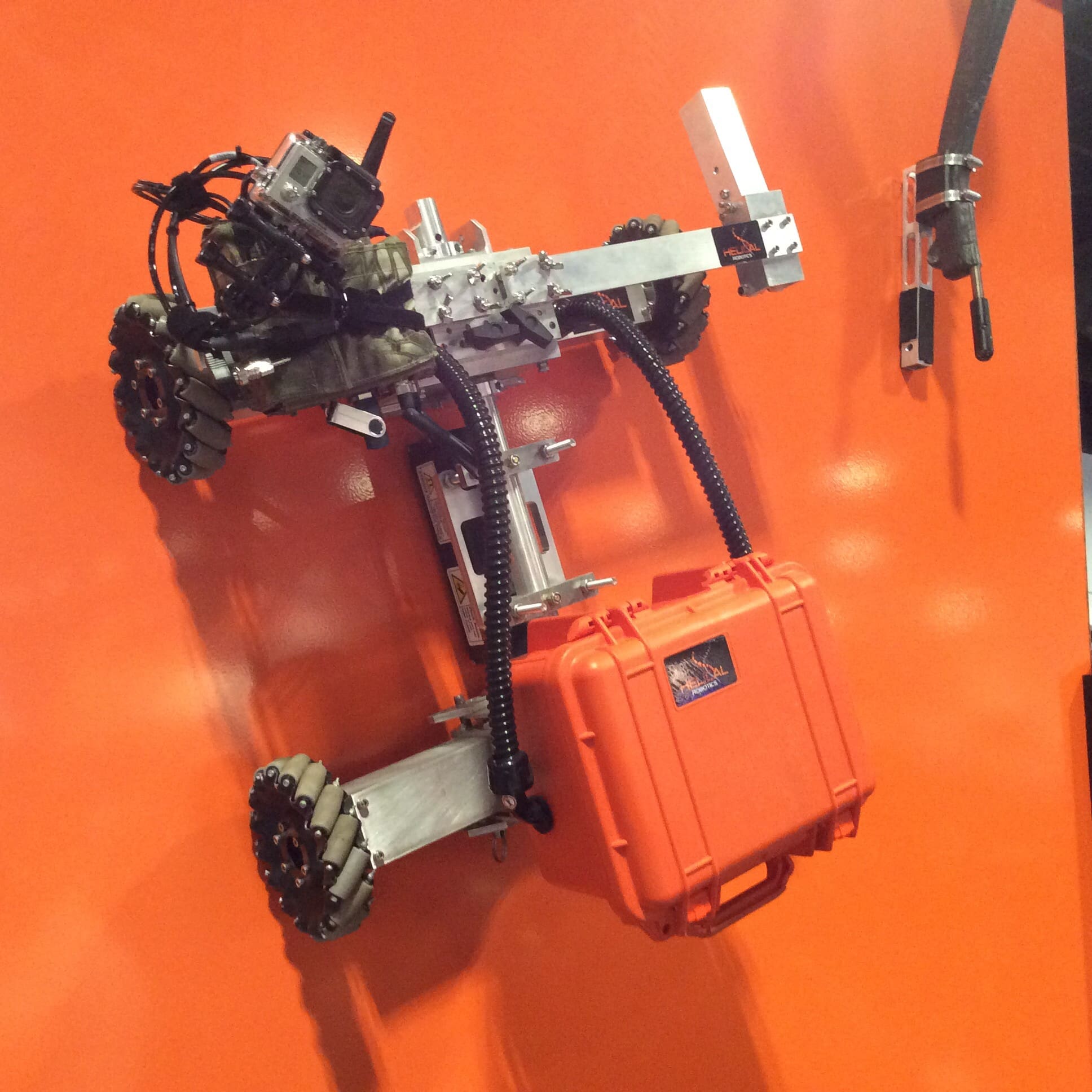
Helical Robotics was on hand to demonstrate their line of MP Series Magnetic Platform robots. Designed for operations in difficult, dangerous, or hard to reach places, MP robots utilize rare earth magnets that are positioned as such they will adhere to metallic surfaces without making direct contact. Their design allows for vertical travel, and the robots can be outfitted with cameras, sensors, and other observational equipment.

20140604-153024.jpg

The unique mecanum wheels consist of 45 degree angled treads that allow the robots not only to more forwards and backwards, but side-to-side as well. Their operation is fully wireless which allows for an expanded work environment.

20140604-153041.jpg

Multiple model MPs exist, from small sized observation models, to larger models designed to carry up to a 100 lb. / 45 kg payload.

www.helicalrobotics.com

SOFIC 2014 – ADS Inc / HDT Global Robotics – Protector

Wednesday, May 28th, 2014

20140527-182325.jpg

The Protector from HDT Global Robotics is a small unmanned ground vehicle that performs a wide variety of tasks.

20140527-182951.jpg

The Protector gives a small unit a great deal of organic rough terrain carrying capacity as well engineering support. It can be configured as Backhoe/Loader, Flail/Roller/Rake, weapon carrier with CROWS or as a mortar carrier, and as a logistics carrier. Additionally, it can offer support CASEVAC, ISR systems or comms relay.

20140527-183049.jpg

The tracked Protector can carry 1,250 pounds of gear and is <3' wide. It features a 32 horsepower turbo diesel/JP8 engine with 2kw of power available to users. The Protector is available for agency and unit purchase through ADS Inc.

MDM -MCWL

Wednesday, September 26th, 2012

20120926-092648.jpg

Legged Squad Support System is sponsored by DARPA and manufactured by Boston Dynamics. MCWL will begin to conduct a series of Limited Technical Assessments later this year to begin to learn more about how this technology works with the Squad. This model weighs about 1200 lbs and carries 400 lbs. It’s also smarter and quieter than previous technologies.

20120926-093201.jpg

The real win here is the Tactical Robotics Controller. Finally, there’s a common, government defined architecture that will control all tactical ground and some small unit air vehicles. Since the interfaces are nonproprietary, there will be one controller and all robotics vendors will build to this standard. The project has been so successful that both the Army and Marine Corps are teaming up to produce a CDD to turn this into a program of record.

The benefits are huge. TRC lowers cost, streamlines training and logistics and offers increased utility. For example, if a ground robot’s controller goes down, any other TRC can be used to take over.

Future developments include dual screens to allow the simultaneous control of two robots.

ARA Robotics Solutions – Nighthawk Mini UAV

Wednesday, September 12th, 2012

SSD would like to thank Weapon Outfitters LLC for sharing this report on the Nighthawk UAV with us from the recent NTOA conference in Seattle.

In the last ten years, Unmanned Aerial Vehicle (UAV) technology has grown exponentially as technology has taken a leap forward to meet the needs of service men and women in the war on terror.

Information lag used to span days and minutes, as well as down organizational hierarchies… but modern technology has increasingly shortened the lag of gathering of information to delivering that information to the folks on the ground.

The ARA Robotics Solutions Nighthawk is an extremely intuitive and user friendly mini UAV that can support operations at the lowest levels: no need to call up to command to ask for assistance to see what’s right beyond the hill with the Nighthawk.

One of the first things you notice about the the Nighthawk Mini UAV is its impressive, all carbon fiber construction. The fuselage, wings, and “cargo bay” which stores the optical and optional thermal camera are all made of carbon fiber. Known for its lightweight and durability, carbon fiber is an ideal material for this application, and handling the demo Nighthawk, it was clear ARA was quite skilled with this sometimes finicky medium. Impressively, the carbon fiber wings of the Nighthawk are easily wrapped around the fuselage for storage and quick deployment, and can also be easily installed or removed with just two pins, and the payload selection.

A complete system with two Nighthawks, control units, support materials, carry pack for field use, and hard case for transport is estimated to be around $125K. Each Nighthawk is estimated to cost around $25 to $35K depending on imaging payload, as the thermal imaging unit is worth $12K by itself! Adding to the cost are the live video and data transmission hardware, as well as the $6K for a COTS autopilot system. Though a $6K autopilot may seem expensive, as anyone with RC airplane experience will tell you, crashing is very, very easy and can be very expensive considering the electronic payloads the Nighthawk is designed to carry.

Designed with user friendliness in mind, the Nighthawk’s COTS autopilot system that eliminates the need for users to have anything other than a basic understanding of flight. Users just have to launch the unit, and can then control the unit by plotting coordinates on a map, or controlling the Nighthawk with a video game-like interface. With programmed automatic landing, map based “point and click” navigation, failsafe responses to loss of communication or GPS, and other traditionally vexing problems for novice pilots, the autopilot system truly takes out all the hard work from controlling what amounts to a miniature aircraft.

For a guy in the field who jobs and hobbies have nothing to do with RC aircraft piloting, the well designed and complete system offered by ARA Systems looks to be a useful tool for safe reconnaissance.

The Nighthawk has been purchased and fielded extensively by the military, but suffers from FAA regulation in domestic operations by police departments. Though rules have loosened somewhat in the last few weeks, there is still a byzantine layer of red tape which must be navigated by law enforcement agencies to use this unit stateside. Some larger departments are using this system though, so don’t hesitate to give it a shot!

Quick Facts

-Each Nighthawk UAV weighs roughly 2 pounds
-Extensive carbon fiber use for strength and weight
-Modular design allowing for easy reconfiguration, repair, and storage
-10 KM range
-60 minute run time in Lithium Polymer Batteries
-18-30 knots cruise speed
-Built in autopilot system for easy navigation and/or piloting
-Live relay of day time and/or thermal optic capability

-Roy

Weapon Outfitters LLC
www.weaponoutfitters.com
www.facebook.com/weaponoutfitters

Disruptive Tech – 3D Printed Exoskeleton

Tuesday, August 21st, 2012

Here’s another story about those pesky 3D printers and the possibilities they represent.

www.stratasys.com

Emma was born with a congenital condition known as arthrogryposis multiplex congenita (AMC). It leaves her unable to control her arms. Her mother found out about the Wilmington Robotic Exoskeleton (WREX), an assistive device made of hinged metal bars and resistance bands.

WREX is designed for use in conjunction with a wheel chair so designers had to scale the system down for the tyke Emma. Tariq Rahman, Ph.D, head of pediatric engineering and research, and Whitney Sample, research designer, both from Nemours/Alfred I. duPont Hospital for Children in Wilmington, Delaware set to work and were able to adapt the dimensions for her use. Additionally, the design can be refitted with larger and larger components as Emma grows. Not only are the current components produced on a 3-dimensional printed but future parts will as well. From all accounts, Emma’s life has been immeasurably improved by this technology. Already, other children are receiving customized variants of WREX.

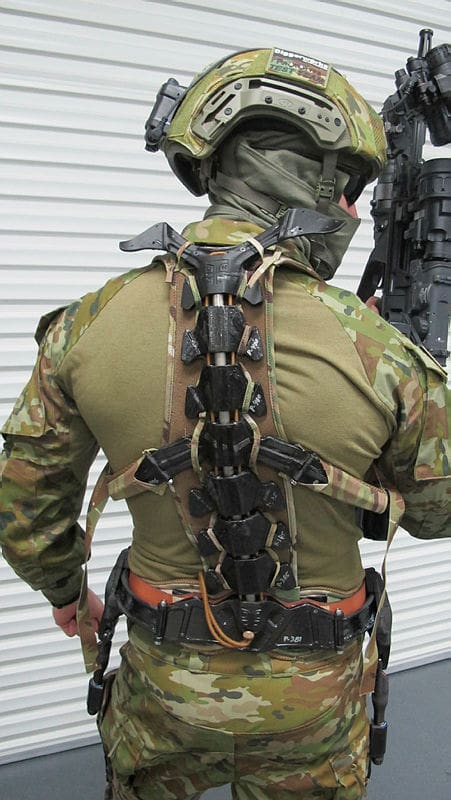
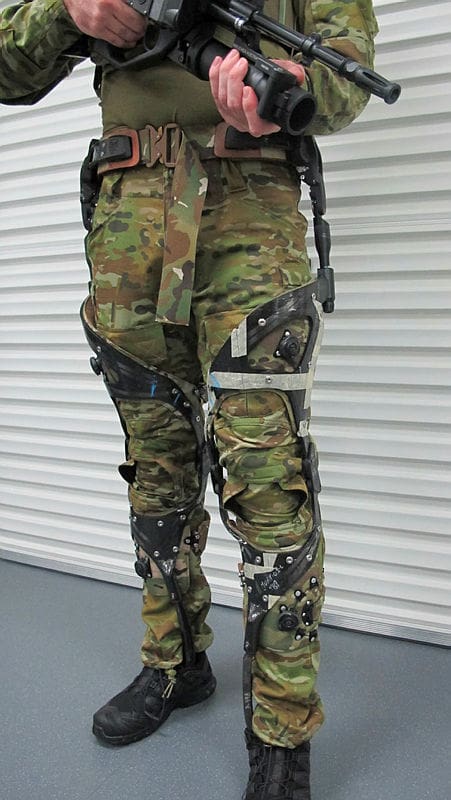
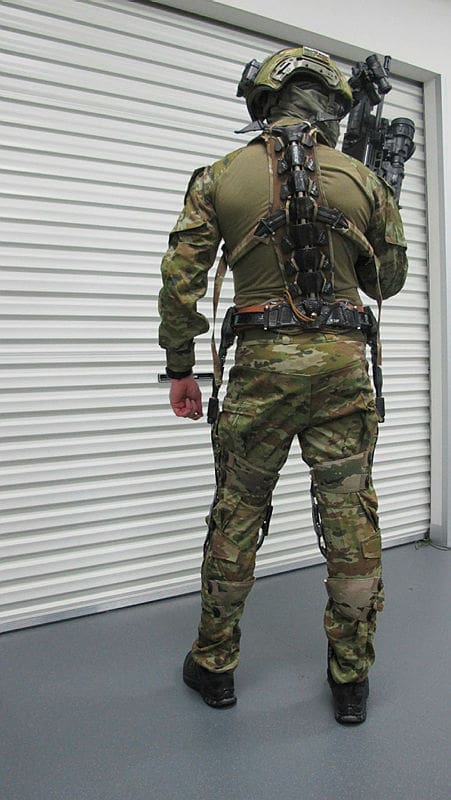
This story affects our community on so many levels. First, there is the medical aspect. We have plenty of troops who have muscular and skeletal injuries. The lower profile, and the cheaper we can produce these robotic assistance devices the better. Second, is the robotics issue. technologies such as this may actually leap ahead of current military programs. And finally, we have the 3D printer phenomenon. The technology is becoming more powerful, more common and less expensive. It is going to drastically change how we interact with technology in the future. Stories like this should inspire us to apply these capabilities to our own community.

Army Places Order For iRobot Unmanned Ground Vehicles

Monday, July 2nd, 2012

Early last month, iRobot Corp received a $12.7 million order from Army Contracting Command for 68 model 310 SUGV robots and spares kits with the delivery completed by next month. This is the second order under a IDIQ contract that is valid through September 2015. So far, the Army has taken delivery of 138 robots and spares kits. IDIQ contracts can be tricky with lofty ceilings and actual orders turning out to be a fraction of the full value. Literally, this is an off-the-shelf purchase and it’s a testament to iRobot’s confidence in this system to deliver so quickly. These are complicated systems and you don’t let them sit on the shelf if they aren’t going to sell.

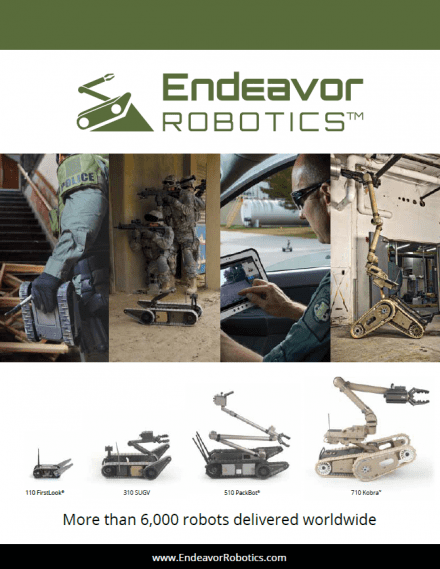
Many are familiar with the model 510 Packbot used by EOD. The 310 is slightly smaller and fits in a MOLLE pack.

It runs for up to 6 hours using 2 x BB-2590/U batteries (or 1.5 hours with 2 BB-2557/U batteries). The 4 built-in cameras include 1 with 40x zoom and IR and white light illumination for low-light and no-light operations. It also features a dextrous arm that is controlled by a standard Xbox 360 controller making training easy for many operators.

Overall, iRobot has delivered over 4,500 UGVs woldwide including over 600 of the 310 model.

iRobot products are available to units and agencies who are not covered under this IDIQ contract through ADS Inc.

www.ADSinc.com/iRobot

Novatiq Scorp Available From SPECOPS.PL

Thursday, February 16th, 2012

Swiss firm Navatiq has developed a new compact Unmanned Ground Vehicle called the Scorp which can pull double duty as a recce as well as EOD asset. It is a lightweight (~2.5 kg), throwable bot that boasts day/night 360° omnidirectional panoramic vision via 4 cameras mounted 1 per side. As you can see from the photo below, it also incorporates a built in microphone as well as Picatinny rails to mount additional accessories or sensors. Planned enhancements include biochemical detector, disruptor, encryption, manipulator with pincer, autonomous navigation, firing explosive charges, thermal imaging, etc.

The tracked Scorp also features articulating flipper arms to right itself in the event of a tumble or to aid in climbing. The control unit offers full recording capability as well as a range of 500 meters outdoors (line of sight) and 100 meters indoors (line of sight). Additionally, by utilizing alternative frequencies you can operate up to four robots within the same zone.

The Scorp is now available from the Polish form SPECOPS.