Phantom Lights

Archive for the ‘Robotics’ Category

DSEI 2019: General Robotics Ltd. Showcases the Next Generation of the Pitbull-3 Anti-Drone Remote Weapon Station and the DOGO – Anti-Terror & Crime Robot

Wednesday, September 4th, 2019

The systems come with a new faster and more accurate Point & Shoot technology, and are already operational

DSEI 2019, September 10-13, London, Israel Pavilion, Stand S5-220

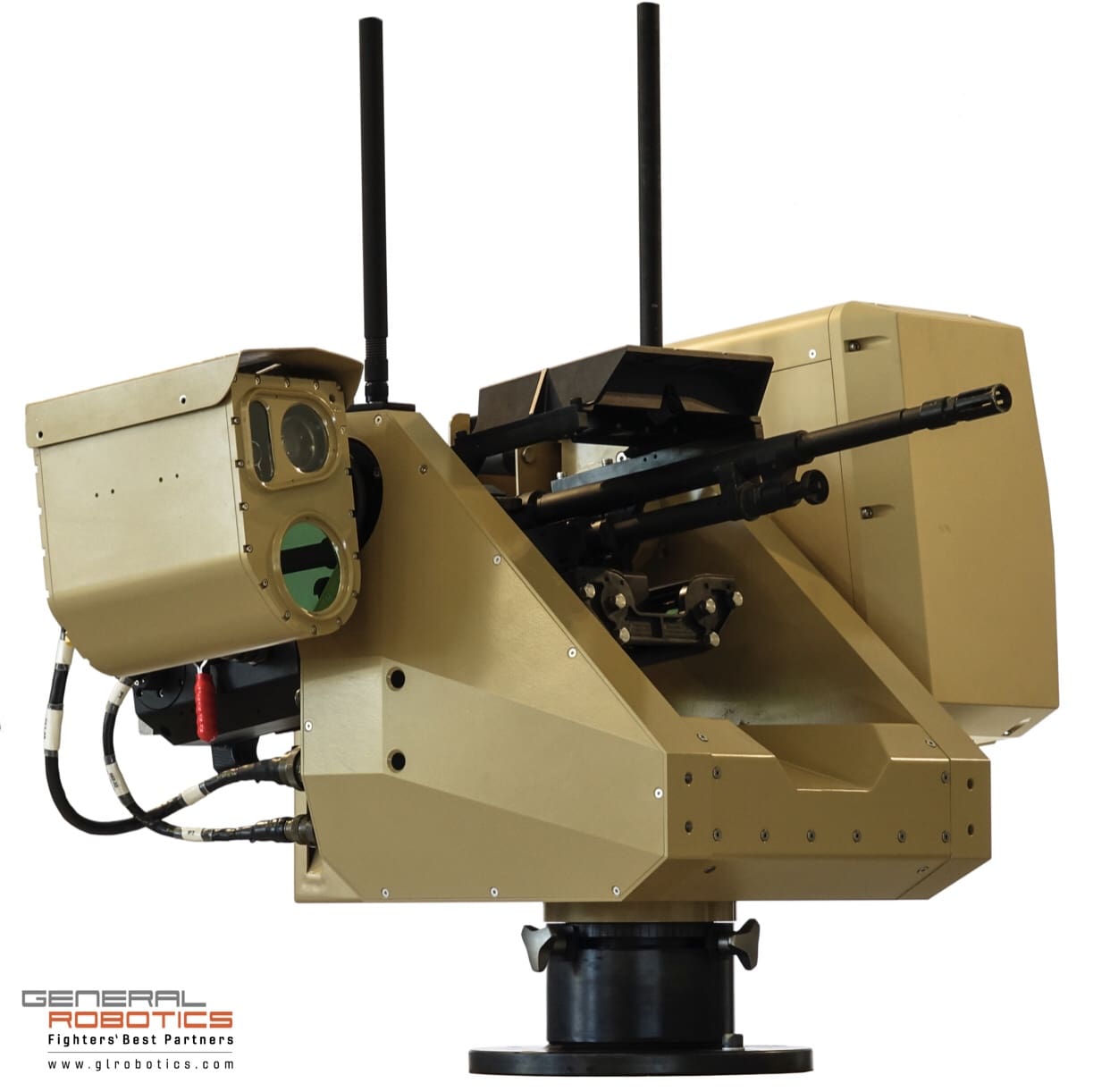
2 September 2019. General Robotics Ltd., – a company specializing in developing, manufacturing and marketing advanced robotic systems for defense and homeland security applications – will reveal, for the first time at DSEI 2019, the new anti-drone remote controlled weapon station with its latest features.

The Pitbull-3 is an ultra-lightweight RCWS that delivers Point & Shoot technology, is highly accurate and highly reliable, and provides an ideal solution for detecting and tracking all types of drones during flight, enabling their neutralization and downing.

Weighing only 70 kg, the Pitbull-3 anti-drone station provides a complete solution in one compact and mobile system that can be easily installed on any manned or unmanned ground, air or maritime platform, including ultralight vehicles such as ATVs, and fixed stations.

“While hard-kill solutions are inevitably needed to stop advanced drones and drone swarms, there is a strong focus on soft-kill capabilities. Pitbull-3 enables both.” says Shahar Gal, CEO of General Robotics Ltd.

The system’s complete solution against drones enables three key courses of action to be taken:

•       Detection of drones by different kinds of radar integrated within the system, with a drone detection range of up to 5 km.

•       A soft-kill via an integrated jammer which can induce simultaneous disruption of all drones’ communication frequencies – command, video and GPS – thereby forcing the drone to stop, land or return to base.

•         A hard-kill whereby an advanced prediction algorithm enables moving drones to be shot down from 500 meters, and hovering drones from 800 meters.

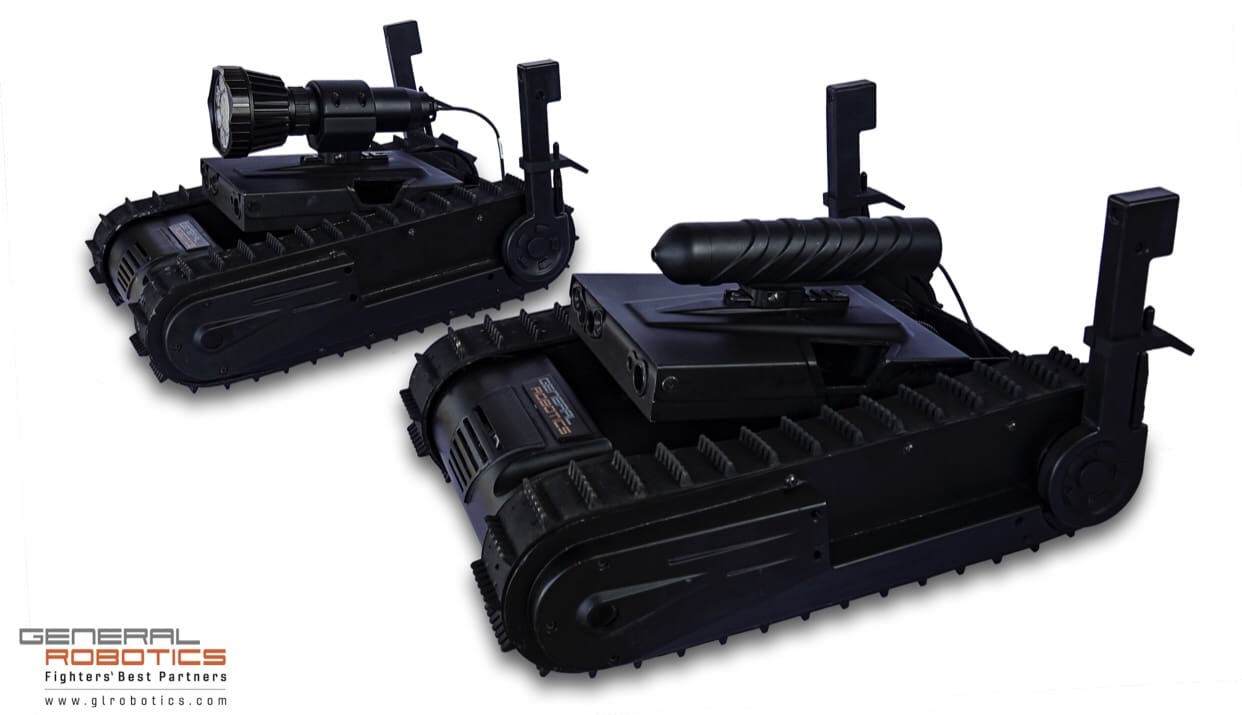
In addition to Pitbull, at DSEI, the company will also present the new, DOGO Mark II anti-terror robot with its latest capabilities, which include faster Point & Shoot™ interface, enabling accurate designation of lethal or non-lethal means simply by clicking on the screen; non-lethal pepper spray and non-lethal dazzling light module attachments; and front extenders, for overcoming various obstacles.

Weighing just 11 kg, DOGO is in use by special forces, SWAT teams and infantry around the world. Standard pistols can be quickly attached to the robot and easily operated via Point & Shoot™ technology. DOGO can also be integrated with non-lethal modules. The robot includes eight video cameras that provide 360° live video and boresight views and can communicate in hostage situations. The DOGO is being sent into fatal funnels to provide situational awareness and remote engagement capabilities to increase the survivability of the fighting forces.

www.glrobotics.com

Army Futures Teaming with Industry on Advanced Robotics, Sensors

Tuesday, August 20th, 2019

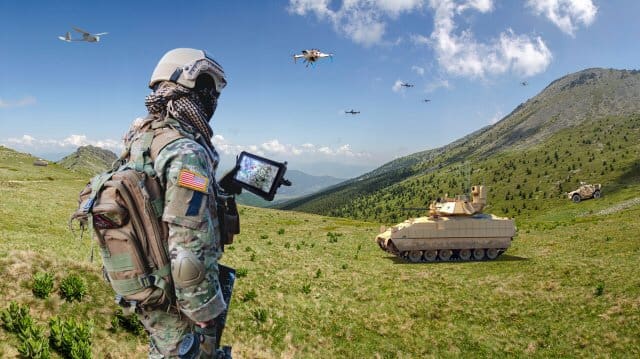
ABERDEEN PROVING GROUND, Md. — Army Futures Command is soliciting industry for information on emerging technologies in robotics and sensors to enhance the targeting capabilities of Army small tactical units.

Researchers are in the initial stages of the Smart Targeting Environment for Lower Level Assets, or STELLA, program that will enable Soldiers to operationalize robotics to rapidly employ, build and share target data in multi-domain operations. The goal is to shorten the amount of time it takes for Soldiers to detect, acquire and identify a target before they engage the enemy.

AFC’s major subordinate command, the Combat Capabilities Development Command, or CCDC, is leading the effort and will issue a request for information, or RFI, in August 2019. The RFI will help the Army to gauge current capabilities, ongoing research and development, and emerging trends.

“We’re developing an efficient system so there is a Soldier in the loop making a decision much more quickly on what needs to be engaged. The future battlefield will include a large number of sensors detecting targets and high-value assets. With higher volumes on information, we need to ensure the Soldier isn’t overwhelmed,” said Osie David, a chief engineer within CCDC’s center for Command, Control, Communications, Computers, Cyber, Intelligence, Surveillance and Reconnaissance — or C5ISR.

Several areas of science and technology expertise will converge for the STELLA program, Osie said. C5ISR Center will use the findings from the RFI to inform future efforts in support of the Army’s manned-unmanned teaming concept.

C5ISR Center anticipates releasing a request for proposal, or RFP, in early 2020. The STELLA program is scheduled to begin in fall 2020.

Story by Dan Lafontaine, CCDC C5ISR Center Public Affairs

Graphic illustration by Jamie Lear, CCDC C5ISR Center

Liberty Dynamic, ReconRobotics to Integrate Flash-Bang with Throwable Robot

Wednesday, August 14th, 2019

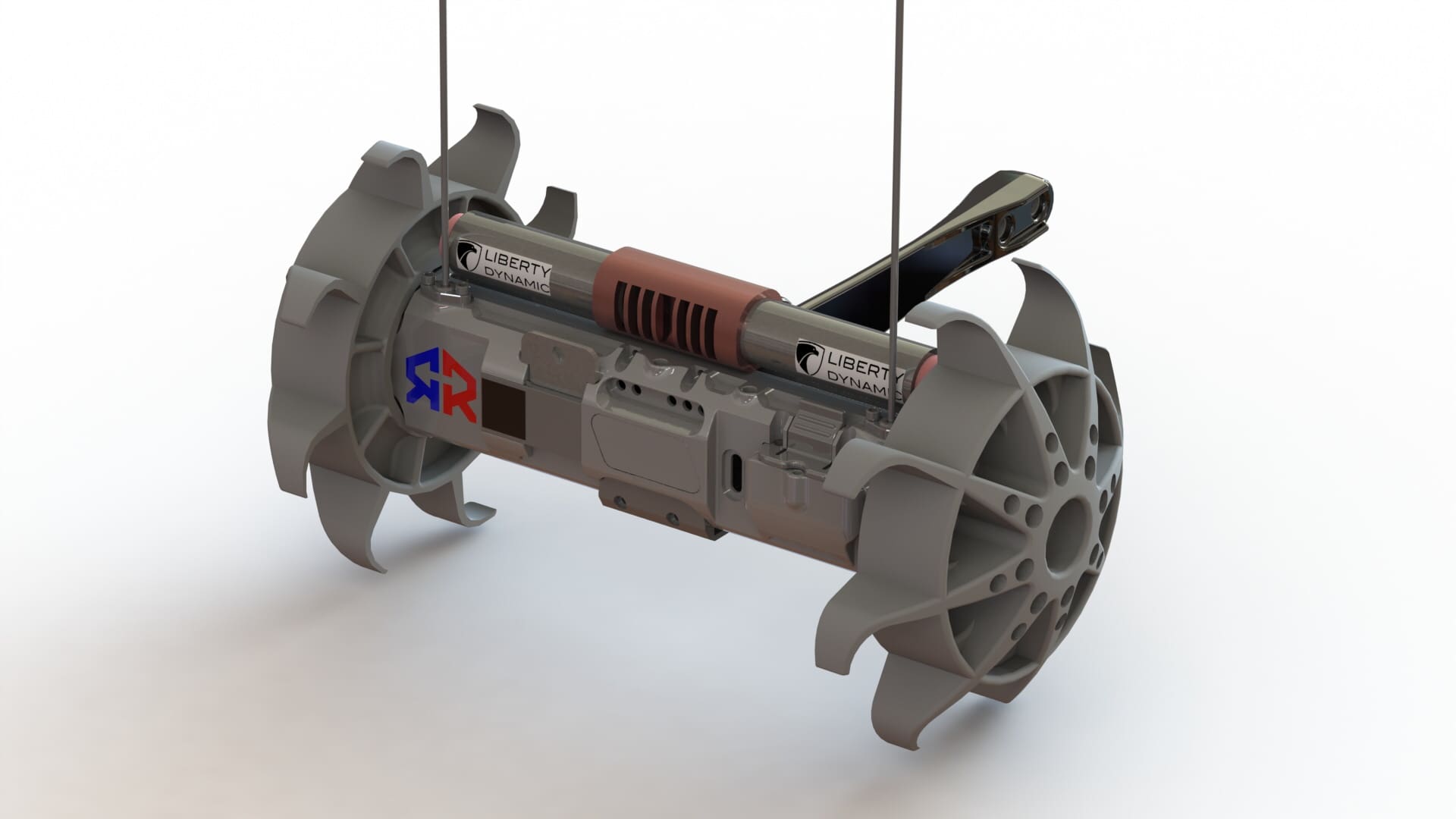
Digital, reusable Enhanced Diversionary Device will give added “kick” to Throwbot 2® robot

COLORADO SPRINGS, Colo.—August 13, 2019—Liberty Dynamic announced today that it will begin collaborating with ReconRobotics, Inc., on adapting the robotic company’s tiny, tactical Throwbot 2® robot so that it includes an Enhanced Diversionary Device.

By having the robot blended with a flash-bang, military and law enforcement users (hostage rescue, special reaction and SWAT teams) save precious seconds before detonation as well as benefit from real-time intelligence.  

“It’s all about giving operators tactical advantage,” said John Chapman, CEO of Liberty Dynamic. 

First unveiled this past January, the Enhanced Diversionary Device is a reusable, microprocessor-controlled flash-bang designed to be safer and more economical than the standard stun grenades currently used by police officers and military personnel.

“Legacy flash-bangs are supposed to be safe,” Chapman said, “but their chemical detonators can sometimes ‘cook off’ too early. They can also cause fires and secondary fragmentation because they burn very hot and explode on the ground.”

By contrast, the Enhanced Diversionary Device has a digital fuse for precise, programmable detonation, and it fires its special binary load into free space. As a result, there is a loud and blinding airburst, but the device doesn’t kick up secondary debris from the floor.

“This has made the Enhanced Diversionary Device very attractive for law enforcement and special operators as well as other platform-makers,” Chapman said.

One such platform company is ReconRobotics.   

ReconRobotics is the developer of the Throwbot 2®, a super-lightweight (1.3lbs) yet rugged (30-foot drop height) robot that can be tossed over walls and into rooms—allowing operators to surreptitiously surveil an area without exposing themselves to hostile fire.

Founded in 2005, the robot company has seen its products used by various local and federal law enforcement agencies as well as by the U.S. and allied military forces.

“That’s why we are so excited by the idea of working with Liberty Dynamic,” said Mack Traynor, CEO for ReconRobotics. “The partnership demonstrates our commitment to continue to develop products that protect personnel from hidden threats, enhance mission planning and execution and minimize collateral damage for our users.”

For more information about Liberty Dynamic, come by our booth (#605) at the upcoming National Tactical Officers Association’s law enforcement conference, held on August 18-23, at the Orange County Convention Center in Orlando, Florida.

Or visit our website at www.libertydynamic.com.

US Army Experiments With Robotic Combat Vehicles

Thursday, July 18th, 2019

Soldiers to operate armed robotic vehicles from upgraded Bradleys

AUSTIN, Texas — Soldiers are slated to fire at targets next year using a platoon of robotic combat vehicles they will control from the back of modified Bradley Fighting Vehicles.

The monthlong operational test is scheduled to begin in March at Fort Carson, Colorado, and will provide input to the Combat Capabilities Development Command’s Ground Vehicle Systems Center on where to go next with autonomous vehicles.

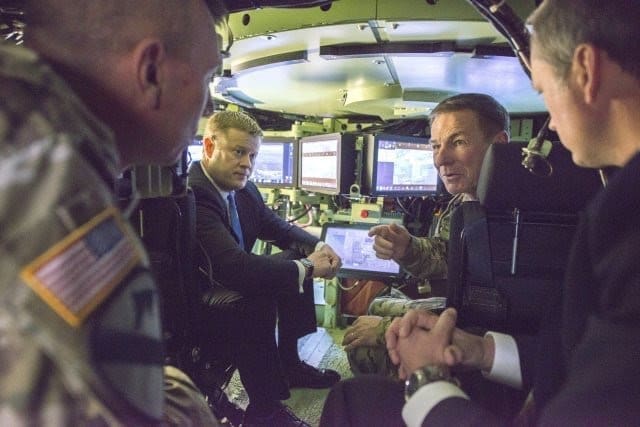
The upgraded Bradleys, called Mission Enabler Technologies-Demonstrators, or MET-Ds, have cutting-edge features such as a remote turret for the 25 mm main gun, 360-degree situational awareness cameras and enhanced crew stations with touchscreens.
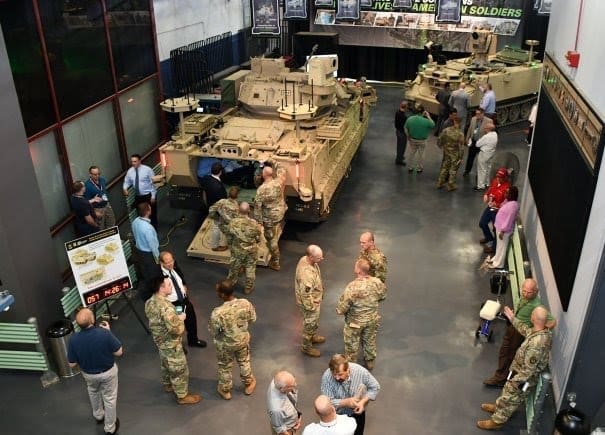
Initial testing will include two MET-Ds and four robotic combat vehicles on M113 surrogate platforms. Each MET-D will have a driver and gunner as well as four Soldiers in its rear, who will conduct platoon-level maneuvers with two surrogate vehicles that fire 7.62 mm machine guns.

“We’ve never had Soldiers operate MET-Ds before,” said David Centeno Jr., chief of the center’s Emerging Capabilities Office. “We’re asking them to utilize the vehicles in a way that’s never been done before.”

After the tests, the center and Next-Generation Combat Vehicle Cross-Functional Team, both part of Army Futures Command, will then use Soldier feedback to improve the vehicles for future test phases.

“You learn a lot,” Centeno said at the International Armored Vehicles USA conference on June 26. “You learn how they use it. They may end up using it in ways we never even thought of.”

The vehicles are experimental prototypes and are not meant to be fielded, but could influence other programs of record by demonstrating technology derived from ongoing development efforts.

“This technology is not only to remain in the RCV portfolio, but also legacy efforts as well,” said Maj. Cory Wallace, robotic combat vehicle lead for the NGCV CFT.
One goal for the autonomous vehicles is to discover how to penetrate an adversary’s anti-access/aerial denial capabilities without putting Soldiers in danger.

The vehicles, Centeno said, will eventually have third-generation forward-looking infrared kits with a target range of at least 14 kilometers.

“You’re exposing forces to enemy fire, whether that be artillery, direct fire,” he said. “So, we have to find ways to penetrate that bubble, attrit their systems and allow for freedom of air and ground maneuver. These platforms buy us some of that, by giving us standoff.”

PHASE II, III

In late fiscal year 2021, Soldiers will again play a role in Phase II testing as the vehicles conduct company-level maneuvers.

This time, experiments are slated to incorporate six MET-Ds and the same four M113 surrogates, in addition to four light and four medium surrogate robotic combat vehicles, which industry will provide.

Before these tests, a light infantry unit plans to experiment with the RCV light surrogate vehicles in Eastern Europe next May.

“The intent of this is to see how an RCV light integrates into a light infantry formation and performs reconnaissance and security tasks as well as supports dismounted infantry operations,” Wallace said at the conference.

Soldier testing for Phase III is slated to take place mid-fiscal 2023 with the same number of MET-Ds and M113 surrogate vehicles, but will instead have four medium and four heavy purpose-built RCVs.

“This is the first demonstration which we will be out of the surrogate realm and fielding purpose builts,” Wallace said, adding the vehicles will conduct a combined arms breach.

The major said he was impressed with how quickly Soldiers learned to control the RCVs during the Robotic Combined Arms Breach Demonstration in May at the Yakima Training Center in Washington.

“Soldiers have demonstrated an intuitive ability to master controlling RCVs much faster than what we thought,” he said. “The feedback from the Soldiers was that after two days they felt comfortable operating the system.”

There are still ongoing efforts to offload some tasks in operating RVCs to artificial intelligence in order to reduce the cognitive burden on Soldiers.

“This is not how we’re used to fighting,” Centeno said. “We’re asking a lot. We’re putting a lot of sensors, putting a lot of data in the hands of Soldiers. We want to see how that impacts them. We want to see how it degrades or increases their performance.”

The family of RCVs include three variants. Army officials envision the light version to be transportable by rotary wing. The medium variant would be able to fit onto a C-130 aircraft, and the heavy variant would fit onto a C-17 aircraft.

Both future and legacy armored platforms, such as the forthcoming Mobile Protected Firepower “light tank,” could influence the development of the RCV heavy.

With no human operators inside it, the heavy RCV can provide the lethality associated with armored combat vehicles in a much smaller form. Plainly speaking, without a crew, the RCV heavy requires less armor and can dedicate space and power to support modular mission payloads or hybrid electric drive batteries, Wallace said.

Ultimately, the autonomous vehicles will aim to keep Soldiers safe.

“An RCV reduces risk,” Wallace said. “It does so by expanding the geometry of the battlefield so that before the threat makes contact with the first human element, it has to make contact with the robots.

“That, in turn, gives commanders additional space and time to make decisions.”

By Sean Kimmons, Army News Service

US Army Ground Robots to Integrate Persistent Systems Network

Thursday, June 13th, 2019

Wave Relay® MANET to serve as communication network on QinetiQ robot for CRS(I) program of record

For Immediate Release

NEW YORK, New York. – June 12, 2019 – Persistent Systems, LLC (“Persistent”) announced today that it will be supplying its Wave Relay® mobile ad hoc networking technology to the QinetiQ North America (“QNA”) team chosen for the U.S. Army’s Common Robotic System-Individual (CRS(I)) program of record.

CRS(I) is a backpackable robot, less than 25 pounds, that dismount users can carry with sensor suites for viewing and detecting threats, providing greater situational awareness in the field.

In March, QNA won the Indefinite Delivery Indefinite Quantity (IDIQ) contract, valued at up to $164 million. And the company has already begun placing Low Rate Initial Production orders for Persistent’s Wave Relay®-enabling Embedded Module, which will be fitted into each new ground robot.

“We’re excited to, once again, deliver the Wave Relay® MANET to the U.S. Army and help lead the drive towards networking the battlefield,” said Leslie Hulser, Director of Programs for Persistent. “We are also very proud of our partnership with QinetiQ and congratulate them on this award.”

QNA was one of the first members of the Wave Relay® Ecosystem, an industry alliance of unmanned system and sensor companies putting their platforms on a common Wave Relay network—with the ultimate goal of giving the warfighter easy access to every unmanned vehicle, sensor and camera.

The Persistent Systems Embedded Module form-factor is QNA’s MANET radio of choice for CRS(I), providing secure, long-range data communication for the small ground robots.

For information on the Wave Relay® Ecosystem, visit www.persistentsystems.com/ecosystem

US Military Purchases Aquabotix Swarmdriver

Friday, May 31st, 2019

Aquabotix awarded an approximately US$150,000 contract to supply SwarmDiver system, training, and test support.

Sydney, Australia and Virginia and Massachusetts, USA – UUV Aquabotix Ltd (ASX:UUV) (“Aquabotix” or the “Company”) is pleased to announce that it has been awarded an approximately US$150,000 contract for the purchase of its SwarmDiverTM system along with training and test support for the United States Military. This hardware and services sale will enable necessary government evaluation activities for the Military’s consideration of operational use of the product in theatre.


 

This award represents the fourth (4th) order placed by the United States Armed Forces related to the SwarmDiver family of vehicles since the product’s launch in April 2018. Chief Executive Officer of the Company, Whitney Million, “We are proud to have this opportunity to provide our SwarmDiverTM solution once more to the United States Military and are optimistic about related future opportunities. We see this award as being significant for a few reasons. First, the award demonstrates a now solid trend of acquisition activity by the United States Military branches – a trend oftentimes followed by other nation’s navies as products become qualified for use. Additionally, the value of this award is significantly larger than those from the United States Military to Aquabotix in the past. While contract values for providing this type of hardware and services support for evaluation activities are generally small, they represent meaningful and necessary steps to progress commercially developed product to a state of full operational use. These facts leave us anticipating potential future, more sizeable orders from both United States and other navies.”


U.S. Military personnel reviewing the SwarmDiver system during the U.S. Navy’s Advanced Naval Technology Exercise in August 2018.

Rheinmetall’s Autonomous Rescue and Surveillance Vehicles to be Showcased in Canada at CANSEC 2019

Wednesday, May 29th, 2019

Rheinmetall is launching the Rescue model of its Mission Master at CANSEC 2019. The Mission Master is a modular unmanned ground vehicle (UGV) that facilitates recovery of injured troops without compromising the operators’ safety, along with many other dangerous, dirty, and dull (DDD) tasks.

The newly released rescue variant of Rheinmetall’s flagship autonomous vehicle allows for in-field medical intervention. This gives remotely situated soldiers the ability to evacuate casualties over long distances either autonomously or via remote control.

Rescue model: enhancing casualty care effectiveness

In the field, the right equipment can be the difference between life and death for wounded soldiers, since 90% of fatalities occur between the time of trauma and arrival at the combat zone medical facility.

Rheinmetall’s Rescue UGV has all the equipment necessary for a successful evacuation, including two basket stretchers with sliding provisions, head and foot immobilizers, oxygen masks and canisters, a monitor defibrillator, and a hot/cold box. All of these items would be impossible for a medic to carry on foot, but the Mission Master can handle the load with ease.  

Operators can command the Mission Master from near or far using autonomous navigation, reducing the number of personnel needed on the ground. This feature leaves medics free to focus all of their attention on the injured soldier, as opposed to wasting precious time driving back to the extraction point. While transporting a wounded soldier using the UGV’s stretcher, for example, accompanying medics can use the vehicle as a workstation to administer emergency care.

Using the “follow me” function, the UGV can roll alongside other soldiers, who are busy making sure that the surrounding area is safe and secure. In both “follow me” and autonomous navigation modes, the Mission Master significantly relieves cognitive and physical stress, allowing troops to deal with the mission at hand.

Surveillance that saves lives

The Mission Master – Surveillance is designed to carry out observation and reconnaissance. Rheinmetall’s UGV is equipped with long-range EO/IR cameras, a 5-metre telescopic mast, radar, laser rangefinders (LRF), and GPS heading systems for 360-degree surveillance.

As an autonomous vehicle, the Mission Master – Surveillance can minimize the number of troops needed on the ground, while providing timely situational awareness for enhanced security and informed decision-making. Multiple sensors relay real-time data to the integrated Rheinmetall Command and Control Software (RC2S) and Argus soldier system, enabling rapid threat detection during operation in the field.

The UGV can transport much more specialized, high-performance equipment than soldiers can typically carry on their person. As a result, not only does the Mission Master help to significantly reduce the physical load carried by dismounted soldiers, it also enhances the likelihood of mission success.

The integration advantage

Each version of the Mission Master is networked to both the Argus soldier system and RC2S, the Group’s command and control software. This type of integration is a Rheinmetall specialty, and will be proudly on display at this year’s CANSEC tradeshow.

The rugged, ultra-portable Argus soldier system can control the UGV as well as receive data from its many sensors, delivering mission-critical information straight to soldiers’ tactical user interface. It can also send essential reconnaissance and updates to higher echelons of command via the RC2S.

Seeing is believing

Nothing compares to seeing our UGV in person. At this year’s CANSEC exhibition, Rheinmetall will be showcasing the Rescue model at its outdoor booth, and the Surveillance version in its indoor booth. Don’t miss your chance to speak with our experts about the Mission Master and its many advantages!

www.rheinmetall.com

USSOCOM Awards Contract to Sarcos Robotics for Delivery of Full-Body, Autonomously Powered Robotic Exoskeleton

Tuesday, March 19th, 2019

SALT LAKE CITY and BELLEVUE, Wash. – March 18, 2019 – Today, Sarcos Robotics, a global leader in robotic systems that augment, rather than replace humans working in the industrial, public safety and military sectors, announced that it has been awarded a contract by the United States Special Operations Command (USSOCOM) to deliver a pre-production version of its Guardian™ XO® (“XO”) full-body, autonomously powered robotic exoskeleton. The XO is capable of operating for up to eight hours per battery charge, while walking at three miles per hour and carrying up to 200 pounds of payload. With the ability to “hot swap” rechargeable batteries in the field, XO run-time is essentially unlimited.

The USSOCOM XO contract follows Sarcos’ recent announcements regarding collaborations with both the U.S. Air Force and the U.S. Navy to develop and evaluate variations of the Guardian™ XO® for use cases specific to these services. With 17 years of development efforts and more than $175 million invested in R&D, Sarcos has been laser-focused on ensuring the Guardian XO Max is safe, intuitive and power efficient. Sarcos recently shared significant power and performance enhancements to the XO, including significant improvements in power consumption, control system functionality and load transfer.