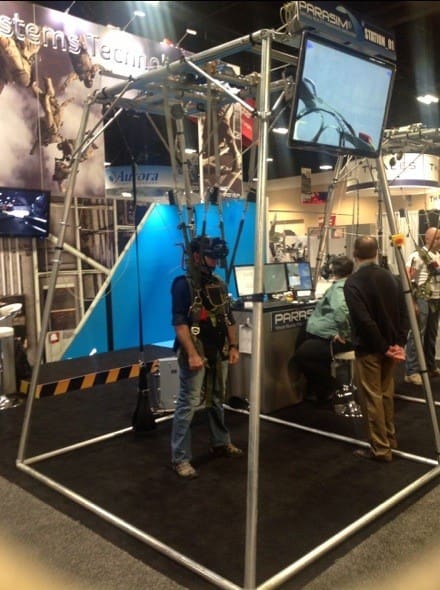
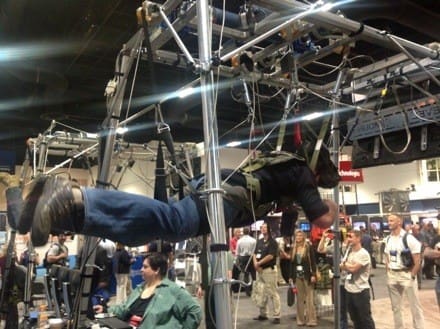
Pat McNamara showing us how it’s done.


The Innovative Tactical Training Solutions HH-60 CASEVAC Training Simulator is an accurate representation of an H-60 cabin that offers accurate crew positions including realistic crew securing landmarks, allowing securing of patients as well as aircraft lighting (white, green/ blue).
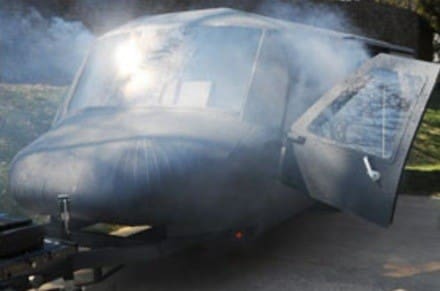
It provides the capability to train appropriate personnel on the proper methods of administering medical aid to occupants from the interior of a structure within the parameters of a training exercise in multiple conditions and can even be set up to simulate an H-60 crash.
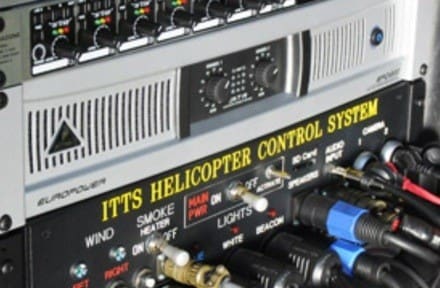
The remote PC controlled unit, with a custom designed interface allows for an increase/decrease in the level of stress on the trainee via the control of environmental factors, including light, noise, wind (fans), water, smoke (foggers), and other specialized components. Factors can also be controlled manually via the Sensory Control Unit (SCU) which comes with the simulator and is seen above.
The HH-60 CASEVAC Training Simulator is available for unit and agency purchase through ADS Inc.

When you hit a plateau in your handgun training, a way to bridge the gap to reach the next level is work strong and support hand. Do this at distance as well. I was a skeptic back a decade ago but bought into it and started training for National Match courses of fire. These matches are done strong hand only at 50 yards slow fire and at 25 yards timed and rapid. My overall results (up close) in speed and accuracy increased.
Work support hand at distance as well. If you are right eye dominant and right handed, switch to your non-dominant eye when working support hand. We do this simply to work the other side of your brain.
An advantage to training this way is that you will maximize available use of time and recourses in an age when recourses are scarce and expensive.
You will gain a keen appreciation for the fundamentals when your stability has been reduced and when you’ve increased your distance some 25 yards beyond your comfort zone.
Patrick McNamara
SGM, US Army (Ret)
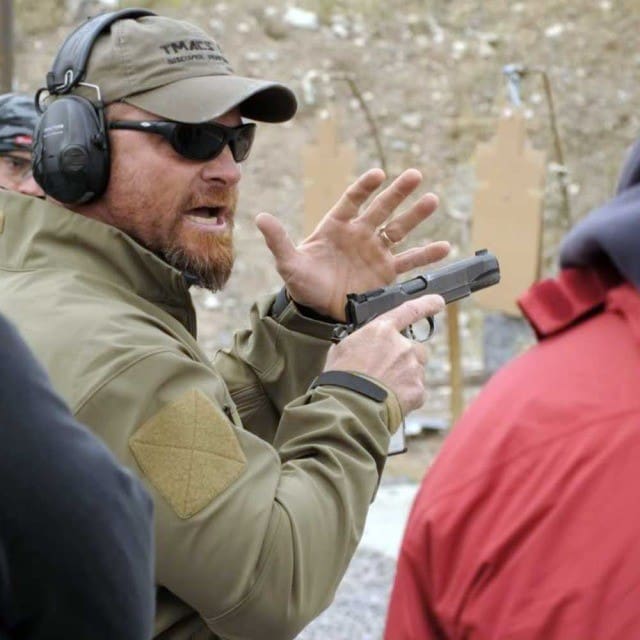
Patrick McNamara spent twenty-two years in the United States Army in a myriad of special operations units. When he worked in the premier Special Missions Unit, he became an impeccable marksman, shooting with accurate, lethal results and tactical effectiveness. McNamara has trained tactical applications of shooting to people of all levels of marksmanship, from varsity level soldiers, and police officers who work the streets to civilians with little to no time behind the trigger.
His military experience quickly taught him that there is more to tactical marksmanship than merely squeezing the trigger. Utilizing his years of experience, McNamara developed a training methodology that is safe, effective and combat relevant and encourages a continuous thought process. This methodology teaches how to maintain safety at all times and choose targets that force accountability, as well as provides courses covering several categories, including individual, collective, on line and standards.
While serving as his Unit’s Marksmanship NCO, he developed his own marksmanship club with NRA, CMP, and USPSA affiliations. Mac ran monthly IPSC matches and ran semi annual military marksmanship championships to encourage marksmanship fundamentals and competitiveness throughout the Army.
He retired from the Army’s premier hostage rescue unit as a Sergeant Major and is the author of T.A.P.S. (Tactical Application of Practical Shooting).
Gunfighter Moment is a weekly feature brought to you by Alias Training & Security Services. Each week Alias brings us a different Trainer and in turn they offer some words of wisdom.
When conducting real operations or higher level training where individuals are in anything other than a static firing line, all persons must adhere to at least three of the four rules of firearms safety at all times, including accidental falls, and incorrect movement. No exceptions.
If you saw some of the weapons handling and manipulation in Boston you know that this is one of the least touched upon subjects in the shooting/LE world. It is considerably better now in the mil with the exception of pistol only work, which still trips up our soldiers who don’t use a handgun that much.
“Advanced” shooting has nothing to do with targets and timers and everything to do with decisions and tactics. Don’t invent it on the day.
-Kyle Defoor
(SEAL Assaulter & Sniper)
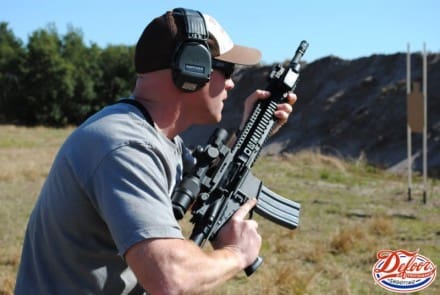
Kyle Defoor is one of the world’s most committed and passionate shooting instructors. Literally growing up with a gun in hand he took his talents into the military where he was combat decorated as a SEAL assaulter and sniper. Kyle helped to create and define modern training while along the way personally teaching thousands of military personal and civilians from around the globe. His shooting prowess led to appearances on multiple TV shows including Shooting Gallery, Tactical Arms, and Tactical Impact, and guest appearances on History Channel. Kyle’s outdoor athletic lifestyle includes shooting, ultra running, stand-up paddle surfing and climbing. He now serves as the brand ambassador for Mission Ready Equipment and runs his own company which offers tactical training, wilderness navigation, TV and film consulting, and motivational speaking.
Gunfighter Moment is a weekly feature brought to you by Alias Training & Security Services. Each week Alias brings us a different Trainer and in turn they offer some words of wisdom.
Troy Industries has introduced two new divisions: Troy Asymmetric and Troy Prepared.
Troy Asymmetric’s mission statement is simple,
To provide world-class tactical instruction to government, military, law enforcement and corporate risk organizations.
We’ll keep you updated as we learn more about this new undertaking, helmed by former FBI agent Kevin Miles.
Today Grey Group Training announced that John “Shrek” McPhee has signed on as Director of Training. Congrats to all!
Grey Group Training is pleased to announce that John “Shrek” McPhee is BACK ON TAP at Grey Group (Q the righteousduke “back on tap” T-shirt). As you may know, GGT is under new ownership and has chosen to invest in building a robust and comprehensive training program. In addition to providing excellent hands on training himself, John will be filing the role as the Training Sergeant Major here a Grey Group working next to Ramia, the Training Coordinator and primary contact for training. He will be leading the way by taking GGT into an organized progression of skills method taught by the best instructors in their respective fields. As a retired Army Sergeant Major, serving at the absolute pinnacle of warriors, with extensive combat experience in multiple theaters, no one knows training better!
Please be patient, as we will not overlook anyone that wants to reach out to John or take his classes. If you have already signed up for his class with Alias Training, please contact us (via phone at 910-323-4739 or email at info@greygrouptraining.com) and we will walk you through the simple process to move your booking to GGT. We are working hard to make the transition as smooth as possible. We will proactively re-enroll you into the SAME class on GGT and if you have already given a deposit to Alias (once your money is refunded) we will establish your deposit or enrollment fees. We apologize for any inconvenience and want to make this as painless as possible for you. At the end of the day this is about you the student, giving you everything you need, and making you as survivable and lethal as possible.
In addition to our commitment to provide excellent training, we are bringing added value to the student. We are proud to announce the following sponsorship agreements for Shrek: Arc’teryx, Velocity Armor, Mayflower Consulting, Kryptec Camo, Sheriff of Baghdad, and Combat Flip Flops. Students training with Shrek will receive a coupon code good for discounts on products from his sponsors. In addition, we will be offering “Training Packages” where students who attend a class with Shrek may purchase specific items your instructor endorses for a discounted price.
V/R
John Mcphee shrek@greygrouptraining.com
Ramia Whitecotton info@greygrouptraining.com
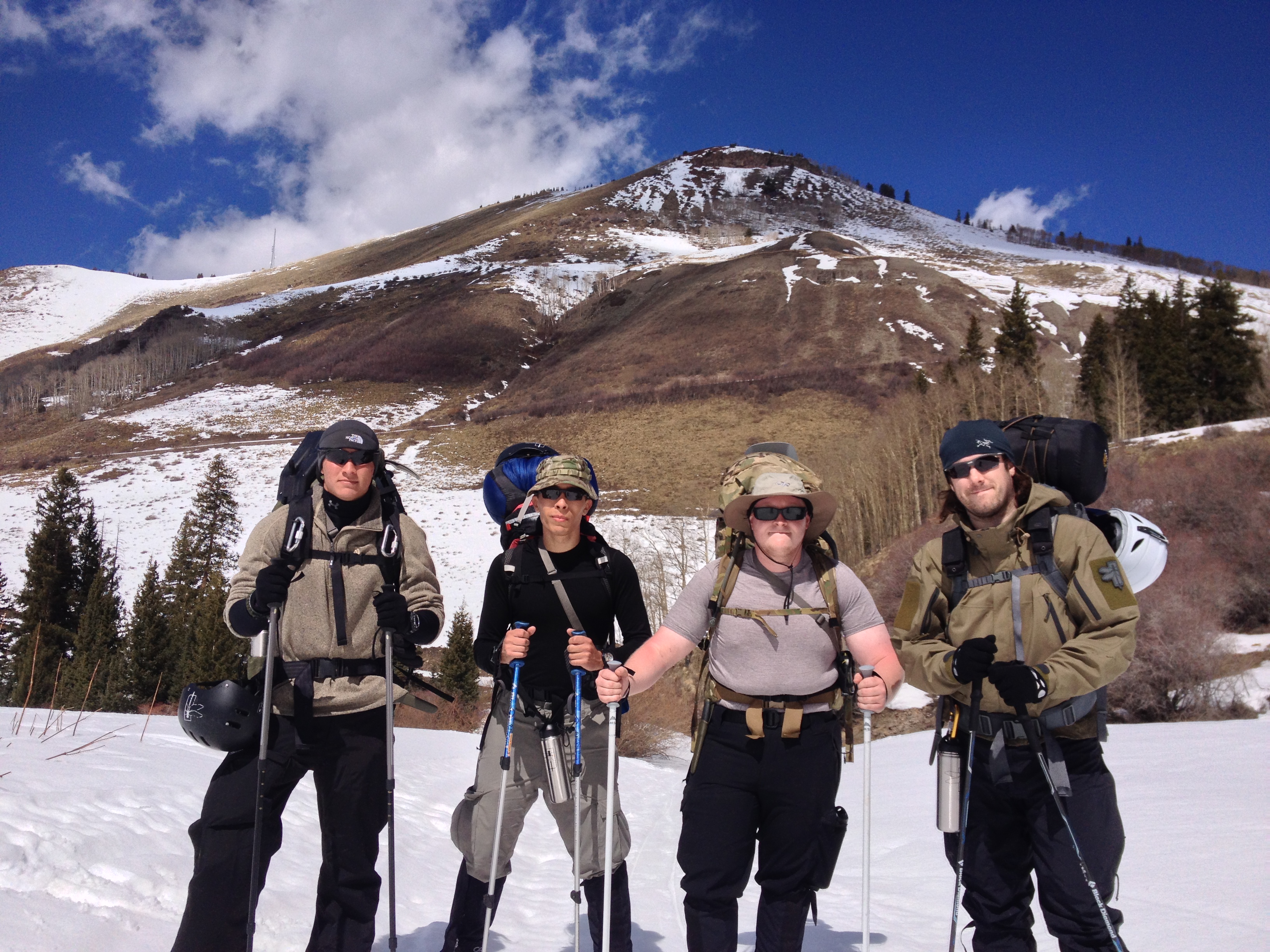
Tactical Fanboy attended the Haley Strategic Partners Winter Problem Solver course in Telluride, Colorado from March 31st through April 4th. This was his first time attending a mountaineering/survival course and this AAR is in his voice. You can read about the equipment he used here and TD1 here.
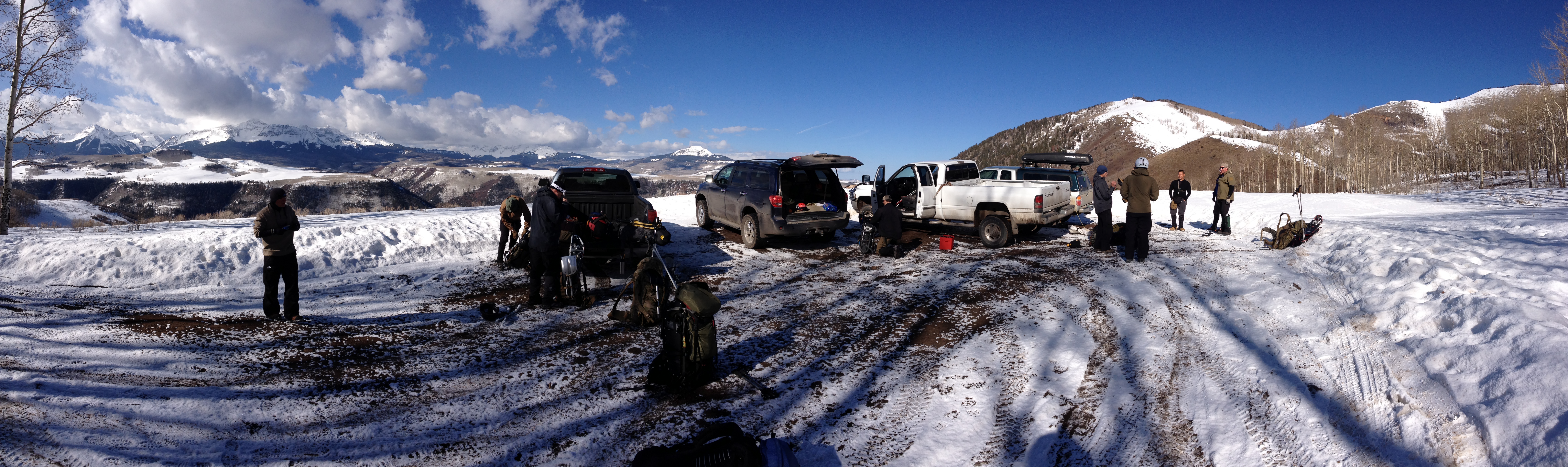
At the start of TD2, we met up at HSP headquarters, did an equipment weigh-in, then loaded up our packs and took a 1-1/2 hour drive towards the staging area. After being assigned to our teams (I was assigned to Team 1) and undergoing a team exercise, a map folding competition for speed, we headed towards the campsite. Early on in the march towards camp we underwent a simulated rescue mission, looking for victims [beacons] trapped under the snow. Team 1 headed downhill and managed to find two beacons, wading through thigh-deep snow in the process; Team 2 took the high ground and also found two beacons. Afterwards, we discussed the exercise and continued our march towards base camp.
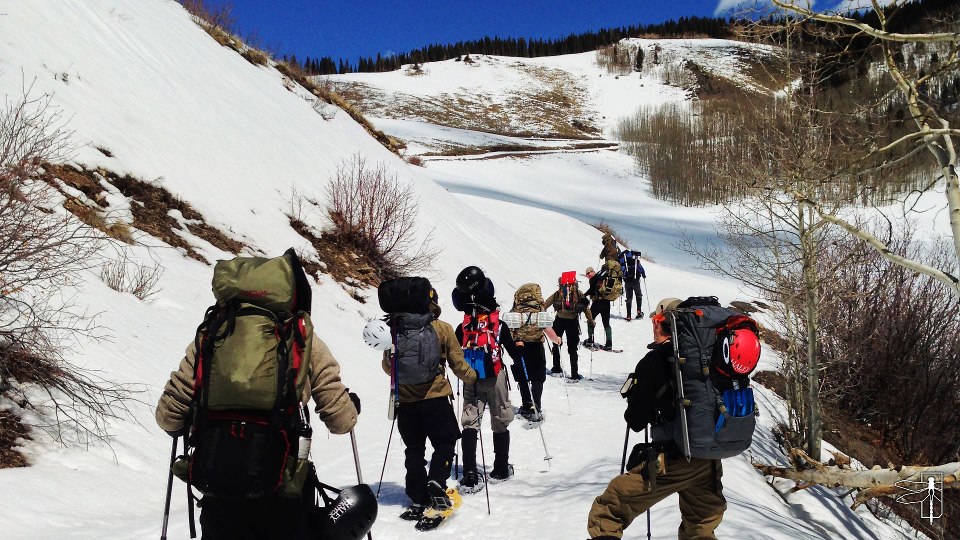
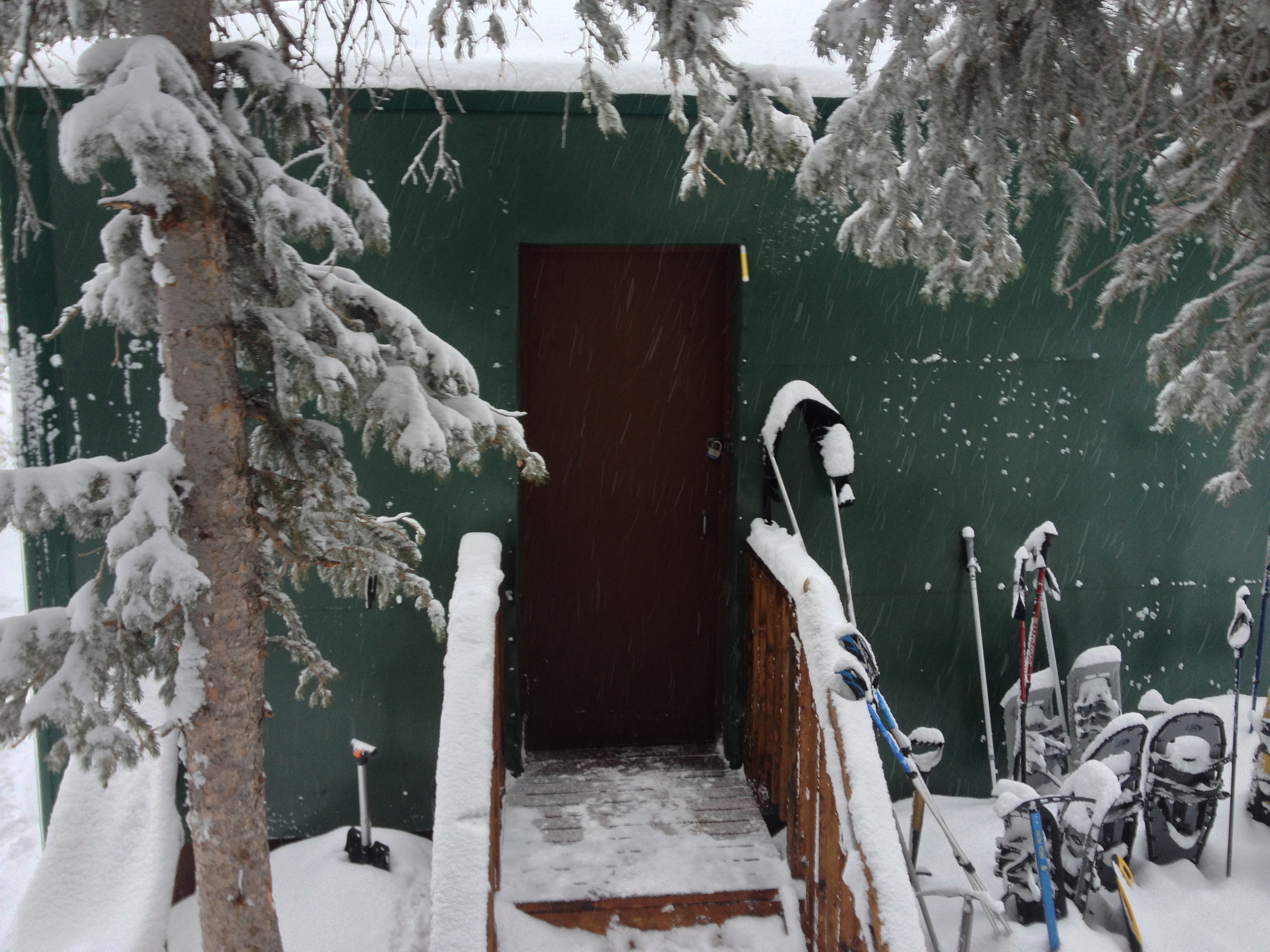
One fairly challenging march later, featuring a modest incline, switchbacks, and requiring the use of our showshoes, we made it to the campsite. It was a wooded area featuring a hut, outhouse, and trash/recyclables area. The hut was home base for the majority of the class. It featured a stove and 8 sleeping mats, and functioned as a (mostly) dry place to eat or undertake a bit of classroom instruction. Our packs, and by extension most of our gear, was stored outside most of the time, hung on a rack.
Throughout TD2 through TD4, we practiced a variety of survival and mountaineering skills:
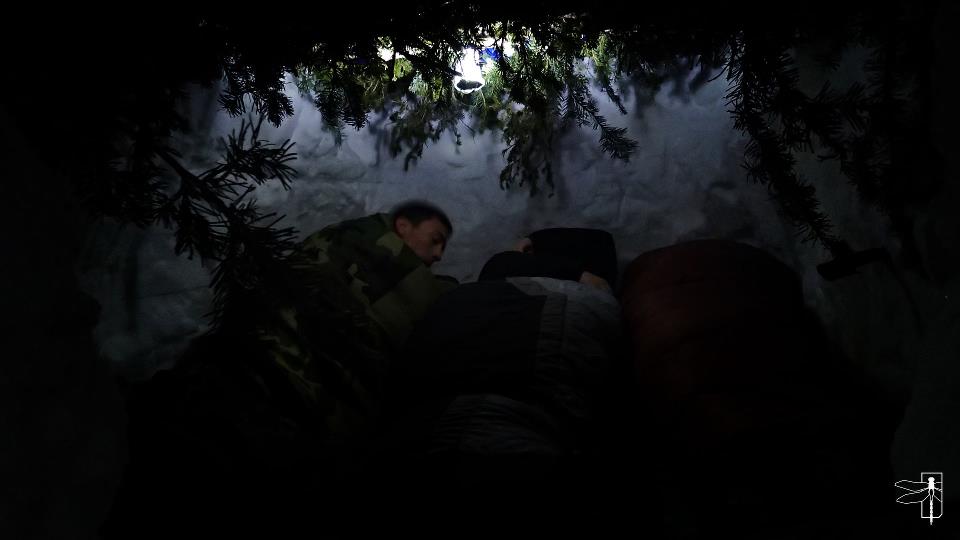
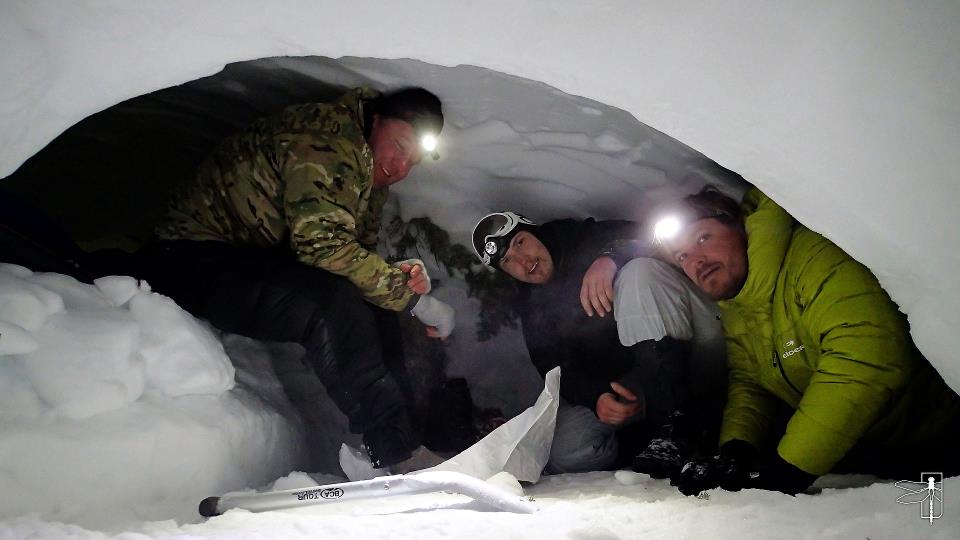
Shelter building was a primary focus. We built two shelters during our time at the campground; every attendee was required to sleep at least one night outside (I slept two). Team 1 completed two separate hybrid snow trenches/caves, while Team 2 completed two separate snow caves, the latter of which was large enough for at least six people, eight if space wasn’t a concern.
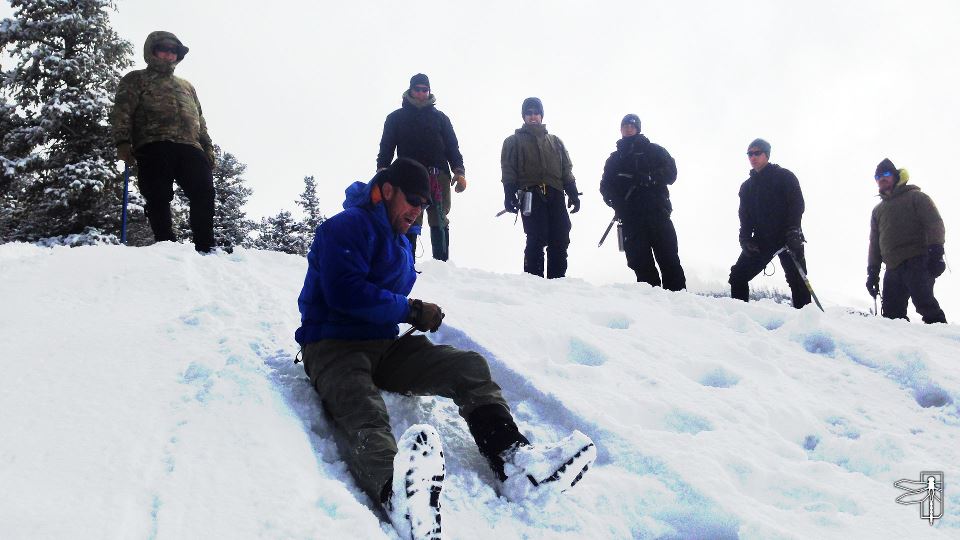
We practiced techniques for efficiently traversing up and down a slope. These techniques included different foot positions and use of our ice axes as another point of contact and for self arrest in case of a fall. We also practiced glissading.
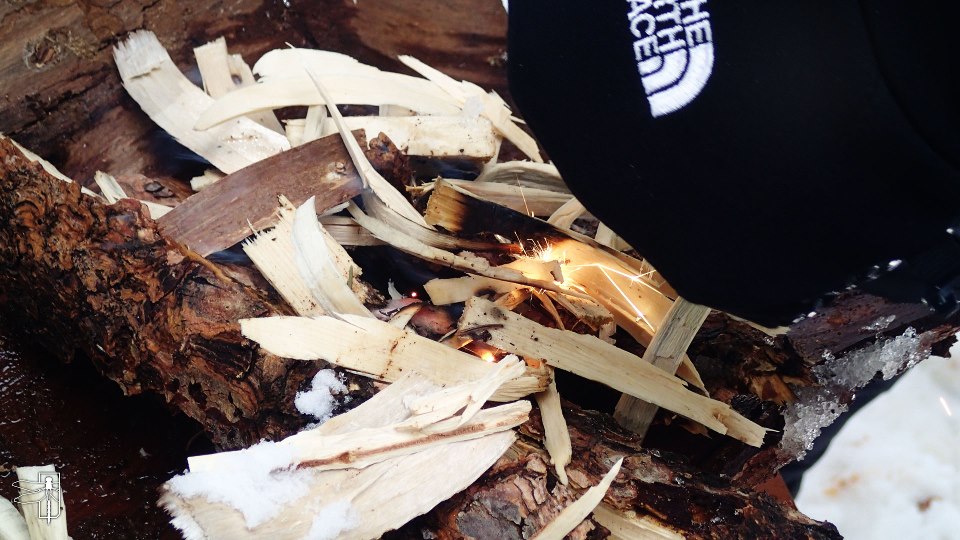
We did a brief class on fire building. Afterwards, we were tasked with building a fire of our own. We separated into our teams and had to built a fire using a striker, a bit of a starting material, and whatever we could gather from the environment.
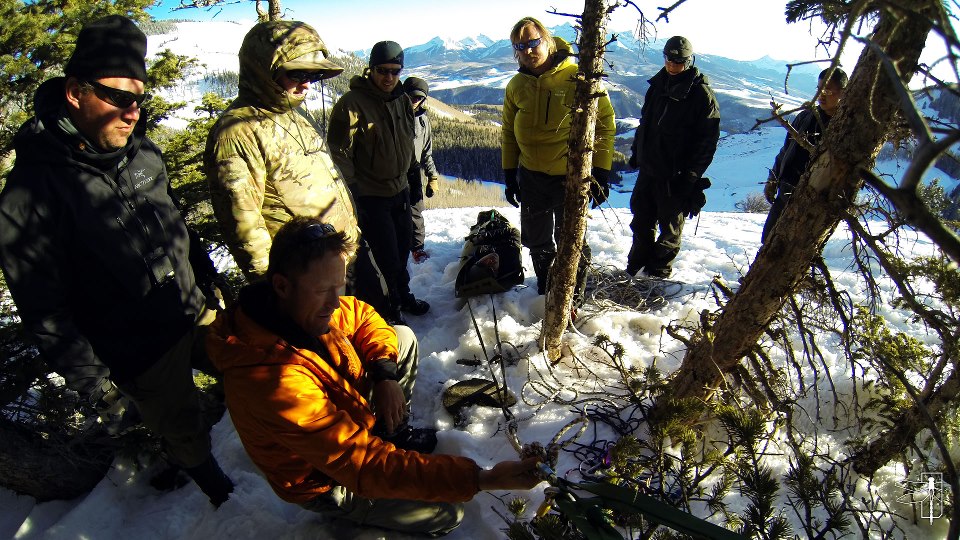
We practiced rope work as well. Aside from a few important knots, including the double fisherman’s knot, multiple forms of situational figure eights, and the munter mule, we also worked on rappelling and ascending on a rope, and the use of a pulley system, primarily for pulling up a rescue litter.
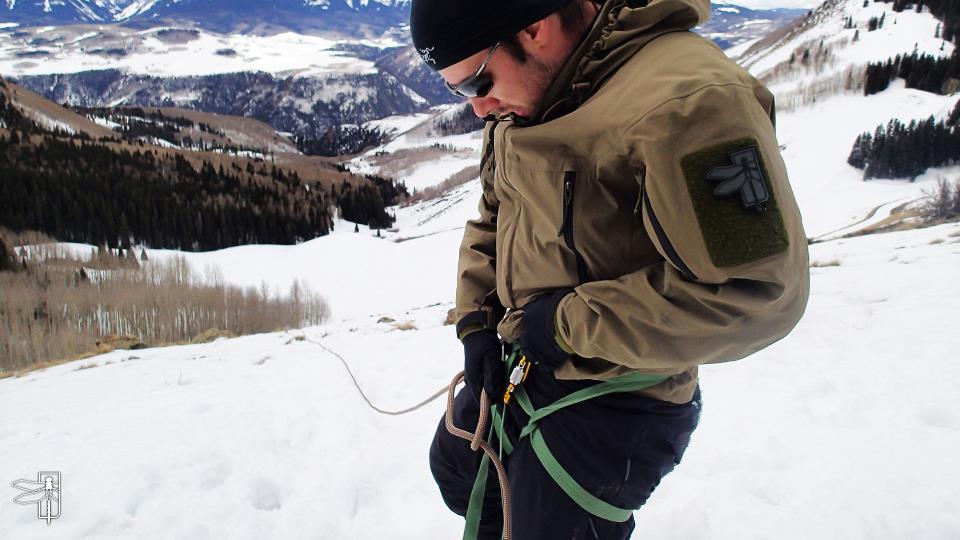
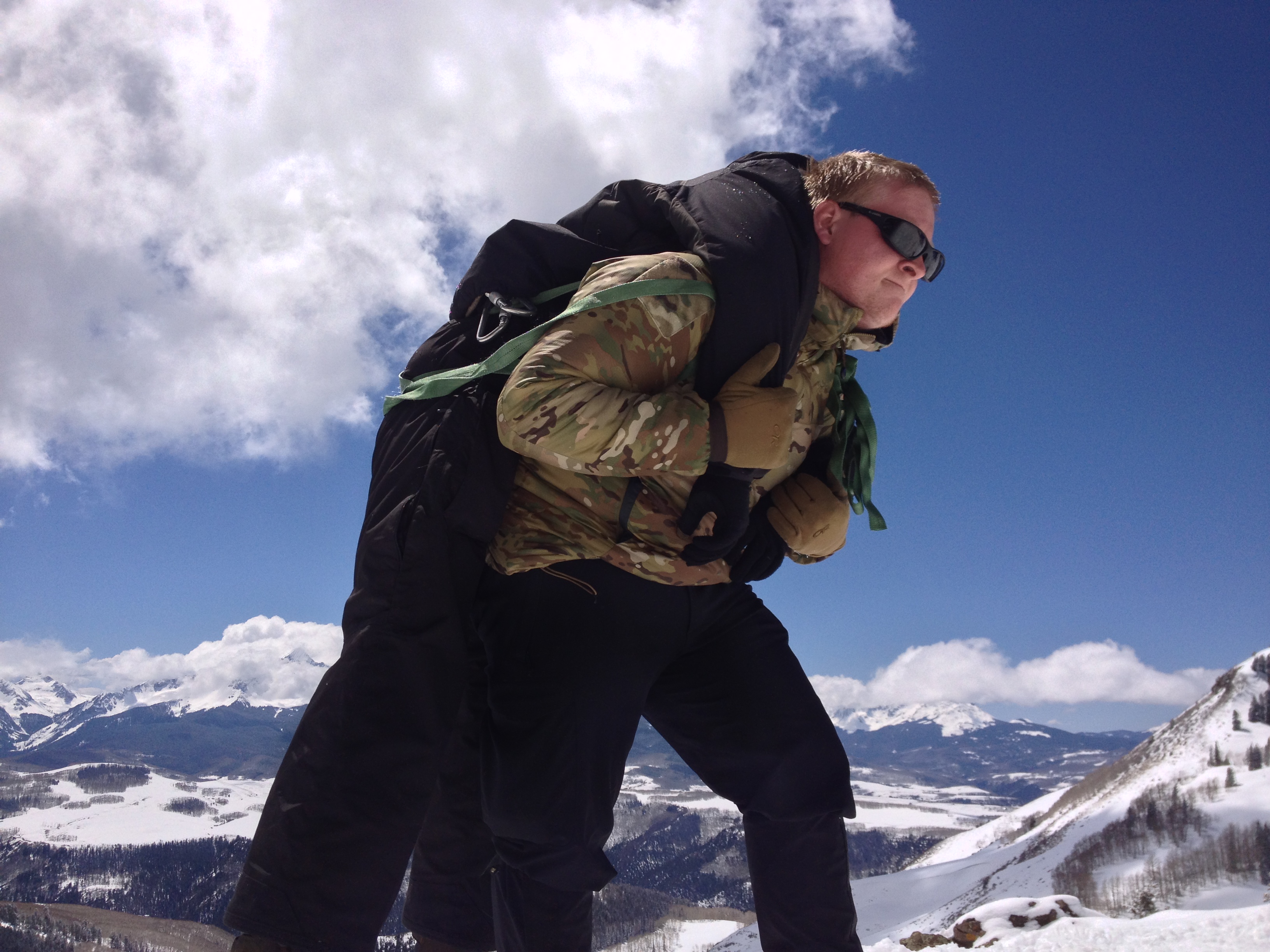
Other skills we worked on included navigation, methods on how to transport an injured person, and additional rescue work in the form of hunting for buried beacons.
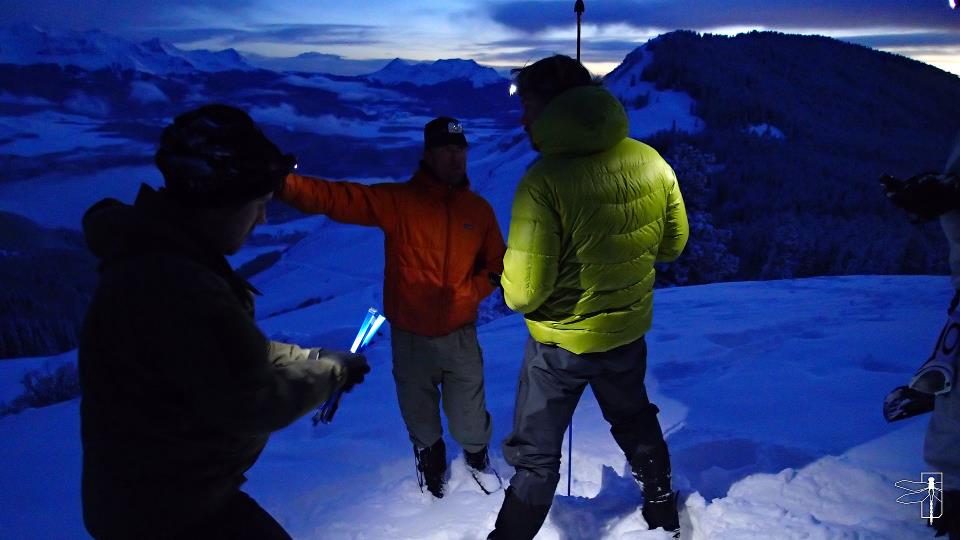
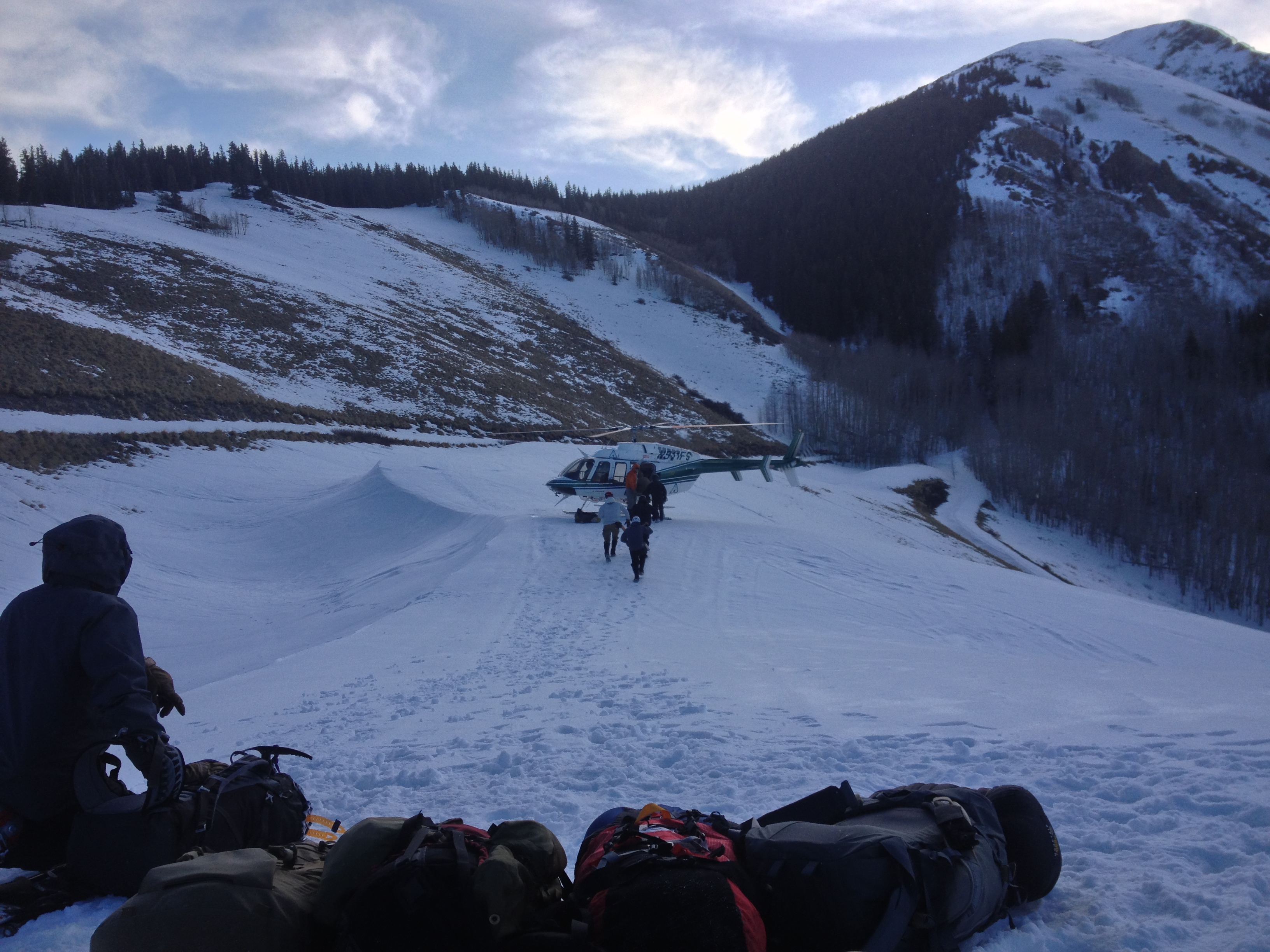
At the start of TD5, we rose just before sunrise and cleaned up camp. We then geared up and started to descend from the camp grounds. Shortly after our return started, Travis announced a helicopter was coming to pick us up. We prepped our gear and went in two chalks; a third trip was made to transport our gear. It was my first time ever riding in a helicopter and it was an exhilarating experience.
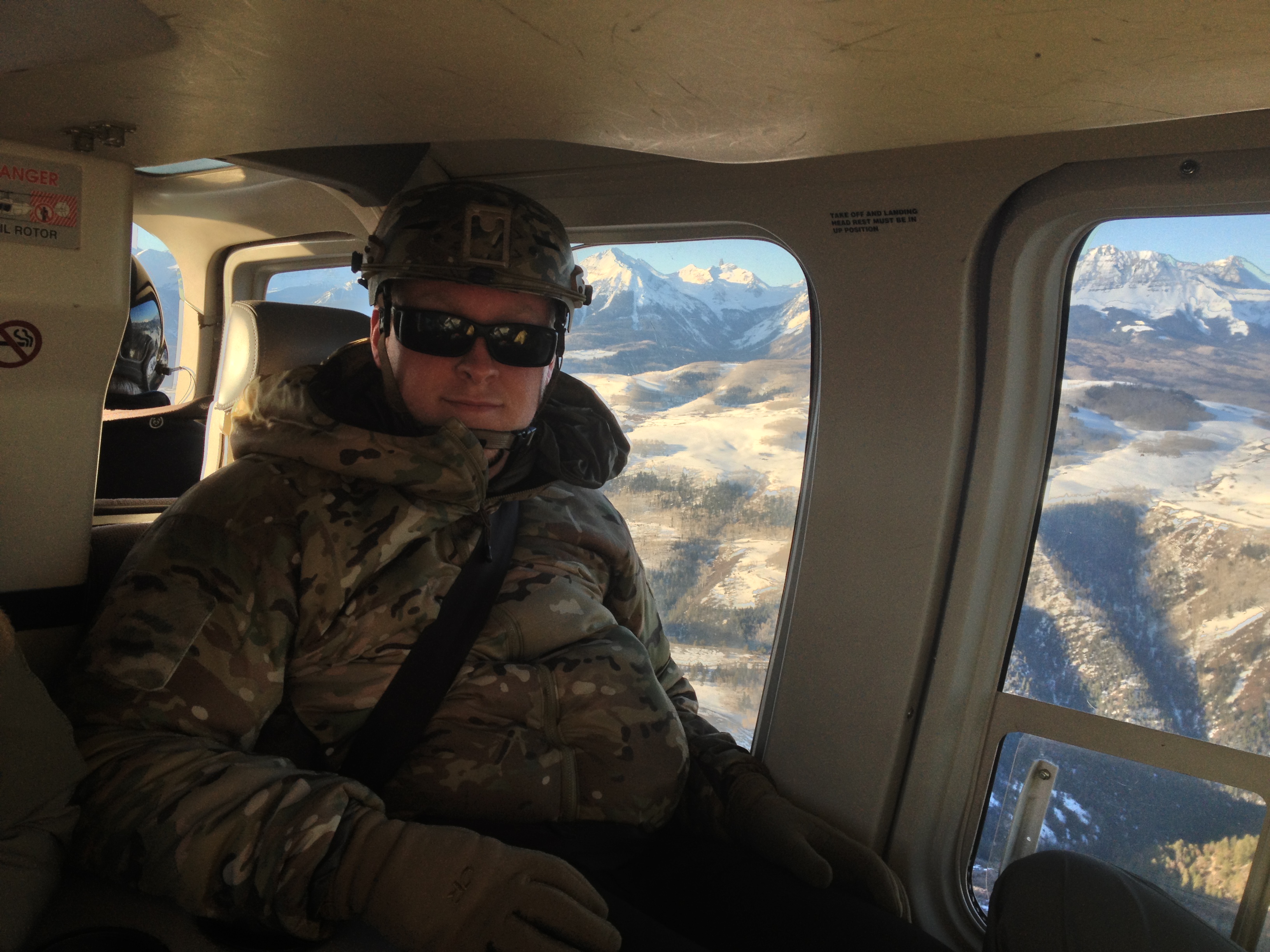
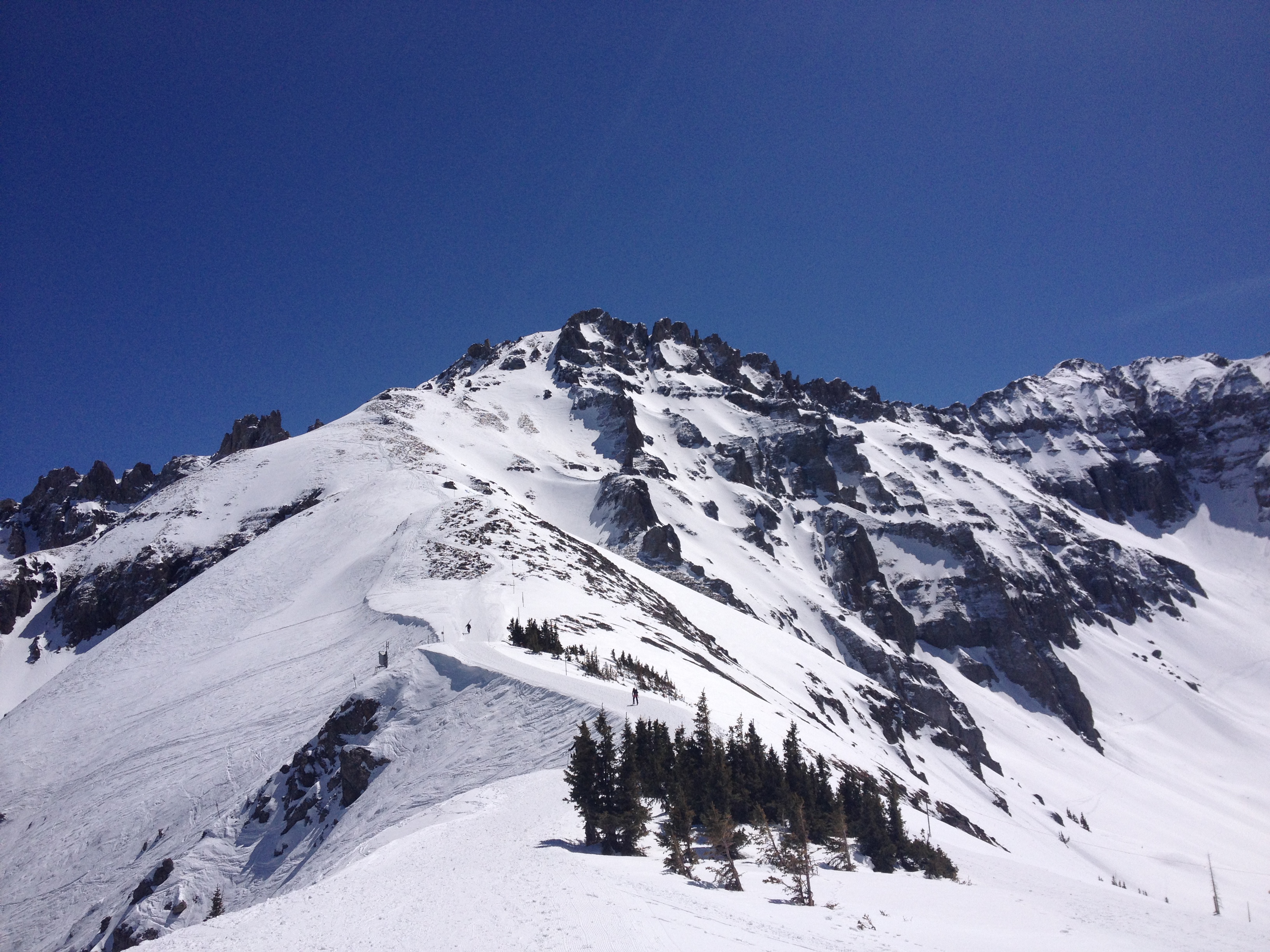
We were dropped off at Telluride ski resort before the general public arrived so we could undertake our final challenge for the class, reaching the 13,230ft Palmyra peak. This involved traversing the increasingly steep ridge using minimal equipment. Thankfully, one of the ski resort SAR personnel was willing to make the climb first, placing footholds for the rest of us to use. Although that did take away some of the difficulty, it was still a challenging endeavor.
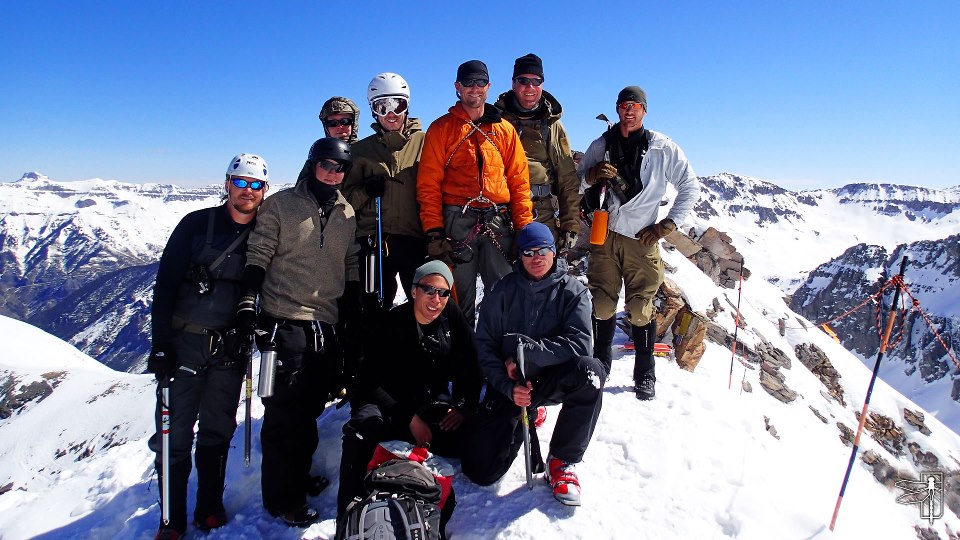
When we reached the peak, we enjoyed a “special treat”, took some photos, and began our descent, retracing our path up. It was a bit faster going down, but also required using some of the descent techniques we practiced earlier in the week. As we returned, the skiers started to flock in. More than a few were grateful that there was already footholds available thanks to our ascent. It was a fantastic end to the class proper, and of course we took the obligatory final class photo:
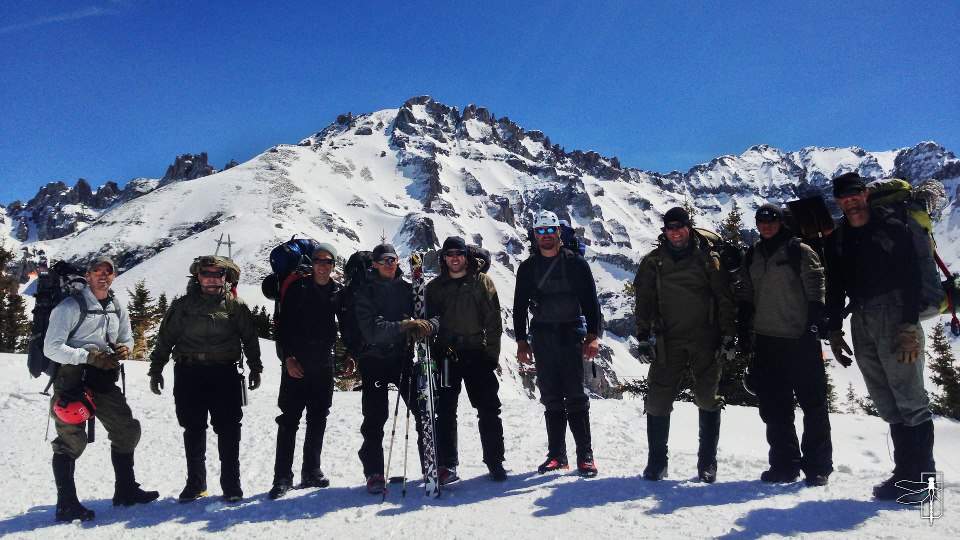
With this, the class was all but over. We descended into Telluride using the fantastic gondola system, where we enjoyed a great meal at a restaurant called ‘Oak…The new Fat Alley’. We then said our thanks and goodbyes to our two resident SAR personnel, and made the long drive back to HSP headquarters where we gave back our issued equipment, received our certificates of completion, and reflected on the class.
Final note: The Winter Problem Solver course offers a wealth of information regarding survival in a winter environment and mountaineering in general. However, due to the relatively short duration of the course in conjunction with the volume of information, it shouldn’t be considered a definitive source of skills for either of these topics; rather, it should be treated as more of an introduction. Additionally, this particular Winter Problem Solver was a “beta course” in that it was the very first run of the course. I can all but guarantee the course will become further refined and may even change in content as further courses are planned and run.