FORT PICKETT, Va. — Senior Department of Defense officials and congressional staff were briefed on the status of the Integrated Visual Augmentation System, or IVAS, program at Fort Pickett, near Richmond, Virginia, Nov. 6. IVAS is a next-generation situational awareness tool under development to return overmatch to Soldiers in small units throughout the close combat force.
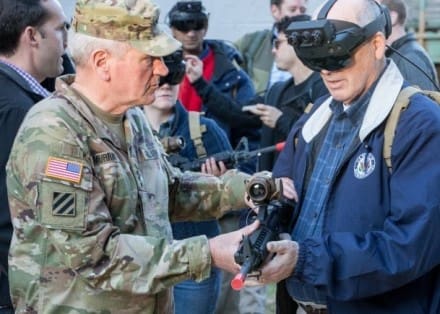
“Technology will never be as slow as it is today,” said the Hon. James E. McPherson, the senior official performing the duties of undersecretary of the U.S. Army. “We never want to have a fair fight.”
“Budgets make us make hard choices,” McPherson said. “Could we field everything we have on the drawing board today? Probably not. We’re going to have to make hard choices, budget-driven choices on what’s most important to field.”
Decision-making can be informed through aggressive evaluation to quickly discern viable military solutions and modify designs early, before sinking additional costs into a program. To facilitate research, U.S. Army Futures Command’s eight cross-functional teams, or CFTs, have conducted dozens of Soldier-centered engagements called Soldier touch points to further the Army’s modernization priorities.
“Soldier touch points help us better demonstrate technology, like the IVAS, at specific points in the development process, the cross-functional team gets direct feedback — and if something fails — it fails early and we learn from it,” said Gen. John M. Murray, commanding general of Army Futures Command.
Soldiers are brought into the development process to provide input to industry, testers, researchers and acquisition experts on the capabilities they will need to fight and win. During these events, prototypes are delivered to units to incorporate into their training.
The events are designed to empower Soldiers to help improve the final equipment and technology. This feedback loop is critical to drive cost-effective and timely innovation.
“That’s why these touch points are so very, very important, something that is really revolutionary that we’ve not done before,” McPherson said. “Before, it’s been, the engineers put it together, met the requirements, ‘Ok, here you go,’ and the Soldier gets it and says, ‘I’ve got to adapt to this now.’ Now, we’re making the weapon system adapt to the Soldier.”
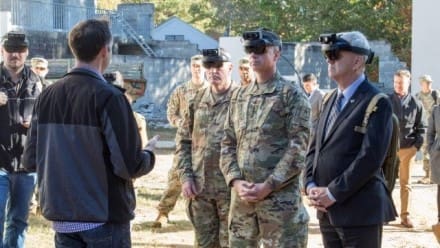
The current IVAS touch point was led by AFC’s Fort Benning, Georgia-based Soldier Lethality CFT in conjunction with the command’s Orlando, Florida-based Synthetic Training Environment CFT. They were joined by industry partners to gather tens of thousands of data points and direct feedback to spur rapid iterations of the IVAS design and technology before the next touch point takes place in the future.
Soldier touch points are conducted in coordination with the Program Executive Office Soldier, or PEO Soldier, an organization within the Office of the Assistant Secretary of the Army — Acquisition, Logistics and Technology, or ASA(ALT). Based at Fort Belvoir, Virginia, PEO Soldier is the Army’s acquisition agency responsible for everything a Soldier wears or carries.
“We’re doing something called Soldier-centered design,” said Jason Regnier, PEO Soldier’s technical director for the IVAS project.
“The touch points now are a culmination of months of work, where we actually put it in their hands and get real-time feedback, make improvements, even on the site, and then think about what that next turn is going to be,” Regnier said. “Instead of one, stamped-out design that we can give to Soldiers — that may or may not really work — this is designed, in essence, by Soldiers through this Soldier touch point project.”
These engagements not only generate Soldier-initiated problems that have been overlooked, but also confirms or dispels the need to address real or perceived problems with the technology for the development teams.
This Soldier-centered design concept was also explained by an industry partner developing the IVAS device for the Army.
“It’s really an adaptation of an industry practice known as human-centered design, where you really have to start with deeply understanding the underlying human needs. In this case, what are the needs of the Soldier?” said Scott Evans, Microsoft Corporation’s general manager for the IVAS program. “In the case of a Soldier, you have to have a methodology to make sure that we understand those needs and that we can evaluate prototypes against those needs.”
These touch points are about teamwork, collaboration, and common-sense innovation, said Brig. Gen. David M. Hodne, the director of the Soldier Lethality CFT.
“Soldier-centered design, feedback from Soldiers and feedback from our partners at Microsoft on how we can achieve technical solutions to arrive at an exceptional device that will allow Soldiers to fight, rehearse and train in a manner they’ve not been able to previously.”
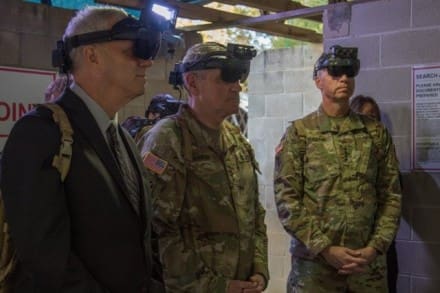
The Soldier touch points make rapid iteration of the prototypes possible.
“We’re here not just to evaluate the prototype against the measures that we identified, but we’re also here to learn more around the Soldier needs and carry that forward,” Evans said. “We’re also here to evolve our methodology. Every time we have a Soldier touch point, our ability to understand, what is the most effective way to measure things like Soldier performance? We get better at the actual methodology itself.”
In addition to working with traditional industry partners, AFC seeks solutions from non-traditional innovators through the Army Applications Laboratory and a small business office within the command’s headquarters.
AAL was stood up in the Capital Factory in downtown Austin to provide a venue for innovators with novel solutions to discover how they could support Army modernization efforts. They host regular engagements with entrepreneurs and seek direct feedback from Soldiers.
For example, in July, an AAL team held a collaborative event at Fort Hood, Texas. They visited with III Corps Soldiers from military occupational specialties related to combat arms, combat support, and combat service support to provide innovators with their reactions to proposed technologies. It is also an opportunity for start-ups to grasp the hurdles they may encounter in development.
“Scalability is often an issue for small businesses, which could provide opportunities for the traditional defense industry to assist them,” Murray said. “We’re trying to figure out how we can become more agile. There are a lot of great small companies out there, and we’re trying to figure out how we can become more agile in the way that we resource them. Providing early Soldier input, when possible, is an easy value add.”
Regnier said Soldiers participating in the Fort Pickett exercises were enjoying their involvement. It not only serves a research method, but also provides an outlet for them to build confidence in their future equipment — they get a first-hand look at tomorrow’s battlefield technology.
“The feedback has been extremely positive, in the sense that the Soldiers understand the technology, in that there are some limitations now,” Regnier said. “But they can see where we’re going. They understand the difference between equipment they either have or wish they had in their normal units and what this capability is.”
Regnier said he has been with the IVAS project since its inception and has also provided technical advice on the development of another device recently fielded, the Enhanced Night Vision Goggle — Binocular, or ENVG-B, which the Soldier Lethality CFT coordinated.
“As we walked into this, we realized, normally the way the defense department approaches a problem like this is: we come up with a specification, for say a thermal weapons sight. It has to be able to see 1,000 meters, under cold and hot conditions, and in the rain, and can only weigh four or five pounds,” Regnier said.
He said the new process is completely different.
“In this case, we started looking at: ‘How does industry make a product?'” Regnier said. “And the way they make a product is, they figure out, ‘What does the user actually need? What does the Soldier need to do?’ That changed the approach. So, instead of doing a specification, we did studies. Soldier-oriented studies, where they came in and talked to researchers to explain what their job really is.”
Ten Soldier touch points were conducted during the ENVG-B’s development phase to inform its final design. Soldiers reported hitting twice as many targets while wearing the ENGV-B, as opposed to the current single-tube, monocular night vision device in broad use. They were also able to drive faster and complete land navigation tasks quicker as a result of the clarity the new binocular provided.
“The ENGV-Bravo was designed by Soldier for Soldiers,” said Pvt. 1st Class Dustin Roy, an infantryman with the 1st Infantry Division, following the fielding of the device at Fort Riley, Kansas, in September. “It makes me feel more confident in it, that it was designed by Soldiers. I know that I’m getting a good piece of gear, a good tool.”
The initial fielding of the ENVG-B speaks to the success of the cooperative relationships being fostered between AFC, ASA(ALT) and PEO Soldier, and industry partners, to keep Soldiers at the centerpiece of modernization efforts.
The Soldier touch point program provided significant feedback during the development of the ENVG-B, and is now doing the same for the IVAS developers.
“We need our Soldiers’ input, the end-users who are going to actually use this equipment,” Murray said. “Our decisions today will have a direct impact on them in the years to come. They’re the ones who will be using this in the field. The quicker we can work out kinks, the quicker — and cheaper — we can get it into their hands for effective use.”
Story by Army Futures Command