

“The US Army Contracting Command – New Jersey (ACC-NJ), on behalf of Project Manager Soldier Lethality (PM SL), located at Picatinny Arsenal, NJ, is conducting a market survey for direct view optics and aiming lasers for use on shoulder fired weapon systems (i.e. rifles, carbines and automatic rifles) within the Close Combat Force.”
That’s how the recent US Army RFI to industry for commercial off the shelf weapon enablers starts out. I’m going to dissect it a little bit. It’s for “rifles, carbines and automatic rifles within the Close Combat Force.” Considering the Army is currently replacing the M4 Carbines and M249 Squad Automatic Weapons with the M7 Rifle, XM8 Carbine (basis of issue still undetermined), and M250 Automatic Rifle, this is obviously for the Next Generation Squad Weapon System.
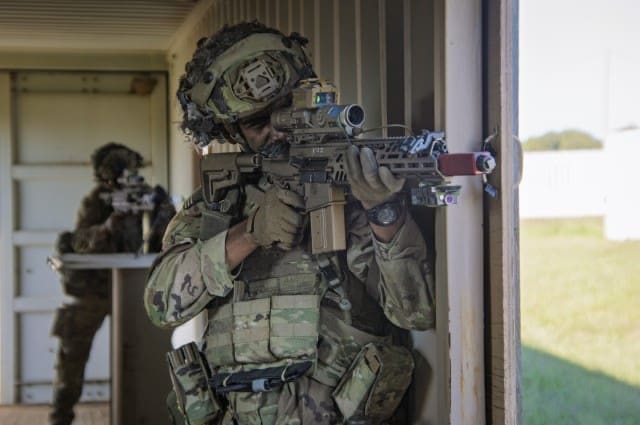
Photo by Mr. Thomas Mort, Audio Visual Specialist
They want to hear from companies manufacturing direct view optics, aiming lasers, and scope rings/mounting hardware for optics that are at a technology readiness level 9, currently in production, and may be commercially available.
Here are the specifics:
Direct view optics and mounting hardware must be mountable on a MIL-STD-1913 Picatinny Rail. Direct view optics may include but are not limited to red dot sights with flip-in magnifiers, low-power variable optics, discrete variable magnified optics, or fixed magnified direct view optics with magnification contained in the range of 1x to 10x. The direct view optics should aid Rifleman and Automatic Rifleman to effectively engage targets at distances up to 600m. Optics must survive weapon pyro-shock, be rugged for Soldier use and conform to MIL-STD-810 Environmental conditions for Small Arm Weapons. Optics should allow for the use of protective eyewear and provide an interface for attaching laser protection filters and anti-reflective devices.
Aiming lasers must be mountable on MIL-STD-1913 Picatinny Rail or using Modular Lock (M-LOK) and provide a visual aiming laser, infrared aiming laser, and an illuminator flood light that aids Rifleman and Automatic Rifleman to effectively engage targets at distances up to 600m. The IR pointer and illuminator must be compatible with I2 night vision devices and offer eye safe settings for general use and high-power settings (no greater than 3B) for long range use. Aiming lasers may have laser range finder and/or remotes but not required. Aiming lasers must survive weapon pyro-shock, be rugged for Soldier use, and conform to MIL-STD-810 Environmental conditions for Small Arm Weapons.
XM157 Next Generation Squad Weapon Fire Control
NGSW was procured to be fielded along with the XM157 Next Generation Squad Weapon Fire Control, manufactured by Vortex Optics. This sustem was actually selected before the weapons it was intended to be attached to and offers an integrated laser ranger finder as well as ballistic software to present a disturbed reticle for the shooter to increase first round hits. Additionally, it is a 1-8x magnified optic and includes visible and IR aiming lasers.
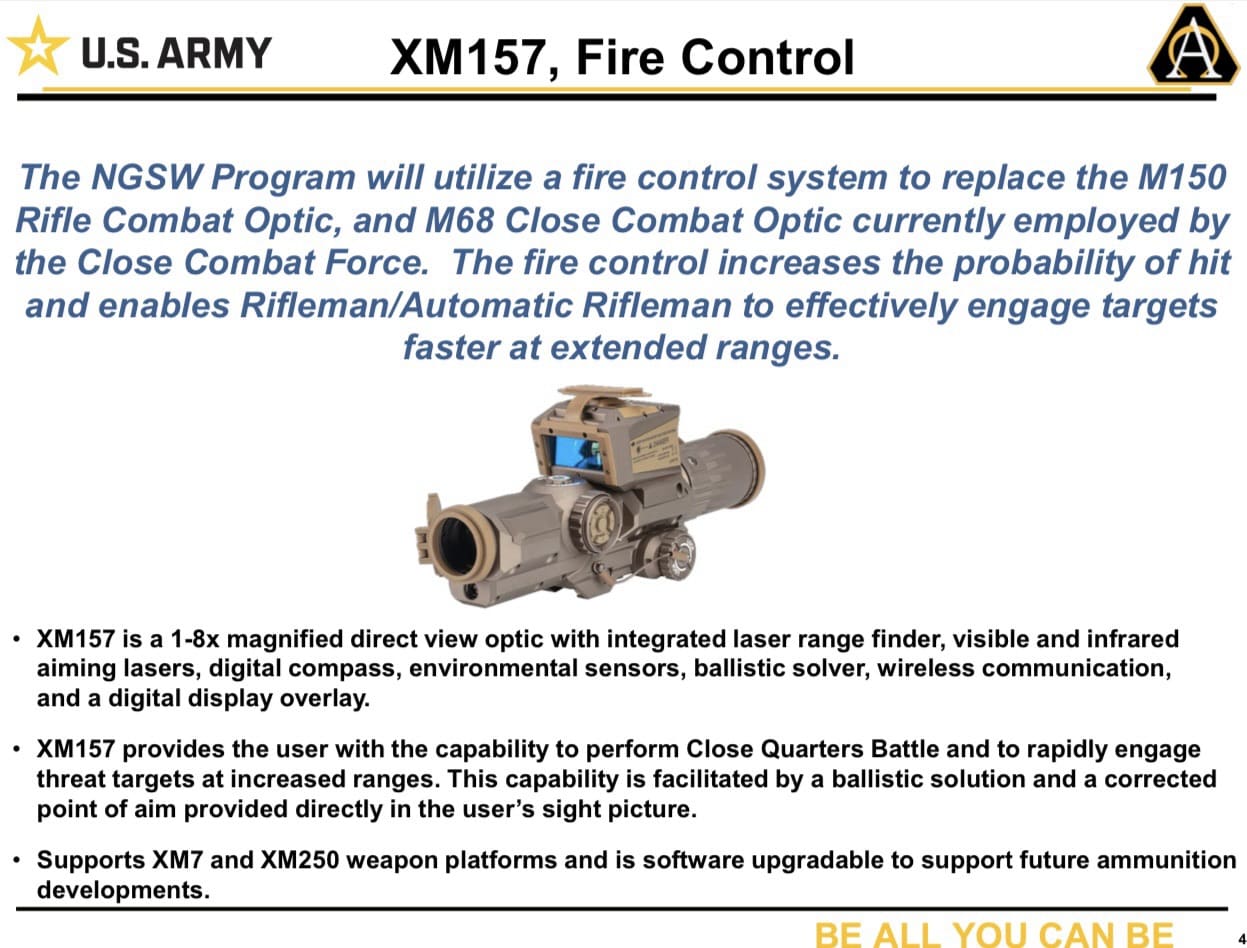
Early NGSW fieldings included the XM157. However, more recently we’ve seen M7 Rifles being used with various optics to include LVPOs and Red Dots.
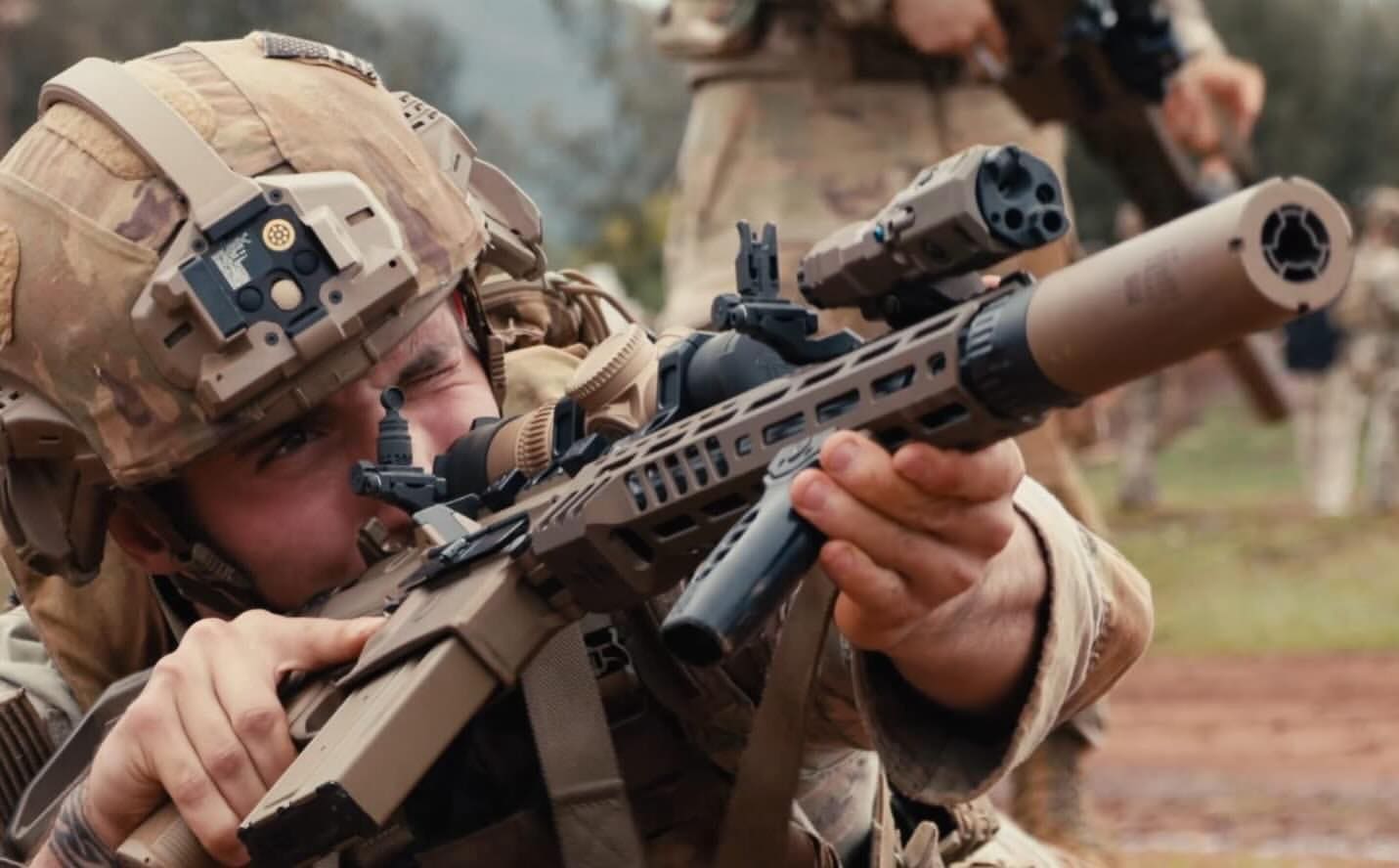
Take for example this Army Marksmanship Unit photo by SFC Timothy Hamlin. It depicts a Soldier with M7 outfitted with a B.E. Meyers MAWL X-1 aiming laser and a Vortex Optics “Eleanor” AMG 1-10x optic.
Although the Army has not commented on the disparity in Fire Control systems to NGSW weapons it may well come down to how quickly they are manufactured. Weapon manufacturer SIG SAUER is ahead of schedule, allowing the Army to speed up fielding of the M250 to select Infantry Brigades. Considering the complexity of electro-optics in the XM157, Vortex may be proceeding more slowly.
To be sure, there have been critiques of the NGSW program, generally from those who have not yet had any experience with the guns. The M7 is indeed heavier than the M4 it replaces, especially when equipped with the XM157. In fact, it is said to be three pounds heavier than an M4A1 with Close Combat Optic when equipped with the XM157 NGSW Fire Control System and suppressor. But in that scenario the M4 doesn’t have a suppressor or lasers (aiming and range finding).
On the other hand, the M250 is lighter than the SAW, 2.7 pounds to be exact. Regardless, the 6.8x51mm composite case round has a longer range and a larger projectile which travels at a higher velocity than the 5.56mm NATO round. This makes it difficult to offer a direct comparison between legacy and NGSW.
One of the answers to this feedback from the field is to develop the Product Improvement Effort versions of the M7 and M250 which has succeeded in lowering the weight. This project also resulted in the XM8 carbine variant.
Granted, the XM157 offers the Soldier capabilities on an individual weapon that few others enjoy, but it comes at a price. Aside from the weight of the XM157 still others are concerned about the cost and complexity. While a per unit cost has not been disclosed, the Army was talking at one time at under $10,000 per unit. Since all of the fire control unit’s capabilities are integrated into a single chassis, the only feasible way to upgrade the system is via software. This single component architecture also means that if one of the features malfunctions the entire system has to be taken out of service for maintenance.
Does this move to procure COTS solutions mean the demise of the XM157? There’s been no direct evidence of that. However, it does signify that the Army is using acquisition authorities to quickly close lethality capability gaps through use of readily available technologies.
While NGSW is definitely the US Army’s major small arms focus, there are a lot of legacy M4s and M249s out there and these COTS solutions can be proliferated across the force if they prove valuable.
Any company who wants to get in on this has until April 3rd, 2026. Visit Sam.gov for details.
I still can’t get over the fact that the Army and Marines will be using two different calibers. It will be huge problem in a big war.
We’ll have to see, They use a lot of different rounds already. Adding two more really isnt as much of a burden as it was when everything was a couple of loadings of 7.62 or 30-06. It’s not like the Marines will hurt for 5.56 or 7.62 from the Army, but maybe a 7.62 barrel for the NGSW would be worth looking into in the future.
On the plus side, it could lead to some gtowth and diversification of supply that would benefit everyone.
They will go 6.5×43 along with NATO.
“They will go 6.5×43 along with NATO.”
***
***
Pretty sure if the Marines didn’t go with 6.8×51, they aren’t going with a new caliber. They’ll stick with 5.56x45mm.
Why you ask?
The major cost in small arms procurement isn’t the weapon… it’s the AMMO.
It’s great that 6.5x43mm has a STANAG, but that doesn’t mean it has been adopted by anyone. Canada is the only one I know of, and they only adopted for their SOF forces. They JUST bought brand new 5.56mm rifles for the entirety of their Armed Forces… which kind of suggests they aren’t planning on using 6.5x43mm large scale.
The only members of NATO who will make any ammo for it are countries that have adopted it as a cartridge. It’s not like NATO countries are going to make ammo that may not be used. And no other countries have announced a switch to 6.5x43mm that I’m aware of.
So if NATO isn’t making 6.5×43 ammo, and the rest of the DOW isn’t making 6.5×43 ammo, that means the bill will fall on the USMC. And since they won’t be able to leverage economies of scale that the rest of the DOW will with 6.8x51mm… That can be pricey.
So I seriously, seriously doubt that the USMC is going to go rogue out of the entirety of the DOW and adopt 6.5x43mm.
The Army’s Official position is that M4A1 will remain in service. Returning to the original position of the M4 carbine. A rifle for truck drivers, clerks, cooks, and logistics. The M7 and XM8 are supposed to go to the pointy end guys.
“I still can’t get over the fact that the Army and Marines will be using two different calibers. It will be huge problem in a big war.”
***
***
It will not be as big an issue as you think. It’s not like they both are using proprietary ammo, one’s using 5.56mm pure, the other is using 5.56mm for non-CCF forces.
There are significantly more DODIC’s used by the average infantry company than you realize. One more will not make a significant difference.
Re, NGSW Fire Control cost.
Per the Army Financial Management & Comptroller Budget Materials: Discretionary Budget, Justification Book Vol 1, “Procurement of Weapons and Tracked Combat Vehicles,” .pdf page 193…
FY24 unit cost – $10,963
FY25 unit cost – $11,077
FY26 unit cost – $11,255
Found here:
https://www.asafm.army.mil/Budget-Materials/
Thanks, but I always take those numbers with a grain of salt and that’s across the board.
Your logic is unassailable.
“To be sure, there have been critiques of the NGSW program, generally from those who have not yet had any experience with the guns.”
True. Never seen one. Never touched one. Logic tells me the 6.8mm Common round is vastly more capable than 5.56, simplifies logistics, etc, etc. My inner sarcastic, hobbyist historian tells me once upon a time we took away M14s and issued M16s. Now we’re taking away M4s and issuing M14s.
Personal musings aside, there are plenty of DVOs to choose from with several having already been vetted as worthy and put on contracts; Vortex, Sig, Trijicon, Elcan and the like. They all do the same thing essentially; a metal tube with lenses that allows a gunner to drop rounds on target. Big Army just needs to tell industry exactly what it wants (LPVO, fixed, or red dot w/ magnifier) and they’ll build it to spec. Without the electro-optical gizmos, such as found on the XM157, there’s not much innovation between what’s out there currently.
It will need to be compatible with thermal clip-ons as well, but that’s no major feat.
It would be pretty interesting to see if Sig came up with something wild like integrating an LRF into a new LAM and linking it to their BDX software. Sort of like an alternative take on the M157.
A variant of the Sig Romeo 8T AMR whereby the flip-in reticle was a calibrated 6.8×51 BDC would be really interesting as well.
I am 1000% sure SIG USA is salivating over the chance to get its Electro-Optic division into the fight.
If they can secure a win on this contract it will be a giant pay day and guarantee the haters will lose their minds.
Meanwhile I will be eating popcorn and reading the comments.