GORE-TEX Professional

Archive for the ‘Air Force’ Category

Air Force Reconsiders Black Boots

Thursday, July 3rd, 2008

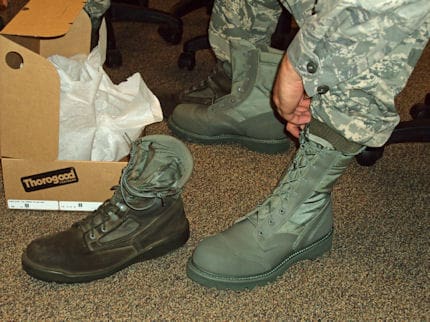
One of the major issues brought to the attention of the latest Air Force Uniform Board is the susceptibility of suede boots to the grease and other lubricants often encountered by maintainers. The new sage green boot has been singled out as looking particularly natty after just a few days on the flight line. Although many Airmen maintain that the tan suede boots currently issued for wear in the CENTCOM AOR are less likely to show stains.


Still to be determined is who will be allowed to wear black boots and under what circumstances. What has been made very clear is that the sage boot is here to stay but the material may change to something more robust or the suede may receive a stain resistant treatment.

Team Soldier Certified Gear

Thursday, June 19th, 2008

PEO-Soldier mentioned this item at the APBI in May, but didn’t have any details on implementation. However, they have just made a formal announcement of the Team Soldier Certification program. The reasoning behind the program is sound. The point is to help Soldiers identify soldier systems items that meet certifications for issue. This will help both individual Soldiers as well as units to avoid purchasing substandard equipment. Certification has already been implemented for Protective Eyewear, FR Gloves, and the Family of Flashlights.

PEO Soldier is developing Authorized Products Lists (APLs) for certain types of gear. When an item is authorized, it is placed on the APL. The APLs are published on the PEO Website, furnished to the Army/Air Force Exchange Service (AAFES), and communicated to Army commands. Eventually every commercial item authorized for use by Soldiers will have this certification.

One VERY interesting piece of information on the program has surfaced. Vendors selling authorized items in commercial retail stores may use the logo on the item and in their advertising. The logo will be the way Soldiers can verify that the item is authorized. Vendors using the logo for commercial retail sale of authorized items will require a License and Royalty Agreement with the US Army. And as a warning to those who might counterfeit the new logo, the PEO-Soldier website says this, “PEO Soldier, working with Army Legal Services, will take action to ensure that only actual authorized items have the logo. A range and series of actions will be taken against any fraudulent use of the logo.”

Each item will be identified with a tag similar to this one.
Team Soldier Certified Gear Tag

Both the USMC and USAF have indicated that they will follow suit.

AFRL’s TRON

Saturday, June 14th, 2008

TRON

My first exposure to TRON was at SOFIC in conjunction with BAE’s Corona system. Since then I have been doing some research on this revolutionary Combat ID system. I post the article from February of this year from Associated Press as a backgrounder.

Originally published by Associated Press February 20, 2008

DAYTON, Ohio – When Taliban forces attacked a police checkpoint in central Afghanistan under dark of night in late 2006, special-operations Master Sgt. Andrew Martin called in air support and then slapped a high-tech cloth-like device on his helmet for protection.

Fresh from labs at Wright-Patterson Air Force Base, the device transmitted light from a powerful light-emitting diode, or LED, that pulsed through a fiber optic bundle, giving off infrared signals visible to pilots wearing night-vision goggles.

“The pilots were able to very quickly pick it up,” recalled Martin, who has since retired from the Air Force. “What didn’t happen was additional questions from the pilots asking me my location.”

The new technology – called Target Recognition Operator Notification system – was designed to easily identify friendly forces and avoid casualties from friendly fire.

Martin liked the equipment so much he used it on about 35 missions over six months. He said it is better than strobe lights, which can be mistaken for machine-gun fire, or reflective tape, which is difficult to see from the air.

“U.S. forces have been dogged by the difficulty of finding each other in the fog of battle,” said Loren Thompson, a defense analyst with the Lexington Institute in Arlington, Va. “What this new innovation allows is easy identification of friendly forces without helping the enemy do the same thing.”

Brian Hunt, an engineer with the Air Force Research Lab, said he and his team were approached in 2004 and asked to develop such a system. Working with Lumitex Inc. of Strongsville, the effort was part of a rapid-reaction program where researchers were given up to $100,000 and one year to come up with a product.

“A lot of different units saw the need for something like this, to be able to clearly determine friend or foe,” Hunt said.

The group produced 108 prototypes in six months. Each unit costs about $100.

Built in to the nylon-like cloth is a circuit board and a battery pack. The woven nature of the cloth emits light in a controlled way, creating a uniform surface.

The system can run 200 hours on two double-A batteries and weighs less than three ounces. It can be worn on tactical vests, around an arm or mounted to a helmet.

“You can put it anywhere,” Hunt said. “It’s got Velcro on the back. It sticks to everything.”

The circuitry also allows the system to flash at different speeds. That enables pilots to identify different groups of friendly forces and see which group is under attack, which group is trying to circle the enemy, and who the reinforcements are, among other things.

Mike Sedillo, support contractor at the research lab, said he would like to see the system in the hands of all U.S. forces in the battlefield and become standard equipment in air-crew survival kits.

Sedillo said researchers are working to upgrade the system so it will transmit light in other parts of the spectrum, making it more difficult for enemy forces to detect with conventional night vision technology.

“Friendly fire incidents in general are declining, but in counterinsurgency or counter-terror warfare it’s much harder to sort out our people from the other side because there are no front lines,” Thompson said. “This invention is well-suited to a world in which all the old features of battlefield like secure areas and front lines are missing.”

Copyright AP 2008, Photo Copyright AP 2008

The Danger of Optical Brighteners

Monday, June 9th, 2008

This article courtesy of

Some detergents a hazard for ABUs

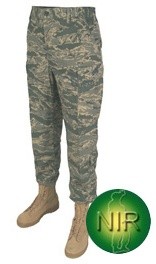
EIELSON AIR FORCE BASE, Alaska--Pictured, the Army Combat Uniform, with material identical to the Airman Battle Uniform, shows the difference optical brighteners make under ultra-violet lighting. Laundry detergents with additives known as
Download HiRes

by compiled from staff reports
354th Fighter Wing Public Affairs

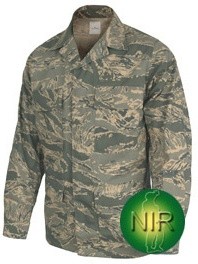
9/4/2007 – EIELSON AIR FORCE BASE, Alaska — Laundry additives known as “optical brighteners” should not be used for washing the Airman Battle Uniform.

Laundry instructions for ABUs specify not using any laundry detergents that contain optical brighteners.

Optical Brighteners make the ABU more detectable by night vision equipment and make the ABU more visible in a low-light environment of any kind, by reflecting more of any available light.

Optical brighteners are chemicals that absorb the ultraviolet and violet region of colors in a fabric. They trick the eye into seeing a brighter shade and reflect more light.

Near Infrared (nIR) capability of the ABU is degraded when washed with detergents containing optical brighteners. Because most commercial detergents contain optical brighteners, there is generally no indication on the packaging.

The impact of optical brighteners is permanent, it cannot be washed out.

Laundry detergents that do not contain optical brighteners:
Bold Powder
Cheer Liquid (all versions)
Cheer Powder (all versions)
All Powder (all versions)
Surf Powder (all versions)
All Detergent Free Clear Country Save Liquid Detergent
Allen’s Naturally Laundry Detergent (liquid and powder)
Bi-O-Kleen Laundry Detergent (liquid and powder)
Charlie’s Soap (liquid and powder)
ECOS Free and Clear Laundry Detergent
Mountain Green Liquid Laundry Detergent
Nature Clean (liquid and powder)
Ecover Ecological Liquid Detergent
Oxy-Prime Powdered Laundry Detergent
Planet Ultra laundry detergents
Seventh Generation Laundry detergents
SportwashSun and Earth LiquidSurf Powder (not Surf Liquid)
Washeze
Woolite, original and dark.

*No federal endorsement of products intended

Air Force FIRESAFE Program

Saturday, May 24th, 2008

The Air Force Clothing Office is hard at work developing new clothing for Airmen serving in ground combat.

The overarching program is called FIRESAFE and charged with development of the Airman Combat System – Ground, Fire Resistant Airman Battle Uniform and the thus far, ill-fated Airman Battle Shirt.

The Fire Resistant Airman Battle Uniform should be on track as the Air Force is leveraging an Army contract for the FR ACU and has only to decide how the coat’s pockets will be laid out. Amazingly, this remains a point of contention for all of the FR clothing items even though they have no garrison application. There is still a faction that wants the enlisted to wear their stripes on their sleeves even in the field.

The Airman Combat System – Ground will consist of under garments, a battle uniform, cold weather clothing, ballistic protection, load carrying system, and ancillary items (these were unspecified).

Air Force clothing programs

Tuesday, May 20th, 2008

The mythical Airman Battle Shirt based on the Army’s successful (Army of One chest logo aside) Army Combat Shirt has yet to even see prototype stage. The original plan was to leverage the Army ACS contract and just change the color to the Air Force pattern in order to get the garment to the troops as quickly as possible. However, sources tell me that the entire program has been held up by one action officer in theater who feels that forearm pockets would be superior to the current bicep pockets found on the ACS.

And the band played on…