FirstSpear TV

Archive for the ‘Boots’ Category

Nike Unveils Project Amplify, the World’s First Powered Footwear System for Running and Walking

Monday, October 27th, 2025

What to know

  • Nike’s Project Amplify is the world’s first powered footwear system for running and walking, designed to help everyday athletes* go a little bit faster and farther — all with less effort. 
  • Engineered to augment natural lower leg and ankle movement, the Project Amplify system breaks the perception of possibility by providing an unparalleled boost to anyone who wants to move, creating a new future for running, jogging and walking. 
  • Still early in testing, Nike is blending art and science to reach performance readiness,working alongside robotics partner Dephy to bring the footwear system to a broad consumer launch in the coming years. 

Nike is unveiling Project Amplify: the world’s first powered footwear system for running and walking, designed to help everyday athletes go a little bit faster and farther — all with less effort.

Engineered to augment natural lower leg and ankle movement, the Project Amplify system breaks the perception of possibility by providing an unparalleled boost to anyone who wants to move, creating a new future for running, jogging and walking. 

Built on motion algorithms informed by the Nike Sport Research Lab, the first-generation footwear system is comprised of a lightweight, powerful motor; drive belt; and rechargeable cuff battery?that seamlessly integrate with a carbon fiber–plated running shoe that can be worn with or without the robotics system.

This makes it easier for everyday athletes to walk or run more often, for longer amounts of time, while having more fun — adding movement to their lives, extending their walking commute, or helping them to enjoy the run for another mile or two.

Each application reflects Nike’s unmatched commitment to solving problems for athletes, improving their experience and powering the future of sport. What’s more: Project Amplify represents one of four major technological advances Nike is unveiling this month, joining innovations across Air apparel, advanced cooling, and mind science in demonstrating the depth, breadth and impact of the brand’s commitment to athlete-centered innovation.

“Our job is to dream big while keeping athletes at the center,” says Michael Donaghu, VP of Create The Future, Emerging Sport and Innovation. “Project Amplify started with a single question: What if we could find a way to help athletes move faster and farther with less energy and a lot more fun? At its core, Project Amplify is about seamlessly adding a little more power to your stride. The fun comes from realizing you can do more than you thought you could — whatever ‘more’ means to you.”

Akin to how electric bikes have made it easier to ride farther and more frequently, revolutionizing urban commuting, Nike is developing Project Amplify to make slower running, jogging and walking easier and more fun, with a focus on athletes running between a 10- and 12-minute mile pace.

The first-generation product, created alongside robotics partner Dephy, isn’t designed for competitive, faster runners trying to shave seconds off their time; rather, it’s intended to serve athletes who want to go faster and farther with less effort by giving them more power for everyday movement — in effect, a second set of calf muscles.

That approach is backed by insights developed from NSRL testing involving athletes of all abilities and intensities, who have shared that the system feels like it’s part of their body and that it makes walking or running uphill feel like moving on flat ground. For some, wearing Project Amplify helps them go from a 12-minute mile to a 10-minute mile.

These learnings are the product of extensive testing over several years, both in outdoor environments and the NSRL. More than 400 athletes have covered over 2.4 million steps, the equivalent of roughly 12,000 laps around the NSRL’s 200-meter track, in more than nine different versions of the hardware —?each iteration focused on refining a different element of the system. 

“Is this new for Nike? Yes and no,” says Donaghu. “It’s obviously a new innovation, but the day Bill Bowerman poured rubber into the family waffle iron was the start of a journey to augment movement and create the future of sport. We’ve always believed movement is medicine, and Project Amplify is the next chapter in that story. It’s a bold leap forward, crossing a new threshold of putting power directly into your stride.”

With Project Amplify still in the testing stage, Nike is blending art and science to reach performance readiness and bring the footwear system to a broad consumer launch in the coming years. 

* If you have a body, you are an athlete.

AUSA 25 – Meindl GORE-TEX ECWCS Boot

Wednesday, October 22nd, 2025

Visitors to the GORE-Tex brand booth at AUSA got an eyeful of cold weather gear, but if we zoom in on the left hand side of the booth, we can check out the Meindl GORE-TEX ECWCS Boot.

Meindl is a German boot manufacturer and they offer a two-boot system for extreme cold wet operations down to -50°C / -60°F.

The Outerboot is made from EXTRAGUARD, a manmade fabric from W.L. Gore & Assoc. that wears like leather but does not absorb moisture, perfect for extreme cold environments, particularly when intermittent wet conditions are encountered. The rand features a wide rubber strip to protect the boot from crampon cuts. This, along with a rigid sole system integrates well with crampons, snow shoes and skis.

Features of the the two components:

Removable GORE-TEX Insert

  • Lightweight / Low Bulk Insulation
  • Quick Re-dry
  • Waterproof
  • Breathable
  • AIR-ACTIVE® Soft Print Dry Sole

EXTRAGUARD Upper Outerboot

  • Low water pickup / Quick Re-dry
  • Waterproof
  • Very Breathable
  • Low Bulk Insulation (mapped GORE-TEX AIRFIBER and GORE-TEX THERMIUM®)

Visit www.goretexprofessional.com/defense-fabrics for more information.

AUSA 25 – GORE-TEX Introduces Improved Army Wet Weather Boot by McRae Footwear

Thursday, October 16th, 2025

GORE-TEX brand displayed their candidate for an Improved Army Temperate Wet Weather Boot.

This boot is commercially available from McRae Footwear and is a GORE-TEX lined variant of their popular modern jungle boot called the Terrassault (T2) Ultra Light Hot Weather Combat Boot. The addition of the GORE-TEX lining makes them suitable for temperate climates where Soldiers often face cold wet conditions such as in Central Europe and across the much of North America.

The boot is 40% lighter, 25% more breathable, and not to mention more flexible, than the Temperate Combat Boot which was removed from the clothing bag. Currently, Soldiers receive two pairs of Hot Weather Boots. One of these could be swapped out for the Improved Army Temperate Wet Weather Boot to offer Soldiers better foot protection in wet environments.

Wear testers said it was more comfortable and lighter than the temperate combat boot as well as offering an athletic fit.

Below is a chart that compares the current Army Temperate Weather Boot with this proposed replacement and the Army Hot Weather Boot.

Rocky Boots Reinforces Its Commitment to Veterans Through Annual Stand Down Events

Sunday, October 12th, 2025

NELSONVILLE, OH. (October 2025) – Rocky® Boots military, tactical and public service division, reaffirms its ongoing mission to support veterans across Ohio through stand down events – 30 years partnering with the Columbus Stand Down and 10 years with the Athens Stand Down – with the most recent event taking place earlier this month.

Each Fall, Rocky donates 600 pairs of boots to the Columbus Stand Down and 100 pairs to the Athens Stand Down events, helping veterans facing homelessness or hardship stay protected and prepared for whatever comes their way. These events bring together local organizations, healthcare providers, and volunteers to provide essential services such as meals and medical screenings to housing assistance and employment support.

“We’re proud to call Ohio home, and we’re honored to stand beside the organizations that make a difference in the lives of those who’ve served,” said Sarah Williams, marketing manager for Rocky® Boots military and public service division.

“These partnerships are bigger than donations. They are about giving back to our community and sharing our gratitude for their service.”

The Columbus Stand Down and the Athens Stand Down, both took place in early October and were free for veterans and their families. Together, they serve thousands of Ohio veterans each year demonstrating Rocky’s brand heritage of hard work, resilience, and service.

For more information, visit www.rockyboots.com.

US Army OCIE Items with No Economic Value to be Removed from Records

Thursday, September 18th, 2025

Earlier this year, the US Army released ALARACT 056/2025, providing updated guidance on the disposition and disposal of Organizational Clothing and Individual Equipment (OCIE) items determined to have no economic value (NEV).

ALARACT 056/2025 outlines the process for removing legacy and end-of-life (EOL) OCIE items from Soldier OCIE records.

Central Issue Facilities (CIF) will remove listed NEV OCIE items from Soldier records during appointments. A new system, Soldier Equipment and Asset Management (SEAM), will automate this process in the future.

Soldiers will be authorized to dispose of certain items and other items will be collected for demilitarization. Patches/insignia will need to be removed, and IR tabs destroyed before disposal.

HQDA, DCS, G-4 will be updating AR 700-84 and CTA 50-900 to reflect EOL processes.

The attached photo depicts OCIE items retained by the Soldier. Helmets, Armor and Sleep Systems will be turned in to CIF upon PCS/ETS.

5.11 Adds New Twist to Stache Sneaker with Latest Color Release, “Iron Grey”

Wednesday, September 10th, 2025

5.11, the global innovator of purpose-built apparel, footwear, and gear, has introduced a new colorway of its renowned Stache Sneaker, in collaboration with The Firearm Blog’s James Reeves. The new shade, Iron Grey, has a dark grey canvas exterior, while the interior pops with tropical vibes and a rebellious edge — a red backdrop featuring hibiscus blooms colliding with skull graphics. The look is finished with a clean, off-white rubber outsole for contrast, making it equally at home on the street or on the move.

The new iteration still boasts all the same trademark features, including a Vibram® bottom that grips like a beast,?a compatible?deconstructed upper?for reduced weight and supreme comfort, and the signature ‘stash’ pocket on the shoe’s tongue perfect for stowing spare valuables. Whether you’re navigating a day at work, urban jungles, or blazing your own trail, the Stache™ Sneaker is your go-anywhere, do-anything footwear companion.

“For me, the real test was whether The Stache could handle real life — from long days on your feet to being machine-washed and crammed into the bottom of a duffel bag before a trip. That’s the kind of reliability I wanted, and I’m proud that this shoe delivers without compromise,” said Reeves.

PRODUCT DETAILS:

MSRP: $95

Also offered in black and ranger green

Sizes available range from 7 to 13

Deconstructed styling

Retro-camo interior lining and outsole area stitch

Ortholite ® insole

Flexible and breathable 1200D nylon upper

The Stache is now available online at www.511tactical.com and in select 5.11 retail stores nationwide.

SORD – Mountain and Cold Weather Operations Booties

Friday, August 8th, 2025

From SORD come the Mountain and Cold Weather Operations (MACWO) Booties.

Insulated with the lightest indication currently available, Primaloft Cross Core Ultra Insulation which contains Aerogel, combined with a DWR-coated NanoSteath 70d Ripstop AU-T Camouflage upper, 210D Ripstop Nylon rand, MIL-SPEC GripTAC non-slip sole and thermal reflective inner lining. These tent booties weigh just 100 grams.

Offered in AU Terrain or MultiCam in sizes 8-10 or 11-13.

www.sordaustralia.com/macwo-booties

Marine Corps Systems Command Explores Cutting-Edge Boot Designs to Enhance Warfighter Lethality

Friday, July 25th, 2025

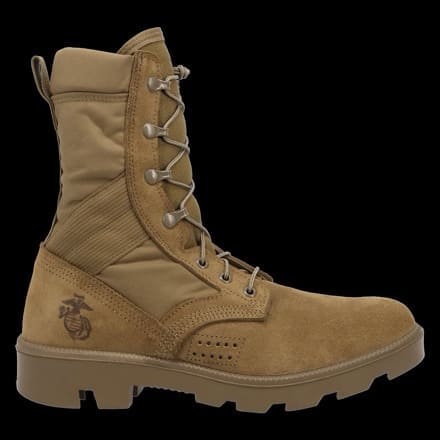
To enhance the lethality of individual Marine warfighters, 25 School of Infantry-West instructors will spend the summer testing a new design for Marine Corps Systems Command’s (MARCORSYSCOM) Optional Boot Program.

This model, which features lighter weight materials, unique drainage ports for improved breathability, and improved ergonomics to reduce leg and back injuries, follows a similar evaluation that took place earlier this year at Camp Lejeune, N.C., where Marines with 2nd Reconnaissance Battalion tested footwear that included advanced orthotic technology.

“The entire process takes about six months,” explained Todd Towles, team lead for Clothing and Equipment, Combat Service Support Equipment (CSSE). “It’s all about determining the fit, form, function, and durability; all at a reasonable price point for the Marines.”

The Optional Boot Program ensures only the highest-performing footwear makes it to the field. The process begins with a detailed visual inspection assessing color shade consistency, proper height, weight, and overall workmanship. After passing this initial review, boots undergo four months of rigorous field testing—worn daily by active-duty Marines in demanding conditions.

“Never satisfied with the status quo, the Marine Corps always looks for ways to improve the warfighter experience,” said Force Recon Company Senior Enlisted Advisor Master Sgt. Andrew Perryman, 2nd Reconnaissance Battalion. “If a product isn’t meeting the standard then it’s cut from the inventory.”

Alongside this summer’s real-world evaluation, which will determine if the boots dry faster to allow for better foot health, lab testing further validates durability, comfort, and quality, reinforcing the Corps’ commitment to providing Marines with superior equipment designed to weather the most challenging missions.

“We see the Optional Boot Program as a way to access the best technology and give Marines more options on fit, performance, and availability on the shelves,” said Maj. Joshua Foster, project officer for CSSE. “We need a diverse set of vendors to ensure we can sustain the fleet’s needs—that has been a serious challenge based on supply chain and quality issues over the last several years.”

The program office for Combat Support Systems (CSS) plays a crucial role in life cycle management for all clothing and individual equipment issued to Marines supporting global operations. From concept development through testing, procurement, fielding, and sustainment, this office ensures that every item meets the toughest standards for performance and durability in extreme environments. The Marine Corps’ rigorous evaluation protocols—often conducted in the most austere conditions—set a high mark.

“Our primary concern is equipping our Marines with quality gear, when they need it,” said Towles, a Marine veteran who has worked with MARCORSYSCOM for almost 20 years. “Anything less and we’re failing them.”

“Through joint clothing boards, we can share test data and lessons learned across DoD. We also seek to adopt equipment tested by the other services to save the Marine Corps on costs and evaluation time; especially when tasks or environments are common among service members. It is a great partnership,” remarked Foster.

This collaboration increases the buying power of the Marine Corps and Joint Force.

“With mission success often hinging on staying warm, dry, and mobile, the meticulous efforts of our team guarantees that Marines are equipped with top-tier gear that embodies the Corps’ unwavering commitment to excellence,” said Towles. “Certification is not permanent; we conduct frequent inspections with our Marine Corps Exchange partners to ensure Marine clothing and footwear continues to meet our standards.”

Illustrating that point, by continuing to push for quality and performance, the CSS team recently identified the delivery of deficient US-made footwear.

“Once we discovered the issue, the program office along with the boot vendor did an MCX-enterprise inspection and identified all stock not acceptable by Marine standards,” said Towles.

Nearly 25 percent of the boots were returned to manufacturers—ultimately preventing Marines from buying substandard gear.

“We were disappointed with them missing the mark, but pleased with their response,” said Towles. “Our vendors understand that the Marine Corps has high standards when it comes to our uniform items, even if the materials are part of an optional purchase. The vendors understand the Marine Corps has a high bar and they will be dropped from the program and removed from our shelves if they do not maintain quality.”

In a briefing last Spring, Col. Paul Gillikin, discussed several key factors impacting this product line such as competition, supply chain, and quality assurance.

“Over the last several years, the Marine Corps and Department of Defense has been challenged in uniforms, uniform accessories, personal protective gear, and footwear,” said Gillikin, program manager for CSS. “Starting with COVID production and supply chain issues, many of our domestic industry partners could not keep up with demand due to staffing shortfalls, access to materials, or quality.”

Gillikin, who has served as the program manager for CSS for two years, explained there have been several instances of acute and long-term issues with uniform items while his team sought new, innovative technologies to improve the performance of Marines while lowering costs.

“We have a great relationship and a lot of successes with our vendors, however, corrective actions and quality assurance problems with some have been a burden that distracts us from seeking better equipment,” he said. “The optional certification program allows us to reach both U.S. and [Trade Agreement Act] manufacturers with a low barrier to entry for vendors and low-cost testing for the Marine Corps. In the long term, an increased number of vendors leads to lower prices and greater innovation. We as a [Department of Defense] enterprise have to be sensitive to that and stimulate a diverse array of manufacturers to include domestic and TAA compliant sources. The bottom line is that the Optional Boot Program incentivizes competition and challenges vendors to actively manage their supply chains and produce the best technology at a lower cost for Marines.”

Currently, most optional boots that are approved to wear, and available for purchase, fall between $189 to $399 retail.

“When I talk with Marines around the fleet, they bring up affordability, access, and quality of materials,” said Gillikin. “It’s an important factor to Marines, and some are struggling financially. Cost is already a central metric for me, but it takes on a whole different level when you talk with younger Marines that are trying to support a family.”

To this end, CSS recently screened additional domestic and Trade Agreement Act (TAA) compliant materials.

“Competition is driving innovation,” said Gillikin. “Marines are excited to test and use the equipment! Our team does supply chain surveillance to ensure quality and supplies come from compliant countries. We are in constant communication with industry, other joint force program offices, Marine Corps stakeholders, the Defense Logistics Agency, and our partners on Capitol Hill to ensure our needs are met.”

Gillikin also said their communication efforts include potential future needs of the Marines Corps as well.

“We expect the next war to be a heavily contested environment where stockpiling and additional sources of supply will be vital,” he said. “For risk reduction, my team has war-gamed multiple scenarios for building prepositioning stockpiles using domestic and TAA manufacturers along with direct shipping TAA compliant gear straight into theater during conflict into areas such as the First Island Chain and High North. We need to keep all options on the table – competition directly supports operational effectiveness and readiness.”

For more information about the Marine Corps Systems Command’s Optional Boot Program and its certification process, visit www.marcorsyscom.marines.mil.

Story by Clinton Firstbrook 

Marine Corps Systems Command