Archive for the ‘Air Force’ Category
Forces Focus – AFSOC CV-22 Special Mission Aviators
Wednesday, March 20th, 2013Forces Focus – SOF TACP
Friday, March 15th, 2013
Forces Focus – USAF Special Tactics
Sunday, March 3rd, 2013
A Quick Spot of Battlefield Airmen
Sunday, February 24th, 2013
AFSOC Goes Back to the Future and Establishes Air Warfare Center
Sunday, February 17th, 2013In the early 1960s the United States Air Force established a Special Air Warfare Center at Hurlburt Field, Florida the modern home of AFSOC. There, they trained Air Commandos in irregular warfare, a concept that the USAF has paid lip service to over the past ten years but done little actualize. To create this new Special Operations Air Warfare Center, AFSOC transformed the existing Special Operations Training Center and added a much needed, expanded aviation advisor capability.
BG Jon Weeks assumed command of the new Special Operations Air Warfare Center last week which also, interestingly enough, now also includes the 919th Air Force Reserve Special Operations Wing at Duke Field as well as two Air Guard units in Mississippi and Alabama.
Headquartered at Hurlburt Field with operating locations at the nearby Duke Field and Robins Air Force Base, Georgia, The Air Warfare Center will organize, train, educate and equip special operations forces; lead major command of counter-insurgency and irregular warfare missions; test and evaluate weapons programs; and develop tactics, techniques and guidelines for special operations missions.
Defensor Fortis Bracelet from Survival Fashion
Sunday, December 9th, 2012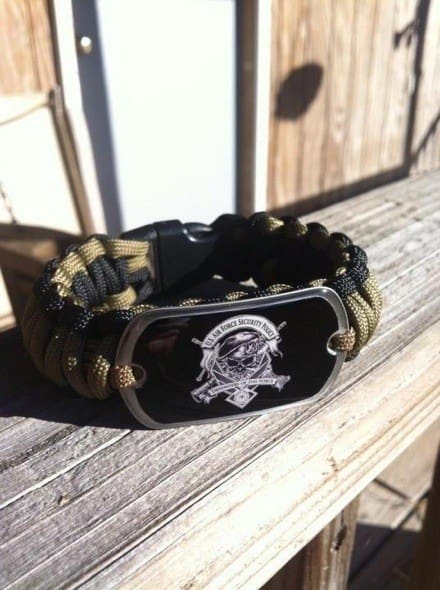
Here’s something cool that I ran across for my USAF Security Forces buddies. It says ‘Security Police’ which reminds me. It’s hard to believe that it’s been 15 years since the change but do any of you guys remember why they changed it from SP to SF?
Get yours through Survival Fasions.
The SR-71 ‘Pick’
Wednesday, December 5th, 2012Offered by some guys I used to be stationed with in the Air Force, the SR-71, also referred to as ‘the Pick’, is a very specialized piece of kit used in airfield surveys.

It’s a simple soil strength surveying device used Internationally by Surveyors when assessing semi-prepared and un-prepared airfields. Individuals or a team of surveyors can quickly assess large areas and trouble spots / weak areas on an airfield by ‘picking’ the ground and checking top layers of soil for indicators of GO or NO GO criteria. This can save a lot of time as you may find that there’s no need to even break out the Dynamic Cone Penetrometer.

specialtacticssolutions.com/STS_Products
SERE Specialist – Fast Food
Sunday, November 18th, 2012