Celebrate 20 years of the TLR-1

Archive for the ‘Congress’ Category

Congressional Camo: The Opposition Speaks

Sunday, August 2nd, 2009

While no one has fessed up to backing the proposed legislation requiring a common camo pattern and combat uniform for all US forces, some in Congress have made their displeasure with the measure known.

Rep. Mike Coffman (R-CO) initiated a letter last week that was signed by seven other members of the House Armed Services Committee (HASC). The joint letter was sent to HASC Chairman Ike Skelton (D-MO) and HASC Ranking Member Buck McKeon (R-CA) expressing strong opposition to a provision in H.R. 2647, the National Defense Authorization Act (NDAA) for Fiscal Year 2010. The provision, Section 352, mandates that all future military ground combat uniforms be a single, standardized design.

Rep Coffman estimates this measure could cost in excess of $5 Billion if enacted. He brings a unique perspective on the issue to a Congress that only boasts just over 100 members who are Veterans. Rep Coffman has served in both the US Army and Marine Corps including service as enlisted as well as officer and in the first Gulf war and current operations.

Please see the contents of the letter below.

# # #

July 16, 2009
The Honorable Ike Skelton The Honorable Buck McKeon
Chairman Ranking Member
House Armed Services Committee House Armed Services Committee
2120 Rayburn House Office Building 2120 Rayburn House Office Building
Washington, D.C. 20515 Washington, D.C. 20515

Dear Chairman Skelton and Ranking Member McKeon:

As Members of the House Armed Services Committee, we are proud that the National Defense Authorization Act for Fiscal Year 2010, passed by the House of Representatives this June, provides for our nation’s warfighters in many ways. However, we respectfully write to express our strong concerns about a troubling provision for a common combat uniform that was included in the bill absent widespread notice and without any debate. This language, Section 352, calls for the Secretary of Defense to ensure that future ground combat uniforms be a single, standardized type.

Section 352, titled “Requirements for Standard Ground Combat Uniform”, lists several flawed rationales for mandating our military Services into a policy that all of the uniformed Service chiefs oppose. This is an expensive initiative that, while well-intentioned, neglects key tactical, cultural, economic, and practical considerations.

Although this provision is intended to increase interoperability of ground combat forces, thus far we have yet to hear of any mission, operation, or campaign’s failure due to uniforms that prevented interoperability. We are certain you will agree that training, leadership, doctrine, and trust cultivate interoperability – not clothing.

The proposed common battle uniform is also intended to eliminate any alleged “uniqueness” that could pose a tactical risk in a theater of operations. They know that all our servicemembers are well trained, well led, and well equipped. The enemy is not taking special care to target one Service over another.

A common battle uniform would also allegedly minimize production costs and the costs for issuing the uniforms. Current law (Title 10 U.S.C. § 5063, USC Section 771) provides for the existing policy of the Services’ uniqueness in their combat uniforms. As such, since 2001 each Service has created, tested, and distributed its own combat uniforms based on their unique mission sets, physical environments, and servicemember surveys. They have each invested the time and the money to outfit their respective Services.

Preliminary analysis by the Department of Defense estimates $4.85 billion to retrofit approximately 2.2 million DoD personnel to a single combat uniform. This initial cost analysis does not include development and sustainment costs. To force such a change after the Services have just completed fielding of their distinctive uniforms is an unconscionable waste of nearly five billion taxpayer dollars, in addition to wasting the funds that have already been spent on the fielding the individual Service combat uniforms.

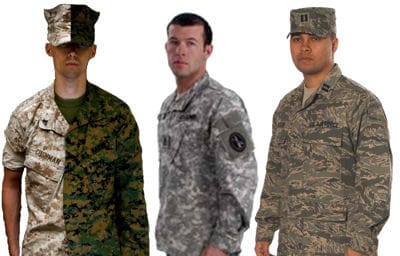
Each Service has a proud tradition and reputation around the world and taking away their distinctive combat uniforms removes their connection with our friends and foes alike. The villagers in a suburb outside of Baghdad see ACUs and know that those were the Americans that pushed out the insurgents and restored their electrical power. The insurgents in Fallujah see the Marine Corps Combat Utility Uniform (MCCUU) and will tell you that there is “no better friend, and no worse enemy.” This connection is key to our nation’s warfighters accomplishing their missions.

At a time when our military faces so many critical missions, and our country’s defense budget is increasingly stretched thin, an unnecessary proposal such as this serves no practical purpose. It has an extensive price tag and takes away the individual military Services’ identity at home and abroad.

We look forward to working with you, and the Senate Armed Services Committee, to correct this provision in the upcoming conference for the National Defense Authorization Act for Fiscal Year 2010. Thank you for your time and consideration.

Sincerely,

Mike Coffman Duncan Hunter
Member of Congress Member of Congress

Vic Snyder Mike Conaway
Member of Congress Member of Congress

Robert J. Whittman Doug Lamborn
Member of Congress Member of Congress

Trent Franks Todd Akin
Member of Congress Member of Congress

Congress Proposes Common Ground Combat Uniform

Thursday, July 30th, 2009

In the 2010 House Defense Authorization bill there is a section that would require standard ground combat uniforms.

“Section 352—

Requirements for Standard Ground Combat Uniform This section would require the Secretary of Defense, in consultation with the Defense Logistics Agency, to require that future ground combat uniforms be standardized in order to ensure increased interoperability of ground combat forces and reduce tactical risks encountered when military personnel wear a different uniform from their counterparts in the other military services in a combat area.

The committee notes that, previously all the military services used the same desert camouflage uniform or the standard battle dress uniform, both in the temperate and enhanced weather versions. However, the Defense Supply Center Philadelphia of the Defense Logistics Agency, which is responsible for the manufacture of all U.S. military uniforms, now procures unique camouflage utility uniforms for each of the military services: the Army combat uniform, the Airman battle uniform, the Navy working uniform, and the Marine Corps combat utility uniform.

The committee is concerned that the recent move toward unique service camouflage uniforms has resulted in increased costs and production inefficiencies. For example, problems with consistency in fabric shading have required remanufacture of some uniforms. In addition, the costs for the unique uniforms are substantially more than for the standard battle dress uniform because of the differences in design, camouflage pattern, and type of fabric.

Most importantly, the committee is concerned that this uniqueness poses a tactical risk in theater, especially for those assigned to combatant commands or as individual augmentees who may be wearing a different uniform from those they are serving with in combat.

The committee also notes that service-specific battle dress uniforms magnify the challenges and costs associated with procuring personal protective gear and body armor that conform to the design and coloration of the basic uniform”

US Military Utility Uniforms

Well, Congress pretty much hit the nail on the head, just six years too late. This horse has been out of the barn for awhile but it does seem that the hoopla over the Army’s use of UCP in Afghanistan has attracted some thoughtful analysis. Interestingly, these are essentially the same arguments made by Robert Strange McNamara when he was Secretary of Defense during the Kennedy administration. At his direction, in the early 1960s the services moved to a standard uniform including boots and at one point, even T-shirts. However, this proposed legislation also references an issue that has been a major concern in the field and that is fratricide and OPSEC.

The services rely heavily on their individual uniforms for branding purposes so it is unclear how the departments may react to such a directive. Although, according to the document, there is some wiggle room including a reference to “future ground combat uniforms” which might allow the services to delay any changes to coincide with the fielding of future individual equipment ensembles. Another issue is that the bill references both utility uniforms as well as combat uniforms. Interestingly, Army, Air Force, and Marine Corps have all adopted FR combat uniforms that closely resemble one another except in the area of camouflage. The real differences come to play in the utility uniform realm. Such distinctions might make implementation difficult.

There have been calls within industry for some time for the services to adopt a single color scheme in order to simplify production and realize cost savings. While the implications of such legislation are very deep for the military as well as industry, it is important to note that this is still just a bill and not yet law. In fact, it may not even make it out of committee.

Thanks to ADS Ventures for alerting us to this legislation. It will be interesting to find out who is promoting this particular measure.

Isakson Amendment

Saturday, July 18th, 2009

Ok, so you are asking yourself, “What’s the Isakson Amendment?” Well, if you are a Soldier or Airman deploying to combat in the future this may be one of the most important pieces of legislation ever. Based on an urgent need for Fire resistant uniforms Congress passed a waiver to the Berry Amendment last year for the procurement of foreign produced fire resistant rayon fiber. Unfortunately, the waiver runs out in 2013. In budget years, that’s right round the corner.

Sponsored by Sen. Johnny Isakson, R-Ga, this Amendment to the 2010 Defense Authorization Act permanently raises the sunset on the Berry waiver.

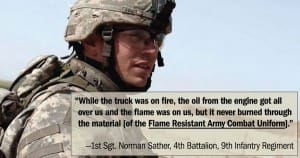
1SG Norman Sather
Photo: US Army

While some may assume that this foreign produced fiber might pose a threat to the US textile industry, this is not true. for one thing, the fibers cannot be produced here in the US due to EPA restrictions. Additionally, the material is shipped from Austria in bales and once it arrives in the US is spun into yarn. Only then is the FR rayon woven into cloth, printed, and cut and sewn. The use of this fabric supports over 10,000 jobs in 14 states. Obviously, it isn’t a threat to the American textile industry. In fact, the opposite seems true.

If the waiver is not renewed, critical FR ACUs like the one that saved 1SG Sather will come in short supply. Unfortunately, the US industrial base would not be able to keep up with the current and projected demand for FR fabrics which are made up of a combination of domestic materials augmented with 65% of the FR rayon fiber. This combination was chosen by the US Army as the best performer from among over 24 candidates as the rayon provides added strength to the fabric and helps our domestically produced fibers go further.

Please support this important legislation.

Camo Wars: An Opportunity to Excel

Friday, July 10th, 2009

What with Congress prompting the Army to adopt a new camouflage pattern specifically for operations in Afghanistan this is the perfect opportunity to procure equipment that is tuned for use in harsh mountainous and high desert regions.

Since it seems that they will likely end up doing something in the camo arena, we certainly hope that the Army will look at this as an opportunity to procure some innovative products and not just buy more standard issue equipment in a new color. In addition to providing the Soldier with equipment that is as appropriate to the environment as the camouflage this would also give the industry a little bit of a kick in the pants since much of the out-of-the-box thinking happens in the smaller companies who are better suited to such smaller procurements.

While the American Warrior is better protected than ever, it has come at a price. Since the beginning of Operation IRAQI FREEDOM the load for the individual Soldier has increased over ten pounds. The Army is already working towards this goal with programs such as the Releasable Plate Carrier but other products can be manufactured from lighterweight fabrics such as 500D Cordura and multi-purpose equipment should also be considered.

Camo Conundrum

Wednesday, July 8th, 2009

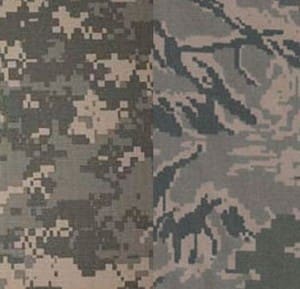
After a discussion I had earlier today a thought struck me. Why did Congress tell the Army that UCP was unfit for service in Afghanistan yet give the Air Force a free pass with it’s Digitized tiger Stripe pattern? The colorway remains the same with one exception. The Air Force added Slate Blue to the Army’s three other colors. Sure it darkens the pattern up a bit but both patterns look all but indistinguishable at distances of more than 100 meters. So what gives? Is Air Force DTS good but Army UCP bad? And if so, what is this based on? See for yourself.

UCP - DTS comparison

Camo Rumors – Some Observations

Sunday, July 5th, 2009

Ever since Congress told the Army that the Universal Camouflage Pattern (UCP) used on the Army Combat Uniform (ACU) wasn’t cutting it in Afghanistan, rumors and just plain old bad info has been swirling about the internet so I thought I’d share a few thoughts on the subject.

Urban Legend 1 -Multicam Uber Alles. Despite internet hype and the military version of an urban legend, Multicam is not replacing UCP in 2011 or 2012. As best I can tell this rumor came about because the Future Force Warrior program was supposed to be fielded in, you guessed it, 2011. It so happens that all of the photos of guys suited up in the FFW garb were swathed in Multicam goodness. For some odd reason, folks couldn’t divorce the concept of FFW from Multicam. Hence the urban legend. Naturally, this new round of Congressionally driven controversy has only fanned the flames of this untruth. Think about it. The Army just spent a gazillion dollars changing everything to UCP. In fact, fielding isn’t even complete. So ask yourself this question. Why would the Army spend a “gazillion” dollars on a new camo pattern and turn right around a field a new one mid-stream? The answer? It wouldn’t. They want to buy FCS not new uniforms.


Urban Legend 2 – UCP is going away completely. It isn’t. The Congressional “suggestion” is only for forces in Afghanistan not the whole shebang.

Urban Legend 3 – The Marine Corps offered MARPAT to the Army and they turned it down. Total Fantasy. Here is a truth. These patterns are about branding. When you see MARPAT, you think “Marine”. When you see UCP you think “Soldier”. MARPAT was developed for the Marine Corps. General Jones, former Commandant of the Marine Corps wanted a uniform that would let his enemies know when Marines were in town. He got one.

Urban Legend 4 – The Army didn’t adopt Multicam because they would have to pay a license for Multicam / it was too expensive. Once again; False. The Army helped pay for the development of Multicam. There is no “license”. Also, the more Multicam printed, the cheaper it gets. The more you buy, the less you pay.

desert brush variant 3

I feel for the Army. What a big poop sandwich. “Hey Army, UCP stinks, issue something else. But use the money we already gave you for OTHER stuff.” You can’t just change out uniforms. You have to replace all of the Soldier’s other kit as well or the contrast will just highlight the guy. So the Army is going to have to compute this huge cost for one theater. That was the point of UCP in the first place. One camo…universal. No more issuing two different patterns to guys…economize.

I feel even worse for the poor action officer at PEO-Soldier who has to develop the decision brief on this one. For example:
COA 1 – Do nothing…Tell Congress “Nuts”, I mean after all, UCP does work in some parts of Afghanistan.
COA 2 – Do Nothing…Beg Congress for cash
COA 3 – Stall…conduct study (Attn PEO-Soldier, I am available for contract to conduct said study)
COA 4 – Issue Woodland or Three-Color Desert
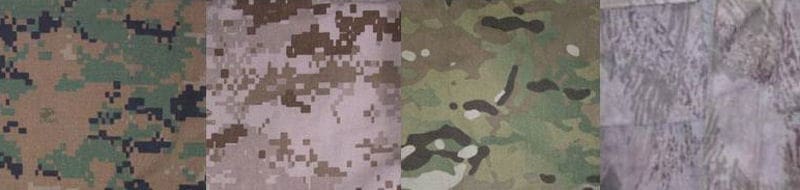
COA 5 – Adopt all new pattern – See pic above

Option 5? That is the fantasy option. Or is it? There are select US forces rocking Multicam all over the place. Oddly enough, so are Snipers. Aside from that, the Army spent a great deal of time and effort developing and testing several patterns any of which could be dusted off including the one in the photo.

However, I am voting for some combo of one or more of the first three with COA 4 as the ultimate outcome. There is already precedence with the Army’s G1 permitting USASOC forces to wear Woodland camo. Plus, there are stock of the older patterns that can be drawn from to get this thing rolling.

Do we love Multicam at Soldier Systems Daily? You’re damned right we do. Will it be adopted for use in Afghanistan? Who knows at this point, but it sure will be interesting watching whatever ultimately happens.

Congress Cares About Camo

Wednesday, June 17th, 2009

It seems someone clued Congress in on the fact that the Universal Camouflage Pattern issued to troops fighting in Afghanistan is far from the ideal. So Congress has told the Army to issue something better. Well, the first word in UCP is after all “Universal” and that makes it a compromise since it has to blend in everywhere. Oddly, Afghanistan is not monochrome and there are a variety of environments to blend in with so ultimately a “Universal” camouflage is what is called for after all. Maybe it just needs to be tuned a bit.

Here is the wording from the Conference Committee Report.
“The conferees understand that soldiers deployed to Afghanistan have serious concerns about the current combat uniform which they indicate provides ineffective camouflage given the environment in Afghanistan. Accordingly, the conferees direct that within funding made available the Department of Defense take immediate action to provide combat uniforms to personnel deployed to Afghanistan with a camouflage pattern that is suited to the environment of Afghanistan.

The conferees further direct the Secretary of the Army to provide a report on the program plans and budgetary adjustments necessary to provide appropriate uniforms to deployed and deploying troops to Afghanistan. The report shall be submitted to the congressional defense committees by the end of fiscal year 2009.”

So Congress wants the Army to reprogram money “immediately” to provide an alternative camo pattern for forces in Afghanistan and report to the Armed Services Committees before the end of the fiscal year on it will be accomplished. Can you imagine how this went over when word reached PEO-Soldier? “The jig is up, they’re on to us”.

Now please remember, that this still isn’t law. The President hasn’t signed it YET but is expected to soon.

So how will this play out? Interesting question, considering when asked just weeks ago at the Soldier Systems APBI about the possibility of alternative camouflage patterns, PEO-Soldier officials gave a curt, “No”. However, it has come to our attention that the 173d Airborne Brigade has been granted approval to wear Multicam during their OEF rotation. So that option seems open…maybe. Alternatively, it is highly unlikely that any new SOCOM patterns will be used by general purpose forces. 3-color desert pattern is still available but was replaced by the “superior” UCP so institutional momentum may veto its use. Desert MARPAT is a possibility, if the Army can wade through the interservice rivalry issues. And finally, what about an entirely new pattern, or old for that matter? Several promising designs were tested by Natick in the 2003-2004 time frame before UCP was adopted virtually out of nowhere.

Ultimately, it is going to be about cost. It isn’t just uniforms. There are a variety of other equipage and accouterments that must also be produced in an alternative pattern. And all of this while the Army is still in the throes of a complete roll out of the UCP pattern. Who will foot the bill? Congress has essentially issued budgetary guidance to the Army to reprogram funds.