FirstSpear

Archive for the ‘Optics’ Category

Two New Soldier Optics Work Together To Offer Rapid Target Acquisition

Thursday, July 23rd, 2015

I recently received an email from PEO Soldier’s Public Affairs team inviting me to a media round table on a rather intriguing subject, “Shooting around corners? Sci-fi or battlefield reality?”  With a promise like that, of course I had to find out more.

Yesterday, several members of the media had an opportunity to listen to a presentation by COL Michael Sloane, Project Manager Soldier Sensors and Lasers (PM SSL). He was accompanied by LTC Timothy Fuller, Product Manager Soldier Maneuver Sensors (PM SMS) and assisted via telephone by Mr. Phil Cheatham, Deputy Branch Chief, Electronics and Special Developments, Maneuver Center of Excellence (MCoE) at Fort Benning.

First off, I’ll give you a little background on PM SSL. COL Mike Sloane began by telling us about his team’s mission which is to provide the tools needed for the US Soldier and Squad to maintain overmatch, in any environment. In this case you’ll see, they are offering leap ahead technology to our Soldiers.

PM SSL provides Soldiers with improved lethality, mobility, and survivability in all weather and visibility conditions. Soldier-borne sensors and lasers enhance the Soldier’s ability to see in all battlefield and lighting conditions, to acquire objects of military significance before the Soldier is detected, and to target threat objects accurately for engagement by Soldiers or precision-guided munitions. These systems provide critical, on-the-ground direct support to U.S. forces.

As the security environment changes America’s Soldiers expect the best piece of equipment for the mission. They deploy anytime, anywhere around the world and thier equipment needs to work. COL Sloane told us this is why they keep their equipment reliability rates high; 100% availability.

It’s a Team Effort
PM SSL doesn’t do this in a vacuum. In addition to working closely with the other PMs at PEO Soldier, they maintain relationships with the Centers of Excellence (Maneuver, Fires and Aviation), the ARDECs under AMC, particularly CERDEC and its Night Vision and Electronic Sensors Directorate (Night Vision Labs). Night Vision Labs is located in the same compound on Fort Belvoir as PM SSL making it easy to interface. In fact, PM SSL has embedded personnel in the lab. However, COL Sloane is quite proud of the rapport his team has built with the warfighter. They spend a lot of time visiting troops both CONUS and abroad.

While MCOE at Ft Benning identifies technology gaps, PM SSL solicits input from Soldiers. Throughout the process, PM SSL conducts sessions referred to as ‘Soldier touch points’ which help ensure that their fingerprints are on the designs. While these range days focus mainly on the warfighter, they strive to include every MOS in the process. They also work with the readiness centers such as JRTC to observe Soldiers and Squads as they train on live fire lanes to extract feedback on how they use their equipment. Whether something is ised can be just as important as how.

Last but not least, PM SSL regularly, and in great detail, interfaces with industry, conducting numerous industry days for each program as well as hosting industry for meetings at Ft Belvoir.

Better Buying Power
COL Sloane mentioned a couple of ways they make more effective use of their procurement funds. He said they continue to incentivize industry through competition. I’ll add to that by pointing out that they offer competition that results in contract awards, unlike some programs that end up being money pits for industry. This competition also helps control pricing and results in improved Size Weight and Power (SWAP) performance. Additionally, they also utilize Government Furnished Equipment as system components in some instances, which helps control cost. For one program, these combined measures have saved the U.S. Army $198 million.

New Technology
While the background was critical to a frame of reference, the true subjects of the presentation were two current issue pieces of equipment managed by PM SSL, the Thermal Weapon Sight and AN/PSQ-20 Enhanced Night Vision Goggle as well as the follow-ons to both of these systems.

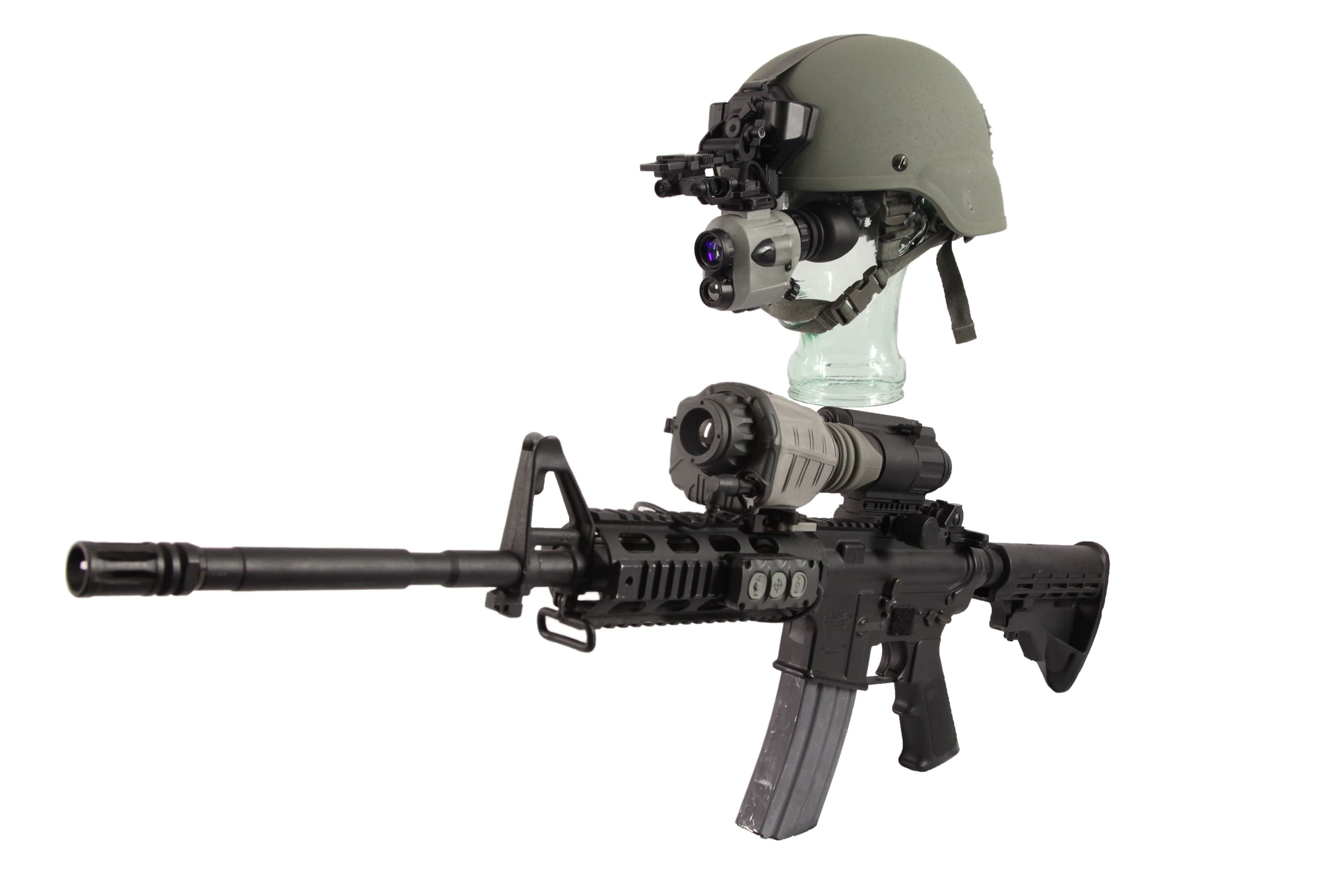
LTC Tim Fuller walked us through these technologies. The current Enhanced Night Vision Goggle II (ENVG II) is being updated with the advent of the ENVG III, whereas the current Thermal Weapon Sight’s (TWS) follow-on is the Family of Weapon Sights-Individual (FWS-I). He described the fledgling Family of Weapon Sights as a “leap ahead”. They’ve been working for about two years with this capability which improves Soldier survivability, lethality, and mobility. Additionally, both of these new systems can be used alone or in conjunction with one another in a new way to offer what is called Rapid Target Acquisition or RTA.


Since in the late 1990s the Thermal Weapon Sight program has fielded three generations of sensors, each reducing size and weight while increasing performance. For example, they’ve decreased weight from the Gen I’s 3 lbs to just under 2 lbs with the latest variant. Additionally, that first variant was a stand-alone only model while the newest TWS can be used as a clip-on sight to extend the capability of existing optics. They’ve also lowered the original cost from around $11,000 to $5,000 now.


The evolution of the Enhanced Night Vision Goggle is interesting. The current ENVG II is a more elegant design than its predecessor and features a wider FOV for the thermal. That’s due to a higher resolution thermal sensor. While the original ENVG I, which was built by ITT, has a smaller I2 tube than we are currently used to experiencing with the AN/PVS14 monocular, the II and III generation each use a standardized tube which is provided by the Army to the manufacturer as Government Furnished Equipment, and integrated into the goggle during production at the factory.

This offers several advantages. First, it ensures a common I2 tube, meaning known performance characteristics. Second, it allows the government to negotiate directly with the I2 tube manufacturers for greater savings across these and other programs rather than having vendors in each program purchase the tubes at different prices. Finally, the government can determine schedule priorities of when programs will receive tubes.

Once again, the Army went to industry with a set of attainable technology goals and industry responded by using their own internal Research and Development (IRAD) Dollars to be competitive.  FWS family will use uncooled, forward-looking infrared technology. The first of these, the Family of Weapon Sights – Individual which is currently in development, can be used with the M16, M4 and now the M249. It is the smallest and lightest thermal weapon sight in the Army’s inventory and can be used as a stand alone sight or as a clip-on for use in conjunction with optical sights.

Here’s where it gets interesting. The FWS-I can now “talk” to ENVG III. The FWS-I is attached to the Individual Weapon or SAW and its reticle can be superimposed as a Narrow Field of View image on the display of the helmet worn ENVG III, right on top of the already fused I2/onboard thermal sensor image. With this technology, a Soldier can see where his weapon is pointed, whether or not it is shouldered and characterize what he is looking at, thanks to the fused image.


These signals are now all digital and the Soldier can individually control the channels which are fused into a common display. Soldiers can toggle through three modes: Spatially aligned mode, Picture in picture mode and FWS-I only mode.

The digital image is transmitted from the FWS-I to an antenna on the ENVG III and then routed through a fiber optic cable to the smart battery pack mounted at the rear of the helmet. This is where the processor is located. This special, ENVG III compatible battery pack is a component of the FWS-I. The ENVG will continue to be fielded with its own standard battery pack. At the processor, the thermal image with reticle is stitched unto the ENVG’s display in the processor. Everything is lined up with one image embedded into the other. A major advantage is that RTA keeps the Soldier passive so no need to use active laser and create a signature.


Some of you may be interested in how the FWS-I ‘talks’ to the ENVG III. The Army has chosen a low power emitter with a range of about out to three feet but won’t go into any details on signal characteristics.

Separate Image Intensification (I2) and Thermal channels are fused into a single display. While the thermal signal offers 18 to 26 degree FOV, with the ENVG III you get 40 degree FOV in I2 mode. This is common to the standard PVS-14 tube manufactured by L3 Warrior Systems and Harris. These GFE tubes are provided to the two ENVG vendors. Once again, this means that ENVG manufacturers, BAE and DRS integrate the government furnished tubes into the ENVG, which saves money.

The fused image will allow the green I2 image to be enhanced by a thermal overlay in orange that indicates a heat signature. This is great for identifying camouflaged targets or those obscured by smoke. Now, the narrow FOV images from the FWS-I can also be integrated into the image, including the reticle, in the correct aspect of the Soldier’s view. This means that Soldiers can observe or engage a target without being directly behind the weapon’s sights. Soldiers can not only see around corners, but shoot around them without exposing themselves. Conversely, if the Soldier looks too far off axis, the FWS-I’s reticle will disappear from view.


With the FWS-I, you are looking at 18-26 degree FOV. The FWS-I significantly increases the effective range from 550 meters for the current issue light TWS out to an astounding 1000m range. This almost two-fold increase is due to focal plane array improvements. Such SWAP improvements also equate to a smaller Soldier load in size and weight.

What About Aiming Lasers?
There’s still a requirement for laser pointers and they aren’t going away. If you’re used to using them, you’ll continue to be able to.

New Helmet Mount On The Way As Well
There is a new single hole, helmet mount assembly that will come with the ENVG III to accommodate this new architecture. This is a government design that has been provided to industry for production and incorporated into all new helmet designs coming out of PM Soldier Protection and Individual Equipment. The full ENVG weighs in just under two lbs along with full battery pack, which also serves as a counterbalance for the sensor.

Who Gets Them and When
ENVG III goes into production this summer with fielding in early FY17. FWS-I is just behind with Low Rate Initial Production beginning this summer. Fielding should commence in late FY18, early FY19.

Fielding priorities are up to the Army but they have already fielded 9,011 ENVG I starting in 2009, with another 16,000 ENVG II in the ensuing years. PEO expects to field 41,000 of the new ENVG III. As you can imagine, there’s quite a bit more capability in the newest version so they’ve got a plan to replace those 9,000-plus original models. There are enough cost savings in this latest buy that they can not only purchase enough ENVG IIIs to replace the initial version, but they’ll even have some spare change.

Due to it’s limited numbers, the ENVG II has essentially been fielded as a sensor for leaders.  According to Mr Cheatham, the Basis of Issue Plan for the ENVG III and FWS-I is much more generous. The plan is 24 ENVG III per Infantry platoon and 18 FWS-I per Infantry platoon, across all formations including Infantry, Stryker and Heavy as well as ABCT.

New Capability Spawns New TTPs
Considering Soldiers will more effectively be able to observe and engage targets without being directly behind their weapon, this capability will result in new Tactics, Techniques and Procedures. PEO Soldier has been working with MCOE’s Directorate of Training to identify ways in which this technology can be used so that they can incorporated into doctrine and training programs of instruction.

Some of this information will come with the system’s New Equipment Training which goes to the unit and uses a ‘train-the-trainer’ approach to prepare NCOs to train their subordinates. The planning for this transition to increased use of thermal weapon sights across the force is massive. The Systems Training Plan includes not only matching trainers and units with the fielding schedule but also ammunition and ranges outfitted with thermal target arrays.

Always Use Lithium Batteries
I’ll throw in another plug for Lithium batteries here. The Technical Manuals call for their use with these pieces of equipment. Not only do they provide better power than alkalines, but are more cost effective. Even at a unit cost of 1.5 to 2 times the rate of alkaline batteries, the L91 lithium battery last 5 to 10 times longer. Additionally, lithium batteries offer increased performance in cold weather.

Compatibility Is Key
As these two complimentary programs progress, the PM is working on cross compatibility between vendors to ensure that if a Soldier has a FWS-I from BAE and an ENVG III from DRS (or vice versa) that they work together.

Future Systems
The Family of Weapon Sights will grow to included Sniper and Crew Served Weapon sights, which are in development. A Request For Proposals is coming soon for the Crew Served variant which will offer an onboard display as well as a remote helmet mounted display (HMD). Soldiers manning crew served weapons won’t necessarily be equipped with the fusion goggle so that’s the reason for the dedicated HMD. The Sniper sight is envisioned as a clip on thermal sight that will interface with their daytime glass. It is still in requirement definition.

In Closing
COL Sloane finished the briefing by reiterating that their work with various stakeholders has been vital to the success of these programs. I for one, am pretty excited about the syndergy im seeing with this new capability. I can’t wait to see it placed in the hands of our Soldiers and how it changes the way they fight.

TNVC Introduces the MOD3 Modular NVG

Monday, July 13th, 2015


TNVC is now offering the incredible MOD3 Night Vision Goggle System. The MOD3 is the most modular goggle ever created and features a fully functional binocular system that can be broken down into two individually-operating monoculars in seconds. TNVC assembles the MOD3 with brand new high spec L-3 OMNI VIII MX10160 image tubes complete with factory data sheets.


  

Until now you could either have a binocular or monocular. The MOD-3 overcomes this problem by utilizing Optical Pods that are waterproof, Nitrogen purged units that can be installed into either a monocular or binocular. Power is conducted to the intensifier tube and indicator LEDs by means of spring loaded, gold plated contacts. Even the springs are gold plated to prevent corrosion.

The Optical Pods can be assembled in the MOD-3 Binocular Bridge to form a full function binocular. A latching mechanism firmly holds the Optical Pods in place and is easily manipulated with one finger. Installing or removing the Optical Pods is accomplished in just a couple seconds.

The other half of the MOD-3 system is the MOD-3 Monocular Adapter. This adapts an Optical Pod into a full function monocular. It has the same circuitry as the Binocular Bridge which means you have a flood IR LED, IR “on” indicator, and low battery indicator. It uses the 3V lithium battery as well. It also accepts the IR Spot/Flood adapters like the PVS-7 goggles use.

Like the Binocular Bridge, the Monocular Adapter releases the Optical pod with the press of one finger, allowing instant changeover from monocular to binocular. The monocular housing is waterproof and has a side mount like a PVS-14, allowing you to use it as you would any other monocular with head and weapon mounts. The monocular is 75 grams lighter than a PVS-14.

All MOD3 kits come complete with two full assembled Optic Pods with MILSPEC PVS-14 Objective and Eye Piece Lenses, One Binocular Bridge, and two Monocular Adapters. The Binocular bridge will attach to any dovetail night vision mount interface while the monocular adapters simply require the addition of any PVS-14 J-Arm to attach to a helmet mount.

tnvc.com/shop/ab-nightvision-mod3-modular-goggle-l-3-omni-viii/

Warrior East – Wilcox Industries 3-Hole Low Profile Rail Shroud

Friday, July 10th, 2015

  
Wilcox debuted the new 3-Hole Low Profile Rail Shroud at Warrior East. It accommodates Wilcox DPAM and GSGM mounts for ANVIS-style Night Vision Goggles.

  
Features:
-Wilcox 3- hole pattern
-Aerospace grade aluminum
-Wilcox NVG retention lanyard
-Fits Ops-Core, Team Wendy, ACH, MICH and Crye AirFrame geometry helmets.
-Low Profile and improves eye relief with ANVIS-style NVGs
-Available in Black or Tan
-Available individually or packaged with DPAM or GSGM
-Lifetime Warranty
-100% Made in USA!

Available from Wilcox Industries or authorized dealers.

Norotos – Dual Dovetail Adapter

Tuesday, June 30th, 2015


The Dual Dovetail Adapter replaces the standard PVS-14 “J” arm on PVS-14 goggles offering an Anti-Wobble interface. It’s adjustable, incorporates fully sealed circuitry and rapid right-eye to left-eye transition.

Specifications
Weight: 2.25 oz. / 64 g.
Dimensions: 1.70L x 2.35W x 2.35H

www.norotos.com

Norotos – Lo-Sto Helmet Mount

Friday, June 19th, 2015

The Lo-Sto Force-to-Overcome Helmet Mount w/ Universal Shroud delivers a fully matured system evolving through extensive user-feedback and enhanced application engineering into the most lightweight and compact helmet mount available on the market. Anti-Wobble Optimization ensures the Lo-Sto’s stability with unwavering rugged durability, while remaining adaptable with available quick change sockets for rapid transformation between horn and dovetail style NVGs.


Features:
Vertical, Tilt, and Fore/Aft Adjustment Levers
Helmet Mount Release Button allows one handed release
Break Away Button allows user to set the desire mode for mount (breakaway or locked), depending on users operational needs.
Glide-Rite Infinitely adjustable in both vertical and horizontal directions.
Reduced weight and an enhanced NVG
Low stow on the helmet position

Specifications:
Vertical Range: 1.10”
Weight lbs./grams: 4.9 oz. / 140 g.
Tilt: 23 degrees total
Force-to-overcome pressure for use/stow positioning.
Forward/Aft range: 1.5” (optional)
Auto Shut-off

www.norotos.com

TNVC – IR Defense IR Patrol M300 Thermal Sight

Tuesday, June 16th, 2015

M300WM_af

TNVC is now receiving the IR Defense IR Patrol Thermal Sight. It features a 640 x 480 BAE Systems MicroIR detector with a 12µm Micron sensor pitch. The housing is made of machined 6061 Aircraft Aluminum with a black, corrosion-resistant finish, and the M300 is capable of a runtime of 1.5 hours on a single CR123A battery. The M300 can be ordered with the addition of a weapon mount and helmet mount interface.

download

TNVC also shot some video of the Edge Detect thermal palette mode in action:

tnvc.com/shop/ir-patrol-m250-thermal-monocular-copy

Troya To Reveal Its New Aviator’s NVG, The STRIX, At The Paris Air Show 2015

Thursday, June 11th, 2015

Troya Tech Defense has announced they will reveal their new Aviator’s NVG, The Strix, at the upcoming Paris Air Show 2015. The full release can be read below:

Troya Tech Defense Ltd., an Israeli manufacturer of Electro-Optical devices and Defense related equipment, will expose in the upcoming Air Show in Paris, the STRIX, its new advanced Night Vision Imaging System for Aviators (ANVIS).

Troya was established by veterans of the Israeli Defense industry, with vast experience in the Electro-Optics world. The company has recently developed the STRIX (the name of an owl genus), a Night Vision Goggles for Aviators, or ANVIS (Aviator Night Vision Imaging System), which complements the company’s abilities in the field of aviation. The STRIX allows the pilot for scenery familiarization at nighttime, or in cases when there is no sufficient light source available in the surrounding area. A rotary or fixed wing aircraft can be landed, ground forces acquisition and ranging can be done at ease, all using the STRIX, which is fully compatible to the illuminated panels of the cockpit. The STRIX is very lightweight, can be mounted on the majority of existing pilot helmets in use, and is compatible with various visors.

Click to view .pdf
Strix

“In such case where a certain country does not have modern aircrafts, we can also provide upgrade services and transform the existing cockpit to a fully NVG compatible platform, so that is a non-issue.” Says Troya’s CEO and one of its founders, Mr. Yacov Galam. “It is true that there are already a few ANVIS models available in the market, but you could say the same thing in regards to cellular phones, for instance. And as you know, every year dozens of new models come out to the market, each taking the existing components and their output a few levels above what we knew to be possible before. This is exactly how we see the STRIX- an idea already known to all, but at the same time, with specifications and performance that were never seen before! And on a side note, it also looks amazing. We very much believe in correct design and ergonomics, and we have invested a great deal of time, resources and efforts in order to bring the user interface to the maximum comfort and functionality levels possible. The STRIX is going to be the chosen ANVIS for military and civilian pilots, for all kinds of missions; SAR (Search &Rescue), EMS (Emergency Medical Services), nighttime landing and many more.”

Troya, a new player in the Night Vision production business, develops a broad spectrum of Image Intensifying devices, where the user is exposed to levels of sight and observation that the human eye simply cannot detect. Galam- “A lot of people have already wrote obituaries for the Image Intensifying Tube, and said that the future is going to be all thermal. This has been heard for over a decade, and we still see today , that there is a growing demand for IIT based devices. There is no way around it, you simply shouldn’t change horses in midstream. Having said that, we do acknowledge the special capabilities of the thermal imaging based devices, and we are obviously working at this front as well, with new capabilities to be revealed”.

Troya’s laboratory is at Kibbutz Negba, Israel. Its headquarters are at Ra’anana, Israel. The company has another office at Milan, Italy that deals with the European market.

www.troya-tech.com

TNVC – TM-14 Mk. III Mount Adapter

Thursday, June 11th, 2015

TM14_Mk3_af

TNVC is now shipping the latest iteration of the TM-14 mount adapter for the PVS-14 night vision goggle. This TM-14 Mk. III incorporates end-user feedback to smooth the interface with the Aimpoint Twist Mount Base as well as moving the lanyard loop out from under the J-Arm; making it more accessible. The beauty of the TM14 Mk. III is that it allows users to keep both a weapon and helmet mount adapter attached to the goggle at all times, allowing instantly smooth transitions between active and passive use of the NVG.

TM14_Mk3_g1

tnvc.com/shop/tnvc-tm14-mk2-pvs-14-weapon-mount