GORE-TEX Professional

Archive for the ‘SOF’ Category

90s-Era 5th Group Mod Demo Video – Run Through The Jungle

Monday, January 3rd, 2022

One of the banes of existence in SOF is the requirement to conduct periodic Mod Demos and static displays for visiting dignitaries.

5th SFG(A) created several videos to assist them in this endeavor. This is one of those videos entitled: “Run Through The Jungle” which depicts a Foreign Internal Defense mission, training indigenous forces in infantry tactics for their Counter Narcotics role.

SOFWERX Wants to Help You Understand the Small Business Innovation Research Process

Monday, December 27th, 2021

SOFWERX in conjunction with Dcode is presenting Small Business Innovation Research (SBIR) 101 on 19 January 2022.

Dcode’s procurement experts and USSOCOM leaders will walk you through how SBIRs and STTRs are being leveraged and the value this funding can provide as your company looks to grow.

RSVP NLT 18 January 2022 11:59 PM ET.

Visit events.sofwerx.org/dcode.

GAO Report – Special Operations Forces: Additional Actions Needed to Effectively Manage the Preservation of the Force and Family Program

Friday, December 24th, 2021

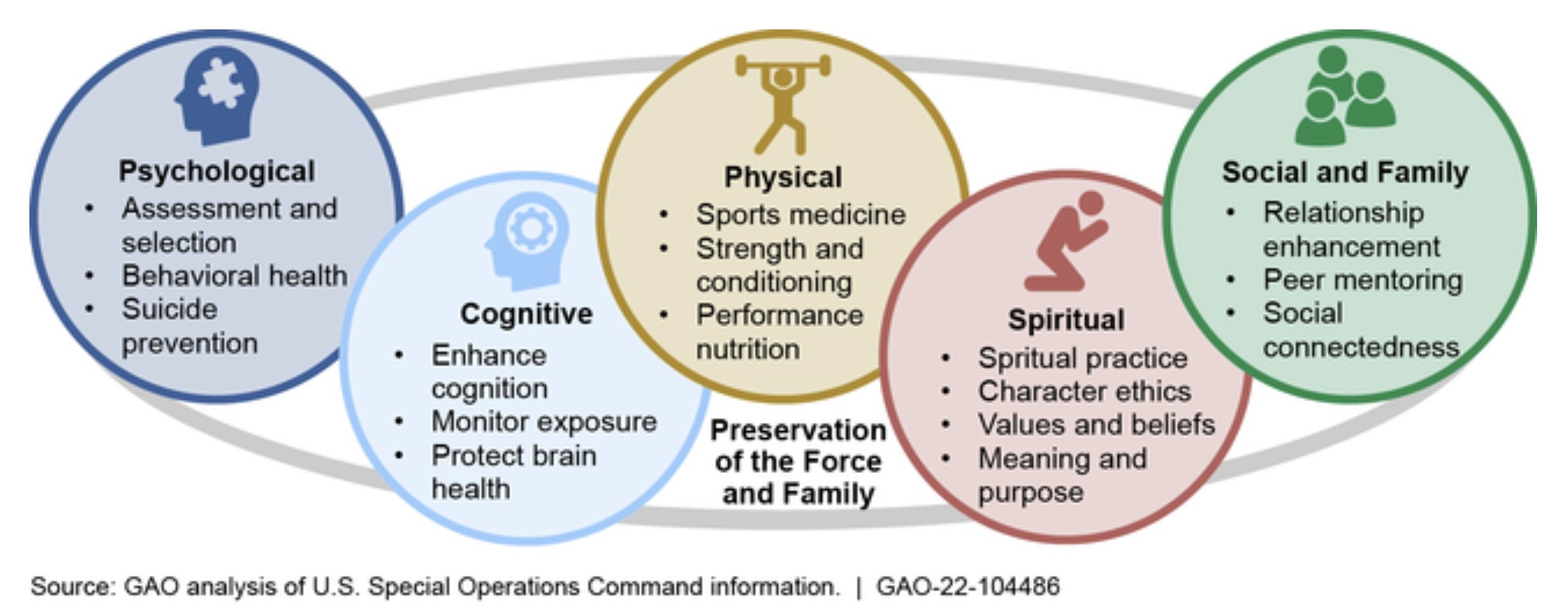
The GAO has released a new report on USSOCOM’s Preservation of the Force and Family Program which boasts a budget of about $80 million in FY 2021.

The program offers a holistic system of care that targets physical, psychological, spiritual, and other areas of well-being. However, key program terms aren’t well defined, making it unclear how subordinate commands will carry the program out and achieve its goals.

What GAO found is that although SOCOM has established minimum requirements for its Preservation of the Force and Family (POTFF) program to improve the readiness and resilience of Special Operations Forces (SOF) and their families, it has not clearly defined a key term—integrated and holistic system of care—to guide implementation of its efforts across the five POTFF domains (see figure). SOCOM officials interpret this key term differently and SOCOM guidance does not provide clarity on how subordinate commands should implement activities to achieve it. Without defining an integrated and holistic system of care or how to achieve it, SOCOM leaves interpretation of the term to subordinate commands and is unable to establish a standard for POTFF’s essential coordination functions or activities against which it can assess efforts to help SOF and their families.

GAO is making five recommendations, including that SOCOM update its guidance to define its objective to coordinate POTFF programs, establish an allocation model that uses program data, develop a deployment strategy that aligns with its updated allocation model, and develop guidance for POTFF data that aligns with SOCOM’s strategy for managing data. DOD concurred with all five of these recommendations.

Read the report here:

www.gao.gov/products/gao-22-104486

SOFWERX – Hyper-Enabled Awareness Kit (HEAK) Assessment Event

Monday, December 20th, 2021

SOFWERX, in collaboration with USSOCOM PEO SOF Warrior (PEO-SW), will host an Assessment Event (AE) 22-24 February 2022 to identify solutions for a situational awareness and messaging capability through a Hyper-Enabled Awareness Kit (HEAK).

Technology Focus Areas

• Blue Force Picture

• Basic Messaging

• Check-in Messaging

• Quick Reference Navigation

• Mission Payload

• Workflow Configurator

• Mission Planner

• Wired and Wireless Capability

Submit NLT 24 January 2022 11:59 PM ET, with details at events.sofwerx.org/heak.

USSOCOM Fact Book 2022

Saturday, December 18th, 2021

Get your copy at www.socom.mil/FactBook/2022%20Fact%20Book

137th SOW Hosts CANSOFCOM Aircrew for MC-12W Training

Saturday, December 18th, 2021

Members of the Canadian Special Operations Forces Command (CANSOFCOM) participated in the first-ever Manned Intelligence, Surveillance and Reconnaissance (ISR) Fundamentals Course held by the 137th Special Operations Group (SOG), Aug. 2-Oct. 25, 2021, at Will Rogers Air National Guard Base, Oklahoma City.

The Canadian aircrew and American instructors collaborated to develop tactics, techniques and procedures (TTPs) for operations with the MC-12W that the CANSOFCOM aircrew could use to further develop a training syllabus for their aircraft.

“The training gained here will be invaluable to developing TTPs and bringing our new aircraft into the service,” said Canadian LCol François Lavertu, Commanding Officer of 427 Special Operations Aviation Squadron. “We are grateful for U.S. Special Operations Command, Air Force Special Operations Command and the 137th Special Operations Wing’s support and training provided to our troops.”

The program covered both air and ground training, incorporating tactical air control party experience with the Canadian aircrew’s exposure to ground tactics, bringing squadrons from around the base together, including: the 185th Special Operations Squadron, the 146th Air Support Operations Squadron, the 137th Special Operations Support Squadron, the 285th Special Operations Intelligence Squadron and the 189th Intelligence Squadron.

“One of the unique aspects of the courses offered by the 137th SOG is the focused integration of MISR with close air support (CAS) through our MISR management course,” said U.S. Air Force Maj. Karl Hurdle, security cooperation director with the 137th Special Operations Group. “This exposes aircrew to the ground perspective of operating in a two-dimensional battlespace.”

For the aircrew, this perspective helps them understand the platform and how it integrates into a bigger picture.

“This is my first exposure to helping bring a major capability online, and we worked as a team to learn new skillsets and apply them to future roles,” said a CANSOFCOM training participant.

This collaboration is part of the Canadian aircrew’s initial operational training, bringing two years of planning to fruition.

“The 137th Special Operations Wing is uniquely postured to aid in training having stood up our own program under AFSOC less than five years ago,” said U.S. Air Force Maj. Korey Larson, operations officer for the 137th SOG, Detachment 1. “With a two-week academic phase and three flying phases, our expert instructors in both the ground and air provided these aviators with perspective on the mission that other wings are not able to do without outsourcing the training. To my knowledge, the 137th Special Operations Wing is one of the only ones that has both a MISR squadron and an air support operations squadron assigned and collocated, making for much more effective operators with this enhanced integration.”

With six NATO partner nations participating in various training programs hosted by 137th Special Operations Wing units this year, the training marked a new addition to the already extensive training catalogue. Squadrons from around Will Rogers ANGB worked in concert to create a multi-functional and international battlespace to develop effective training for these aviators.

“The CANSOFCOM aviators had backgrounds in multiple fixed- and rotary-wing aircraft, which allowed for great feedback to our instructor cadre on the course, and we will implement many of the recommendations that they provided for any future training with foreign partners,” said Larson. “Sharing our unique program and honing training with this iteration will allow the wing to have lasting effects on both partner force and United States Combined Operations throughout the world.”

Story by TSgt Brigette Waltermire 

137th Special Operations Wing Public Affairs

Rapid Dragon’s First Live Fire Test of a Palletized Weapon System Deployed from a Cargo Aircraft Destroys Target

Friday, December 17th, 2021

EGLIN AIR FORCE BASE, FLORIDA (AFRL) – The Air Force Rapid Dragon Program, a fast-paced experimentation campaign led by the Air Force Strategic Development Planning and Experimentation (SDPE) office, successfully completed its final flight test December 16 at the Eglin AFB Overwater Test Range.

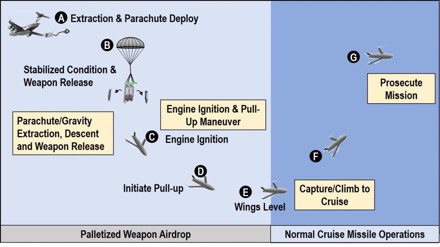
The flight test capstoned a 2-year series and culminated in a live fire of a current inventory cruise missile armed with a live warhead. Rapid Dragon demonstrates the ability to employ weapons using standard airdrop procedures from cargo aircraft using the Rapid Dragon Palletized Weapon System.

The program name is derived from a thousand-year-old Chinese military designed crossbow catapult that launched multiple crossbow bolts with the pull of a single trigger, raining destruction down on armies from tremendous ranges. These lethal devices were called Ji Long Che—Rapid Dragon Carts. Today, the Rapid Dragon concept is changing the game again, this time as an airborne delivery system for U.S. Air Force weapons. And like its namesake, these palletized munitions promise to unleash mighty salvos en masse on distant adversaries.

During the December test, an MC-130J flown by an Air Force Special Operations Command operational flight crew, received new targeting data while in flight which was then routed to the cruise missile flight test vehicle (FTV). The aircraft agnostic Battle Management System’s inflight receipt and upload of the new targeting data into the FTV was a first-time achievement with a live cruise missile.

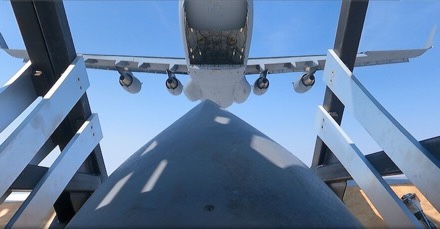
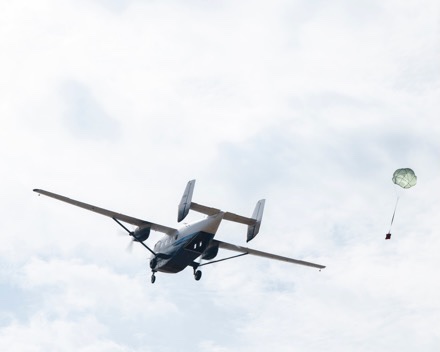
Once inside the drop zone over the Gulf of Mexico, the MC-130J aircrew airdropped a four-cell Rapid Dragon deployment system containing the FTV and three mass simulants, which were sequentially released from the palletized deployment box while under parachute. Safe separation from the deployment box and weapon deconfliction was demonstrated using an unconventional deployment method (nose-down vertical orientation). Immediately after the vertical release, the FTV deployed its wings and tail, achieved aerodynamic control, ignited its engine, performed a powered pull-up maneuver, and proceeded toward its newly assigned target. The cruise missile successfully destroyed its target upon impact.

The next step for the Rapid Dragon Program will be a live-fire test with a cruise missile from a C-17 in Spring 2022, demonstrating the aircraft agnostic capabilities of the Palletized Weapon System. Of note, the new retargeting methodology developed by the Rapid Dragon team is designed to be transferrable to other strike and cargo platforms, potentially increasing the lethality of those aircraft. Lastly, a follow-on program will look at expanding the Rapid Dragon carriage portfolio to include additional weapon systems and multiple effects capabilities, as well as continuing the maturation of the system, taking it from a developmental prototype to an operational prototype over the next two years.

“This type of experimentation campaign, that address capability gaps and demonstrates transformative efforts, helps us shape future requirements and reduces timeline to fielding,” said Maj. Gen. Heather Pringle, Air Force Research Laboratory commander, adding “This approach ultimately enables a rapid fielding alternative to traditional lengthy acquisition timelines.”

In addition to SDPE and AFSOC, demonstration participants included the Naval Surface Warfare Center-Dahlgren; Standoff Munitions Application Center; Lockheed Martin Missiles and Fire Control; Systima Technologies; Safran Electronics & Defense, Parachutes USA, and R4 Integration, Inc.

Agility and collaboration enabled this government/industry team to go from a design to a system level flight test in 10 months, followed by a live fire five months later. During those last five months, Rapid Dragon has conducted five system level flight tests using three different aircraft (MC-130J, EC-130SJ, and C-17A).

“Rapid Dragon is a prime example of a government/industry partnership that embraces this acceleration mindset, building a community of subject matter experts and executing an aggressive, but well-thought-out, experimentation campaign,” said Dr. Dean Evans, SDPE’s Rapid Dragon Program Manager.  This sentiment was echoed by Aaron Klosterman, SDPE’s Experimentation & Prototyping Division Chief when he said, “This accomplishment is a testament to what an agile U.S. Air Force and industry team can do when it is empowered to do business differently.”

The successful Rapid Dragon experiments pave the way for U.S. and allied mobility platforms to dramatically increase fires available for a combatant commander to place more adversary targets at risk. 

“Rapid Dragon was able to accelerate development by building a broad and strong team.  We were committed to a ’test often/learn-fast’ culture, dedicated to experimenting frequently and taking calculated risks. In addition to the MAJCOMs and Air Staff, the Rapid Dragon team included the Developmental Test (DT) and Operational Test (OT) communities, the aircraft and weapons Program Offices, and the mission planners. This collaboration from the onset streamlined the process and accelerated development, involving groups from the program inception that are not normally included at the very early stages, and that has made all the difference,” Evans added.

By Air Force Research Laboratory Public Affairs

1st Special Forces Command Releases New Vision Statement

Wednesday, December 15th, 2021

The Premier Partnered Irregular Warfare Force:

24,000 Strong

7 Special Forces Groups

2 Psychological Operations Group’s

1 Civil Affairs Brigade

1 Special Operations Sustainment Brigade

United under a single patch,

Focused on a single purpose.