XC3 Weaponlight

Archive for the ‘Army’ Category

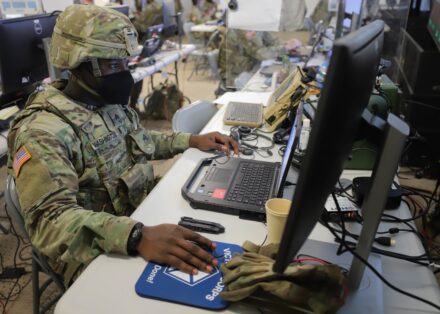
US Army Revamps Cyber Doctrine to Support Joint Warfighters

Wednesday, August 25th, 2021

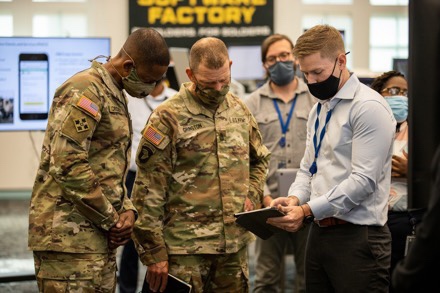
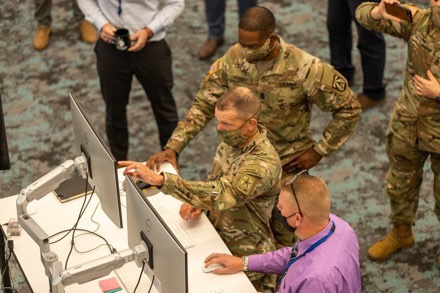
AUGUSTA, Ga. — The Army plans to update its cyber operations doctrine, as it continues to march toward a more data-driven joint environment, a top Army cyber officer said last week.

Once published, the updated field manual, FM 3-12, will outline how the service plans to integrate its cyber operations mission into the larger vision of a modernized Army, said Brig. Gen. Paul T. Stanton, commander of the U.S. Army Cyber Center of Excellence.

Although no timeline was given on the document, Stanton said during the AFCEA TechNet conference on Aug. 17 that his team was moving quickly. The doctrine was last revised in 2017.

“The [new doctrine] is being drafted as we speak,” said Lt. Gen. Ted Martin, commander of the Army Combined Arms Center, in a pre-recorded video.

Martin said the doctrine, which stems from the National Defense Strategy of 2018, will continually evolve to keep pace with new technology and help the Army increase its lethality against near-peer threats.

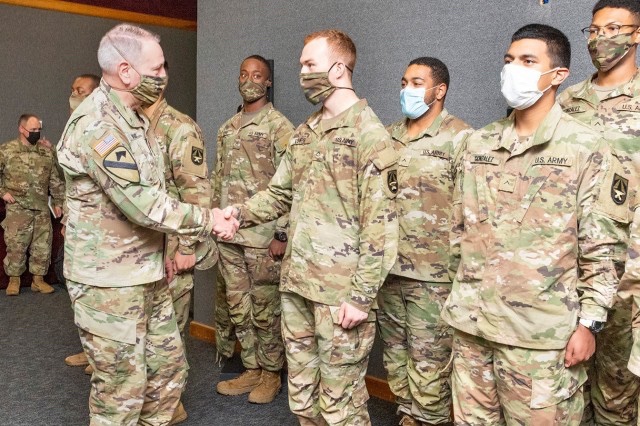
Despite being a cyber-based field manual, Stanton said the entire Army could benefit from it and not just cyber operators.

For example, at the Army Maneuver Center of Excellence, Soldiers can adapt the document in their classrooms to explain how cyber can be used by them, he said.

The major role cyber plays in the future is also why leaders across the Army need to be on board with how to use it, he added.

“If there’s one theme across all this, it’s that we are driving operations for commanders,” Stanton said. “Commanders are the ones that make the decisions [and] commanders are the ones that develop the course of action and scheme of maneuver.”

In the future, all commanders will have to know the ins and outs of the Army’s cyber doctrine and cannot “bury their heads in the sand and say, ‘I can’t understand the science,’” he said.

“We can help abstract away some of the complexity of the science, but our commanders have to understand the fundamentals because this is a huge part of how we’re going to fight in the future,” he continued.

Even with knowledgeable leaders, achieving an information advantage through cyber is not possible without a unified network supporting it, he said.

To bring about a unified network, the Army is looking to use the latest technologies such as 5G capability, zero-trust cybersecurity and pulling data from the cloud.

No place where information advantage is more critical than on a joint battlefield, Stanton said, where warfighters may need to collaborate against a potential adversary.

Multi-domain operations will require data to be pulled from several locations. By pulling information, it “implies that my tactical edge assets are combined with my operational [and strategic] assets,” Stanton said.

“I have to move the right data to the right place at the right time inside the decision cycle of the adversary, so that I can maintain [the] information advantage,” he continued. “I can’t do that without a unified network.”

A common operational picture that brings together data from the tactical, operational and strategic levels helps enable commanders to make quick decisions, he said.

However, being able to pull the data isn’t enough. Army officials “have to protect that information,” Stanton said. “We’re pushing hard toward a zero-trust environment and an architecture to support and apply zero-trust principles across the entire Department of Defense Information Network.”

While the future of cyber warfare continues to change, Martin said that with the help of junior leaders, “we can get it right.”

“You don’t have to be a general to come up with this doctrine,” Martin told the crowd. “I feel that the best ideas are out there in the audience right now, because at [U.S. Army Training and Doctrine Command] — victory starts here.”

By Thomas Brading, Army News Service

CSASS Goes To War

Sunday, August 22nd, 2021

Paratroopers of the 82nd Airborne Division’s Immediate Response Force prepare personnel and equipment for a deployment to the U. S. Central Command Area of Operations. The Immediate Response Force is charged with remaining ready to answer the Nation’s call to deploy to anywhere in the world at a moments notice.

10th SFG(A) Group Foundations Course

Saturday, August 21st, 2021

The Group Foundations Course is a two-week course designed for Green Berets new to 10th SFG(A). During this two-week process, the new Special Forces Operators learn about the history of the group and cover the fundamentals of being an Original – which includes combatives, pistol and rifle marksmanship, physical fitness and in-depth military vehicle familiarization.

Leaping Squirrels Could Help Scientists Develop More Agile Robots

Friday, August 20th, 2021

RESEARCH TRIANGLE PARK, N.C. — Understanding the split-second decisions squirrels make as they jump from tree branch to tree branch will help scientists develop more agile robots.

With funding from the U.S. Army, researchers at University of California, Berkeley studied how squirrels decide whether or not to take a leap and how they assess their biomechanical abilities to know whether they can land safely.

Understanding how squirrels learn the limits of their agility could help scientists design autonomous robots that can nimbly move through varied landscapes to help with military missions such as traveling through the rubble of a collapsed building to aid in search and rescue or to quickly access an environmental threat.

“The team at UC Berkeley is challenging the comfort zone of today’s robotic design in a very clever way, taking us one step closer to tomorrow’s truly autonomous and versatile robots,” said Dr. Dean Culver, program manager for Complex Dynamics and Systems at the U.S. Army Combat Capabilities Development Command, known as DEVCOM, Army Research Laboratory. “Studying organisms’ behavior, like jumping squirrels, lets the engineering community ask fascinating questions about an autonomous agent trying to navigate an uncertain environment. For example, what stimuli cause learning? How does the interplay between structural compliance in a limb and surprises in an environment permit adjustments during a maneuver?”

To tackle these questions, Dr. Robert Full, professor at UC Berkeley and former doctoral student Dr. Nathanial Hunt, now an assistant professor of biomechanics at the University of Nebraska, Omaha, joined forces with professor of psychology Dr. Lucia Jacobs and former UC Berkeley doctoral student Judy Jinn.

Jacobs and her students developed precise methods to study cognition in wild campus squirrels, and they proposed integrating these studies with biomechanics, extending Full’s laboratory models not only to mammals for the first time, but to a wild mammal–squirrels–that had experienced the full natural development of its agility.

In the journal Science, the researchers report on their experiments on free-ranging squirrels, quantifying how they learn to leap from different types of launching pads–some bendy, some not–in just a few attempts, how they change their body orientation in midair based on the quality of their launch, and how they alter their landing maneuvers in real-time, depending on the stability of the final perch.

“As a model organism to understand the biological limits of balance and agility, I would argue that squirrels are second to none,” said Hunt, now an assistant professor of biomechanics at the University of Nebraska, Omaha. “If we try to understand how squirrels do this, then we may discover general principles of high-performance locomotion in the canopy and other complex terrains that apply to the movements of other animals and robots.”

Researchers conducted the experiments in a eucalyptus grove on the UC Berkeley campus, where the Berkeley team enticed fox squirrels that roam the campus into sketchy situations where they had to decide whether to leap for a peanut or let it go.

They found that, as expected, the flimsier or more compliant the branch from which squirrels have to leap, the more cautious they were. But, it took squirrels just a few attempts to adjust to different compliances.

“When they leap across a gap, they decide where to take off based on a tradeoff between branch flexibility and the size of the gap they must leap,” Hunt said. “And when they encounter a branch with novel mechanical properties, they learn to adjust their launching mechanics in just a few jumps. This behavioral flexibility that adapts to the mechanics and geometry of leaping and landing structures is important to accurately leaping across a gap to land on a small target.”

The squirrels don’t balance the bendiness of the launching branch and the gap distance equally. In fact, the compliance of the branch was six times more critical than the gap distance in deciding whether to jump.

This may be because squirrels know that their sharp claws will save them if they miscalculate. Their claws are so failproof, Hunt said, that none of the squirrels ever fell, despite wobbly leaps and over- or undershot landings.

“They’re not always going to have their best performance–they just have to be good enough,” he said. “They have redundancy. So, if they miss, they don’t hit their center of mass right on the landing perch, they’re amazing at being able to grab onto it. They’ll swing underneath, they’ll swing over the top. They just don’t fall.”

That’s where exploration and innovation come into play as squirrels search for the best leaping strategy.

“If they leap into the air with too much speed or too little speed, they can use a variety of landing maneuvers to compensate,” Hunt said. “If they jump too far, they roll forward around the branch. If they jump short, they will land with their front legs and swing underneath before pulling themselves up on top of the perch. This combination of adaptive planning behaviors, learning control and reactive stabilizing maneuvers helps them move quickly through the branches without falling.”

One unsuspected innovation was that during tricky jumps, squirrels would often reorient their bodies to push off a vertical surface, like in human parkour, to adjust their speed and insure a better landing. Parkour is a sport in which people leap, vault, swing or use other movements to quickly traverse obstacles without the use of equipment.


“Learning from squirrels the limitations of improvisation with a given controller architecture and compliant actuators will help engineers understand how to design a robot controller and actuators to maximize improvisational capabilities,” Dean said. “To get to that next step for more agile robots, we first have to observe and quantify the ideas of adjustment and improvisation, which this research provides.”

This research complements earlier Army-funded research at UC Berkeley that developed an agile robot, called Salto that looks like a Star Wars Imperial walker in miniature and may be able to aid in scouting and search-and-rescue operations.

In additional to the Army, the National Science Foundation and the National Institutes of Health supported this research.

By U.S. Army DEVCOM Army Research Laboratory Public Affairs

US, Colombian Army Paratroopers Successfully Conclude DFE Bilateral Exercise

Tuesday, August 17th, 2021

TOLEMAIDA AIR BASE, Colombia – U.S. and Colombian army paratroopers concluded a bilateral airborne training exercise July 30 with a demonstration of the tactical capabilities of the Colombian Army’s elite special forces unit, the Lanceros, at Tolemaida Air Base in Colombia.

The six-day U.S. Southern Command (SOUTHCOM) and U.S. Army South bilateral Dynamic Force Employment exercise allowed for the rapid deployment of U.S. troops within the SOUTHCOM area of responsibility to respond to crises and support partner nations in the Western Hemisphere.

Over the course of the week, the two armies collectively trained on day and night airborne operations, a tactical field training exercise, medical evacuation procedures, a combat water survival course and engaged an obstacle course at the Lancero School.

The Lancero School was established by U.S. Army Ranger, and recent Medal of Honor recipient, then-Capt. Ralph Puckett, who earned gallantry for his combat during the Korean War.

Brig. Gen. William L. Thigpen, U.S. Army South commanding general, and Gen. Eduardo Enrique Zapateiro, Colombian army commander, observed the paratroopers take part of the combined airborne jump on the first day of the exercise.

“General Thigpen and I are in the field today, working hard to develop this training and be completely interoperable,” Zapatiero said. “We are going to put in practice all the distinct skills and capabilities that make a great soldier.”

The trip to Colombia marked Thigpen’s first to an Army South partner nation since his assumption of command on June 30, 2021, and provided him an opportunity to see firsthand the operational and tactical capabilities of the Colombian army.

“We want to thank both General Zapateiro and the Colombian Army for hosting us,” Thigpen said. “This Dynamic Force Employment is critical in demonstrating readiness with the U.S. and Colombian Army.”

As SOUTHCOM’s Joint Forces Land Component Command, Army South conducts security cooperation operations and activities with partner nation Armies in the SOUTHCOM area of responsibility in order to strengthen regional security and counter threats in support of a networked defense of the homeland. Through previous agreements at the conclusion of staff talks between the two armies, Army South staff planned, coordinated, synchronized and executed the DFE; with the 82nd Airborne Division serving as the operational unit of the exercise.

U.S. Army jumpmaster and platoon sergeant for Charlie Company, 2nd Battalion, 501st Parachute Infantry Regiment, 1st Brigade Combat Team, 82nd Airborne Division, Sgt. 1st Class Joseph Capen reflected on the efficiency of the Colombian paratroopers with whom he trained and jumped.

“One of my favorite things to see was how similar their military and our military operate,” Capen said. “Another thing was, from a technological standpoint, is they don’t utilize the newest and most advanced equipment, but they are still very proficient in how they operate tactically. It was neat to see.”

The positive impression of the Colombian military echoed throughout the ranks of U.S. paratroopers who took part in the exercise, as they were impacted by the various training events and cultural exchanges during the week.

At the closing ceremony, Lt. Col. David Webb, 2-501st Battalion commander, expressed his gratitude and respect for the military participants from the Colombian army who took part in the Dynamic Force Employment exercise.

“The Colombian military is the best partner force that I’ve worked with in 18 years,” Webb said. “I pray for peace, but I’m always ready for war. If I do have to fight a war, I would be proud to serve with each and every one of you.”

By Joshua Taeckens

Defender Pacific 21: Special Forces Soldiers, JGSDF Conduct Bilateral Operations in Guam

Sunday, August 15th, 2021

GUAM — Two C-130s launch from Yokota Air Base, Tokyo, into midnight darkness on course to deliver airborne personnel with U.S. Army Special Forces and the Japan Ground Self-Defense Force members to Guam.

History is being made as Green Berets with 1st Battalion, 1st Special Forces Group (Airborne), and members of JGSDF, execute their first bilateral airborne operation outside of Japanese territory. On board, both units know well the commands and procedures that lead up to exiting a high-performance aircraft.

The operation begins with a call from the drop zone control party. The pilots check in and wind calls are made. The JGSDF exits on first pass with the Type 13 parachute. On second pass, special operations forces exit with the steerable MC-6 parachute. Directly below is a flight line—which guarantees a hard landing—and grass off to the sides.

On July 30, 2021, a Special Forces Operational Detachment-Alpha (ODA) assigned to 1st SFG (A) and approximately 80 members with JGSDF conducted bilateral operations in Guam as part of Defender Pacific 21.

DP21 is a U.S. Army Pacific exercise designed to operationalize the national Defense Strategy through realistic, iterative training across all domains—land, sea, air, cyber and space.

Following the airborne infiltration, U.S. Special Forces and the JGSDF conducted an air assault in vicinity of their first objective near Naval Base Guam, said the Special Forces ODA team leader assigned to 1st Bn., 1st SFG (A). After destroying the first objective, which were anti-air weapon systems, the bilateral force reconsolidated and moved toward their follow-on mission.

Thirty-six hours elapsed from when mission planning started to when the second objective — an enemy command and control node — was destroyed.

Despite tropical heat, humidity and lack of sleep, the bilateral force conducted a high-performance mass-tactical airborne operation and executed two targets with zero major injuries, said the team leader. The airborne operation sends a clear message that the United States and Japan share a commitment to freedom and security and can employ a combined force in support of these principles.

“This experience provided valuable insight into JGSDF capabilities and maneuver techniques; giving insight into how we can better support their operations in the future,” he continued. “Furthermore, this operation allowed the team to create valuable relationships with JGSDF [members] and leadership that will serve as the foundation for future bilateral operations.”

Throughout the operation, the ODA team leader made sure bilingual Green Berets and JGSDF members were placed strategically in the formation to ensure communication and commands were understood.

“Joint operational capability is important for us to defend [Japanese] territory,” said Capt. Ryosuke Taki, lead U.S.-Japan bilateral operations planner for JGSDF.

For six months, Taki coordinated with the JGSDF and 1st SFG (A) on making this training opportunity a reality.

“I had to overcome many obstacles to accomplish this mission,” he said. “As far as airborne operations go, [U.S. Army] uses many words we don’t know. Language sometimes [created] misunderstandings making coordination difficult…[however,] our members wanted to coordinate with 1st Special Forces Group.”

“Special Forces are experts in military freefall and close-quarters combat, as well as static-line jumps,” Taki said. “We have more lessons to learn from their rich experiences.”

The Indo-Pacific region is the most consequential theater on the planet and DP21 provides opportunities necessary to create, refine, and deploy new options and solutions for the challenges our nation, allies and partners face. This exercise anticipates requirements to support regional alliances and the existing security architecture to exploit opportunities.

By Anthony Bryant

Bell 360 Invictus Build Makes Significant Progress for US Army’s FARA Prototype Competition

Thursday, August 12th, 2021

Bell and Team Invictus are combining industry-leading technology with digital processes to improve manufacturing, testing, and integration schedules to deliver a high-performance attack and reconnaissance aircraft

Fort Worth, Texas (August 11, 2021) – Bell Textron Inc., a Textron Inc. (NYSE: TXT) company, has released new data on the build and testing for the Bell 360 Invictus competitive prototype. The Bell 360 program is rapidly progressing through manufacturing, assembly, components testing, and systems integration work for the U.S. Army’s Future Attack Reconnaissance Aircraft (FARA) program. The team has completed multiple design and risk reviews with the Army and is on schedule for all program requirements. The Bell 360, a low-risk, high-speed platform with proven technology and inherently reliable designs, will deliver soldiers transformational operational capabilities at an affordable cost.

“This team is achieving great results responding to requirements, reducing programmatic risk, and delivering state-of-the-art capabilities for the Army,” said Chris Gehler, vice president and program director for the Bell 360 Invictus. “We are combining Bell’s unique knowledge of the demands placed on scout aircraft with engineering and technical expertise to give the Army a weapon system to dominate attack reconnaissance missions for decades to come.”

Since beginning the build in late 2020, Bell has made significant progress on the Bell 360 Invictus fuselage, main rotor blades, gearbox assembly, cases, and other high-value components. By implementing a design-as-built methodology that digitally connects the entire program throughout its lifecycle, Bell has increased its ability to collaborate in real-time with program partners and the Army. This method accelerates decision-making among distributed teams using a common, secure data environment that creates a singular source of data for the program leading to reduced assembly, rework time and cost.   

Along with assembling the Bell 360 Invictus, high-value components such as the main rotor gearbox, driveshafts and couplings are being tested at Bell’s Drive Systems Test Lab (DSTL). The DSTL is used to carry out risk-reduction efforts that ensure the program has accurate and verified data to qualify components in advance of flight test. 

A new FARA-specific Systems Integration Lab (SIL) is also operational at Bell. This facility allows Bell to integrate flight-critical components, software, and mission systems for testing, verification, and validation of functionality before they take flight on an actual aircraft. This approach reduces technical risk and aids in the safe, rapid, and efficient execution of flight test program.

“The Bell 360 Invictus is an exciting aircraft that brings sophisticated digital systems together in a high-speed, reliable, maintainable vehicle for austere environments around the world,” said Jayme Gonzalez, program manager, Bell 360 Invictus. “The Bell 360 offers the Army the ability to modernize using simplified and inherently reliable designs to reduce costs and deliver enhanced effectiveness for the Army.”  

To learn more about Bell 360 Invictus and Future Vertical Lift (FVL), please visit the Bell FVL website, and follow us on YouTube, LinkedIn, Twitter, Facebook, and Instagram.

Soldiers Test New Army System to Increase Command Post Mobility

Sunday, August 8th, 2021

FORT CAMPBELL, Ky. — Soldiers from Headquarters and Headquarters Company, 3rd Brigade Combat Team, 101st Airborne Division (Air Assault), conducted a Command Post Modernization Operational Assessment July 22-26, at the Kinnard Mission Training Complex on post.

Command Post Integrated Infrastructure, better known as CPI2, is a major modernization line of effort. It integrates emerging technologies and capabilities with mobile mission command platforms and command post support vehicles as a means of increasing agility and improving survivability on the battlefield.

“CIP2 will help units succeed in combat by providing mobility of the command post and getting after the signature aspects, like the electromagnetic and physical signature by reducing the number of vehicles and providing the workspace for units to be successful in their mission set,” said Lt. Col. Jeremy Rogers, product manager for CPI2.

The previous program that CPI2 is attempting to replace typically took between four and eight hours to set up and displace, says Rogers. The goal is to reduce this time down to approximately 30 minutes.

Utilizing this program has knocked placement and displacement times down to between an hour and an hour and a half, approximately 80% faster than before. This is done by reducing the footprint that the tactical command post, or TOC, normally creates.

“The TOC tents that we were used to in the past were a large footprint,” said Staff Sergeant Michael Prater, an operations and plans Noncommissioned officer for 3 BCT and battle NCO for the operation. “This is a more mobile, smaller, diverse footprint that creates a better way of getting into the fight and getting out of the fight.”

Prater’s focus, as the operational NCO, has been teaching the Soldiers, officers and other NCOs of his unit how to use, set up and tear down the equipment, focusing on increasing efficiency over time.

Being more mobile enables Soldiers to move, shoot and communicate with the efficiency they need to accomplish the mission. So far, other units that have tested this innovative system include, 2nd Stryker BCT, 2nd Infantry Division; and Headquarters, 4th Infantry Division, each with different command post configurations.

“As we take the unit feedback from both of our operational assessments, it will help inform not only our future requirements, but the baseline of the command post moving forward,” said Rogers.

Spc. Lance Lee, brigade air defense valve management systems operator for HHC, 3 BCT, says that CPI2 makes his life a lot easier because he is able to fall in on a pre-made shelter with network connectivity ports already allotted to him, eliminating time previously spent searching for a spot on the switch.

“CPI2 is a valuable asset for us because we’re able to fall in on an experimental software location where we can try new ideas, and essentially game plan to create new ways for us to affect the fight for the brigade commander,” said Lee. “I serve in the Army to make a difference, to innovate, and to get out there and try to find a new solution to currently existing problems. If I can be at the forefront of finding something that can affect the fight for the future, then I will be.”

By SPC Andrea Notter, 40th Public Affairs Detachment