Troop Performance

Archive for the ‘Army’ Category

US Army Aviation Center of Excellence Launches Unmanned Advanced Lethality Course to Equip Soldiers for Future Warfare

Thursday, August 21st, 2025

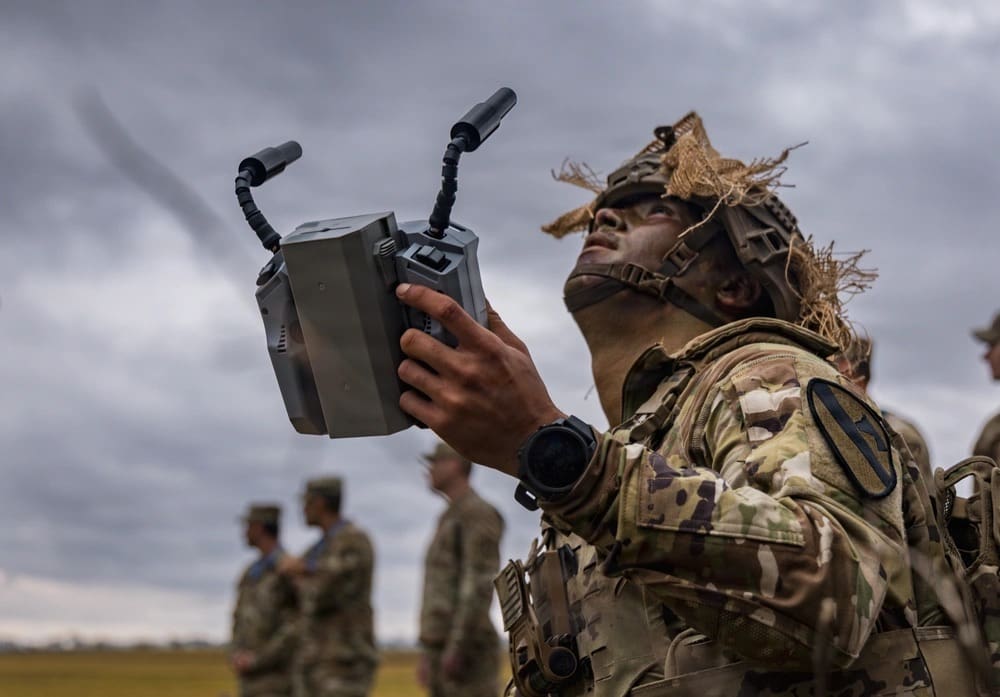
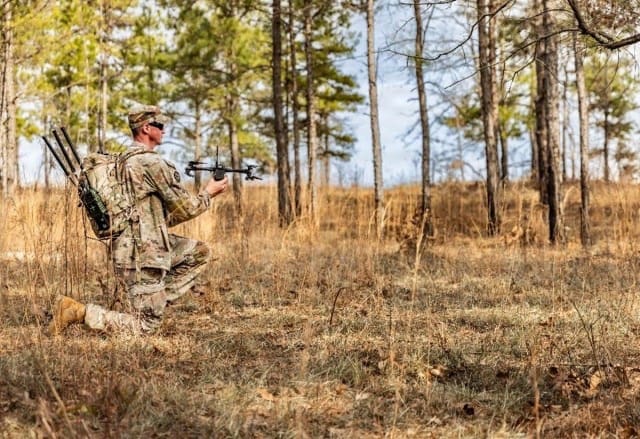
FORT RUCKER, Ala. — In a bold move to modernize battlefield capabilities and close critical training gaps, the U.S. Army Aviation Center of Excellence (AVCOE) has launched its inaugural Unmanned Advanced Lethality Course (UALC) at Fort Rucker. Designed to rapidly train soldiers on the lethal employment of small UAS (SUAS), including First Person View (FPV) drone operations. The course lays the foundation for standardized UAS employment across warfighting functions, redefining how small UAS platforms are used in reconnaissance, fires, and maneuver operations.

Maj. Wolf Amacker, the chief of the AVCOE Directorate of Training and Doctrine UAS and Tactics Branch, is one of many personnel at AVCOE who played a key role in developing the course.

“This is the first time the Army has done this in a TRADOC setting, coordinating between three difference COEs,” Amacker said. “We’re helping to train the most people, the quickest, on FPV systems that are having a real impact on the battlefield.

Capt. Rachel Martin, the course director, was tasked with building the program from scratch just 90 days ago. With a background as an intelligence officer in an attack helicopter battalion and an air cavalry squadron, air cavalry troop commander, and Gray Eagle company commander during a 2023 deployment, Martin brought deep operational experience to the challenge.

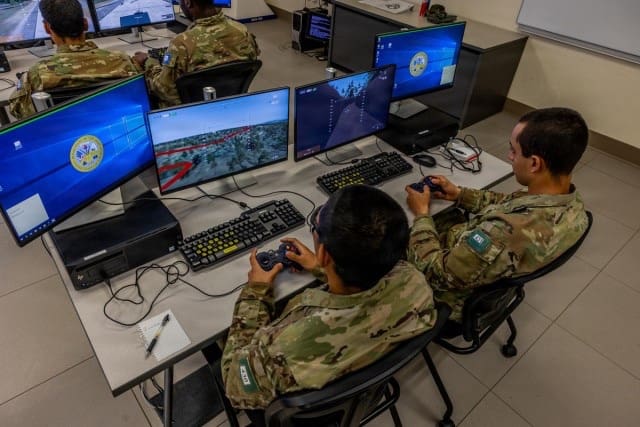
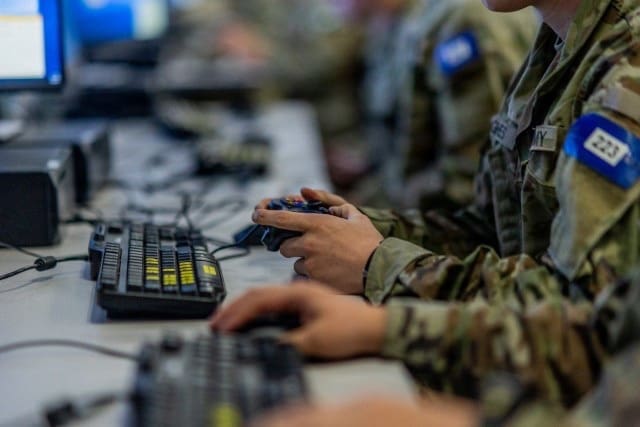
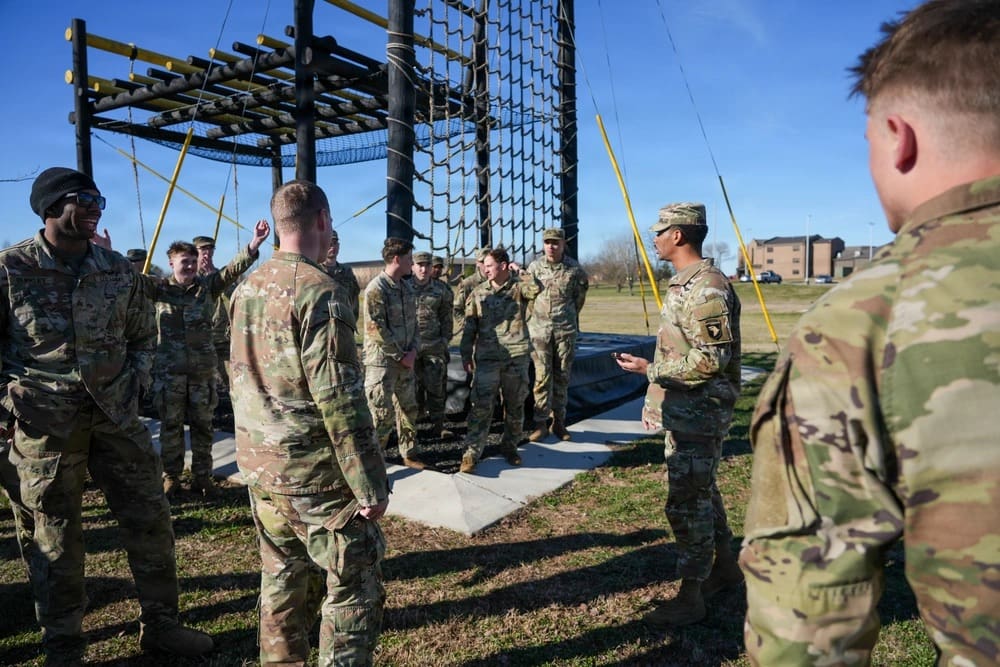
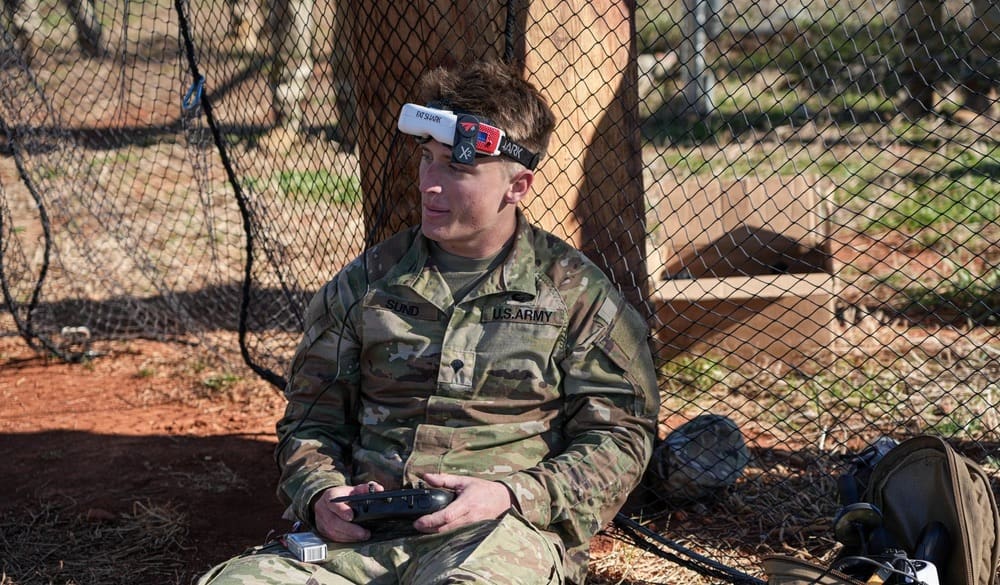
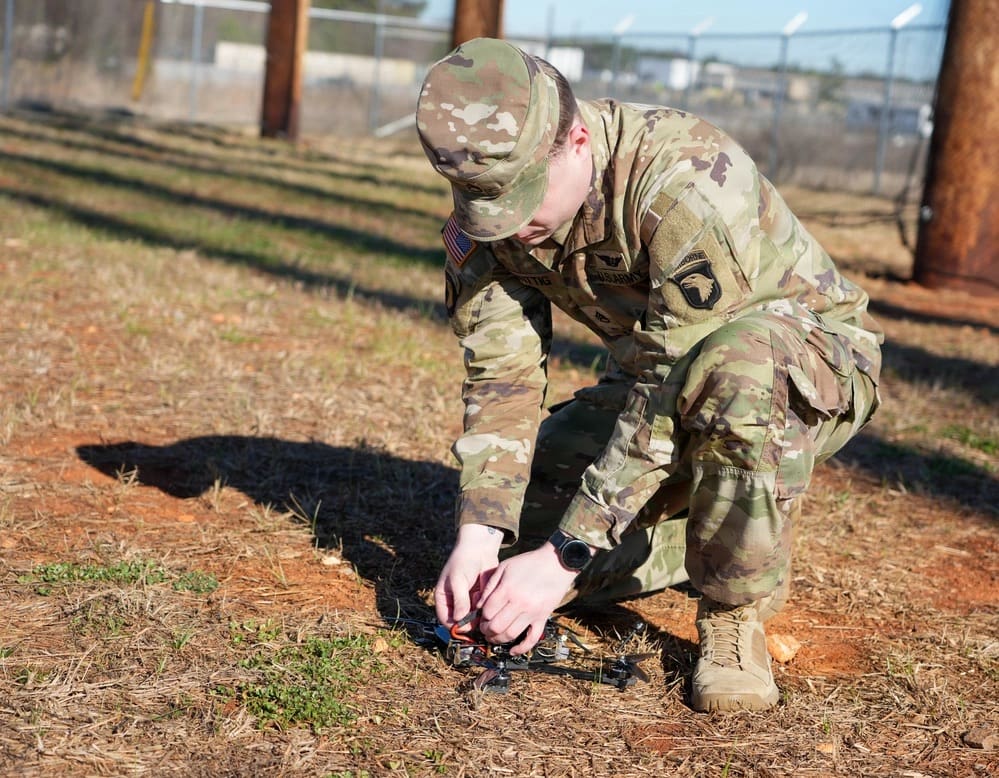
The three-week course begins in the classroom, where students use commercial off-the-shelf drones and simulation software to develop FPV flight skills. After 20 to 25 hours of simulator time, identified as the proficiency threshold through interviews with allied forces, students transition to live flight exercises at the Military Operations on Urban Terrain (MOUT) site.

Instruction also includes fire support integration, with Fires Center personnel teaching students how to adjust fire using drone video feeds in the Call for Fire Trainer.

“An 11B [infantryman], 13F [fire support specialist] out there with a SUAS calling for fire and adjusting based on drone video is a relevant skill for the current and future battlefield,” Amacker said. “This may be the first time our students are introduced and trained to do that.”
This training not only enhances lethality but also demonstrates how small UAS platforms can support traditional fire missions in dynamic environments.

The course currently hosts 28 students from across the Army, including infantry soldiers, cavalry scouts, 15W and 15E aviation personnel, and warrant officers from the 150U career field. Participants were selected based on rank and certification as SUAS master trainers, and Transformation in Contact Units. Cadre from the 2-13th and 1-145th Aviation Regiments at Fort Rucker, along with additional aviation personnel, are supporting instruction.

Observers from the Maneuver and Fires Centers of Excellence are evaluating the course for potential adaptation, providing feedback and implementation. The goal is to empower operational units to create their own basic qualification programs while Fort Rucker evolves into the hub for advanced UAS training.

“Aviation becomes that central integrator,” Amacker said. “We’re helping all the warfighting functions and branches get into this space. Maneuver and Fires care about how SUAS helps them engage targets and keep their operators alive, while we also care about how sustainment and MI use small UAS to fulfill their responsibilities.”

The course is designed as both a resident program and eventually a mobile training package (MTP). The accompanying Training Support Package (TSP) will allow units a way to conduct basic FPV training independently, while Fort Rucker will host advanced iterations focused on munitions, diverse UAS platforms, and tactical employment.

“Right now, we’re doing basic things,” Amacker said, highlighting that this is the pilot course, emphasizing the tasks and academics being taught are what units out in the force are struggling with right now.

Students also learn to manufacture and repair drone components using 3D printing. Instruction covers resin, filament, and carbon fiber printers, CAD software, and STL files. The course aims to build a centralized repository of print files for students to take back to their units.

“Eventually, we want students to build and test their own FPV bodies,” Amacker said. “We’re teaching and learning from the force on what’s possible and how to sustain these systems in the field.

The long-term vision for the course aligns with Fort Rucker’s broader innovation goals. Martin hopes to integrate the program with the post’s emerging innovation lab, creating a collaborative hub for data sharing and tactical experimentation.

“This course is a catch-up,” Martin said. “We’re behind globally, and this is our aggressive attempt to close that gap.”

The course also collects performance data on five different drone systems, tracking variables such as crash rates, environmental resilience, and operational effectiveness. This data will inform future procurement and training decisions across the Army.

Designed to evolve with battlefield needs, the UALC will adapt its curriculum as new technologies and tactics emerge, ensuring soldiers remain at the forefront of unmanned systems employment.
“This is constantly changing,” Amacker said. “We’re building something that can grow with the force.”

Martin emphasized the challenges of launching a drone training program from scratch.

“Most of my peers, including myself until 90 days ago, didn’t know how to do this,” she said. “Now we know what it takes, how many people, how much equipment, how much money, and we are sharing this information already with our partners out in the force.”


The pilot iteration is already producing results. Soldiers are eager to learn, and many report a lack of resources and expertise at their home units. The hope is that graduates will return to their formations equipped to train others and establish sustainable programs.

Ultimately, the course aims to empower soldiers to return to their units as trainers and innovators. Many participants are self-taught hobbyists or informal experts. This program, however, provides structure, certification, and a pathway to build unit-level drone programs.

Future iterations will expand into advanced tactics, including one-way attacks using purpose-built FPV drones. By February, Martin envisions students employing low-cost systems to prosecute targets with precision, an ambitious leap toward integrating UAS as a lethal, scalable weapon system.

“We’re creating operators who are not only lethal but also survivable. sUAS operators are the most sought-after high pay-off target on the battlefield right now,” Martin said. “I am very aware that my team has been entrusted with developing solutions for a critical need in emerging Army tactics.”

SFC Jeremy Charm, a 15W UAS Operator with the AVCOE Directorate of Evaluations and Standardization and primary flight instructor for the UALC said, “Teaching our students to know under what circumstance to use these systems to achieve commander’s intent and how to tactically employ them and survive post engagement is our ultimate goal.”

As the Army continues to modernize its approach to warfare, the UAS Lethality Course at Fort Rucker stands as a bold step toward integrating unmanned systems across all domains, and empowering soldiers with the tools and training to dominate the modern battlefield

Story by Leslie Herlick 

Aviation Center of Excellence

Army Accelerates Adoption of Advanced Batteries Through S&T Integration

Tuesday, August 19th, 2025

ABERDEEN PROVING GROUND, Md. — To ease physical, cognitive and logistical burdens on Soldiers, the Army is transitioning to a family of standard batteries — for systems ranging from night-vision goggles to radios, GPS devices, weapons and more — in an effort led by Army research and industry collaboration.

The Army’s Command, Control, Communications, Computers, Cyber, Intelligence, Surveillance and Reconnaissance (C5ISR) Center is working across industry and several DoD organizations to more rapidly integrate these batteries with Solider-worn and -carried devices, bringing interoperability and ease of use to the battlefield. Prototypes addressing these demands are moving toward full-scale industrial production.

“When the pace of Army modernization increases, we see the number of applications for rechargeable batteries going up significantly,” said Dr. Nathan Sharpes, a C5ISR Center research mechanical engineer. “As the new equipment is fielded, we want to work as early in its development as possible to make sure it will operate with our newest standard batteries.”

The Army’s power solution for handheld, small form-factor devices is the newest standard battery, the Small Tactical Universal Battery, or STUB.

STUB delivers eight sizes of batteries that share a common mechanical and electrical interface — the key to unlocking interoperability. Each battery size provides a different amount of energy, from which Soldiers could choose, depending on their mission needs.

The Center’s work also supports senior Army leadership’s priority of streamlining and simplifying logistics across the force. Secretary of the Army Daniel Driscoll said “massive logistics convoys … are relics of the past” during Congressional testimony in June.

When a Soldier is on a mission carrying five different pieces of gear that each have a unique battery form factor, along with spares, there is extra weight and items to keep track of.

“Any battery in the STUB family will be able to attach to any device designed for it because of the standard interface. Soldiers can focus more on their missions and less on which types of batteries and how many of each to carry,” Sharpes said.

C5ISR Center senior enlisted adviser Master Sgt. Arean Harbison provides Soldier feedback to scientists and engineers developing new power technologies.

“Standardizing the power type lets us achieve that long fight that we need to build the future,” Harbison said. “The STUB will be a better fix than what we’ve had in the past of resupplying batteries. Now we’re looking at potentially charging in the observation post and not needing resupply. To remain lethal, we need to sustain ourselves with additional power. Power becomes a form of lethality.”

The C5ISR Center has partnered with three fellow DEVCOM centers — Armaments Center, Army Research Lab, and Soldier Center — to develop and test STUB using their respective areas of expertise of weapons integration, advanced chemistry R&D, and experimentation. Partnering early in development ensures both the batteries and systems they will power can be designed to be interoperable, rather than needing to make changes further along in the development cycle.

C5ISR Center Senior Scientific Technical Manager for Power and Energy Marnie Bailey said the Army S&T community has been essential in leading the way to implementing standardized batteries.

“DEVCOM scientists and engineers have overcome the technical hurdles to demonstrate that standardization and interoperability are possible,” Bailey said. “This research shows industry that adopting STUB to work with their equipment is the future of how the Army will power Solider-worn and -carried devices.”

As the Army and industry have transitioned the project to the manufacturing phase, acquisition partners can now procure and integrate the batteries to power fielded systems. The Army is delivering standardized batteries in GPS devices and radios with plans for integrating into additional electronics. Specific research is focusing on providing central power for helmet- and small arms-mounted systems.

“Small-arms enablers are a new area of significant power draw,” said Sharpes, who also works with the integration of standard batteries. “Where there was once just glass optics with no power draw, there are now sophisticated fire controls. These offer a potent increase in lethality but also a significant increase in power draw.”

To answer the power demand of next-generation small-arms enablers, C5ISR Center has been developing the Powered Weapon Demonstrator, or PWD, to distribute power (from STUB) and data to any device plugged into the system.

“We’re working closely with C5ISR Center and Armaments Center small-arms-enabler development efforts to ensure the power and data needs of advance fire control technologies are supported, toward transition to PM Soldier Lethality,” Sharpes said. “Even counter-UAS will need this type of power to support their operation.”

“The great thing about the PMs adopting first-generation STUB into fielded equipment is engineers are always in the background working on the next iteration,” Sharpes said. “As the technology improves, we’re putting that directly into the batteries that already integrate with the PMs’ equipment for increased capability and better performance in different environments.

“We’re working down to the basic chemistry level, always updating our standard battery solutions with the newest technology. PMs will periodically receive increased performance of their products without additional investment, just by specifying the use of a standard battery. In addition, the U.S. battery industrial base has more incentive to produce in America because there is a consolidated demand on a particular type of battery.”

Standard batteries are only useful if there are systems that use them, said Sharpes. By leveraging battery integration expertise and out relationships across DEVCOM, Army and industry, C5ISR Center expedites the adoption and fielding of standard batteries into more systems. This ensures Warfighters have the best possible power source for their missions.

The Army launched a battery website (battery.army.mil) in 2024 to provide information related to Soldiers, safety, system integrators and battery developers. The goal is to better serve the Warfighter and industry by creating a central location for information on military batteries. The latest specifications, guidance and integration documents can be accessed in a tailored form.

Additionally, the Army has published MIL-STD-3078 (Interoperability Standard for Batteries Utilized in Army Equipment), which defines the battery types for new system design: battery.army.mil/system-integrator-hub/mil-std-3078. This document is maintained by the C5ISR Center and can be updated as new standard battery form factors are required to meet emerging needs.

By Dan Lafontaine, C5ISR Center Public Affairs

The Jump That Changed US Warfare History

Sunday, August 17th, 2025

WASHINGTON — Since the inception of airborne warfare, the practice of using parachutes to insert troops into combat zones without land passage has turned the tides of conflicts. Commanders use airborne forces to seize the initiative. A brigade of paratroopers can envelop the ground from the sky in moments, allowing an army to strike deep inside enemy territory to gain key terrain and rapidly build combat power.

Paratroopers today learn their craft in the Basic Airborne Course at Fort Benning, Georgia, where Soldiers leapt into history 85 years ago.

On Aug. 16, 1940, 48 volunteer members of the Army Parachute Test Platoon jumped from a Douglas B-18 Bolo bomber at 1,500 feet. The jump was less than 45 days after the establishment of the platoon and marked the true beginning of U.S. airborne forces.

Paratroopers everywhere now celebrate that date as National Airborne Day, commemorating “the bravery and daring spirit of sky Soldiers,” according to the 2002 presidential proclamation that established the observance.

The Art of the Jump

Ever wonder what it’s like to learn to be a paratrooper? Check out The Art of the Jump on Defense.gov to find out what it’s like for students of the Army’s Basic Airborne Course. Get ready for a crazy ride!

By DOD News

Northern Strike Brings Electromagnetic Warfare to the Front Lines

Saturday, August 16th, 2025

CAMP GRAYLING, Mich.—In modern warfare, battles are not only fought with rifles, tanks and artillery. Some of the most decisive victories are won across the electromagnetic spectrum.

At Northern Strike, the National Guard’s premier readiness exercise held this month at Michigan’s National All-Domain Warfighting Center, Soldiers trained in a high-intensity environment that pushed the limits of electromagnetic warfare, or EW. It tested their skills in realistic combat scenarios.

In classrooms, electromagnetic warfare specialists often train to disrupt, or “jam,” enemy communications, intercept signals and scan for threats. Jamming works by overpowering or confusing an enemy’s radio or data transmissions, preventing them from communicating or coordinating effectively.

Last year at Northern Strike, the 37th Infantry Brigade Combat Team, or IBCT, launched a pilot program that sent a mobile EW team into the field to disrupt the communication systems of units in training.

This year, the EW teams were embedded in infantry squads to create a more realistic, complex environment for Soldiers.

“This is a rare training opportunity in the National Guard and in the Army as a whole,” said Spc. Robert Bowley, an Electromagnetic Warfare specialist in the 37th IBCT from Columbus, Ohio. “To train with the equipment, you need the funding, and Northern Strike allows for that.”

Bowley was equipped with the Beast+ system, a handheld multi-channel receiver and transmitter designed for Army EW operations. The system scans the electromagnetic spectrum to detect enemy signals, identify spoofing or jamming threats and enhance battlefield awareness.

“The antenna gives you a general direction and signal strength. I can see anything on the [radio frequency] spectrum,” Bowley said. “We also have a power amplifier that lets us jam communication systems.”

Bowley, who also participated in the exercise in 2024, said he acted as “an early warning system. I will be giving the direction of the opposing force and jamming their comms.”

The mission brought together electromagnetic service members from the 37th IBCT, the Royal Irish Regiment and the Latvian National Armed Forces. The teams combined their expertise by embedding an electromagnetic specialist with the Irish regiment and managing signal towers with the Latvian forces to carry out a complex, coordinated operation.

“In my job, you are on the front lines. We are not cyber on computers, we are in the field,” Bowley said.

At 1800 hours, Browley and seven infantry soldiers from the 2nd Battalion, Royal Irish Regiment, British Army, stepped off to the Combined Arms Collective Training Facility, which simulates fighting in urban terrain. Once they arrived, the squad cleared the building and Bowley looked for the best place to set up the Beast+.

“Ideally, it would be on top of a roof,” he said. “But they have drone capabilities, so this [his location] was the next best thing. In the best case scenario you want to be high up and have nothing around you.”

While the Royal Irish Regiment placed obstacles around the building, Bowley found a dark corner with windows on both sides.

“We will be defending from up here. With this spot, I have a window on both sides and am able to get the antenna outside. The main thing that is important is what is being said over the radio. When I see something on my screen, I will know the direction they’re coming from,” Bowley said.

Bowley knew the long night ahead would test his focus. He monitored the electromagnetic spectrum for hours, watching for the slightest signal of an attack and standing ready to jam enemy communications.

“I brought a lot of caffeine,” he said, laughing. “We have the go-ahead to jam whatever. Usually, you have to really go through hoops. The problem with jamming is that it is risky. Turning off comms can do a lot. The things that I will be looking at jamming are important. Like when they call up nine-lines, or before an assault.”

Bowley’s squad was on defense, which required members to stay alert the entire time. At 2200 hours, they experienced probing from a platoon-sized element testing their defenses. A drone tagged four simulated casualties.

At 0300 hours, shouts echoed as infantry teams moved in to assault the objective. With their communications jammed, the attackers yelled to coordinate.

“They realized we were jamming them and immediately got off their comms,” Bowley said.

Moments later, the opposing force stormed into the room and took down the defending squad in the exercise.

Master Sgt. Jason Ross, the electromagnetic spectrum operations noncommissioned officer for the Army National Guard Information Advantage Division, said the exercise was a reminder of why electromagnetic warfare must be integrated into training.

“Communications systems have changed rapidly in recent years and now evolve almost monthly,” Ross said. “The threat has grown significantly. Thinking outside the box is critical, but it’s not always an easy discussion to have.”

This scenario was unique because the communications cell was on the red team, creating an unpredictable training environment.

“It is hard to duplicate what we are doing at Northern Strike. The approval for this type of training is tricky. The support that Michigan has given to this exercise is amazing,” Gilly said. “The reality is when we train on a rifle range, a Soldier knows what to expect. That is not the case with electromagnetic warfare.”

Maj. Tucker Palmatier, a cyber electromagnetic warfare officer and Cyber Electromagnetic Activities officer in charge of the 37th Infantry Brigade Combat Team, said training in electromagnetic warfare is challenging because of federal restrictions.

“The FCC [Federal Communications Commission] law on jamming dates back to 1934, which makes it difficult to realistically train for today’s technology-driven battlefield,” Palmatier said.“Our challenge is maximizing training opportunities without breaking laws or regulations so Soldiers know exactly what to expect when it matters most.”

Despite those hurdles, Palmatier said the operation was a success.

“Our enemy was not anticipating electromagnetic warfare. We were able to degrade their communications, which left them unable to coordinate their attack, allowing a smaller force to successfully defend the position,” he said.

By 2LT Paige Bodine, Michigan National Guard

New Army Reconnaissance Drone Earns High Praise from Soldiers at First Fielding

Saturday, August 16th, 2025

Fort Bliss, TX – If you’ve seen any footage from the ongoing war in Ukraine, odds are it was video that came from a drone. As the war has expanded since it began in 2022, so too have the usage of drones. The need for armies to reliably gather intelligence, spot dangers, and target enemies without putting Soldiers’ lives at risk has become a paramount concern.

Enter Soldier Borne Sensor, a program under Program Executive Office (PEO) Soldier with the mission of providing Soldiers with an effective Unmanned Aerial System (UAS) aimed to increase situational awareness while reducing detection risk.

After years of progress, the latest iteration of the Soldier Borne Sensor is now officially in Soldiers’ hands.

For three days, Soldiers of the 90th Sustainment Brigade, as part of the Joint Task Force – Southern Border, packed into a hot warehouse less than five miles from the southern border to train with the newly fielded Soldier Borne Sensor reconnaissance drone. The training involved two days of in-class learning of every function and feature, and one day of hands-on field experience learning to fly the drone.

The other units who participated in this training as part of the Joint Task Force were the 2nd Stryker Brigade Combat Team, part of the 4th Infantry Division, and the 89th Military Police Brigade.

This iteration of the Soldier Borne Sensor is an improvement in just about every regard possible from its predecessor. It has a much longer battery life, more durable frame, and a greater operating range.

All of those and other upgrades come wrapped up in one user-friendly reconnaissance drone built from the ground up with Soldiers in mind. It was that high functionality and ease of use that Soldiers took notice of and praised the most.

“It’s super easy to fly,” said one Sergeant who took part in the fielding. “I didn’t expect it to be as simple as it was. It’s definitely something you can pick up in 15 to 20 minutes.”

“On a basis level of being able to get the drone in the air and doing whatever you need to do, it’s very simple and user friendly,” a second Sergeant said. “It’s a great system that I would love to see implemented more… I would love to see these at a squad level, or one per fire team.”

One Soldier who had never flown drones before this training said the system was “very user friendly and easy to pick up and learn.”

As previously mentioned, this version of the Soldier Borne Sensor comes packed with many unique features and systems, all designed to increase a Soldier’s lethality and situational awareness.

And each Soldier there seemed to have a feature they liked the best.

“I liked the zipline feature,” one Soldier reported back. “You can just pick one point and be like ‘hey I want you to go from where you’re at now to this point’… and it will go from the point you’re at now to the point you set. Plus, you can pan the camera and it doesn’t matter which way you face it will keep going to that point you set.”

“The most impressive feature I saw was the different camera features,” said another Soldier. “I could see as clear as day as I can now, but it can also go to different versions of thermal which I found very impressive for how compact the device is.”

This iteration of the Soldier Borne Sensor comes equipped with an improved, high-resolution camera that can alternate between normal view, low-light, black-hot, white-hot, and thermal views at the push of a button.

Unlike previous iterations, which had its daytime and nighttime cameras separated into two different drones, requiring Soldiers to carry more weight, the latest version of the Soldier Borne Sensor wraps all these improvements into one drone.

“For me, the number one feature that I love is fly-to-home,” said one Staff Sergeant. “You’re the beacon for the drone. Instead of manually trying to control the drone to follow you, you set yourself as home.”

More than a few Soldiers had fun testing this feature out, as they paced around the training area with their drone following them wherever they went with no input on the Soldiers’ part.

Overall, the latest iteration of the Soldier Borne Sensor promises to be a valuable tool in the arsenal of our men and women in uniform.

As with all things PEO Soldier, the Soldier Borne Sensor program will only improve further as it learns from and incorporates feedback directly from Soldiers. That feedback at the first fielding has been overwhelmingly positive.

“I have nothing bad to say about the system,” said one Soldier when asked to summarize his time learning about the Soldier Borne Sensor. “It’s extremely versatile and it’s definitely a great asset to have.”

“This is probably going to be the greatest asset to both missions at home and abroad,” said another Soldier. “Instead of sending the actual Soldier in harm’s way, why not use the asset that doesn’t cost the life of an actual Soldier? I think it’s going to be a really good investment. It’s probably going to be the best investment for units, recon, signal, infantry, land survey… I think this piece of equipment checks all the boxes.”

By Zachary Montanaro

Next Generation Squad Weapons Complete Desert Environmental Testing

Friday, August 15th, 2025

FORT BLISS, Texas – No matter where Soldiers are deployed, from the jungles of the Pacific to the deserts of the Middle East, the performance of their weapons and gear is paramount. Given the U.S. Army’s extensive history of operating in harsh, arid environments, it’s essential that the Next Generation Squad Weapons (NGSW) system be rigorously tested under extreme heat conditions.

In the desert heat of Fort Bliss, TX, where temperatures averaged over 100?F, Project Manager Soldier Lethality (PM SL) and the Army Test and Evaluation Command (ATEC) conducted the Hot Weather Test for the M7 Rifle, M250 Automatic Rifle, and XM157 Fire Control. Supported by Soldiers from the 1st Armored Division, the team spent weeks performing various tests, including New Equipment Training, weapons qualification, tactical vehicle ingress/egress drills, and a 72-hour Force-on-Force exercise.

“Throughout these exercises, we closely monitored Soldiers’ feedback, focusing on the weapon systems’ suitability, reliability, and maintainability in desert conditions,” explained Maj. Mark Fischbach, Assistant Program Manager for Soldier Weapons. “Soldiers also provided valuable input on how the weapons performed in practical, real-world scenarios.”

During the exercises, the evaluators also focused on ingress and egress drills from the Bradley Fighting Vehicle (BFV) and the Joint Light Tactical Vehicle (JLTV). Soldiers, especially mounted infantry, must be able to enter and exit these vehicles with their weapons and gear intact in order to remain lethal.

The successful trials in the harsh desert environment underscore the NGSW’s ability to meet the demands of future warfare, offering Soldiers a more reliable, lethal, and adaptable weapon system. The NGSW Desert Test is one in a series of environmental tests that includes arctic, desert, and tropic.

The M7 Rifle and M250 Automatic Rifle are the successors to the M4A1 Carbine and M249 Squad Automatic Weapon (SAW) respectively. Both weapons utilize the XM157 Fire Control, a 1-8x variable magnification optic with a number of advanced technologies integrated into the optic, and the 6.8mm family of ammunition. The NGSW provides Soldiers significantly more accuracy, range, and lethality beyond legacy weapon systems capabilities.

The NGSW is currently being fielded to Units across the Close Combat Force (CCF).

By Garrett Dacko

Army Principal Cyber Advisor Visits U.S. Army’s Only Offensive Cyber Operations Brigade

Thursday, August 14th, 2025

FORT GEORGE G. MEADE, MD – Mr. Brandon Pugh, the U.S. Army’s Principal Cyber Advisor to the Secretary of the Army, visited the 780th Military Intelligence Brigade (Cyber) on August 6. The brigade is the Army’s sole offensive cyber operations unit, playing a pivotal role in national defense and cyber warfare.

The visit followed Mr. Pugh’s three-day trip to U.S. Army Cyber Command (ARCYBER) headquarters at Fort Gordon, Georgia, where he received briefings and engaged directly with ARCYBER’s top talent.

“The 780th Military Intelligence Brigade (Cyber) is on the frontline of defending our nation and conducting cyber operations,” said Brandon Pugh, the Army’s Principal Cyber Advisor. “The brigade is an invaluable component of the United States’ cyber enterprise. My visit to the 780th Military Intelligence Brigade (Cyber) was an extraordinary opportunity to meet Soldiers conducting these important cyber operations and to see its unique capabilities firsthand.”

During his time in Georgia, Mr. Pugh met with capability developers from the 11th Cyber Battalion, who showcased innovative, in-house engineered devices tailored to meet the operational needs of expeditionary cyber teams. He also interacted with Soldiers from the 782nd Military Intelligence Battalion (Cyber), who support Cyber Joint Force Headquarters (JFHQ-C) for the Army, Air Force, Navy, and Marine Corps.

The 780th MI BDE (Cyber) is geographically dispersed across four states. The brigade headquarters, the 781st MI Battalion (Cyber), and the Operations Support Element (OSE), are based at Fort George G. Meade, Maryland; the 11th CY Battalion and 782d MI Battalion (Cyber) are headquartered at Fort Gordon, Georgia; and the 782d has operational detachments in Hawaii and Texas.

According to the Brigade commanding officer, Col. Candy Boparai, the 780th MI BDE (Cyber) is a critical enabler of ARCYBER and U.S. Cyber Command (USCYBERCOM), delivering unique, multi-domain capabilities to sense, understand, and deliver effects in the information environment.

“The 780th MI Brigade (Cyber) directly supports USCYBERCOM’s core missions: defending the Nation and conducting cyber operations to achieve Combatant Command objectives,” said Boparai. “We operate as a key component of the Army’s Cyber Mission Force (CMF), specifically providing National Mission Teams, National Support Teams, Combat Mission Teams, and Combat Support Teams, and Capability Solutions Developers.”

According to Command Sgt. Maj. Joseph Daniel, the brigade’s senior enlisted leader, “As the Army’s only offensive cyber force, the 780th provides unique capabilities to sense, understand, and deliver tactical, operational and strategic cyber effects globally to achieve Combatant Command objectives.”

Daniel remarked that the brigade supports Joint Force efforts, leveraging their more than 2,100 personnel to address cyber challenges worldwide; and the brigade’s cyber teams, 11th CY BN Expeditionary CEMA (cyberspace electromagnetic activities) Teams (ECTs), and developers are all actively involved in regular cyber operations, collaborating with USCYBERCOM, Army electronic warfare units, and other partners.

In addition to receiving briefings, Mr. Pugh was able to see a live operation in the brigade’s Joint Mission Operations Center and view an Army Continuous Transformation drone demonstration by the OSE Cyber Solutions Development team.

As part of the Principal Cyber Advisor’s briefing, the brigade discussed the training requirements to achieve and maintain mastery in a Cyber Soldier’s assignment. These requirements are executed at the brigade, following their training at the U.S. Army Cyber School. The additional training can range from several months to more than a year and continues as the Soldiers progress.

“The Army’s most significant inputs into cyber readiness are presenting high quality personnel and providing the supporting talent management policies to sustain them in Cyber Mission Force long enough to achieve and maintain mastery in their skillsets,” said Boparai. “We are the only U.S. Army offensive cyber operations brigade and our focus as the administrative command headquarters is to man, train, equip, assess and enable the Army CMF and CEMA teams in accordance with published USCYBERCOM and ARCYBER standards.”

The 780th MI Brigade (Cyber) motto is inscribed on the organization’s Distinctive Unit Insignia “Ubique Et Semper In Pugna.” Latin for “Everywhere and always fighting,” we don’t specifically talk about what we do nor who we are in a cyber ‘knife fight’ with; however, we are “Everywhere and Always…In the Fight!”

Story by Steven Stover
780th Military Intelligence Brigade (Cyber)

Army UAS and Launched Effects Summit Begins at Fort Rucker

Wednesday, August 13th, 2025

FORT RUCKER, Ala. — The Army’s Unmanned Aircraft Systems and Launched Effects Summit opened Aug. 11, setting the tone of week-long events focused on the rapid increase in unmanned systems in the US Army.

Maj. Gen. Clair Gill, commanding general of the Army Aviation Center of Excellence and Fort Rucker, gave the opening remarks to summit attendees, stressing that UAS need to be seen not solely as a tool for the aviation branch but a capability to support the Army as a whole.

“The battlefield is going to be busy, so we need to be thinking about what the enemy is doing, as well as ourselves,” Gill said in his opening remarks. “We need to do this quickly because the future is now.”

Gill pointed to recent global events and the Department of Defense’s decision to lift restrictions on UAS acquisition and fielding, a move he said will drive increased deployment of smaller systems at lower levels within the Army. He emphasized the importance of integrating those systems with manned aircraft, noting that the mission of Army Aviation is evolving alongside the technology.

Gill also spoke to the Army’s plan to merge the currently separate UAS operator and maintainer career fields into a single UAS specialty. The beginning steps of this merger are already in place as the Army is currently training the first wave of Soldiers that will operate and maintain the small UAS systems the Army is expected to adopt going forward.

“We just stood up a course in Hawaii where we are going to start training what will be the new (UAS military occupational specialty), the 15X,” Gill said.

Gill explained that the Army is adopting a “train the trainers” plan to help increase the number of UAS qualified Soldiers, with the Soldiers currently in training expected to go on to help further develop UAS training throughout the Army.

The adoption of small UAS is a big shift in how the Army fights, as the systems are expected to be in use at much lower levels than previously operated. However, Gill also sees a future where new technology and networked solutions will allow the proliferation of UAS to still provide the larger unit and commanders with vital information.

“We want to embed and launch effects at every level. You might have something down at that platoon that can support the company or battalion… Imagine if you put a sensor on a UAS that could find things you weren’t even looking for. Imagine if it could pass that information to a network and feed that to only the people that need to see it,” Gill said.

Gill went on to talk about how he sees a future where UAS are not only platforms for sensors, but will carry systems for use in electronic warfare, psychological and deception effects, weapons systems for direct attack, and repeaters and relays to extend not only communications, but also extend the control range of other UASs.

“It’s pretty exciting when you see where this is all going,” Gill said.

The increase in the type and number of UASs in use by the Army, as well as the rest for the DoD is expected to have a direct impact on airspace management and battlefield coordination.

“Low altitude is that space only aviators and artillerymen used to worry about. We like to fly low, that’s part of our security, that’s how we protect ourselves. Now there’s all kinds of things up there with us,” he said.

On the lighter side, Gill also spoke about the establishment of the Army drone team and their recent success at a racing competition. While the team will take part in certain competitive events like racing, the team will also be competing in events with a more tactical bent, using their competitive drive to help develop new methods and uses for UAS that can help shape how the average Soldier will be able to use the aircraft.

Following Gill, Col. Joshua Ruisanchez, director of the Army Aviation Capabilities and Integration Directorate went into more detail of the kinds of things the Army UAS operator, officer, and Soldier can expect to see in the future.

According to Ruisanchez thanks to the changes at the DoD level, the number of civilian manufactured drones for use by the Army has expanded, adding 11 new aircraft to the list bringing the number to 30. Soldiers can also expect to see funds made available to acquire UAS, as well as an expansion of options like 3D printing and additive manufacturing systems that can allow units at division level and below to design and produce their own components.

Adding to this, Col. Nicholas Ryan, director for the Army Capabilities Manager – UAS discussed how the changes will enable the unit and Soldier to make use of these new options. One example he gave was the plan to establish an online marketplace where officers at the brigade and regimental level can authorize units to purchase approved systems.

“Now that (Colonel) can go out there and get a drone,” Ryan said.

Ryan also spoke to the need to change the perspective on what a UAS even is. Traditionally the Army considered most UAS to be durable items that needed to be carefully accounted for, with the loss or destruction of a UAS requiring a lot of paperwork and an investigation, possibly even a fine. Going forward Ryan said some UAS, especially smaller, cheaper ones, need to be normalized and considered expendable items, with reasonable losses in combat and training to be expected.

“We need to start treating drones like any other piece of a Soldier’s kit. Just like your radio, or night vision devices, you need to get used to having a drone,” Ryan said.

The UAS and Launched Effects Summit will continue through the week, featuring presentations, panel discussions, and demonstrations of UAS, including some equipped with live weapons.

By John Hamilton