GORE-TEX WINDSTOPPER

Archive for the ‘Camo’ Category

Syrian Camo?

Thursday, September 17th, 2009

*Soldier Systems Daily Exclusive*

We received an excerpt of the 2009 Natick report “PHOTOSIMULATION CAMOUFLAGE DETECTION TEST” in order to determine the origin of the so-called “Syrian” pattern.

The internet has been aflame with concern and indignation that a “Syrian” camouflage pattern is out performing UCP. Still others have taken recent articles printed on other websites as an indication that the Army is considering this pattern for issue but nothing could be further from the truth.

In an effort of clearing the air, Soldier Systems Daily offers these quotes taken directly from the report followed by some analysis. A couple of tidbits from the report:

“Eighteen patterns were included in the imagery collection and observer data collection.

Guidance for pattern selection was given by BG Brown, PEO-Soldier in March 2007. Guidance included patterns of foreign countries, patterns presently available on the commercial market and the UCP. Final pattern selection was controlled by pattern availability. The Woodland and Desert Battle Dress Uniforms (BDU) were not included in this evaluation because, at the time of pattern selection, they were not being worn by the U.S. Army.

All targets wore desert combat boots and a green Advanced Combat Helmet (ACH). Helmet covers were not worn because of the lack of availability of covers for most patterns. Deployment and training schedules limited the availability of observers during the short data collection period. Therefore, to focus data collection on the patterns of greatest interest, the patterns were prioritized into two tiers. When a complete data set was collected on the Tier 1 patterns, which are annotated in Figures 6-10 with an asterisk, observer data collection then began on the Tier 2 patterns.

Although detection data were collected on 18 patterns, five patterns (i.e., Sweden, Spec4 Woodland, Spec4 Urban, North Korea, and Woodland British) were eliminated from the final data analysis. The two Spec4 patterns were not available for desert image collection; therefore, they did not have a complete data set. Sweden, North Korea and Woodland British were eliminated, due to being the worst performers in two out of the three environments. Their similarity to other woodland patterns was further justification, although it must be noted that detection data are available for further analysis, if desired.”

“Given these environment-specific results, five patterns consistently performed better than UCP – Syria, Desert MARPAT, Desert Brush, MultiCam®, and Natural Gear.

Although the performance of the Natural Gear pattern was consistently better than UCP, it is not a viable pattern to consider for possible near-term military use because it does not have military near-infrared properties and the Government has no rights to the pattern. Natural Gear was also the lowest performer of this group of five patterns. Therefore, further discussion is focused on the remaining four uniforms – Desert MARPAT, Desert Brush, MultiCam® and Syria. Syria, although a foreign uniform and not practical for U.S. military use, yielded very favorable results in the environments tested and may be useful in future research on pattern / color effectiveness in multiple environments.
italics added for emphasis (mine)

As you can see from the study, the now infamous “Syrian” pattern is not under consideration for issue to US troops but rather considered a “lab pet” to be used during future camouflage study.

syrian-camo

This is the photograph of the “Syrian” camo from the Natick report. Unfortunately, we still do not know the true origin of this pattern. International camouflage experts have reviewed that photo and determined that it is not on general issue to Syrian forces. Furthermore, it has been suggested that it closely resembles the German Sumpfmuster (Marsh Pattern) issued to the Bundes Grenz Schutz from the late 50s on. This pattern in particular was based on a WW II German Army Marsh pattern and has been also worn by the Libyan military.

Notice that “British Woodland”, beloved Temperate DPM was eliminated due to being among the worst performers in the study but on the flip side, Desert DPM fared pretty well. Interestingly, this will be very big news across the pond as the British military struggles with PECOC and their efforts to field a more effective pattern for operations in the Middle East.

Crye Precision FROG Combat Shirt and Trousers

Thursday, September 17th, 2009

*Soldier Systems Daily Exclusive*

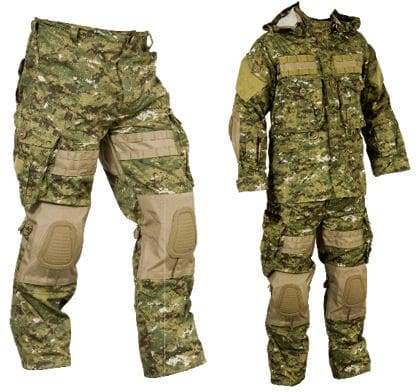
Propper International has partnered with Crye Precision in a licensing agreement to manufacture and sell the Crye designed USMC Flame Resistant Operational Gear (FROG) combat shirt and trouser for Military and Government customers. Many don’t know that the FROG uniform was designed by Crye Precision based on lessons learned from their successful Combat Uniforms and this is exactly the same fighting ensemble issued to the Marines but in a wider selection of colors. The FROG combat shirt and trouser which are already available in Desert MARPAT are also planned to be available in Multicam, Tan, Green, Black, AOR1, AOR2, Army Universal, and Digital Tiger Stripe.

FROG Ensemble Produced in MulticamFROG Ensemble Produced in Multicam

Propper has been manufacturing the combat shirt and trouser for the USMC since 2006 and looks forward to bringing this battle proven product to additional customers in different markets. Distributors, government agencies, and military acquisitions personnel are welcome to visit the Propper booth for further info at the Infantry Warfighting Conference and Modern Day Marine for more information.

Infantry Warfighting Conference, Booth # 1110
Sept. 22-23

Modern Day Marine, Booth # 1553
Sept Sept 29 – Oct 1

Gov/Mil Sales Contact: Greg Graves
GSA purchase information will be available soon.

Note: Propper is not taking individual commercial orders at this time but as product becomes available through distributors they foresee availability coming to retail customers.

What’s the Frequency Kenneth?

Tuesday, September 15th, 2009

A funny thing happened the French on the way to fielding their new Future Soldier System FELIN (Fantassin à Équipement et Liaisons Intégrés, English Integrated Equipment and Communications Infantryman). It seems that in 2013, the French Government is going to sell off the frequency spectrum used by FELIN. I Love it when a plan comes together. The FELIN information network sub-system operates in the 802 – 862 Mhz range which is scheduled for sale in 2013. Yes, that says “sale”, as in someone else will own it and the French Army will no longer be authorized to use it. This means that prime contractor Sagem will have to alter the software of the radio and no one has yet publicly disclosed how much this will cost. Sagem is currently filling orders for 5,045 FELIN systems to be delivered through the end of 2010.

Another issue beyond cost is performance. The current radio has a range of 1km in open terrain, 600m in urban areas, and only 100m indoors. Concerns have been expressed that a new, higher frequency range will be further inhibited in areas of high biomass such as jungles.

The RIF or information network sub-system consists of a radio with integrated global positioning system (GPS). This voice and data network connects the Soldier to others in the section and to the section commander, who is connected to the SITEL battle management system in a combat vehicle. SITEL, also developed by Sagem, is being fitted to all French Army vehicles. The RIF relies on the Thales Communications PR4G VS4 frequency-hopping radio for tactical internet connectivity and links to the vehicle’s SITEL.

FELIN

Recent versions of FELIN have boasted a new Tenue Combat (combat uniform) that more resembles the loose “Guerilla” suits of the 50s and 60s than the current issue tight fitting uniform. Additionally, the camo pattern seen in the photo above was an affectation of Sagem and will not be a part of the FELIN which will retain the current issue CCE pattern. CCE is similar in coloration to the old US issue Woodland pattern.

Afghanistan Camo Testing Announced

Tuesday, September 15th, 2009

*UPDATED* Natick has been busy developing several new variants of UCP which retain the base pattern but replace individual colors. Word has it that some of them are down right ugly. It has recently been revealed by Brig. Gen. Peter Fuller, PEO-Soldier that the new “UCP-Delta” which integrates Coyote Brown into the pattern along with Multicam will be evaluated in Afghanistan beginning in October. In response to the Congressional directive to field a new camo pattern for operations in Afghanistan two Battalions worth of uniforms will be tested.

Below are two photos of UCP-Delta. One with an IOTV and one without.

UCP Delta with IOTV UCP Delta
Photos courtesy of PEO-Soldier

According to sources at Natick, 30% of the pattern of the UCP-Pattern is Coyote Brown. One advantage exhibited in the photos is that UCP Delta offers the perception that current UCP field equipment will not need to be replaced.

Mayflower Releases Quick Detach UW Chest Rig

Friday, September 11th, 2009

The production version of the UW Chest Rig, QD is now available. Small runs of the design have been produced and refined over the last couple of years. As the name implies, the rig is intended for use as a general purpose mid-size vest platform to be worn with the detachable H style harness or attached directly to Mayflower’s Low-Profile Armor Carrier. This gives a great deal of flexibility to the user and the detachable H-style harness features loops to route antennas, comms wires, and hydration bladder tubing.

UW Chest Rig, QD UW Chest Rig, QD Mounted to Armor

Made in the USA from 500D Cordura, the UW Chest Rig, QD is available in Ranger Green (solution dyed), Coyote Brown (solution dyed), Multicam, UCP, and Black. Please note: Desert Digital is NOT available.


For more information contact Mayflower Research and Consulting, LLC or to order visit Grey Group.

Canada Seeks Tools to Develop New Camo

Thursday, September 10th, 2009

Earlier this week the Canadian Department of National Defence (DND) issued a Request for Proposals for “Review and Development of Camouflage Pattern Generation for the Visual Spectrum” with the work to last through March 2012. So what exactly does that mean? To translate, they are looking for a set of software tools to rapidly prototype camo patterns.

CADPAT Temperate Woodland
Photo: Canadian DND

From the Solicitation:

Title:
Review and Development of Camouflage Pattern Generation for the Visual Spectrum
Objective:
The objective of the work is to develop a gallery of tools for Defense Research and Development Canada (DRDC) that will be used within the Canadian Dept of National Defence (DND) to synthesize new camouflage patterns in accordance with important aspects of the human visual system and a collection of environment-specific imagery.
Scope of the Work:
The scope of work pertains to the development of algorithms for the synthesis and evaluation of camouflage patterns. An image processing term related to the development of camouflage patterns is “colour texture synthesis”. Camouflage patterns produced as part of the work must be effective in the visible spectrum for use on stationary targets against unaided human observers (i.e. without the aid of vision or detection enhancing devices). The outcome of the work include: 1) an interpretive review on the current “state-of-the-art” methodologies and techniques for the synthesis and evaluation of camouflage patterns and 2) a gallery of algorithms for the synthesis and evaluation of camouflage patterns. The Contractor is to conduct
the work in 5 phases.

So what’s the intent here? Keeping up with the Jones’? MARPAT and UCP are both close cousins to CADPAT. Perhaps our recent preoccupation with camouflage is rubbing off on our friends north of the border. Do the Canadians feel the need to tweak the colorways or perhaps develop entirely new patterns? Similar to the USMC’s MARPAT, CADPAT currently comes in two flavors; Temperate Woodland, a verdant variation for jungle and other lush areas and Arid Regions produced with a combination of brown shades for desert use. Interestingly, just over a year ago, in the US, the Marine Corps Systems Command awarded Timothy R. O’Neil a sole source contract for just under $31k for the “development and testing of an improved Marine Corps camouflage measure for individual clothing and equipment”. Timothy R. O’Neil is said to have been involved in the development of CADPAT and has partnered with the Canadian company HyperStealth Biotechnology Corp. Perhaps they will be contenders for this new work.

Army Combat Pants Update

Wednesday, September 2nd, 2009

Army Combat Pants
We recently mentioned that the Army is working to pair the Army Combat Shirt with a Pant. A successful Limited User Evaluation earlier this year is going to be followed up with a rather extensive Field Trial in Afghanistan early next year.

Crye Precision Knee Pads
Yes, they look mysteriously like Crye knee pads.

While there is still no formal requirement for the ACP, newly revealed plans include integrating the trouser’s special features into the ACU. Naturally, by extension, any changes made to the ACU will also be made to the FR-ACU. So, perhaps by 2011 we could begin to see the ACU transform once again into an even more combat focused uniform. What will be interesting to see is if it can survive peacetime.

EOTAC Operator Pant – in UCP!

Tuesday, September 1st, 2009

It seems that EOTAC has been listening to their customer base and has finally released their Operator Pants (Style 201) in the Army’s Universal Camouflage Pattern.

EOTAC Lightweight Operator Pants in UCP

Manufactured from a fade resistant 7 ounce all-cotton ripstop, end users affectionately call this pant the “pajama pant” due to its comfort. I can attest to this claim, they are very comfortable and have a soft hand. Additionally, EOTAC applies DuPont Teflon® fabric protector to repel both water and oil based spills.

All critical seams are double-needle stitched and bar-tacked at stress points. The Action Waist has side elastic panels for freedom of movement. The 1 inch wide reinforced belt loops are strategically placed and accommodate belts up to 1 3/4 inches wide and the gusseted crotch allows for a greater range of mobility while reducing the stress around the crotch area of the pant.

There are multiple pockets to cover a wide range of uses. Two secured back pockets accommodate a wallet or ID while two larger easy access rear pockets accommodate larger gear. Like the ACU pant, there are two slant top bellows cargo pockets. They feature hook & loop closure flaps and elastic drawstring with cord lock for additional security. Inside the cargo pockets are elastic webbing loops that secure up to two 30-round magazines per pocket. The reinforced knees feature external openings with hook & loop closures for inserting foam knee pads (included). Two lower leg bellows pockets each feature a hook & loop closure flap and two chem stick holders.

“This was a natural progression for us. Our Operator Pant is based very closely on the US Army’s ACU pant. Because of that similarity in look, soldiers had asked us to offer it in the UCP. That was an easy decision to make. If it helps our soldiers, then it was worth doing,” said Fernando Coelho , president of EOTAC.

Sizes are available in 28″to 48″ waist and inseam lengths of 30″to 36″ (even sizes). In addition to UCP, the pants are also available in Khaki, Black, Navy, and OD Green. To order visit www.EOTAC.com.