You’ve seen our coverage of the ultra-lightweight ghille-style boonie hats from Tactical Distributors. Now they are on sale. So stop making excuses get one for yourself.

To order visit Tactical Distributors.
You’ve seen our coverage of the ultra-lightweight ghille-style boonie hats from Tactical Distributors. Now they are on sale. So stop making excuses get one for yourself.

To order visit Tactical Distributors.
The much anticipated Lizard pattern Field Jacket (style 502) from EOTAC has finally hit the market.
In addition to the Lizard pattern shown, the Field Jacket is also available in Black, Coyote, and OD. To order visit EOTAC online. Get them before they are gone.
Pack manufacturer Mystery Ranch has launched a slick new website. Separate sections are available for Military and Tactical, Backpack Hunting, Fire and Trail, as well as recreation and Adventure packs.
Check it out including several new styles including the Tacticplane and SATL Assault Pack at www.mysteryranch.com.
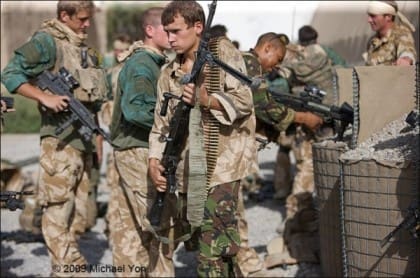
Strike Hold! has put together an excellent article on the challenges of providing effective camouflage for troops serving in Afghanistan. It seems the British are now starting to ask about their force’s patterns as well. An article appeared in the Daily Mail and one of the headlines was “Soldiers forced to dye their own camouflage gear in MoD blunder”. The photos in Stike Hold!’s story tell all and American readers should pay particular attention to very last one (shown here).

In it we see a US Marine in MARPAT-Desert, a very effective pattern; for the desert. This is the ultimate problem with specialized patterns. They are tuned for particular environments and once you are in another, you really stick out. It can be like showing up to a black tie function dressed for a costume ball, only deadlier. So answering Congressional concerns over Army camo in Afghanistan may not be as simple as “replace UCP”. It is highly likely that logisticians (and leaders) will look at Afghanistan and say “Desert”. The desire to field a desert uniform for a country with multiple environments will have similar consequences to what we see happening here with US Marine and British Army personnel. A universal pattern becomes very desirable in an operational area where troops could be in the city in the morning and an area with lush vegetation by evening.
Be sure to read the entire article.
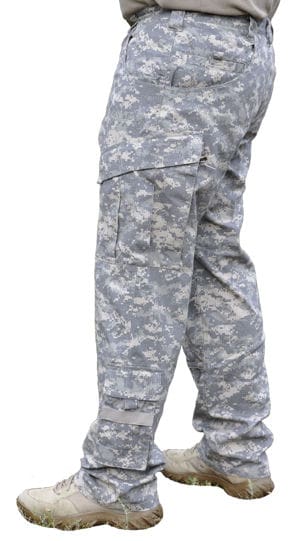
In light of an impending directive from Congress to the Army to get their camo house in order, rumors continue to circulate about an upcoming test involving four camo patterns with the Army’s current Universal Camouflage pattern serving as a control.
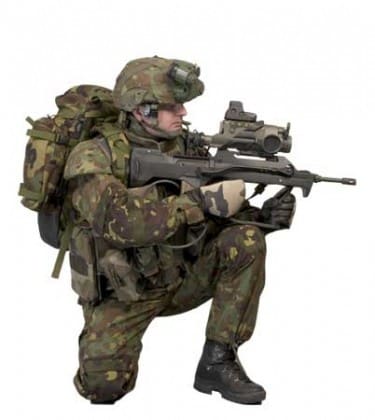
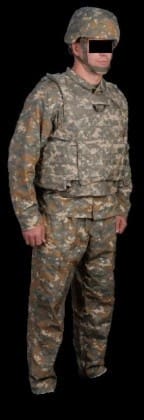
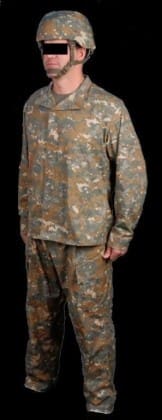
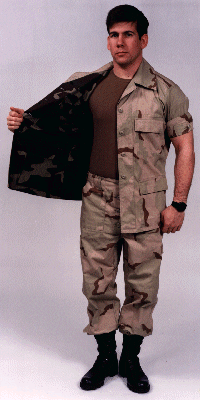
The four patterns are MARPAT-Woodland, MARPAT-Desert, Multicam, and Desert All Over Brush (seen below). Originally, we had heard that the fourth pattern would be the 3-color Desert pattern issued to all services prior to adoption of their new distinctive uniforms. However, based on some recent, unverified information we believe it is actually the Desert All Over Brush which interestingly gave a very good showing during the Army camo trials of 2003-2004. According to a Natick report, a modified variant of the Desert version All Over Bush pattern performed best in all environments. You can also access a briefing presented on the subject at the 2004 International Soldier Systems Conference here.
Based on a series of evaluations documented in the report and briefing slides Natick developed the variant of All Over Brush pattern.

Having said all of that, the info on that particular pattern is old news. At some point in the Spring of 2004, the Army took a serious sidestep from all of its research and adopted UCP. if the rumors are true, looking at what is on the table, neither Marine patterns would really be considered serious candidates due to a variety of morale, and as we have discussed before, branding issues. You think the black beret issue was rough, imagine the outcry from two services if the Army adopted a Marine camo pattern. Consequently, while effective, we don’t consider the MARPAT variants as serious contenders. This leaves, depending on who is telling the story, either 3-color Desert which is still used by some US Navy forces (and a few others) or the prototype Desert All Over brush pattern in addition to Crye’s Multicam. While there are limited stocks of 3-color equipment still in the system, virtually none of it is in the configuration currently used by US forces. If it were adopted, the US Soldier would literally take a five year step back in capability until production of current issue equipment could be accomplished. Additionally, there is a political dimension to such a move. UCP was sold as a superior pattern to both Woodland and 3-Color Desert. Someone would naturally ask the question of why the Army discarded a pattern in favor of something less effective.

This leaves Desert All Over Brush and Multicam. Multicam has been used operationally by select US forces to great success and even more importantly, is currently supported by the US industrial base. A wide variety of Berry Compliant products (and raw materials) are available as COTS items. Additionally, industry already offers versions of current issue equipment in Multicam. Furthermore, there are numerous lightweight and multi-purpose Soldier Systems items designed specifically for environments like Afghanistan. Multicam is a mature, widely available, low hanging fruit. On the other hand, adoption of Desert All Over Brush would require long lead times as fabric mills first perfect and then produce sufficient quantities of materials. Only then could uniforms and equipment for our Soldiers begin to be procured.


We are waiting with bated breath to see if these rumors are true and what’s more, if they are, what will come of them. Naturally, Soldier Systems Daily will keep you updated.
Up to now information on Bulldog Equipment’s Mirage camo has been under serious wraps. To even look at photos, a perspective customer had to provide proof of affiliation with the US military. But apparently, that has all changed.
Our friends at Strike Hold! have additional photos of the camo in operational settings and information on a second generation of the uniform. According to the article, gone are the Superfabric knees and elbows and mesh panels have been incorporated into the design. We thought these had only been part of the Sniper uniform but it seems that troops wear testing the garments preferred the feature.


Check out the article here.