GORE-TEX WINDSTOPPER

Archive for the ‘EOD’ Category

MCSC Begins Fielding Amphibious Robot System for Littoral Missions

Friday, October 22nd, 2021

MARINE CORPS BASE QUANTICO, Va. —

In September, Marine Corps Systems Command began fielding an amphibious, unmanned robot system to support littoral operations globally.

The Explosive Ordnance Disposal Remotely Operated Vehicle is a next-generation, box-shaped robot that enables Marines to navigate safely and efficiently in shallow waters to identify and neutralize explosive hazards and other threats.
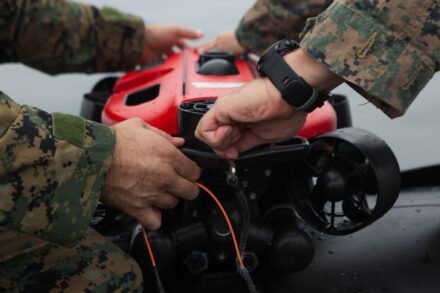
“This robot gives Marines eyes in the water,” said Master Sgt. Patrick Hilty, an Explosive Ordnance Disposal project officer at MCSC. “It is a capability the Marine Corps has never before had.”

The ROV employs sound navigation and ranging sensors, a high-definition video capability and cameras that provide real-time feedback for EOD divers. It includes an articulator arm that helps Marines maneuver through underwater foliage or neutralize explosive threats.

“It is a system that saves Marine divers from having to swim hundreds of meters, an activity that can tire them out,” said Hilty.

Marines can use the robot for various amphibious missions. For example, they can leverage the ROV to search harbors before docking a Marine Expeditionary Unit ship. Operators can use it for activities in very shallow waters, conducting littoral lost object searches, damage assessments and mine countermeasure missions.
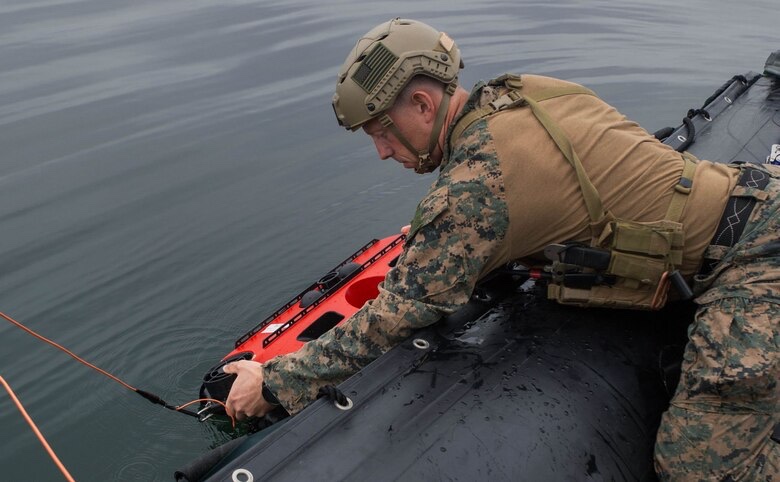
Hilty applauded the ROV’s tether feature, which keeps EOD technicians at a safe distance from explosive hazards. Before the capability, Marine divers could only disrupt or dispose underwater explosive threats by swimming in close proximity, exposing them to hostile elements.

“The ROV gives us a remote means to search underwater while also helping us stay at our best when having to prosecute explosive devices,” said Hilty.

Master Sgt. Matthew Jackson, a staff non-commissioned officer in charge of 1st EOD Company’s Littoral Explosive Ordnance Neutralization section, said the ROV is highly stable in an underwater environment. He noted how the machine requires minimal equipment and reduces the Marine Corps’ overall footprint during operations.

“This intuitive system has the ability to complete critical underwater tasks much deeper than manned missions can,” said Jackson. “The ROV will serve as an important capability to support our tasks.”

Jackson also praised the system for its ease of use. He said it requires minimal training when compared with other unmanned underwater systems. This ultimately saves the Marine Corps time and money required for training.

“Instead of sending a Marine to a course for seven or eight weeks, it takes about four days to learn basic operations for successful employment,” said Jackson.

The ROV also supports naval integration. In 2019, the Navy acquired this commercial off-the-shelf capability. The service conducted a series of tests to determine its viability for EOD missions. These tests included reliability and maintenance evaluations to test its effectiveness and ease of employment during simulated activities.

“Testing conducted by the Navy allowed us to field this capability to Marines more quickly,” said Hilty. “Additionally, the Marine Corps and Navy both having this system increases interoperability among the services.”

The robot is the first increment in the Littoral Explosive Ordnance Neutralization Family of Systems. This series of robotic capabilities will allow Marines to search a wider area in the littorals, including the very shallow water, surf and beach zones.

This robot gives Marines eyes in the water.

– Master Sgt. Patrick Hilty, an Explosive Ordnance Disposal project officer at Marine Corps Systems Command

LEON systems, to be fielded gradually by MCSC over the next several years, will also help the Marine Corps complement Navy EOD teams in joint operations as it strives to evolve naval force integration in the future.
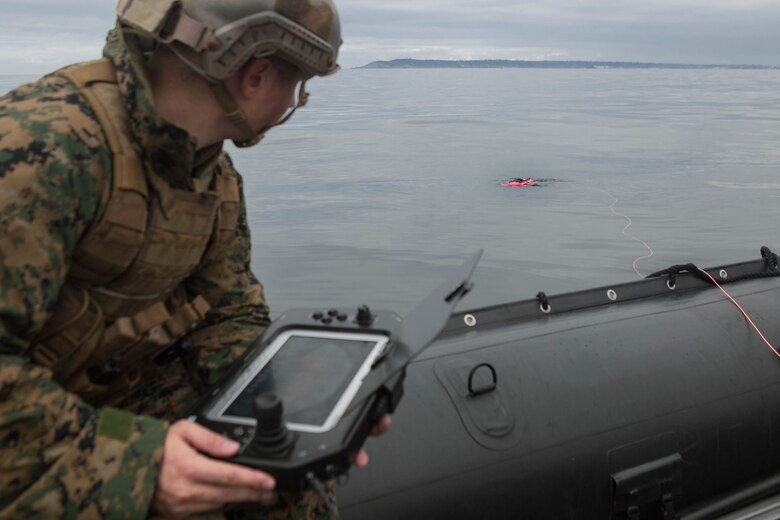
“Having this capability aids in naval force integration by giving us the same equipment that the Navy is using,” said Staff Sgt. Seth Barnes, EOD Technician with 1st EOD Company. “It allows us to bolt on with Navy EOD as we move forward.”

Achieving Force Design 2030 remains an ongoing, concerted effort for the Marine Corps, as repeatedly stated by Commandant of the Marine Corps Gen. David Berger. This goal requires the acquisition of next-generation, unmanned systems, like the ROV, to support Expeditionary Advanced Base Operations.

“We’re bringing the EABO concept to the modern day,” said Ronald Diefenbach, a program analyst on the Explosive Hazard Team at MCSC. “Adhering to this concept, we can use the ROV to support Marines when operating from the littorals and while conducting island-hopping tasks.”

Hilty said the Marine Corps has never before leveraged waters for missions. In the past, Marines would begin operations from land, typically a beach. This new concept requires a shift in the paradigm in how the Marine Corps operates.

Fielding capabilities that conform to the vision to support an evolving naval fight will ultimately support the present and future Marine.

“We’ve always done this piece via the Navy,” said Hilty. “Now that the Marine Corps is doing it, we are learning valuable skillsets, becoming much better-rounded and proving to be a bigger asset to the MAGTF.”

Story by Matt Gonzales, MCSC Office of Public Affairs and Communication

Photos by LCpl Kristy Ordonez Maldonado

Galvion Wins $5.8 million Contract to Supply US Army with EOD Tools and Equipment Kit (ETEK)

Thursday, October 7th, 2021

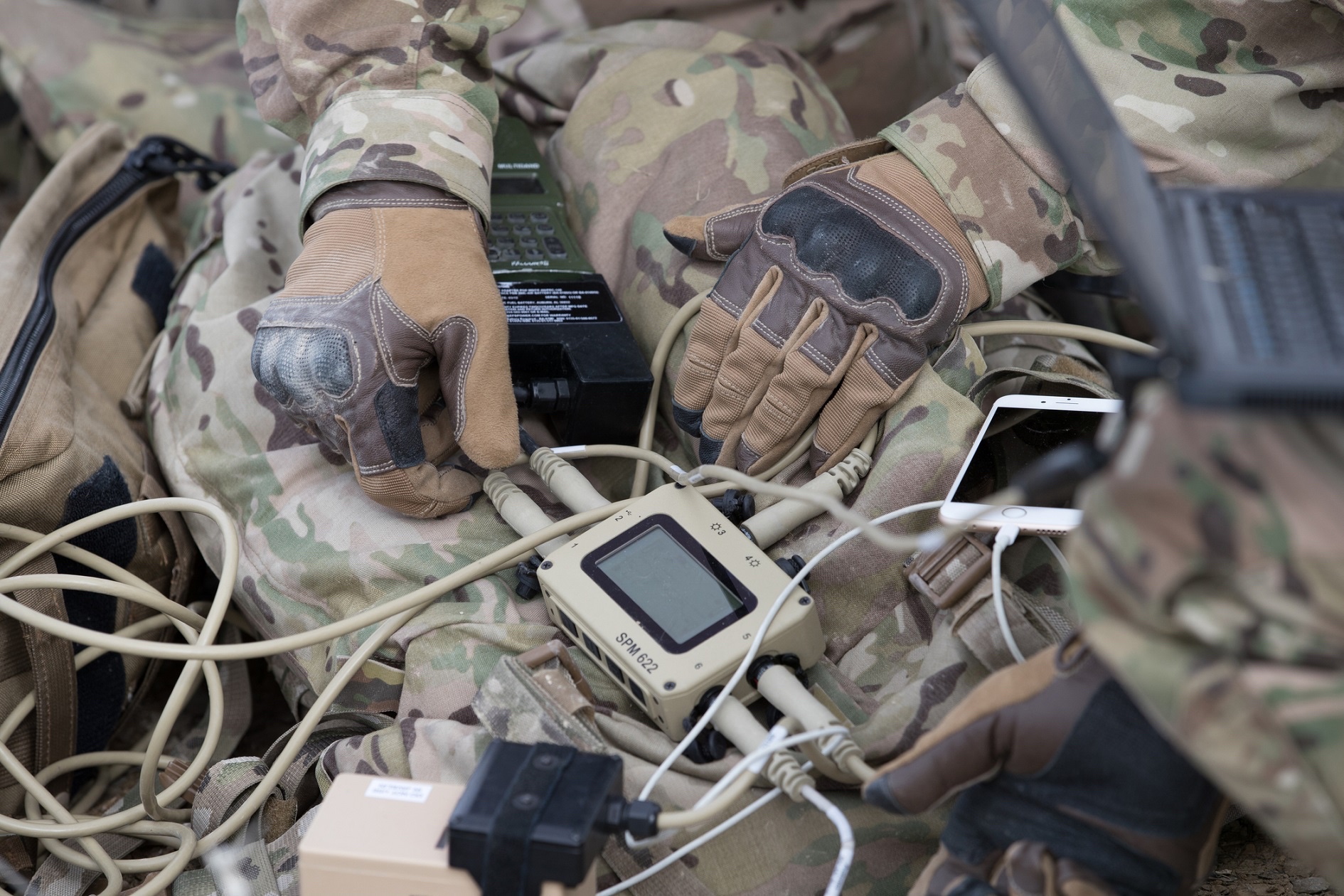
Galvion, a world leader in the design and manufacture of military power and data management solutions is pleased to announce that its Squad Power Manager™ (SPM) kit will be included in the U.S. Army EOD Tools and Equipment Kit (ETEK).  A $5.8 million contract from Program Manager Close Combat Systems (PM CCS) was awarded to supply an EOD-tailored SPM™ system to all active EOD units starting in December 2021.  The Squad Power Manager is a core element of Galvion’s Nerv Centr® Active Systems range, which provides scalable power and data solutions to the dismounted soldier.  Galvion will be exhibiting the SPM, along with their full range of active systems and their next generation head systems, in booth 3817 at the AUSA exhibition, taking place in Washington DC, 11-13 October 2021.

EOD teams use specialized equipment that requires sustainable and lightweight power when off-grid.  The US DoD were seeking to upgrade their entire EOD dismounted kit and needed a single, customizable solution that could recharge the batteries for EOD tools and scavenge power from multiple sources such as solar, vehicle power or AC mains.  The SPM ETEK Kit includes multiple cables and accessories that offer operational flexibility, allowing EOD units to harvest, scavenge and provide power to mission-critical equipment. The SPM requires no special configuration or programming, converting and managing power as efficiently as possible depending on power sources and equipment needs.  This allows teams to minimize weight and logistical burden by carrying fewer batteries, while increasing operational efficiency through active monitoring and management of power usage.

Kristen Lomastro, President of Active Systems, said: “We are a company that is dedicated to delivering mission success by fully understanding not just the military requirement, but the environment, the conditions and the additional circumstances that the dismounted soldier may encounter.  We pride ourselves on providing the very best technical and engineering solutions possible and by reducing the physical, cognitive and logistical burden for the warfighter, we increase their agility, lethality and survivability.  Galvion is extremely pleased to announce this new contract for ETEK with US Army EOD units, and to continue in our mission to protect and support those who protect us.”

Galvion’s modular and scalable power management systems are battle-ready, flexible and easily integrated with commonly fielded equipment.  The Squad Power Manager is a field-proven system, with customized kits in use across all U.S. DoD branches, including units of the U.S. Army, Navy, Marines, Air Force, and SOCOM.  In addition, Galvion’s power management systems are being used by allied forces in Canada, the UK, Australia, France, Denmark and Sweden, among others.

www.galvion.com

Army EOD Soldiers First to Field Test Unmanned Aerial System

Tuesday, September 28th, 2021

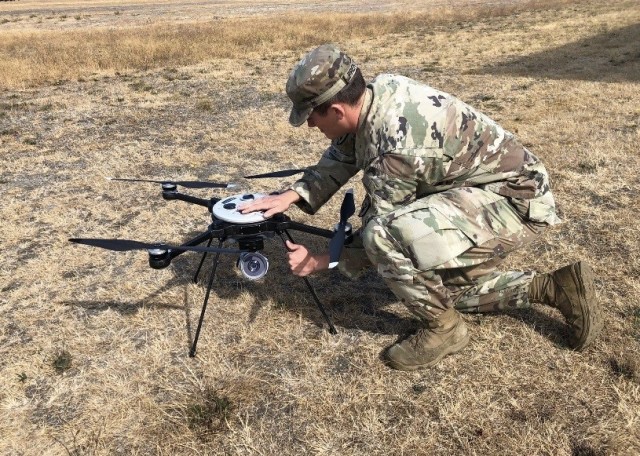
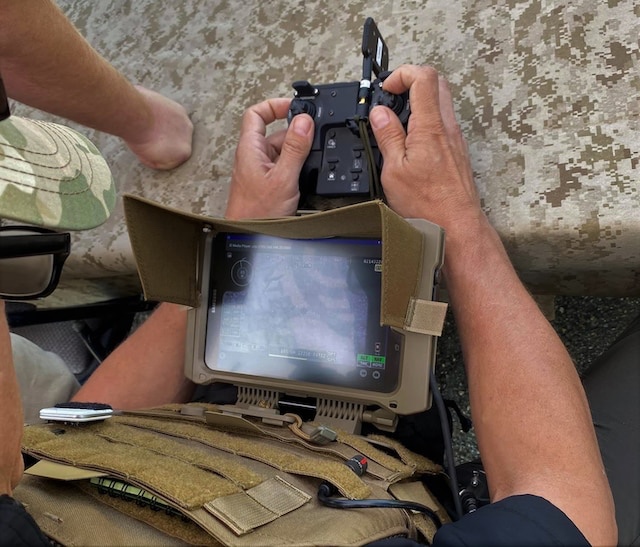
JOINT BASE LEWIS-MCCHORD, Wash. — Explosive Ordnance Disposal technicians from the 707th Ordnance Company (EOD) were among the first U.S. Army EOD Soldiers to conduct field testing with the Skyraider Unmanned Aerial System.

EOD Soldiers from the company put the UAS through its paces from a village in Training Area 4 on Joint Base Lewis-McChord, Washington, Aug. 23 – Sept. 2.

According to Capt. William R. Hartman, the commander of the 707th EOD Company, the UAS provided greater visibility of the heavily forested training area.

“They can mostly be used for reconnaissance of terrain and to identify possible explosive hazards,” said Hartman, a native of Reading, Pennsylvania, who has deployed to the U.S. Central Command area of operations.

Hartman said the UAS was also used to deploy lightweight robots called Throwbots that helped his EOD Soldiers to identify hazards in less accessible areas and structures.

The 707th EOD Company is part of the 3rd EOD Battalion, 71st EOD Group and 20th Chemical, Biological, Radiological, Nuclear, Explosives (CBRNE) Command. Based 19 installations in 16 states, 20th CBRNE Command is home to 75 percent of the Army’s EOD and CBRN units, as well as the CBRNE Analytical and Remediation Activity, 1st Area Medical Laboratory, Nuclear Disablement Teams and Weapons of Mass Destruction Coordination Teams.

Soldiers and civilians from the Aberdeen Proving Ground, Maryland-headquartered command work with joint, interagency and allied partners to defeat CBRNE threats around the world. Since 2003, 20th CBRNE Command EOD Soldiers have partnered with U.S. Navy EOD technicians to disable hundreds of thousands of improvised explosive devices in Iraq and Afghanistan.

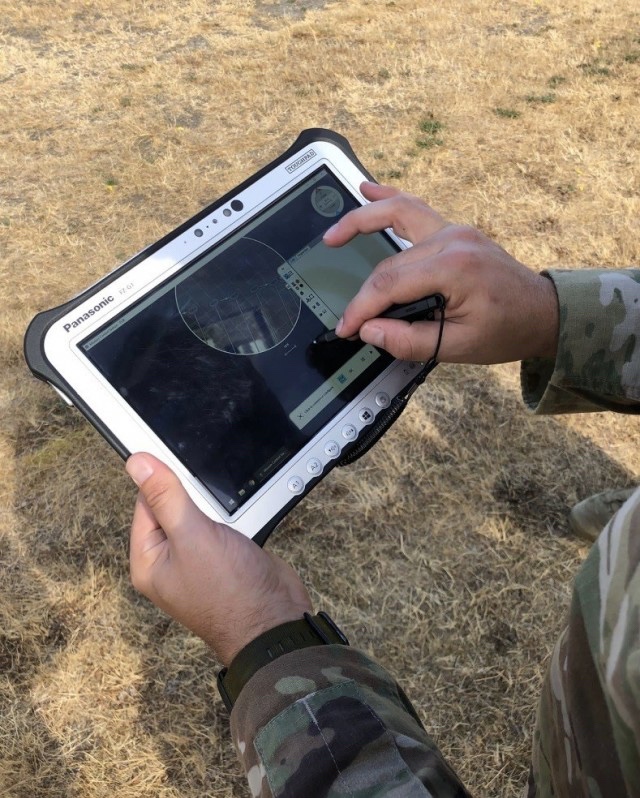
Hartman said the highlight of the fielding was connecting Light Detection and Ranging or LDIR technology to the UAS system and using it to map terrain.

The EOD company commander said the UAS could be a great use in a combat zone.

“We could definitely benefit from its capabilities in that environment,” said Hartman.

By Walter Ham

Eastern National Robot Rodeo Showcases EOD Emerging Capabilities

Saturday, August 21st, 2021

INDIAN HEAD, Md. (AFNS) —

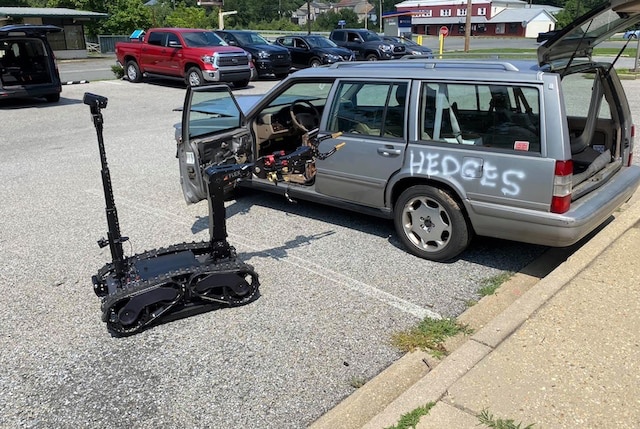
Explosive ordnance disposal and bomb squad experts in the Department of Defense and civilian sector tested the latest EOD robotics and emerging capabilities during the Eastern National Robot Rodeo and Capabilities exercise Aug. 2-6.

The Robot Rodeo, in its fifth year, was back after more than a year-long hiatus due to the COVID-19 pandemic.

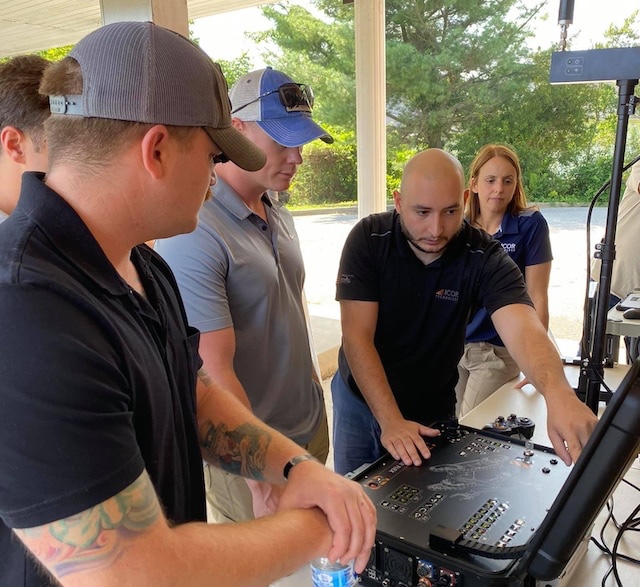
The event, conducted at the Naval Surface Warfare Center Indian Head Division and town of Indian Head, brought together experienced EOD operators and public safety bomb squads to evaluate EOD capabilities in real-world operating environments and provide real-time feedback to industry partners.

“Everyone – sponsors, vendors and participants – was excited about the 2021 ENRR-CAPEX, especially after having to cancel the 2020 event due to the COVID pandemic,” said Dr. John Olive, deputy director of the Air Force Civil Engineer Center’s EOD Division and Air Force EOD subject matter expert.

The rodeo is extremely important to AFCEC, which is responsible for central procurement of equipment for the Department of the Air Force’s 1,700 Total Force operators at 84 locations around the globe.

“The rodeo showcases technologies under development from various industry vendors and has a direct impact in putting the absolute best tools in the hands of our EOD and public safety bomb squad operators, and international partners,” he said.

While all CE missions are critical to the Department of the Air Force and mission platforms, EOD is perhaps the most dangerous.

“Having these technologies that give our operators the ability to do more standoff investigation, interrogation and mitigation of hazards, keeps our warfighters out of harm’s range and enables them to do things more efficiently,” said Col. John Tryon, AFCEC Detachment 1 commander.


AFCEC in general is always looking to push the envelope and do things smarter and more efficiently, Tryon said, with EOD in particular always being on the cutting edge.

“With new threats it won’t be one or two unexploded ordnance we’ll be dealing with in future, it will be hundreds or thousands of UXOs and we have a limited number of EOD operators. We need technologies that we can leverage, that are force multipliers, so we can achieve the result that we need,” Tryon said.

In addition to the equipment showcase, ENRR included a multi-day, multi-event technical competition to include potential real-world scenarios like a swarm of unmanned aerial systems employing explosive devices, and clearance of a homemade explosive laboratory, while integrating emerging technologies such as advanced radio graphics and multi-shot disruption off from existing robotic platforms.

“Participating multi-agency teams were given one hour to train on new equipment, then given three hours to complete a scenario that challenges that new technology,” Olive said. “Operators provided vendors direct feedback, which shapes future development of that technology in-line with the Chief of Staff of the Air Force’s accelerate change or lose initiative.”

The rodeo directly allows AFCEC to build relationships with industry partners, public safety bomb squads and various other agencies, Olive added, to shape future tech development and “enable us to better support our nine core mission areas for the Air Force EOD program.”

“Getting military and civilian bomb techs together is vital to the overall success of defeating hazardous devices,” said T.J. Brantley, a member of Plano Police Department’s Bomb Squad in Texas. “You get the opportunity to talk about different tactics and procedures other teams are using. Meeting with vendors and getting hands-on training with the latest and greatest technology available helps us do our job safely. Hands down (Robot Rodeo) was one of the best training opportunities I have been to.”

During the event’s distinguished visitor day, Brig. Gen. Bill Kale, director of Air Force Civil Engineers, said he appreciated the opportunity to meet with industry.

“I think it’s very important, as civil engineers, that we stay on the cutting edge of technology,” Kale said. “We need to make sure that whatever we decide to procure, or what we’re looking at, that we can use it or innovate it to improve our readiness.

“We have quite a challenge ahead of us with near peer competition with some of our adversaries and we need to use every tool in our toolkit to make sure we make it challenging for them to even think about trying to come after the United States or our interests,” Kale said.

The Air Force Civil Engineer Center’s Readiness Directorate was one of four sponsors for the event, but it was a joint effort with Naval Surface Warfare Center Indian Head Division and the town of Indian Head as hosts, and the United States Bomb Technicians Association as a core partner.

“We very much appreciate the NSWC hosting ENRR and the opportunity to come together with the different vendors that provide the robots, sensors and different technologies that EOD teams can employ now and in the future, and for them to interact with our Air Force and joint partner warfighters,” Tryon said. “Actually getting some stick time and providing direct feedback with the vendors is valuable for them not only on how to adapt their technologies, but also for us being able to see what we want to add to our arsenal going forward.

By Debbie Aragon, Air Force Installation and Mission Support Center Public Affairs

USAF EOD Tests New Imaging Technology

Wednesday, August 11th, 2021

EGLIN AIR FORCE BASE, Fla. (AFNS) —

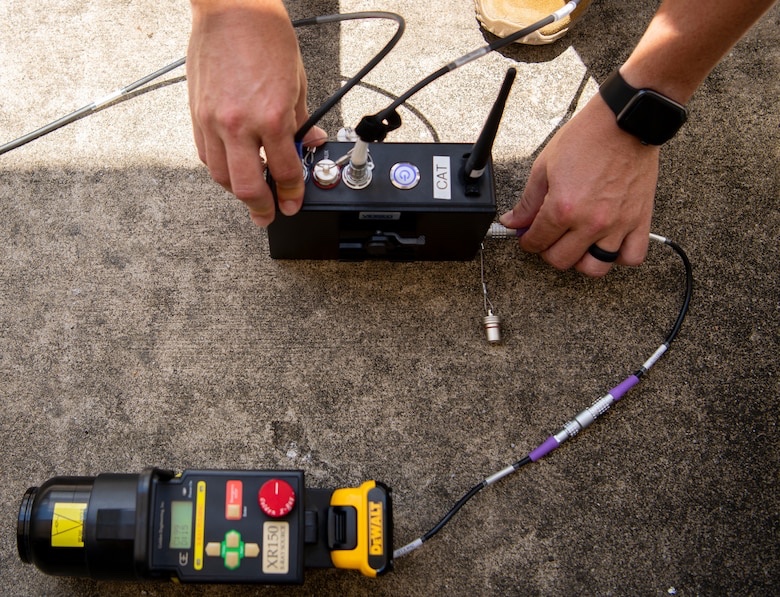
Local explosive ordnance disposal units received and were trained on a new and upgraded portable imaging X-ray system at Eglin Air Force Base July 22.

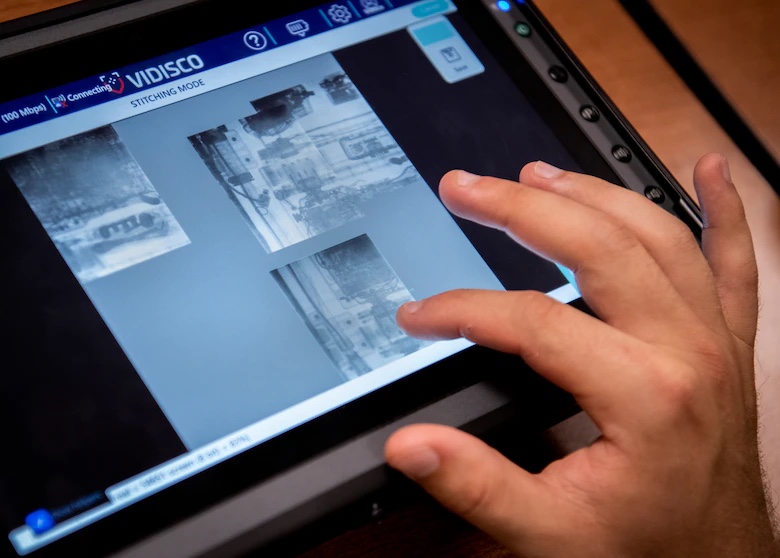
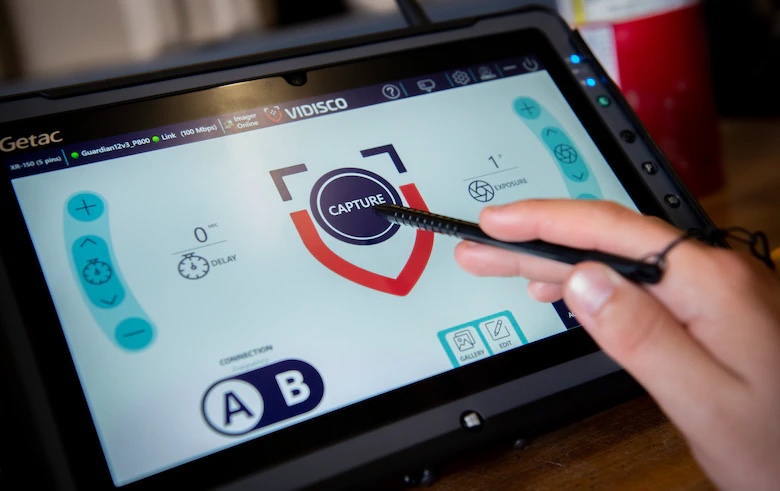
The Vidisco Guardian 12 Digital Radiographic X-ray system enhances EOD’s capabilities by making it easier to view the internal contents of suspicious, improvised explosive devices and unexploded ordnance.

The Air Force Civil Engineer Center recently delivered the first systems to Hill AFB, Utah and will distribute the remaining systems in conjunction with training events over the next five years. EOD flights from Eglin AFB, Hurlburt Field and Tyndall AFB received the new systems and attended the training.

“The digital X-ray technology will make a world of difference for our EOD forces,” said Tech. Sgt. Quentin Tubbs, 436th Civil Engineer Squadron EOD technician at Dover AFB, Delaware. “It will increase the reliability of capturing clear and concise images and reduce the amount of time we spend next to hazardous devices.”

The Guardian 12 replaces three commercial off-the-shelf systems serving as interim solutions until the new system is fully deployed. This includes a large system weighing over 99 pounds, that primarily serves as base support and requires a wired connection to operate; an X-ray that serves as the wireless mobility system; and a third system that has been obsolete for several years.

“The new system essentially consolidates all the capabilities of previous systems,” said Dave Hodgson, AFCEC EOD logistics lead. “It meets all of the requirements necessary to support the mission.”

Compared to the analog technology of the previous systems, the digital X-ray technology provides a much sharper and clearer image, making it easier to detect explosives such as IEDs or unexploded ordnance, Tubbs said.

Featuring both wired and wireless technology, the new technology combines the capabilities of the off-the-shelf systems currently in use. The wireless capabilities enable remote image capture and can reduce the amount of time Airmen spend going down range, Tubbs said.

“With the older systems, every time we took an image, we had to go downrange and retrieve a panel, bring it back and run it through a machine to verify if the X-ray worked. Many times, we thought a good image was captured only to realize later there was something dense in the way blocking the image.”

The new digital radiographic X-ray system also includes features to improve resiliency. It is lightweight, weighing less than 22 pounds and housed in a compact carrying case for easy mobilization for fly-away missions. The system is also designed to work in extreme temperatures, ranging from minus 14 to 140 degrees Fahrenheit.

Obtaining the new systems was a collaborative effort between AFCEC and the Air Force Installation Contracting Center’s 772nd Enterprise Sourcing Squadron—both part of the Air Force Installation and Mission Support Center enterprise. The $30 million acquisition will put 331 new systems in the hands of EOD Airmen by 2026.

“We’re committed to ensuring our EOD forces have the training, equipment and resources required to accomplish their duties in garrison and downrange,” Hodgson said. “The new systems will allow Airmen to conduct missions safely, rapidly and effectively.”

Story by Emily Mifsud

Photos by Samuel King Jr

Si Hannaford Runs 13-Minute Mile in NP Aerospace Bomb Suit During Ultra-Triathlon

Tuesday, June 22nd, 2021

WO2 Si Hannaford, Bomb Disposal Operator for the British Army, has run an impressive 13-minute mile in an NP Aerospace Bomb Suit – 13 days into a 26-day, 1,777 mile £100k ultra-triathlon fundraiser for the Felix Fund and the Hummingbird Centre.

Si ran the mile in the 35kg fully operational and unmodified NIJ certified 4030 ELITE Bomb suit on Sunday 13th June in John O’Groats, Scotland. The run was in preparation for an attempt to beat the fastest mile in bomb suit world record later in the Autumn of 7-minutes 24-seconds which was set by a British Army Solider in 2017.

Facing challenging terrain and exhaustion after cycling 1,000 miles from Land’s End to John O’Groats and swimming 21 miles (the length of the English Channel) he wasn’t put off by the task. He managed to run an impressive 13 minutes 8 seconds over challenging terrain on the hottest weekend of the year.

The mile marked the start of the last leg of Si’s journey – a 756 mile run back to his home town of Bicester where his wife and four children aged from three to 16 years will be waiting for his return.

Glynn Jones, NP Aerospace Product Manager, who was there to witness the challenge, said: “As we watched the triathlon unfold on social media, we became aware of the extent of the challenge we had set Si. We were unsure whether it would even be possible to complete a mile in a bomb suit let alone achieve a fast time. However, his determination and energy was clear to see from the start and it was an honour to be there and cheer him on.”

Simon Hannaford said: “It was a brave move to commit to the challenge with everything else going on but I did it for the charities and their efforts to support veterans and people suffering with cancer. I wasn’t sure how it would go but I am so glad I did it! I am looking forward to attempting to beat the fastest mile record in the NP Aerospace Bomb Suit when I am recovered and back on flat ground.”

James Kempston, CEO of NP Aerospace, said: “Outstanding result and dedication in the middle of a charitable cause. From the start, Si said the least he could do was suffer for 26 days to support charities who help people who are suffering for much longer. After a grueling swim and a 1000+ mile bike ride he decided to continue with his plan to run a mile in a bomb suit before running a further 756 miles. Most would have given up but Si’s tenacity and motivation are clearly world class and we are thrilled and proud to have been supporting him and raising awareness for his cause. We are also excited to support him in beating the fastest mile in a bomb suit world record later in the Autumn.”

Michelle Hannaford, wife of Si Hannaford, said: “When Si says he is going to do something it always gets done. Whether it’s running a mile in a bomb suit during a triathlon or mowing the lawn! He was determined to do this challenge for the charities involved as what they stand for is very close to home, with his mother and friend being diagnosed with cancer. It’s also been good for his mental health doing something valuable for the community. He’s done an amazing job and the family can’t wait to have him home.”

Si Hannaford is running, cycling and swimming 1777 miles in 26 days to raise £100,000 for charities, the Felix Fund and the Hummingbird Centre. The challenge started in Portsmouth on 1st June and will end in Bicester on 26th June. The Felix Fund provide welfare and financial support to military and police personnel working in bomb disposal and search. The Hummingbird Centre is a cancer support center based in Launton, near his home town of Bicester.

Si is urging people to sign-up and follow his YouTube channel – he needs 1000 followers so he can broadcast it live from his mobile phone.

To sign-up to Si’s YouTube page view www.youtube.com/c/SiHannaford

To sponsor Si view uk.virginmoneygiving.com/SiHannaford/1 Or www.justgiving.com/fundraising/simonhannaford 

NP Aerospace Awarded NIJ Certification for New Bomb Disposal Suit

Wednesday, June 16th, 2021

NP Aerospace has announced that its new 4030 ELITE Bomb Disposal Suit has been certified to NIJ 0117.01, the US National Institute of Justice Public Safety Bomb Suit standard, by the Safety Equipment Institute.

The official report was received this week after an intensive 18 month development and testing program – opening up opportunities to sell the suit in the US and other global markets requiring NIJ certification. NP Aerospace is one of only two manufacturers in the world to have been awarded this level of certification on a bomb disposal suit.

James Kempston, CEO, NP Aerospace: “NP Aerospace Bomb Disposal Suits are world leading in blast mitigation, survivability and overall comfort and ergonomics. Adding NIJ certification to an already world leading product is a significant accolade for our business and our overall EOD product line. As a global armor manufacturer with over 40 years’ experience in ballistic protection we are well versed in complex testing programs, however reaching this milestone in just 18 months is a major achievement. Users who require NIJ certified Bomb Disposal Suits now have the choice for a highly comfortable, ergonomic option with best in class survivability.”

The 4030 ELITE suit is now part of several program tenders – attracting significant interest from defense and law enforcement organizations. Users at recent US EOD events have commented on the suit’s flexibility and fit at a low weight, advanced blast protection and ability to configure the base suit with a wide range of accessories. Communications, cooling and CBRN systems can be easily added to the suit without costly system upgrades.

EOD and Tactical Search suits are part of the NP Aerospace high-performance defense systems range which includes Ballistic Helmets, Shields, Body Armor Plates and Composite Armor for vehicles, vessels or aircraft.

www.npaerospace.com

NP Aerospace Sets UK Challenge to Run Fastest Mile in a Bomb Suit

Friday, May 28th, 2021

Si Hannaford will be attempting to run the fastest mile in a bomb suit as he sets off on his 756 mile run from John O’Groats to Bicester as part of a 26 day triathlon.

NP Aerospace has challenged WO2 Si Hannaford, Bomb Disposal Operator for the British Army, to run the fastest mile in its new Bomb Suit during his Tri26 triathlon charity challenge.

Si Hannaford will be running, cycling and swimming 1777 miles in 26 days to raise £100,000 for charities, the Felix Fund and the Hummingbird Centre, starting in Portsmouth on 1st June and ending in Bicester on 26th June.

06:00, 12 June, John O’Groats, Scotland
On 12th June he will run the first of 756 miles in a 4030 ELITE Bomb Disposal Suit – weighing 35.8kg – in an attempt to beat the fastest mile in a bomb disposal suit record of 7-minutes 24-seconds which was set by a British Army Soldier in 2017.

Si, who has served in the British Army for 10 years and has done tours of Afghanistan, Bosnia, Kosovo and Northern Ireland, was keen to take on the challenge to support the charities for which he has a strong connection. The Felix Fund provide welfare and financial support to military and police personnel working in bomb disposal and search. The Hummingbird Centre is a cancer support center based in Launton, near his home town of Bicester.

Simon Hannaford, the hero of the day, commented: “My mother was diagnosed with breast cancer two years ago, so this cause is extremely important to me. I feel that I can suffer 26 days to help people who may be suffering their whole lives. It’s great to have the support of NP Aerospace. I have worn their bomb suits on operation for many years so I am keen to put the new suit to the test. It will be a gruelling challenge but worth every hour of training.”

James Kempston, CEO of NP Aerospace, said: “Si Hannaford’s courage and tenacity are undoubtedly essential to the success of a challenge like this and we are committed to supporting him every step of the way. Running the fastest mile in a bomb suit is extremely tough in normal circumstances let alone during a 26 day triathlon! As supporters of Felix Fund and other charity causes we are keen to lend our support. It will be great to see how 4030 ELITE suit stands up to the fastest mile challenge.”

Si is urging people to sign-up and follow his YouTube channel- he needs 1000 followers so he can broadcast it live from his mobile phone.

The Tri26 challenge is to swim 21miles – the length of the English channel – then cycle 1000 miles from Land’s End to John O’Groats and finally run 756 miles from John O’Groats back to Bicester. The first mile of the run will be wearing the NP Aerospace 4030 ELITE Bomb Suit.

To sign-up to Si’s YouTube page view www.youtube.com/c/SiHannaford

To sponsor Si view uk.virginmoneygiving.com/SiHannaford/1 Or www.justgiving.com/fundraising/simonhannaford