TYR Tactical

Archive for the ‘Helmets’ Category

News Flash – Military Helmet Designs Contribute To Brain Damage

Wednesday, September 16th, 2009

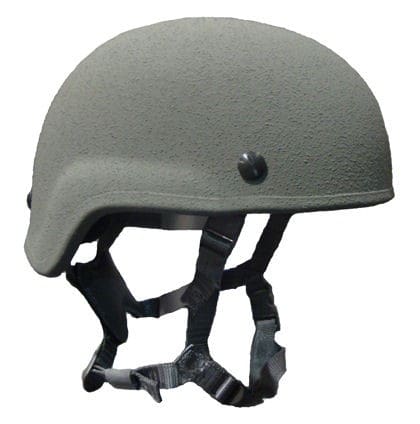
As if we needed a report to tell us that the current helmet design contributes to brain injuries. The current pattern is after all a compromise designed so that a Soldier can breath, smell, hear, and see. All pretty critical capabilities on a battlefield. Based on the cut, it isn’t any big surprise that blast waves enter the helmet. What is interesting is how one protective feature of modern helmets is protecting our troops, it is also putting them at risk to TBI.


The study entitled “Skull Flexure from Blast Waves: A Mechanism for Brain Injury with Implications for Helmet Design” discusses traumatic brain injury [TBI] and how it may be caused by skull flexure from even non-lethal blasts and without actual head impact.

Ultimately, what we are seeing is a similar phenomenon to what we have seen with body armor. Personal protection technology has developed to the point where they protect a Soldier from death in many attacks that would have killed them in previous conflicts. Consequently, we have seen a marked increase in burn, amputation, and brain injuries. These are effects that weren’t considered major requirements, if at all when the current family of PPE was under development.

In particular this report cites the air gap between the Soldier’s head and the inside of his helmet. Once again, with earlier technologies, the helmet shell’s material would not have been sufficient to protect the Soldier from most blasts and the accompanying shrapnel. Current and emerging shell technologies do a much better job at protecting from shrapnel injuries and so TBI is now being found in blast survivors. Unfortunately, the air gap in the helmet protects the wearer from blunt trauma injuries associated with back face deformation of the shell’s ballistic material. The ACH maintains a 1.3-cm gap between helmet and head; in simulations involving a 5-pound bomb exploding 15 feet from a Soldier’s head, blast waves washed into the helmet through this gap. “The helmet acts as a windscoop, so the pressure between the skull and helmet is larger than the blast wave by itself,” study co-author Michael King said. While the ACH’s pads mostly prevented this underwash, they also passed on forces to the skull.

King suggested that the pads’ stiffness could be optimized to “take the best of both worlds; it doesn’t allow the blast in there, and it doesn’t transfer [forces] from the helmet to the head.” He stressed that when making changes to the helmet, preserving its ability to reduce impacts and fend off bullets was paramount. “You’d have to be careful to make sure it doesn’t interfere with what the helmet does very well, which is stopping fragments and bullets,” he said. “The whole idea why there was a big gap between skull and helmet in the first place, is it makes it more likely for the soldier to survive if a bullet hits the helmet.”

Vltor SM-OCG Light Mount on a Helmet

Friday, September 4th, 2009

Vltor’s unique low-profile light mount can be attached to a Ops-Core Accessory Rail Connector (ARC) via the Mil-Std 1913 adapter. ARCs are available in two styles; one is a component of the FAST family of helmets and the other is designed for the ACH and available directly from Ops-Core or MSA.

Vltor Helmet Mount

Vltor’s Scout Mount – Offset Classic G-series mount has been around for a couple of years but now that the ARC rails are seeing wider use we thought it was a good idea to remind our readers about this option.

NVG Counterweight Pouch

Wednesday, August 26th, 2009

Tidewater Tactical now offers this innovative NVG Counterweight Pouch for helmets. Designed to affix via Velcro to the rear of a helmet equipped with Night Vision Goggles, the counterweight pouch features a flexible design that allows the simple addition or subtraction of weight.

NVG Counterweight Pouch

The slim design and flexible lead weights means the NVG Counterweight Pouch will conform to any helmet. Additionally, the rear of the pouch features a large Velcro pile patch that can be used to affix IR markers. The hook Velcro wings on the pouch can be trimmed for best fit and the mesh body allows sand, water, dirt, and other debris to easily drain.

It comes with optional flexible lead weights coated in rubber for better resilience in extreme conditions. Additionally, they offer enhanced noise discipline. Each of the three lead weight bars included with the pouch weighs approximately six ounces for a total of just over a pound. Additional weights are available if needed. The lead weights store inside the envelope formed by the pouch. This envelope can be accessed through a Velcro closure allowing you to carry not only the lead weights included with the pouch but other essentials, such as spare batteries. Additionally, most unit produced “duck weights and tape” will fit inside the pouch.

Available in Coyote, Tan, Black, and Foliage. To order, visit www.tidewatertactical.com.

NVG Mount Lights

Saturday, August 22nd, 2009

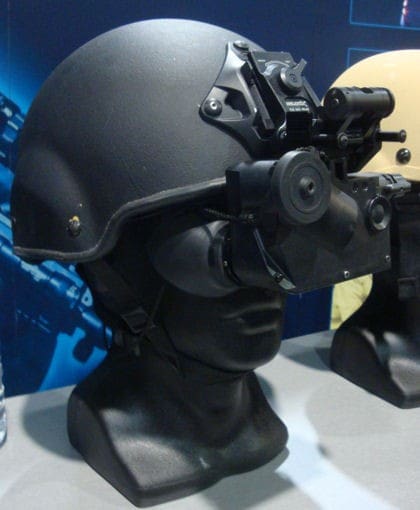
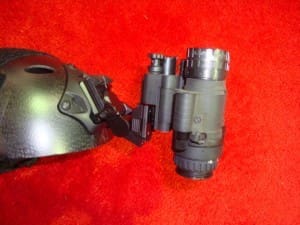
According to Ops-Core, several companies are working on lights designed to attach directly to a helmet’s NVG mount. None of the lights are quite ready for prime-time but we were able to sneak a picture of one example at the recent ADS Warrior Expo.

NVG Mounted Light

No Wonder They Lost

Friday, August 7th, 2009

Some of you may remember the Darth Vaderesque helmet worn by troops in Sadaam’s “elite” Fedayeen forces. Apparently manufactured from fiber glass it saw only limited issue. Perhaps the idea behind the helmet was to make the enemy pause to say, “WTF?” giving the wearer enough time to run away. A badge with the words “The Lord, The Homeland, The Leader” was affixed to the side of the helmet. They bring top dollar in the collector’s market.

Iraqi "Vader" Helmet

A Spanish collector’s site has an excellent backgrounder on the helmet. Check it out here.

GAO Report on Helmet Pads

Monday, August 3rd, 2009

Last week the Government Accounting Office released a report on helmet pads intended as a backgrounder for members of the Senate and House Armed Services and Appropriations Committees. While it was fairly thin, there were a few jewels of information buried in the document’s 12 pages (including covers).

One interesting section covered by our friends at DefenseTech discussed the military’s interest in alternative helmet suspensions and more stringent requirements.

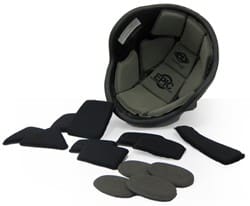
Team Wendy's ZAP Pads

Also of note in the report is the timeline detailing the chain of events that brought us the current pad system. However, most interesting to us were the sections that dealt with the intent of the report which was to determine who currently provides the pads used in Army and Marine Corps ground combat helmets, and how they were chosen. The short answer repeated numerous times was Team Wendy.

To quote the report:
“To date, based on the results of the testing performed, the Army has approved pad systems made by two manufacturers—Team Wendy and Mine Safety Appliances—for use in its Advanced Combat Helmet, while the Marine Corps has chosen to limit its approval to one pad, and has approved only Team Wendy pads for use in its Light Weight Helmet. The approved pads used by the Army and the Marine Corps are consistent with the 2006 U.S. Army Aeromedical Research Laboratory testing results in that they showed the best performance relative to the other pads tested.”

However, Ability One (A JWOD service provider) under contract with DoD to provide helmet pads has chosen to only procure the ZAP pad from Team Wendy. Consequently, Team Wendy currently has the only authorized issue pad for the MICH, ACH, and LWH. To confuse matters, several alternative pad systems are available for local purchase as well as on GSA and are manufactured to the Mil Spec for pads. While they do meet shock mitigation standards they are not the issue item and to curb their use, both the Army and Marine Corps have issued directives for troops to inspect their equipment and replace unauthorized pads.

More on Galea

Tuesday, July 28th, 2009

Information on the new Dutch combat helmet continues to trickle out of the Netherlands. The article from the Dutch Ministry of Defense reveals Galea to be a component of Project VOSS (Verbeterd Operationeel Soldaten Systeem) or Improved Operational Soldiers’ System, IOSS in English.

Dutch NBC Mockup

A translation of an informational piece released by TNO

“TNO has developed a new multipurpose helmet for the Defense Materials Organization (DMO). The helmet’s design is based on operational experience from recent deployments such as the current one in Afghanistan. When/if all the tests are completed successfully, the Galea (Roman word for helmet) will begin issue by 2011.

The new helmet stems from the Verbeterd Operationeel Soldaten Systeem (VOSS in Dutch or Improved Operational Soldiers’System, IOSS in English) and offers some tremendous advantages. The Galea weighs less, has a better fit and offers better protection. The helmet consists of multiple detachable parts, and the intention is that the dressed down variant has a friendly, approachable appearance. This benefits contact with the local population when out on patrol.

Galea weighs 1100 grams, almost half the weight of the current helmet, which has been in use since the 1990’s.

The helmet fitting form has been improved professionally, resulting in a secure fit on the head. New as well is the ergonomic mount for night vision goggles and the helmet may possibly be equipped with an air conditioning system, situated between the helmet and the head.

It is also fitted with separate neck, jaw, and ear pieces which cancel out noise at high ambient sound levels. TNO is currently researching how it can improve the protection of neck, throat, and face even more. The first test run of Galea helmets will be evaluated in the field later this year. The design itself has received several awards at a innovation summit in Prague.

More wearer comfort, more flexibility, and better protection are core components of Project VOSS. In addition to the helmet, a smart vest and a communications and combat information module are also being developed under the project. The goal is to improve and harmonize the battlefield capabilities of the soldier as much as possible. His gear is no longer is a collection of individual components, but a lightweight, wearable system in which the components needed are integrated as much as possible.

5500 frontline troops have been selected for participation in VOSS which is an evolution of the Soldier Modernization Program (SMP), which started in 1998.”

BBC Video of New UK Helmet and Armor

Sunday, June 28th, 2009