We are fortunate enough to be able to share this bio of Master Bladesmith Daniel Winkler. I’ve written about him multiple times and he does awesome work. But it’s his traditional designs that really interest me and how they’ve influenced the modern stuff he does for SOF. Believe me, you’ll get to see plenty of his more primitive/native/early American work in this post. Afterwards, I think you’ll have a better understanding of where he’s coming from. If you can’t tell, Daniel Winkler is a man I admire. Although he’s told me his story in person, it’s always fascinating to hear it again, and, some of it’s pretty darn funny, especially if you know Daniel and Karen. I hope you enjoy it as much as I do.
For those that are familiar with Winkler Knives and those that are not, I thought it might be important to tell a little about where Winkler Knives all got started.
My Name is Daniel Winkler. I was born in 1956 in Boone North Carolina. I have never lived anywhere else.
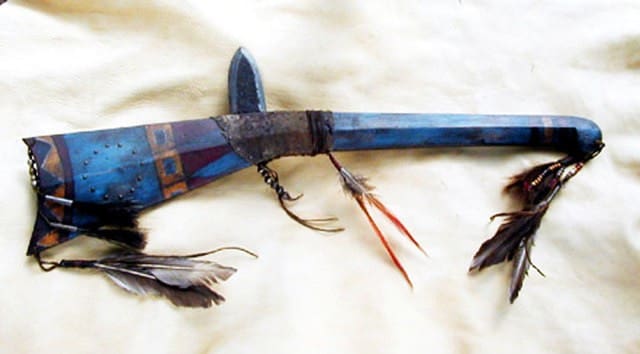
I made the Club and the blade and Karen did the decoration and painting
Stage #1 (Hobby/Business)
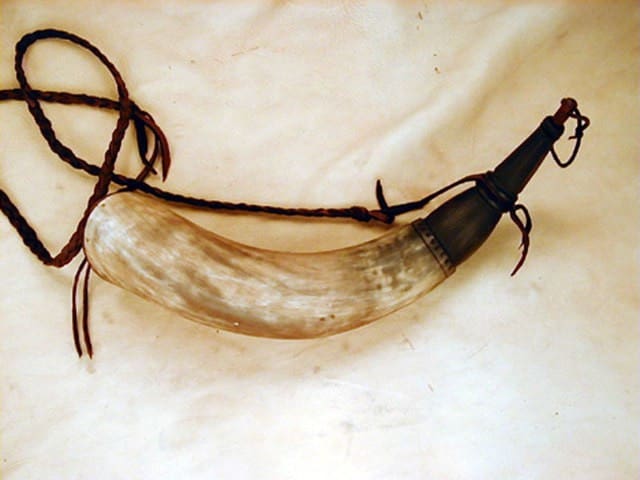
Back in High School in Boone North Carolina in the late 1970’s I started shooting Black Powder guns to extend my hunting season. I really liked the feel of the more primitive guns so I got more involved with the hobby. I wanted to outfit myself with the historic accessories that were correct with the guns so I started making Shooting Pouches, Powder Horns and Knives. I went to events and Black Powder shooting matches where folks saw the items I had made and were interested so I made a few more and either used them as blanket prizes or to sell to make a little money for gas and food for the events. It was a lot of fun and as I got more involved I made more trips and started to make a little extra money. The knives in this early stage of my career were forged.
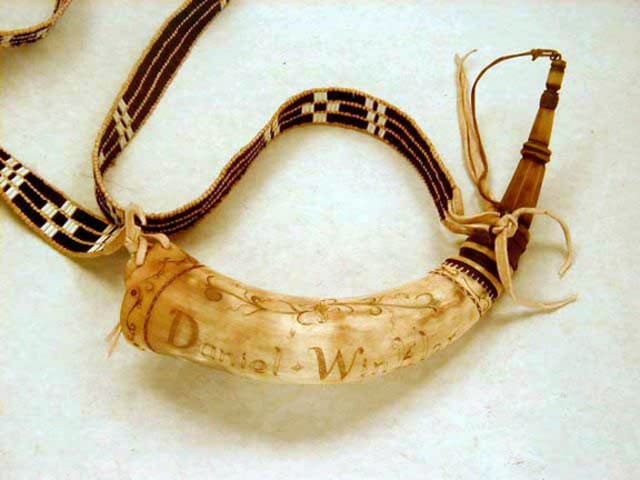
by the same maker that did the strap for Daniel Day-Lewis in “Last of the Mohicans”
My first shop was a car wheel I had made into a forge using an old vacuum cleaner as a blower, a group of files and a hand drill. Later I traded for an old hand crank forge and added a small 1” X 48” belt sander to my collection of files and sanding blocks. Using mostly Bone, antler and wood handles I made knives and sold them at Rendezvous across the Eastern US. This was a fun time and I had a full time job in the manufacturing industry as a supervisor and worked in product development. These jobs paid the bills and provided insurance so I could use all the money I made from knives to buy equipment and materials to improve my knife making abilities. I met a few other knife makers at the Black Powder gatherings and they were very encouraging and helpful. I also saw some really nice work on knives and guns and decided if I was going to continue I had to improve both my skills and knowledge of how to do things right.

I made a lot of knives, a few Tomahawks and about 10 Muzzle loading guns, mostly Flint lock. I became a member of the American Mountain Men and the Backwoodsmen. These were both very strict Historical re-enactment groups. I worked on developing my primitive survival skills and made primitive treks into the wilderness both alone and with these groups. It was a lot of fun and quite an eye opening experience and I went hungry and got wet and cold often on these trips. But I learned a lot about survival and what it took to make equipment that would hold up to really hard use.
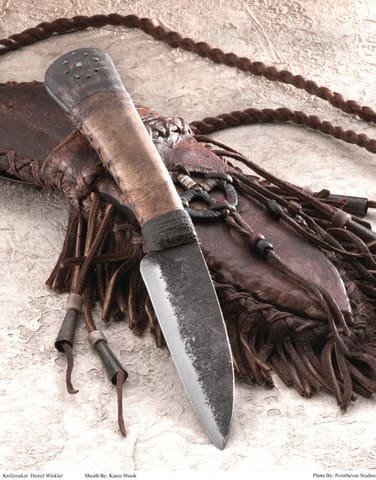
Quilled wheel decoration by Karen.
It only took one trip to realize that a nice looking knife with a slick round handle did not serve well when chopping wood for a fire or shaving fuzz sticks as it tended to slip during use. I also learned a really hard knife was impossible to sharpen in the field and if your sheath was not secure you might have to spend a weekend with nothing but a patch Knife. For quite a long time I was happy making knives and learning wilderness survival. I paid for my hobby with money I made from making knives and started building a customer following which would prove important in the future.

Another great painted sheath by Karen.
I made a lot of lifelong friends and learned a lot about making knives and life for about 13 years before I went to the next stage. This first stage went on until 1988.
Next, the move to a “FullTime Knife Maker”.
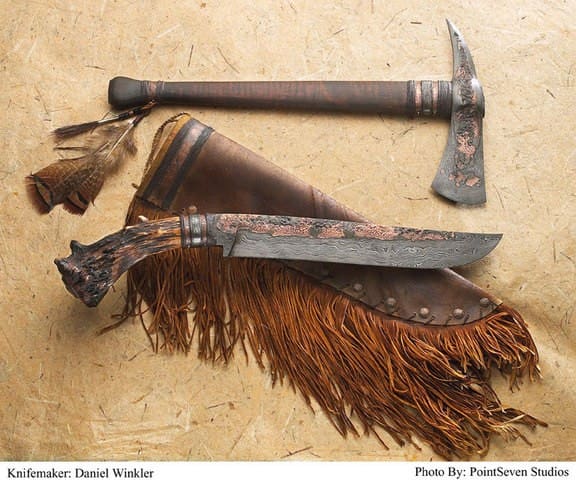
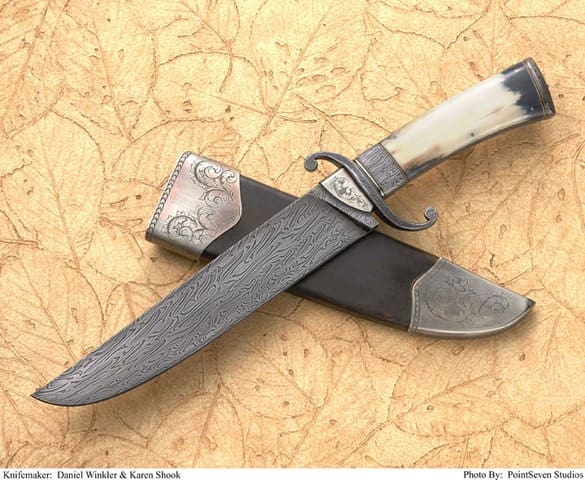
The next stage actually started a couple of years before I went full time as a Knife maker. This was when Winkler Knives really started to take off and the driving force was Karen Shook. I went to work for Karen in the mid 1980’s in product development in the giftware industry. She had been with the company for several years and had knowledge and experience in Marketing and manufacturing processes. As our friendship developed she became interested in my hobby business of knife making. Since each knife I made needed a sheath and I hated making sheaths. I asked her if she would like to make sheaths for me in her spare time. I taught her everything I knew about making knife sheaths which took about 10 minutes. In those days I would put the knives on the table for people to see and only after money was handed over did they get to see the sheath. However when Karen took over making the sheaths we could put them right out with the knives without losing sales.One important encounter we had was when a well-known knife collector took an interest in one of my knives. He asked if there was a sheath to go with it so I reached under the table and handed it to him. It was one of my designs that Karen had reluctantly made. He looked over the sad piece of leather and said that this time he would buy the knife but unless the quality of the sheath matched the quality of the knife he would not be buying any more. This comment was one of the most important learning experiences in Winkler Knives history. We took this to heart and would go to museums in our travels and look at early American and American Indian displays of weapons, tools and clothing. Karen would study the construction and materials and implement a lot of what we saw in the new and improved sheaths.After a short while Karen’s sheaths became as, if not more, sought after than my knives.
I worked for Karen for a while and although I felt I was the best employee a company could have Karen had the opinion I was the worst.
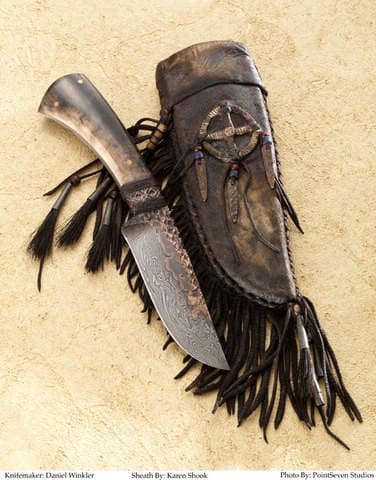
Fringed sheath with Quilled Wheel and hammered copper feathers.
It seems I had a free spirit and took my hobby business more serious than perhaps the owners of the company we worked for thought was reasonable. Anyway we both left the company in 1988. We had developed a pretty good customer base for Winkler Knives, had learned a lot about how to conduct business from our time in the gift industry and were ready for a change. I went straight into making knives, guns and Hawks full time. Karen did some free-lance marketing for a short time then joined me in Winkler Knives full time making sheaths and taking care of the business end of the operation.
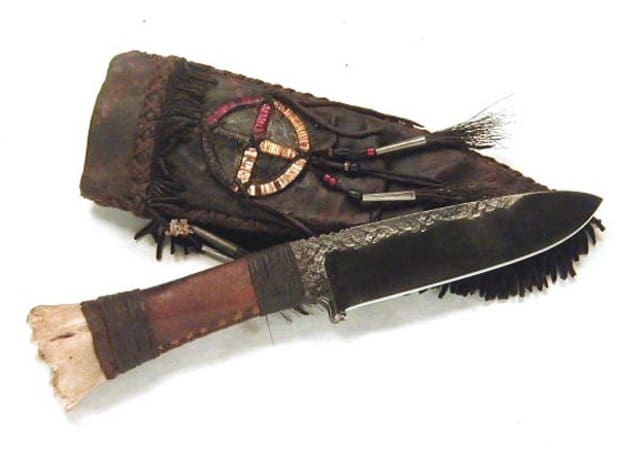
They still have a Cutlery Store there and some of the family were gun builders.
Our specialty was knives and sheaths with a strong Early American/Native American influence. We attended Knife Shows and juried Craft Shows across the country and continued to grow and enhance our following and sales. During this time we did some projects that were “News Worthy” and got a good bit of magazine coverage. One of the most important was our work with the movie “Last of the Mohicans”. We did pieces that were carried by the principal characters in the film. This was a real eye opening experience and we got to goon location and see how the movie was made- pretty exciting stuff but it makes you realize why movies cost so much to make. From a full size waterfall inside an old warehouse to the spread on the caterer’s table, everything was first rate. From this we got the cover of Blade magazine. To this day we never go to a show that we don’t get asked about our work with “Last of the Mohicans”.
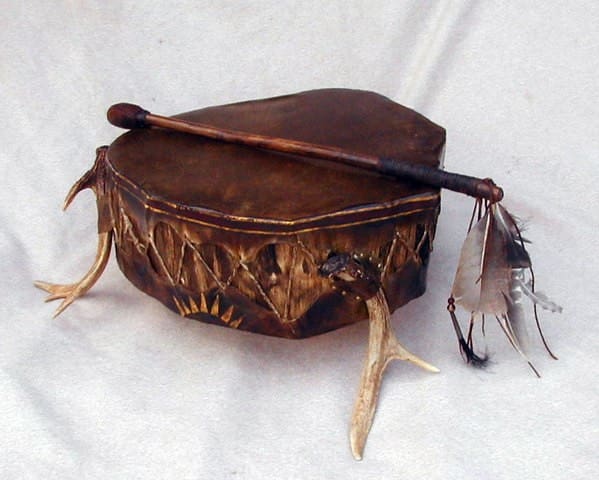
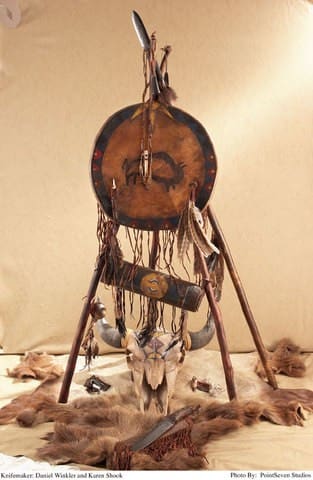
A section of a hollow log covered with Painted Elk Rawhide and a decorative Drum Stick.
Making one-of-a-kind, one-at-a-time, knives and tomahawks continued on and still does, but on a more limited basis. We have stopped taking orders for the forged pieces and only make a very limited number these days, filling old orders and an occasional piece for sale or as a presentation honoring a fallen or retiring Military person. Our roots are reflected in our current Tactical designs, both in appearance and function.
Karen and I got to deliver it personally to his Recording Studio. Then he took us to the Grand Old Opry as his guests.
An important segment in the evolution of Winkler Knives was my involvement in Cutting Competitions. For a while I was an active competitor in events put on by the ABS, ICCT and BladeSports International. I learned more about steel selection, blade geometry, heat treating, handle material, and balance in the three years I actively competed than I did in the previous 20+years of knife making. A knife that is not perfect in all aspects will not perform in competitions. While I was never a great cutter I did place 3rd in the last ABS World Championship in Atlanta. I suggest that any knife maker that wants to make true working knives get involved with competitive cutting.It is a tremendous learning experience and proving grounds.
It is part of the “Tribute to the Sun” display set that Karen and I made.
The next phase of Winkler Knives started as a result of our involvement with the Movie “Last of the Mohicans”. In the early 1990’s a Navy SEAL attending a primitive skills class in New Jersey was asking around as to who made Magua’s Tomahawk in the film. He had been looking for someone to make a compact yet strong Combat/Breaching hatchet. He got in contact with me and after several discussions I adapted a full tang belt axe I was already making into a tool that suited his needs. He took it to his Command and the Team approved the design. Funding was not available for the project so he carried the only prototype with him on missions throughout the first Gulf War. After that conflict he retired from the Navy and went to work as a Game Warden. He kept his axe under the seat of his car during his time with the State of North Carolina. Then 9-11 happened. This former SEAL re-enlisted but this time with Army Special Operations. He was assigned to a Tier 1 Team and still carried his axe. Other members of his Team saw his axe and how effective it could be in the field. They contacted me about making more.
I hand forged and finished about 18 over the next year or so. I honored the 10 year old price I originally quoted for the axe as a way of helping these men acquire what they needed to best do their job. Within the Special Operations community there are times when a member from one Team will deploy with another SOF Team. This happened and a SEAL from another Team deployed with the Army Team that were carrying my axes. The SEAL was given one of the axes which he took back to his Team after his deployment.It happened to be the same Team the now Army Operator had been on when he was a SEAL back in the 90’s. The SEAL Team again approved the axe design for their use but this time had some money to outfit the Squadron. The funds, however,were limited and it was going to take a long time to outfit the men. (This is a whole new story that I will get into in a separate thread.) Regardless we were now faced with an order for a lot more axes than we could make by forging and grinding one at a time. Concurrently, we began design work on a new standard issue Belt Knife for the Navy Team. Business was about to change drastically!
Next the beginning of “Winkler Knives II”.
Now we were faced with making much larger orders than we had done in the past. We still wanted to use the years of knowledge and success we had making forged working knives and axes. These new products were knives and axes with some similar design features and a lot of totally new stuff. Just a lot more at one time. Now we had to figure out how to do it. First we thought we could just go to an established knife manufacturer and give them our specs and they would make the knives like I wanted them made. You know, those guy’s all had their own ideas of how they wanted to make our designs, regardless of how I specified they needed to be done. It was like they thought they knew what they were doing, go figure! Well that didn’t work so on to plan “B”. Now we tried to farm out specific operations to contractors. This showed promise but when you are working on other people schedules with numbers that are considered kind of low, your place in line seems to get longer and longer despite any deadlines we needed to reach to get product out before a deployment date. This wasn’t going really well so when I got the chance to buy a couple of old Nicholas grinding machines I got them. Now we were in the production business but unfortunately these machines that were made in the 1960’s did not come with an instruction manual. After a lot of trial and a lot of error we finally got them “kind of” figured out. (This is a continual leaning process.) We were ableto have blanks water jet cut by a contractor then make tooling for the Nicholas grinders and remove about 80 percent of the material on blade bevels and tapered tangs. From here all the blanks are hand ground to finished dimensions using standard machines from KMG, Bader, Weurtz and Wilmont grinders. We also set up Milling machines, Drum sanders, Drill presses, Sand Blaster, a Co2Laser, assorted other machines and a Salt Pot Heat Treating set up. We hired some help and off we went into the world of Limited Production Knife and Axe production. We spend a lot of time and effort training the guy’s to do a variety of jobs in the shop so they can move from station to station and keep the product carts moving without much backup in one area. Most of our guy’s will specialize in one area but are capable of moving around the shop. Winkler Knives went from Karen and me to 10 people in less than 3 years. We have been very fortunate to have strong business growth during the slowest economy I can remember.
As word of mouth passed through the Special Operations community we started getting quite a following with the SOF Teams. We started getting orders for DOD contracts, Unit purchases and sales to individuals. Besides the Military community we have set up several dealers as well as accepting orders from individuals. The products we have offered in the Winkler Knives II line are either the same as we developed for the Military or variations from these tested designs. Besides the knives and axes the sheaths and axe carriers had to go through extensive design changes to get them to work with the equipment kits the men were wearing. Access, secure carry and comfort are all top considerations and if one of these areas is wrong you might as well figure on the tool being left at camp instead of being carried on missions. No matter how great you think your knife or axe is if the front line guy’s don’t wear it you are just making expensive wall and shelf decor. We now have a lot of different products with a lot of handle and finish options.
For a long time folks in the knife community have speculated on whose knives and axes are carried in the field by our Military. There have been many pictures and first hand reports about the same topics. There has been a lot of stuff written and discussions about what the equipment Tier 1 Teams carry and use, including cutlery. There are many fine makers out there and so many want the recognition afforded by association with those that protect our American way of life. There have been countless makers that have sold and/or given equipment to these men and women and they should all be given credit for what they do. However there are also a lot of bad guy’s in this country as has been proven in recent tragic events. Getting too specific in “who” and “what”can be a really bad idea when there is a chance of compromising the very people that we should be protecting. On our web site and advertising you won’t see any specifics. Only some general reference to our history and influence from the professionals we have the opportunity to work with.
Thanks for reading and if there are any questions I’ll do what I can to answer.
Daniel Winkler
www.winklerknives.com